

Igloo Construction of the Frostborn
Building in Ice – Knowledge Passed Through Generations
Why Not Snow?
In the ice plains of Nyrian there is little snow and much ice. Building a snow igloo would be a logistical challenge unless fresh snowfall has just occurred. For the Frostborn, this is ideal, because a snow igloo insulates and stores warmth. Temperature differences of up to 50 degrees are possible. Since Frostborn feel comfortable at –20 °C and colder, an ice igloo is far more practical and better suited to their well‑being.Protective Qualities of an Ice Igloo
An ice igloo stores almost no heat but provides reliable protection from wind and weather. The temperature does rise slightly due to body heat, but only minimally (2–5 °C). When it is extremely cold outside — cold enough to trouble even Frostborn — the ice structure still offers protection: wind and moisture push the perceived temperature even lower, an effect that does not occur inside the igloo. The lowered entrance prevents wind from entering. A carefully built ice igloo is very stable and can last for decades.Construction Forms and Methods
Ice igloos can be built in various ways, the most common being the spiral form. Small structures use a single spiral; larger ones use two, each forming half of the wall. There is also the method of angling the ice blocks so that the spiral shape emerges naturally. This method is never used while traveling, as the precision of the angle is crucial for stability. In settlements, however, nearly all round ice structures are built this way, as they are more massive and stable. The blocks used in this solid‑construction method are significantly larger and are often lifted into place with cranes. While traveling, only smaller ice blocks are used — at most 20 × 40 × 30 cm (about 18 kg). Smaller blocks of 20 × 30 × 20 cm, weighing around 11 kg, are even better suited.Tools and Preparation
To cut out the blocks, one needs an ice saw with special teeth to prevent splintering. In emergencies, daggers can also be used, but their blades are too short and un‑serrated, making the work extremely slow and difficult. Whether working alone or in a team, one should first cut a small supply of ice blocks — ideally nearby, to avoid long carrying distances. The cutting is done in a stepped pattern, eliminating the need for frequent measuring.From Circle to Dome
Once enough blocks are available, a circle is formed and cut in a spiral — either in one continuous line or in two half‑circles. The next blocks are then placed on the angled edge. The slope causes the igloo to grow inward and upward without requiring much measuring or adjustment. Most ice igloos are not built very high, as the material is heavy and overhead work is exhausting.Interior and Temperature Management
Once the keystone is set, a lowered entrance is dug inside. This is done with hand picks and ice chisels. Afterwards, the floor is also lowered slightly to achieve a comfortable ceiling height and stable temperature.Sealing and Air Holes
The igloo is then worked on from the outside. Ice chips left over from sawing or created by breaking failed blocks are used as filler material — but not all gaps are closed. Every igloo requires air holes to ensure ventilation. If they are forgotten, there is a risk of suffocation. Fresh air can enter through the entrance, but this is often loosely covered with an ice slab for protection against animals.Extensions for Equipment and Sleds
Sleds and other large items that do not fit through the entrance are usually stored in a flatter annex with a sloped roof and a wide opening. This structure serves solely as wind protection.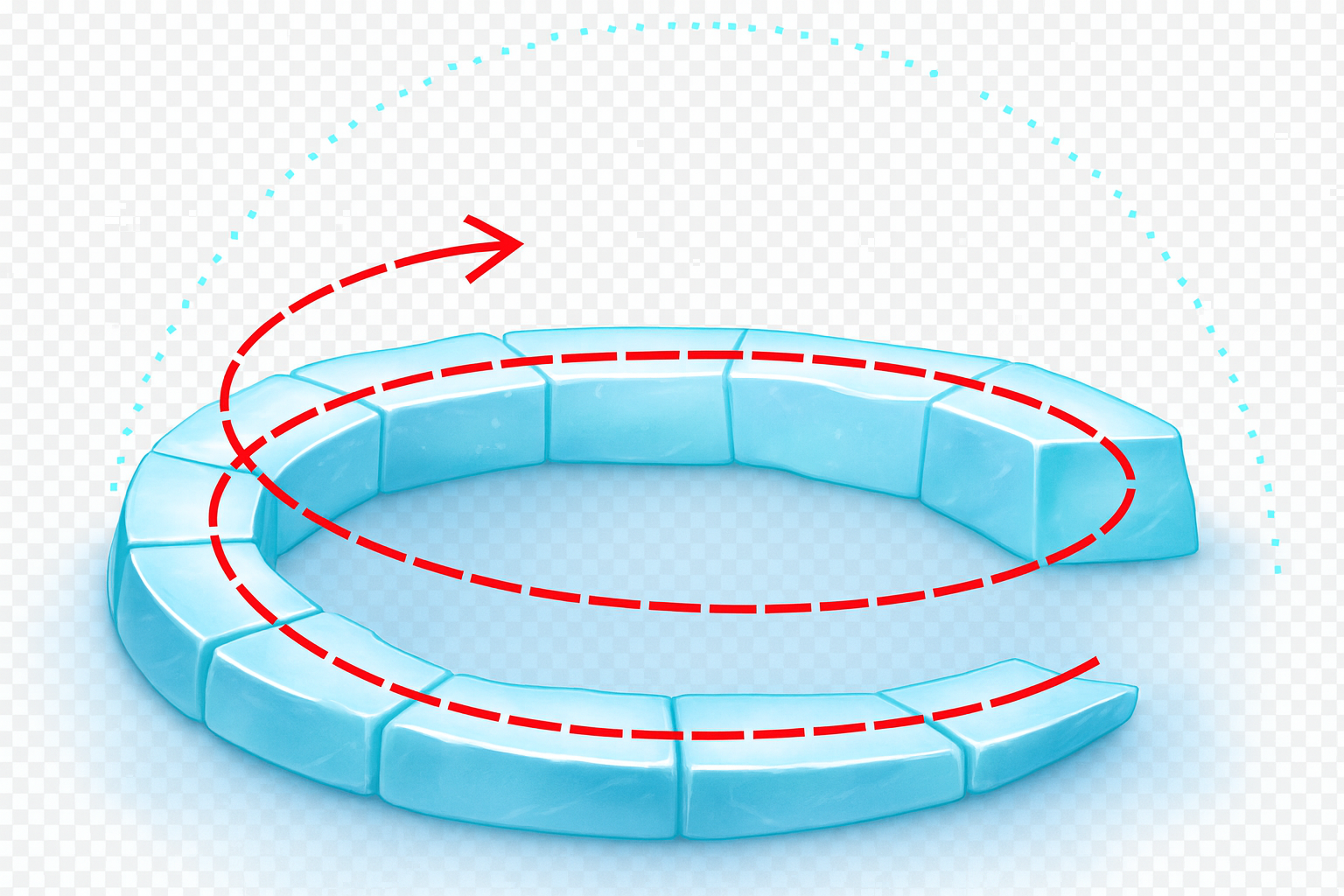
by Microsoft Copilot
Created by Selibaque 2025

Kommentare