

VE - Fire - Ifrit
Ifrits descend from creatures such as efreet, salamanders, and magma dragons. Their spark of ancestral flame gives them a reputation for being passionate, if not capricious.
Ifrits often build up personal relationships between themselves and the idea of fire, feeling as though they embody it mentally or spiritually, in addition to physically. Some ifrits relate to fire's mutable energy, illuminating properties, or destructive nature.
Some ifrits share a connection from birth to specific aspects of elemental fire, such as radiance, ash, or lava; this is called an ifrit lineage. Ifrits often have the same lineage as their parents, though sometimes ifrits are born with lineages different from their families, or to parents without one. Lineages can appear in ifrit children as a reflection of where they were born—for example, cindersoul ifrits sometimes originate from being born in areas prone to forest fires. They can also occur as a reflection of the ifrit's planar ancestry, such as a brightsoul ifrit having a fire-themed celestial ancestor like a peri. Magma ifrits with the lavasoul lineage are most often born the descendants of magma dragons or other lava-themed fire elementals.
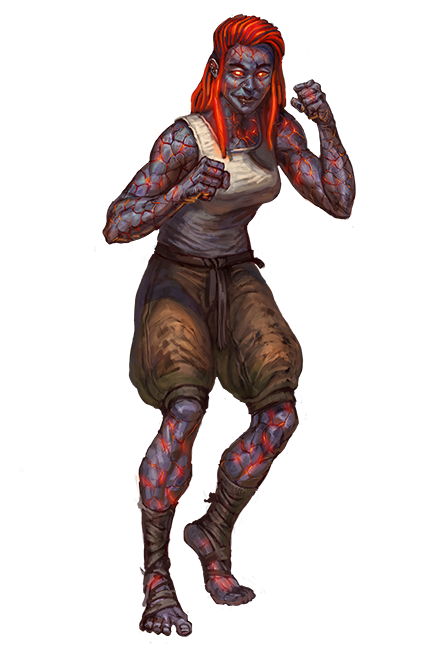
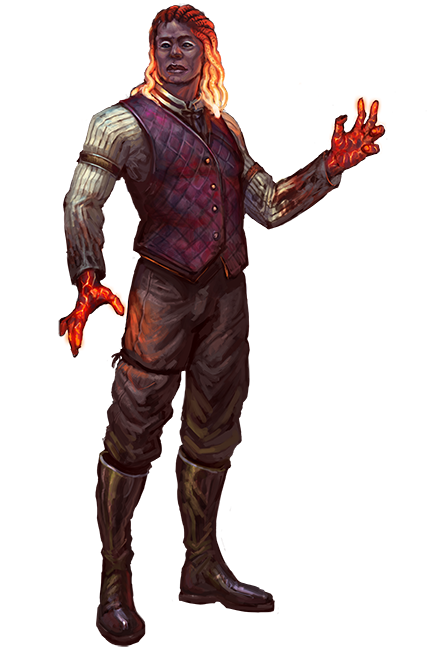
Just as their elemental origins can vary, so too can ifrits' otherworldly appearances. Red, orange, and brass are all common skin colors, while others have charcoal-gray, ash-brown, or radiant white, yellow, or blue hues. Ifrit hair often falls in untamable coils of flame that grow over the ifrit's lifespan. Salamander-descended ifrits can have lizard-like scales, while those descended from efreeti may have huge, red horns curling up from their skulls.
Many ifrits keep their skin uncovered and open to the air, favoring loose or breathable clothes made in light fabrics like silk and chiffon. Their styles often feature bright colors and bold patterns paired with metallic jewelry.
Ifrits are typically born into societies built by others, where they comprise minority populations. Most ifrits place a high value on their freedom, and though they might live within societies and cultures dominated by humans, elves, or dwarves, many carve out peaceful, productive, and fulfilling places for themselves. Because most ifrits aren't bothered by high temperatures, many gravitate toward workplaces that get uncomfortably hot for other mortals, like forges.
Ifrits are fiercely independent, sometimes valuing their personal freedoms above those of others around them. Though frequently accused of lacking morals by their detractors, ifrits who tend toward mischief are rarely motivated by malice. The most common alignments among ifrits are lawful neutral and chaotic neutral, with the rest typically falling into true neutrality, neutral good, or neutral evil.
Ifrits are rarely inclined to venerate Golarion's deities, typically resenting the strictures and rules of an organized faith, but those who do most often worship deities of fire or the sun, or one of the Elemental Lords of Fire.

Comments