

Gnome
Gnomes are magical folk created by gods of invention, illusions, and life underground. The earliest gnomes were seldom seen by other folk due to the gnomes' secretive nature and their propensity for living in forests and burrows. What they lacked in size, they made up for in cleverness. They confounded predators with traps and labyrinthine tunnels. They also learned magic from gods , who visited them in disguise. That magic eventually created the many lineages of gnomes we see today.
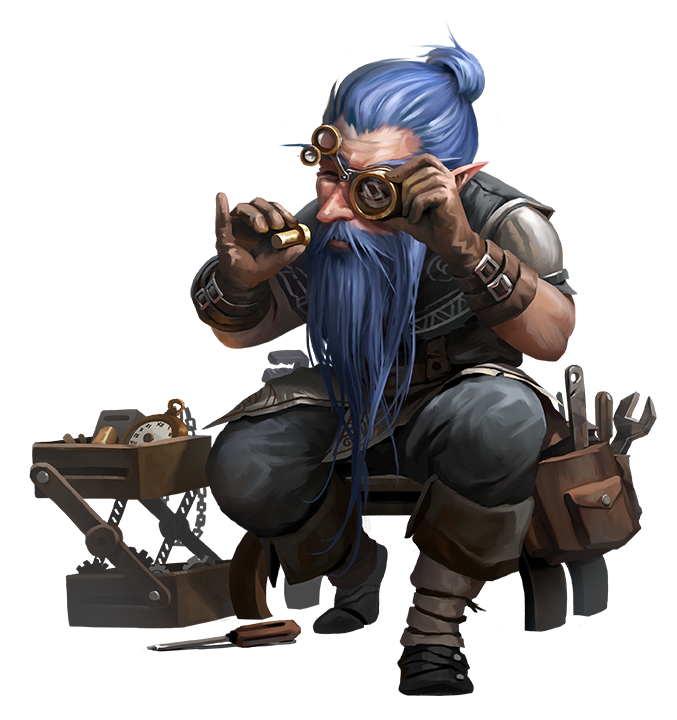
Gnomes are petite folk with big eyes and pointed ears, who live around 650 years. Many gnomes like the feeling of a roof over their head, even if that "roof" is nothing more than a hat.
SUB-ETHNICITIES
Chameleon
The color of your hair and skin is mutable, possibly due to latent magic from First World influences or lingering illusion effects. You can slowly change the vibrancy and the exact color, and the coloration can be different across your body, allowing you to create patterns or other colorful designs. It takes a single action for minor localized shifts and up to an hour for dramatic shifts throughout your body. While you're asleep, the colors shift on their own in tune with your dreams, giving you an unusual coloration each morning. When you're in an area where your coloration is roughly similar to the environment (for instance, forest green in a forest), you can use the single action to make minor localized shifts designed to help you blend into your surroundings. This grants you a +2 circumstance bonus to Stealth checks until your surroundings shift in coloration or pattern.
Fey-Touched
The blood of the fey flows through your veins, saturating you with their magic and making you truly one of them. You gain the fey trait, in addition to the gnome and humanoid traits. Choose one cantrip from the primal spell list. You can cast this spell as a primal innate spell at will. A cantrip is heightened to a spell rank equal to half your level rounded up. You can change this cantrip to a different one from the same list once per day by meditating to realign yourself with the First World; this is a 10-minute activity that has the concentrate trait.
"Kijimuna"
Your ancestors lived in the trees and fished in all the waters of Tian Xia. You gain your choice of the following benefits. Once made, this choice can't be changed.
- You can climb any banyan. You gain the Combat Climber feat, and if you roll a success on the Athletics check to Climb, you get a critical success instead.
- You can catch any fish. You gain a swim Speed of 15 feet.
Sensate
You see all colors as brighter, hear all sounds as richer, and especially smell all scents with incredible detail. You gain a special sense: imprecise scent with a range of 30 feet. This means you can use your sense of smell to determine the exact location of a creature. The GM will usually double the range if you're downwind from the creature or halve the range if you're upwind.
In addition, you gain a +2 circumstance bonus to Perception checks whenever you're trying to locate an undetected creature that is within the range of your scent.
Umbral
Whether from a connection to dark or shadowy fey, from the underground gnomes known as drathnelar, or from another source, you can see in complete darkness. You gain darkvision.
Vivavicious
You have an incredibly strong connection to the positive energy that flows through the First World, making it harder to attack your life force with negative energy. You gain negative resistance equal to half your level (minimum 1). When you have the doomed condition, the condition affects you as if its value was 1 lower than it actually is (doomed 1 has no effect, doomed 2 causes you to die at dying 3, and so on).
Wellspring
Some other source of magic has a greater hold on you than the primal magic of your fey lineage does. This connection might come from an occult plane or an ancient occult song; a deity, celestial, or fiend; magical effluent left behind by a mage war; or ancient rune magic.
Choose arcane, divine, or occult. You gain one cantrip from that magical tradition's spell list. You can cast this spell as an innate spell at will, as a spell of your chosen tradition. A cantrip is heightened to a spell rank equal to half your level rounded up. Whenever you gain a primal innate spell from a gnome ancestry feat, change its tradition from primal to your chosen tradition.
Deep
Forest gnomes and rock gnomes are the gnomes most commonly encountered in the lands of the surface world. There is another subrace of gnomes rarely seen by any surface-dweller: deep gnomes, also known as svirfneblin. Guarded, and suspicious of outsiders, svirfneblin are cunning and taciturn, but can be just as kind-hearted, loyal, and compassionate as their surface cousins.
Svirfneblin seem more like creatures of stone than flesh. Their leathery skin is usually a gray, brown, or dun hue that acts as a natural camouflage with the rock around them. Their bodies are gnarled with hard muscle or fat, and they are heavier than their small stature suggests; svirfneblin often weigh 100 pounds or more but rarely stand much more than 3 feet tall.
Male svirfneblin are bald from early childhood, although adults can grow stiff beards or mustaches. Females have full heads of hair, and they usually tie their hair back in braids or cut it short to keep it from getting in their way as they work.
Svirfneblin are well adapted for their subterranean existence. They have excellent darkvision, and many of them have magical talents that rival the innate spellcasting of the drow and duergar. They are surprisingly strong for their size, enduring toil and danger that would overwhelm most other people.
Despite their guarded natures, svirfneblin aren't joyless. They admire skillful work and delicate craftsmanship, just like any other gnome. Svirfneblin love gemstones of all kinds, and they boldly seek out precious stones in the deepest and darkest tunnels. They are also expert gemcutters and miners, and they prize rubies above all other gemstones.
Svirfneblin are known as deep gnomes because they choose to live far below the earth's surface. Most svirfneblin never see the light of day. Their homes are well-hidden strongholds concealed by mazelike passages and clever illusions. Vast networks of mine tunnels ring most svirfneblin settlements, guarded by deadly traps and concealed sentries. Once a traveler passes through the outer defenses, the tunnels open up into marvelous cavern-towns carved from the surrounding rock with exquisite care. The svirfneblin are austere in their comforts compared to their surface cousins, but they take great pride in their stonework.
Deep gnomes do their best to remain hidden. Even if surface travelers succeed in locating a svirfneblin community, winning their trust can be even more difficult. Those rare travelers who do succeed in befriending deep gnomes find that they are loyal and courageous allies against any foe.
Surface-dwelling gnomes often take up the adventurer's life out of sheer curiosity about the world around them, eager to see new things and meet new people.
By comparison, most svirfneblin possess very little wanderlust and rarely travel far from home. They see the surface world as a bewildering place without boundaries and filled with unknown dangers.
Nevertheless, a few svirfneblin understand that it is necessary to know something about what is happening on the surface near their hidden refuges. As a result, some svirfneblin become scouts, spies, or messengers who venture abroad, doing their best to avoid attention.
These travelers are notoriously close-mouthed about where they come from and what they are up to, but a few eventually learn to trust good-hearted people of the surface world.
A few svirfneblin become merchants who deal with other races both above and below ground. Drow, duergar, and other peoples know that svirfneblin are usually neutral in outlook and typically honest in their dealings. Serving as middlemen between races too hostile to deal with each other directly can be lucrative, and it serves an important defensive function; svirfneblin middlemen tend to know more about rumors and threats between rival merchants than anybody else.
Forest
As a forest gnome, you have a natural knack for illusion and inherent quickness and stealth. In the worlds of D&D, forest gnomes are rare and secretive. They gather in hidden communities in sylvan forests, using illusions and trickery to conceal themselves from threats or to mask their escape should they be detected. Forest gnomes tend to be friendly with other good-spirited woodland folk, and they regard elves and good fey as their most important allies. These gnomes also befriend small forest animals and rely on them for information about threats that might prowl their lands.
Rock
As a rock gnome, you have a natural inventiveness and hardiness beyond that of other gnomes. Most gnomes in the worlds of D&D are rock gnomes, including the tinker gnomes of the Dragonlance setting.
Most gnomes stand just over 3 feet in height and weigh little more than a human child. They exhibit a wide range of natural skin, hair, and eye colors. Nearly any hair and eye color is possible, with vibrant colors most frequent, while skin tones span a slightly narrower spectrum and tend toward earthy tones and pinkish hues, though occasionally green, black, or pale blue.
Gnomes typically reach physical maturity at the age of 18, though many gnomes maintain a childlike curiosity about the world even into adulthood. A gnome can theoretically live to any age , but in practice gnomes rarely live longer than around 400 - 800 years.
While most gnomes adopt some of the cultural practices of the region in which they live, they tend to pick and choose, adjusting their communities to fit their own fey logic. This often leads to majority gnome communities eventually consisting almost entirely of gnomes, as other people, bewildered by gnomish political decisions, choose to move elsewhere. Gnomes have little culture that they would consider entirely their own. Exceptionally few gnome kingdoms or nations exist on the surface of Termina, and most gnomes wouldn't know what to do with such a state if they had one.
By necessity, few gnomes marry for life, instead allowing relationships to run their course before amicably moving on, the better to gain new experiences. Though gnome families tend to be small, many gnome communities raise children communally, with fluid family boundaries. Gnome names can get quite complex and polysyllabic. Gnomes rarely concern themselves with how easy their names are to pronounce, and they often go by shorter nicknames. Among gnomes, the shorter the name, the more feminine it's considered to be.
hough gnomes are impulsive tricksters with inscrutable motives and confusing methods, many at least attempt to make the world a better place. They are prone to fits of powerful emotion and are rarely shy about helping those they believe deserve it. Gnomes most commonly worship deities that value individuality and nature.
Popular Edicts seek new experiences, embrace your inspiration, move from obsession to obsession
Popular Anathema slow down to explain yourself, deprive someone of all stimulation

Comments