
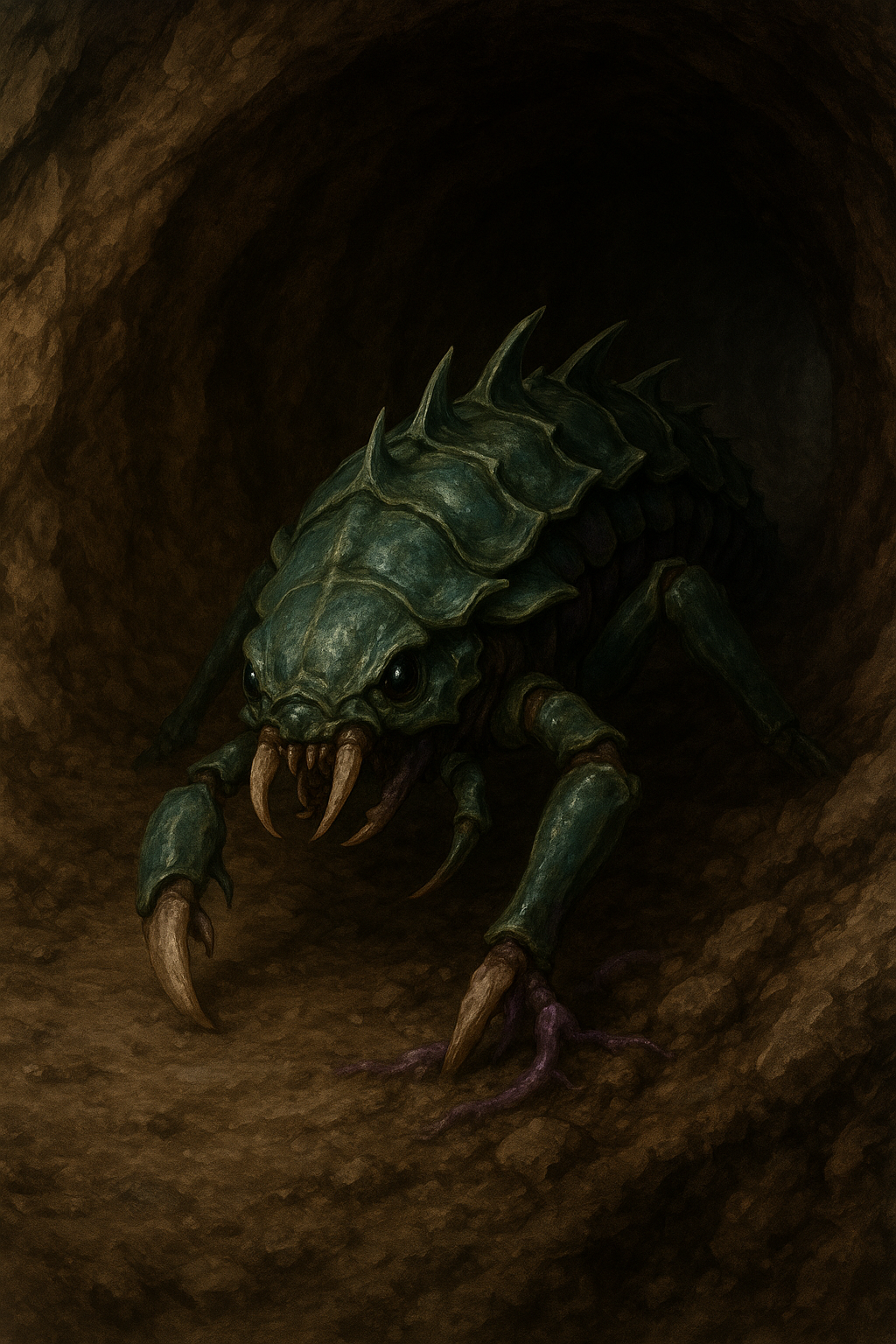
Kryllith (krill-ith — /ˈkrɪl ɪθ/)
(An Anecdotal and Provisional Account)
Among the many curiosities that have emerged in recent decades, few inspire as much unease among explorers and scholars as the creatures now referred to, somewhat reluctantly, as the Kryllith. Even this name is an invention of convenience rather than certainty, for the species has no known spoken tongue, no cultural markers by which one might glean their own sense of identity. Most of what is recorded here is second-hand, fragmentary, or contradictory, drawn from travellers’ journals, broken field notes, and the observations of those few who have seen these beings and lived long enough to offer testimony.
Accounts place the Kryllith in deep caverns, ruinous under-complexes, and other places where the ground seems to hollow itself into unnatural geometry. In nearly all records, the creatures are described as chitinous, multi-limbed, and disturbingly coordinated. Their bodies appear grown rather than born, as if each individual is shaped according to some guiding pattern. Whether this is a biological instinct or a central intelligence directing their evolution remains the subject of considerable academic dispute.
The matter of their communication is even less certain. Many reports claim the Kryllith converse through faint pulses, tremors, or resonance-clicks that ripple through the environment. Some scouts insist these sounds are merely incidental, the natural noise of hard plates and rapid movement. Others maintain that these vibrations are deliberate messages, part of a shared awareness that binds all members of a nest into a single will. A few researchers have attempted to map these patterns, but the results are inconclusive. Some pages suggest a hierarchical signalling system; others argue that what appears to be order is simply the observer’s wishful interpretation of a fundamentally alien instinct.
Scholars tentatively propose several forms or castes within a hive, though even this is debated. Certain witnesses describe small tunneling creatures that collapse stone as easily as soil, while others claim to have encountered swift, hook-limbed hunters that move in coordinated packs. A handful of mercenaries insist there exist larger, heavily armoured brutes—though these tales often come from those who only glimpsed such shapes in the chaos of torchlight and retreat. The notion of a commanding entity, a queen or brood-mind of some sort, persists across multiple accounts, but no reliable observer has ever described one directly. Whether such a figure exists physically or is merely an extension of communal instinct remains unresolved.
What is better established—though still not universally accepted—is that the Kryllith seem to possess an unusual resilience to certain schools of spellcraft. Mind-affecting magics rarely produce predictable results, leading some arcanists to suspect a distributed consciousness that cannot be influenced by targeting a single mind. By contrast, manipulations of light, life-essence, or decay appear to affect them more readily, though some early field trials conflict even with this general pattern. The few living specimens retrieved for laboratory study did not survive long, dissolving into a resinous slurry before their anatomy could be properly examined. Whether this is a defensive response or simply the nature of their biology remains unconfirmed.
No consistent behavioural motive has been identified. Some explorers report nests that avoid contact entirely, retreating deeper into the stone when approached. Others describe sudden, ruthless aggression without provocation. A few isolated stories even suggest a territorial logic, as if the Kryllith defend not a lair but the spreading edge of some unseen boundary. More troubling are the cases in which abandoned mines, shrines, or lower-city tunnels were found partially transformed—walls coated in layered resin, floors warped into ribbed channels, supporting beams honeycombed as though digested. The creatures leave behind a scent that various accounts describe as wet stone, ozone, metal dust, or something sharper and metallic, though the inconsistency of these descriptions may arise from the fear of the moment rather than scientific accuracy.
Until more structured expeditions are undertaken—and until such expeditions return at a higher rate than present—our understanding of the Kryllith must remain provisional. They may be a species newly awakened, or an ancient one newly stirred. They may be creatures of instinct alone, or the shadow of a singular will extending through countless limbs. For now, we rely on the scattered words of those who encountered them by misfortune or by reckless curiosity.
Further study is warranted. Whether it is wise remains an open question.

Comments