
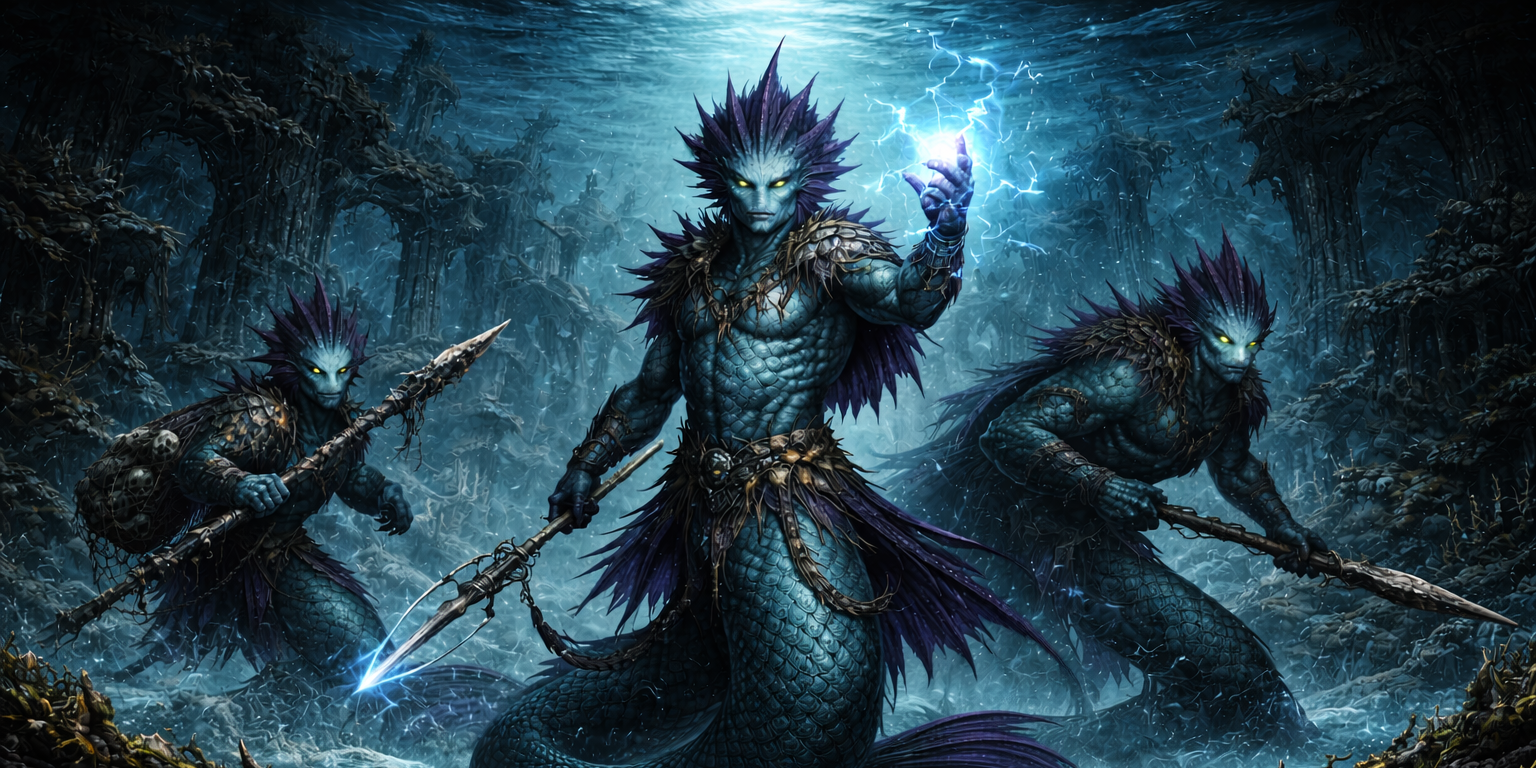
Merrow
Merrow are an ancient aquatic people native to the deepest reaches of Tanaria’s oceans, predating most surface seafaring civilizations. Long before Tritons, before structured oceanic kingdoms, the Merrow carved out survival in crushing depths, lightless trenches, and drowned ruins left behind by forgotten ages. They are not monsters by nature, but they are not gentle either. Life in the deep does not permit softness.
To surface dwellers, Merrow are often mistaken for sea devils, raiders, or abyssal horrors. This reputation is not entirely undeserved, but it is incomplete. Merrow society is shaped by scarcity, pressure, and memory. They remember civilizations that drowned. They remember gods that sank. They do not trust those who live where the sun still reaches.
Basic Information
Anatomy
Merrow possess a highly specialized anatomy optimized for deep-ocean survival, combining humanoid upper morphology with a powerful piscine lower body. Their form reflects an evolutionary priority toward pressure resistance, sustained endurance, and ambush predation rather than speed or elegance.
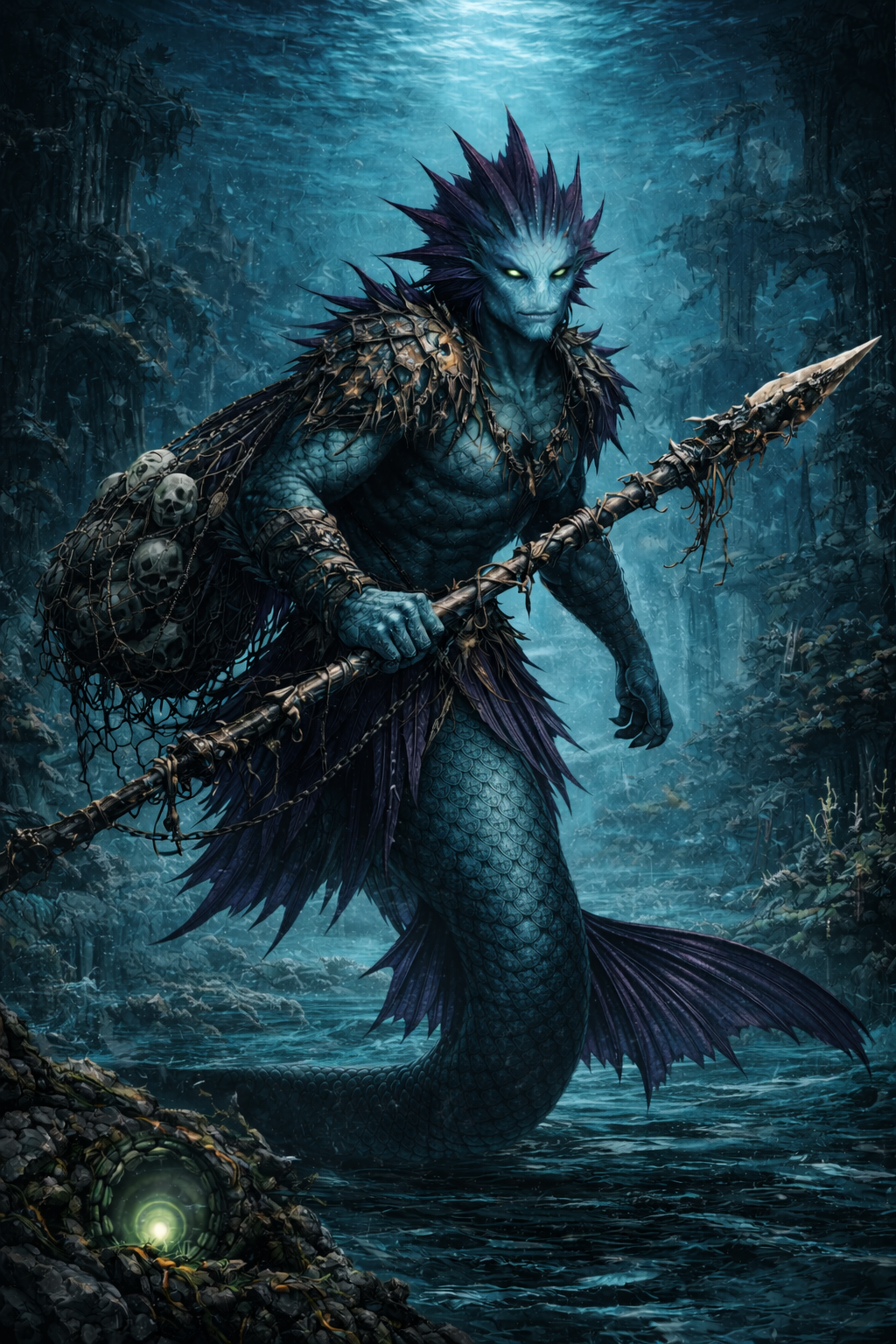 The upper body of a Merrow is broadly humanoid, with a reinforced ribcage, thick clavicles, and heavily muscled shoulders and arms. Bone density is significantly higher than that of surface-dwelling humanoids, reducing the risk of structural failure under extreme pressure. Internal organs are compacted and shielded by layers of dense muscle and connective tissue, limiting compression damage at depth.
From the waist down, Merrow possess a single, continuous tail composed of elongated vertebrae and powerful lateral muscles. The tail ends in a broad fin capable of precise directional control as well as explosive bursts of speed. Smaller stabilizing fins may be present along the hips, calves of the tail, or spine, but Merrow never possess multiple tails; any apparent duplication is the result of overlapping fins or visual distortion in motion.
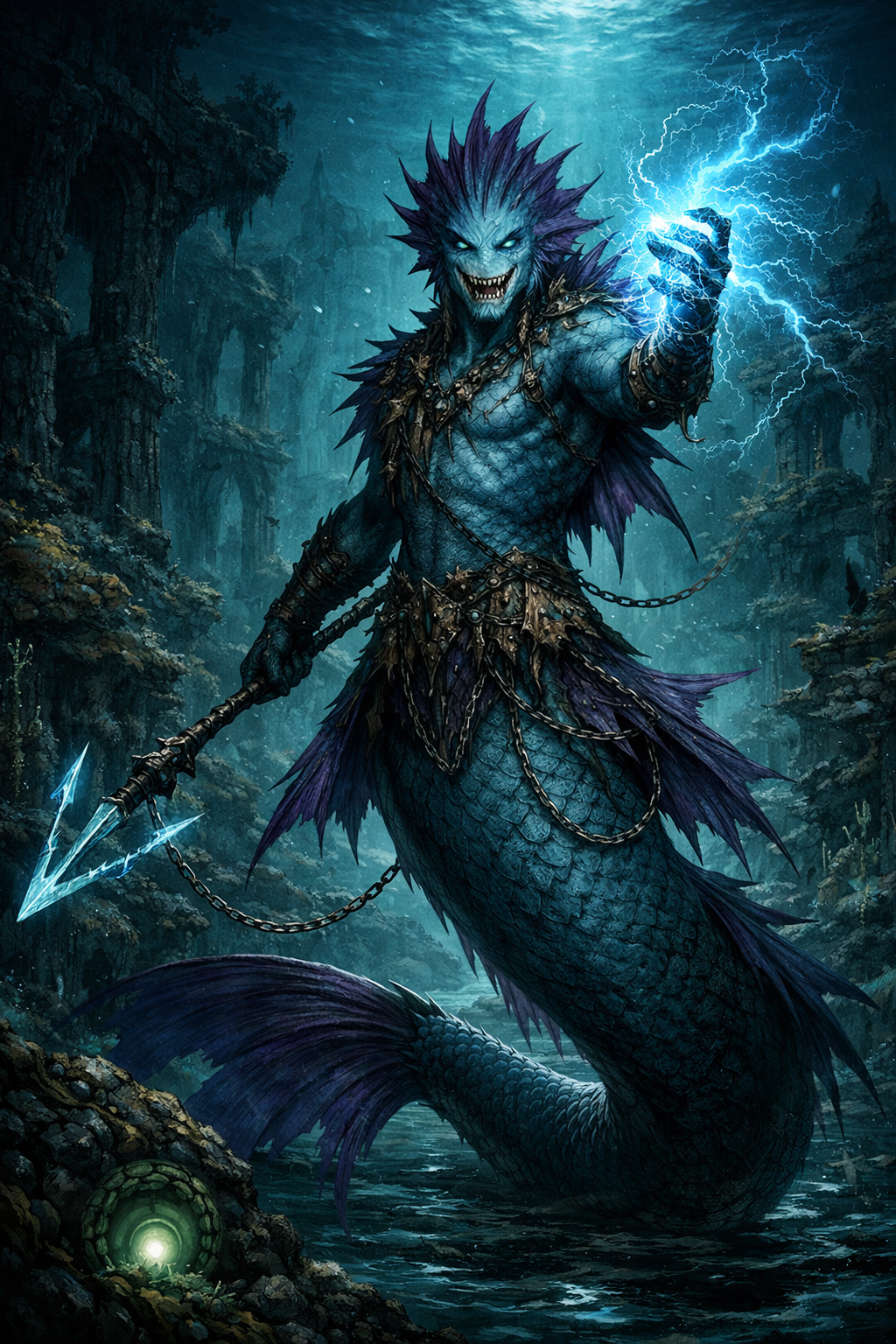
Merrow skin is covered in thick, overlapping scales that vary in size and texture depending on body region. Larger, armor-like scales protect the torso and shoulders, while smaller, more flexible scales cover the tail and joints. Scale coloration ranges from deep blues and greens to slate and near-black, providing natural camouflage in low-light environments. Many Merrow display faint bioluminescent markings along the lateral line, throat, or face, used for communication and navigation rather than illumination.
Facial structure is distinctly non-mammalian. Merrow lack external ears and a projecting nose. Instead, they possess recessed auditory channels protected by scale ridges and specialized vibration-sensitive tissues capable of detecting low-frequency sound through water and stone. Olfactory perception is achieved through internal sensory pits rather than nostrils, rendering the face smooth and streamlined.
The eyes are large and adapted to minimal light, with reflective layers that enhance vision in near-total darkness. Pupils are typically slit or multifaceted, capable of rapid adjustment. Teeth are sharp and recurved, suited for gripping prey rather than chewing, and are replaced periodically throughout life.
Respiration occurs primarily through gill structures located along the neck and upper torso, protected by hardened cartilage and scale flanges. While Merrow can survive briefly out of water, prolonged exposure to air causes severe physiological stress and eventual organ failure.
Overall, Merrow morphology is utilitarian rather than aesthetic. Every aspect of their anatomy serves survival in an environment defined by darkness, pressure, and scarcity, resulting in a species that appears alien, imposing, and unmistakably adapted to the deep.
The upper body of a Merrow is broadly humanoid, with a reinforced ribcage, thick clavicles, and heavily muscled shoulders and arms. Bone density is significantly higher than that of surface-dwelling humanoids, reducing the risk of structural failure under extreme pressure. Internal organs are compacted and shielded by layers of dense muscle and connective tissue, limiting compression damage at depth.
From the waist down, Merrow possess a single, continuous tail composed of elongated vertebrae and powerful lateral muscles. The tail ends in a broad fin capable of precise directional control as well as explosive bursts of speed. Smaller stabilizing fins may be present along the hips, calves of the tail, or spine, but Merrow never possess multiple tails; any apparent duplication is the result of overlapping fins or visual distortion in motion.
Merrow skin is covered in thick, overlapping scales that vary in size and texture depending on body region. Larger, armor-like scales protect the torso and shoulders, while smaller, more flexible scales cover the tail and joints. Scale coloration ranges from deep blues and greens to slate and near-black, providing natural camouflage in low-light environments. Many Merrow display faint bioluminescent markings along the lateral line, throat, or face, used for communication and navigation rather than illumination.
Facial structure is distinctly non-mammalian. Merrow lack external ears and a projecting nose. Instead, they possess recessed auditory channels protected by scale ridges and specialized vibration-sensitive tissues capable of detecting low-frequency sound through water and stone. Olfactory perception is achieved through internal sensory pits rather than nostrils, rendering the face smooth and streamlined.
The eyes are large and adapted to minimal light, with reflective layers that enhance vision in near-total darkness. Pupils are typically slit or multifaceted, capable of rapid adjustment. Teeth are sharp and recurved, suited for gripping prey rather than chewing, and are replaced periodically throughout life.
Respiration occurs primarily through gill structures located along the neck and upper torso, protected by hardened cartilage and scale flanges. While Merrow can survive briefly out of water, prolonged exposure to air causes severe physiological stress and eventual organ failure.
Overall, Merrow morphology is utilitarian rather than aesthetic. Every aspect of their anatomy serves survival in an environment defined by darkness, pressure, and scarcity, resulting in a species that appears alien, imposing, and unmistakably adapted to the deep.
Biological Traits
The biological traits of Merrow are shaped by extreme environmental pressure, prolonged lifespans, and a rigid division of labor within their society. While all Merrow share the same foundational physiology, notable variation exists between individuals based on age, sex, and role within the clan, particularly between hunters, wardens, and seers of the deep.
Merrow exhibit sexual dimorphism, though it is subtler than in many surface species. Males tend to develop broader shoulders, heavier musculature, and thicker scale plating along the chest and arms, adaptations suited for hunting and territorial defense. Females, while no less formidable, often possess longer, more flexible tails and heightened sensory perception, traits advantageous for navigation, offspring protection, and deep-water awareness. These distinctions are averages rather than strict rules, and overlap is common.
Role-based differentiation is more pronounced than gender-based differences. Hunters develop denser muscle mass, reinforced jaw structures, and thicker dermal armor over time, especially along the forearms, shoulders, and spine. Wardens and guardians of ruins often display increased scarification, calcified growths, or coral-like protrusions formed through prolonged exposure to ancient magic and pressure zones. Seers and tide-sensitive Merrow frequently develop intensified bioluminescent markings, particularly around the eyes, throat, and along the lateral line, a side effect of their heightened attunement to magical currents and oceanic vibrations.
Merrow age visibly but slowly. Younger Merrow have smoother scale patterns and brighter coloration, while elders grow darker, more muted in tone, with thickened scale ridges and increased mass. Advanced age does not inherently weaken a Merrow; instead, it often trades speed for endurance and perception. The oldest individuals are typically slower-moving but exceptionally difficult to kill, their bodies hardened by centuries of pressure and survival.
Life expectancy varies widely depending on depth zone and role. Merrow living in shallower or contested waters face higher mortality rates due to conflict and environmental instability, while deep-clan Merrow often live longer but endure harsher physical conditions that accelerate visible aging.
Overall, Merrow biology reflects a species built not for comfort or adaptability, but for endurance, memory, and survival in a world that actively seeks to crush the unprepared.
Genetics and Reproduction
Merrow genetics are highly stable, shaped by millennia of adaptation to extreme pressure, low light, and scarce resources. Natural mutation occurs slowly and infrequently, with most significant genetic divergence arising from prolonged exposure to abyssal magic, corrupted ley currents, or ancient, unstable ruins. Such divergences are not inherently viewed as flaws; depending on the nature of the change, they may be treated with suspicion, reverence, or quiet concern within Merrow society.
Reproduction among Merrow is rare and deliberately regulated. They reproduce sexually and give birth to live young, with long gestation periods that place considerable physical strain on the parent. Fertility cycles are infrequent, and most Merrow will produce only a small number of offspring over their lifetime. This low reproductive rate is offset by high parental investment and extended juvenile development.
Merrow offspring are born fully aquatic but physically fragile, lacking the dense musculature and hardened scales of adults. Early development occurs in protected deep-water nurseries, often located within ruin chambers or naturally shielded trenches. Juveniles remain under close communal supervision for decades, during which time survival skills, spatial awareness, and clan memory are gradually instilled.
Genetic lineage holds cultural importance, though not in a strictly hierarchical sense. Bloodlines are tracked primarily to preserve historical memory, identify inherited sensory or magical traits, and avoid destabilizing genetic convergence within isolated clans. Cross-clan reproduction is uncommon but not forbidden, typically occurring during periods of alliance or forced migration.
Merrow reach physical maturity slowly, often taking several decades to fully develop their characteristic musculature, sensory acuity, and pressure tolerance. Full adulthood is marked less by age and more by demonstrated endurance and successful contribution to the survival of the clan. Aging thereafter is gradual, with older Merrow retaining reproductive capability for much longer than surface species, though most cease reproduction voluntarily as they assume roles focused on memory, guardianship, or leadership.
Growth Rate & Stages
Merrow develop slowly, with growth paced to match the extreme demands of deep-ocean survival. From birth, physical development prioritizes resilience and sensory integration rather than size or speed. This prolonged maturation results in juveniles that remain dependent on clan protection for decades but emerge as exceptionally durable adults.
Neonates are born fully aquatic and capable of basic movement, though they lack the muscle density, scale hardness, and pressure tolerance required for open-depth travel. During the earliest stage of life, Merrow young are kept within sheltered nurseries located in stable trenches, cavern systems, or fortified ruins. At this stage, growth is rapid in terms of neural development and sensory calibration, while physical size increases slowly.
The juvenile stage spans several decades. Young Merrow gradually expand their range under supervision, learning navigation, current reading, and vibration awareness before participating in any form of hunting or territorial defense. Musculature thickens, scales begin to harden, and bioluminescent markings, if present, first appear during this period. Mortality is highest during late juvenility, when individuals begin venturing into contested or unstable regions.
Adolescence is marked by a noticeable increase in size, strength, and pressure tolerance. This stage often coincides with the first independent expeditions and formal instruction in a chosen role within the clan. Behavioral changes include increased territorial awareness, heightened aggression, and intensified sensory perception as the body approaches full adaptation to deep-ocean conditions.
Merrow reach physical adulthood between their sixth and eighth decade of life, though true maturity is determined by demonstrated survival capability rather than age alone. Once fully grown, Merrow experience an extended period of physical prime that can last well over a century. Aging thereafter is gradual, with strength declining slowly while endurance, perception, and resistance to pressure often continue to increase.
Advanced age is characterized by further thickening of scales, darker coloration, and reduced speed. Elders remain formidable due to accumulated experience and hardened physiology, often transitioning into roles centered on memory, guardianship, or deep-sea oversight rather than active hunting. Death from natural causes is rare; most Merrow perish through environmental catastrophe, conflict, or deliberate sacrifice.
Ecology and Habitats
Merrow are apex and mesopredatory inhabitants of Tanaria’s deep oceans, occupying ecological niches largely inaccessible to surface and shallow-water species. Their habitats range from mid-depth continental slopes to abyssal trenches, with population density decreasing sharply closer to the surface. They are most commonly found in regions shaped by strong currents, leyline convergence, or submerged ruins, all of which provide both resources and strategic defensibility.
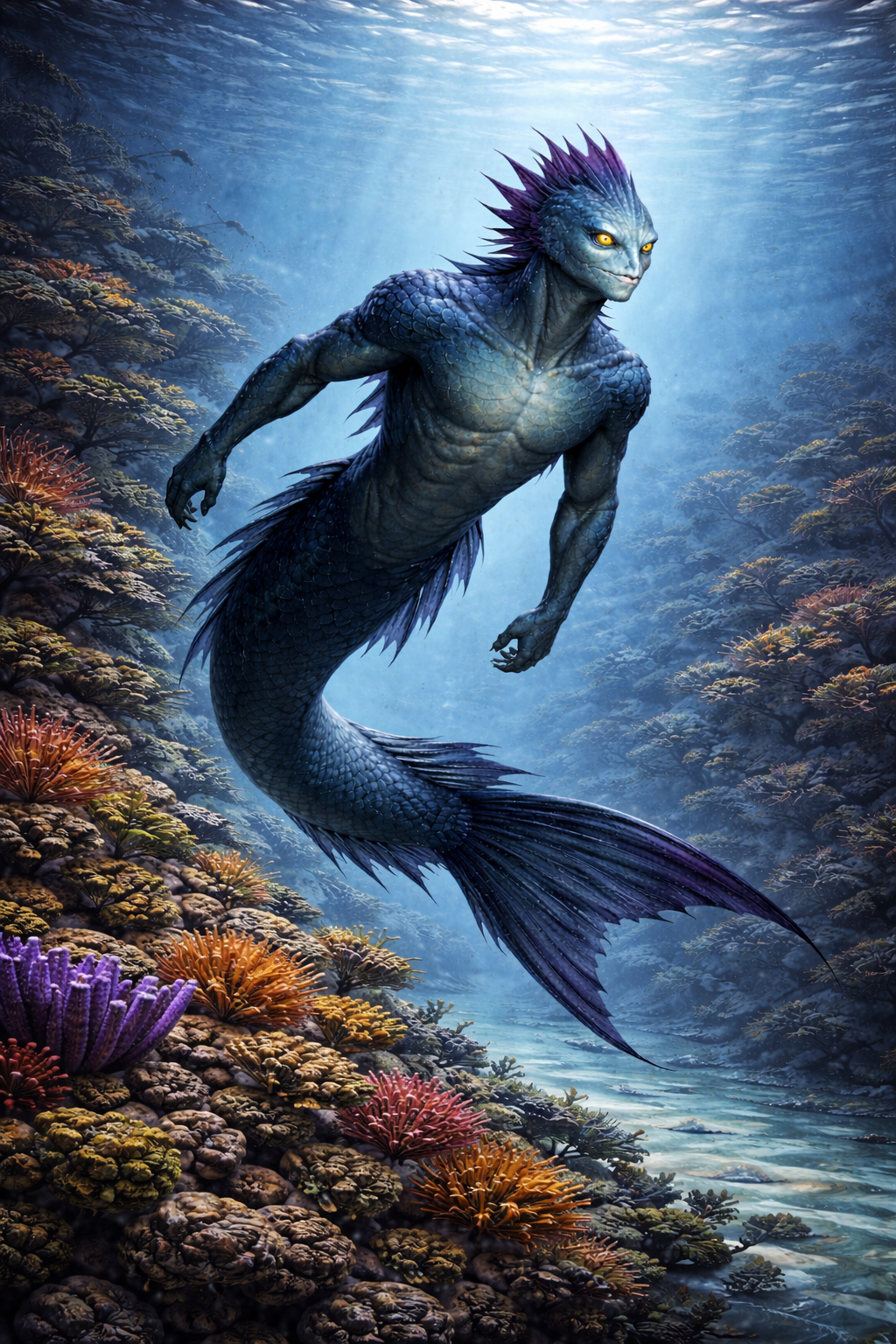 Merrow prefer environments that offer structural complexity. Submerged cities, collapsed temples, coral-choked caverns, and jagged trench walls serve as hunting grounds, nesting areas, and sites of cultural importance. Open water is traversed but rarely inhabited for extended periods, as it offers little protection and increases vulnerability to large predators or surface interference.
Ecologically, Merrow play a stabilizing role within the deep-sea food web. They regulate populations of large aquatic predators, abyssal megafauna, and invasive creatures drawn to magical disturbances. In regions where Merrow clans have collapsed or withdrawn, ecosystems often become unstable, leading to overpopulation of aggressive species, depletion of key resources, or uncontrolled spread of abyssal entities.
Merrow interaction with their environment is not passive. Through long-term occupation, they shape local ecosystems by redirecting currents, cultivating bioluminescent flora, and establishing controlled hunting zones. These modifications are subtle and gradual, designed to maintain sustainability rather than dominance. Areas under long-standing Merrow stewardship are often biologically rich but deceptively dangerous to outsiders.
Habitat selection is closely tied to cultural memory. Many clans are bound to specific locations through ancestral duty, ancient pacts, or the presence of sealed threats. Abandoning such sites is considered a last resort, as relocation often results in ecological imbalance elsewhere and increased conflict with neighboring clans.
While Merrow are capable of adapting to new environments, forced displacement into shallower waters or unfamiliar depths typically results in heightened aggression and increased encounters with surface civilizations. Such shifts are widely regarded among Merrow as signs of systemic failure within the deep, rather than simple territorial migration.
Merrow prefer environments that offer structural complexity. Submerged cities, collapsed temples, coral-choked caverns, and jagged trench walls serve as hunting grounds, nesting areas, and sites of cultural importance. Open water is traversed but rarely inhabited for extended periods, as it offers little protection and increases vulnerability to large predators or surface interference.
Ecologically, Merrow play a stabilizing role within the deep-sea food web. They regulate populations of large aquatic predators, abyssal megafauna, and invasive creatures drawn to magical disturbances. In regions where Merrow clans have collapsed or withdrawn, ecosystems often become unstable, leading to overpopulation of aggressive species, depletion of key resources, or uncontrolled spread of abyssal entities.
Merrow interaction with their environment is not passive. Through long-term occupation, they shape local ecosystems by redirecting currents, cultivating bioluminescent flora, and establishing controlled hunting zones. These modifications are subtle and gradual, designed to maintain sustainability rather than dominance. Areas under long-standing Merrow stewardship are often biologically rich but deceptively dangerous to outsiders.
Habitat selection is closely tied to cultural memory. Many clans are bound to specific locations through ancestral duty, ancient pacts, or the presence of sealed threats. Abandoning such sites is considered a last resort, as relocation often results in ecological imbalance elsewhere and increased conflict with neighboring clans.
While Merrow are capable of adapting to new environments, forced displacement into shallower waters or unfamiliar depths typically results in heightened aggression and increased encounters with surface civilizations. Such shifts are widely regarded among Merrow as signs of systemic failure within the deep, rather than simple territorial migration.
Dietary Needs and Habits
Merrow are obligate carnivores with a diet centered almost entirely on marine life. Their physiology is optimized for high-protein, high-fat intake, necessary to sustain muscle density, body heat, and prolonged activity in cold or high-pressure waters. Fish, cephalopods, crustaceans, and large reef predators form the backbone of their diet, with preference given to oily species that provide long-lasting energy. Plant matter is not a meaningful food source for merrow and is consumed only incidentally.
Hunting is both a necessity and a cultural practice. Merrow favor active predation over scavenging, relying on speed, ambush tactics, and coordinated strikes when hunting larger prey. Reef systems, drop-offs, and migratory routes are frequently patrolled by experienced hunters, while younger merrow are taught to hunt progressively larger and more dangerous quarry as part of their maturation. Waste is minimal; flesh, organs, cartilage, and even bone are utilized, with excess preserved through drying, salting, or cold fermentation in deep-water caches.
Merrow possess a slower metabolic burn rate than most surface-dwelling humanoids, allowing them to endure long periods between meals when necessary. However, extended fasting leads to lethargy and reduced combat effectiveness rather than rapid starvation. During times of abundance, they will gorge deliberately, storing energy for leaner periods such as seasonal migrations or territorial conflict.
Consumption of surface-dweller livestock or sentient aquatic peoples is culturally regulated. While not biologically taboo, such acts are heavily contextual and often associated with warfare, ritual punishment, or survival extremes. As a result, merrow diets are tightly interwoven with territorial control, ocean health, and the balance of marine ecosystems they inhabit.
Behaviour
Merrow psychology is shaped by an environment where constant awareness and restraint are essential for survival. As a result, they tend toward deliberate, controlled behavior, rarely acting on impulse without cause. Emotional expression is typically muted in public, with displays of fear, joy, or anger considered vulnerabilities best kept private or reserved for trusted clan members. To outsiders, this restraint is often mistaken for coldness or hostility.
Merrow possess a strong territorial instinct, tied not only to physical space but to memory and responsibility. Locations are not simply places to live or hunt; they are inherited obligations, often bound to ancient events, sealed threats, or long-standing ecological balances. This fosters a mindset in which abandonment is seen as failure, and defense of one’s domain is both practical and moral.
Social bonds among merrow are deep but selective. Trust is earned slowly through consistent behavior rather than declarations or shared ideology. Once formed, these bonds are enduring, and betrayal carries severe psychological weight. Grudges are not impulsive but methodical, sometimes lasting generations, particularly when tied to loss of territory or kin.
Cognitively, merrow favor long-term thinking. Their extended lifespans and slow reproduction encourage patience, strategic planning, and an emphasis on cumulative consequence. Short-term gains are often viewed with suspicion, especially when they risk destabilizing the deep. This perspective frequently places them at odds with surface cultures driven by rapid expansion or immediate reward.
Aggression in merrow is purposeful rather than emotional. Violence is employed decisively when boundaries are crossed or survival is threatened, but rarely escalates without cause. Outside such contexts, merrow are observant, calculating, and capable of cooperation, though they prefer indirect influence and environmental advantage over open confrontation.
Overall, merrow psychology reflects a people accustomed to pressure in every sense of the word. Their behavior is shaped less by ideology than by survival, memory, and an unyielding awareness that the ocean does not forgive mistakes.
Additional Information
Perception and Sensory Capabilities
Merrow perception is adapted to an environment where light is scarce, sound behaves unpredictably, and survival depends on detecting threats long before they are seen. Their sensory systems prioritize vibration, pressure change, and magical disturbance over conventional visual acuity.
Merrow possess highly developed low-light vision. Their eyes are large, with reflective internal layers that amplify even minimal ambient light, including bioluminescence and residual magical glow. Color perception is limited at extreme depths, with vision shifting toward contrast and motion detection rather than detail. At shallower depths, Merrow can distinguish a broader range of hues, though never with the clarity of surface species.
Rapid pupil contraction allows them to adjust quickly when exposed to sudden light, such as magical illumination or surface glow, though prolonged exposure is painful and disorienting.
Rather than external ears, Merrow rely on subdermal auditory channels and vibration-sensitive tissues embedded along the jaw, spine, and lateral line. These systems allow them to perceive sound transmitted through water, stone, and metal with exceptional accuracy.
This capability enables Merrow to:
- Detect approaching creatures long before visual contact
- Identify the size and movement pattern of targets
- Sense structural instability in ruins or cavern walls
- Track surface vessels by hull vibration alone
- Awareness of active or weakening seals
- Sensitivity to ancient wards or enchantments
- Perception of large-scale disturbances in the deep, such as the stirring of primordial entities
- A persistent sense of being watched in specific locations
Scientific Name
Merraxis profundis
Lifespan
200–300 years
Conservation Status
Vulnerable (Regionally Endangered in Several Seas)
Merrow populations are not uniformly distributed and cannot be treated as a single, stable species. While the Merrow as a whole are not facing immediate extinction, many regional populations have suffered significant decline over the last several centuries, particularly those inhabiting coastal shelves, mid-depth trade routes, and areas of heavy surface interference.
Merrow populations are not uniformly distributed and cannot be treated as a single, stable species. While the Merrow as a whole are not facing immediate extinction, many regional populations have suffered significant decline over the last several centuries, particularly those inhabiting coastal shelves, mid-depth trade routes, and areas of heavy surface interference.
Average Height
Torso (head to waist): 4–5 ft (1.2–1.5 m)
Average Weight
350–600 lbs (160–270 kg)
Average Length
8–11 ft (2.4–3.3 m)
Geographic Distribution


Comments