

Infernal
Unlike mortal languages, Infernal does not merely describe reality; it asserts it. Spoken Infernal carries implicit structure, defining speaker, listener, authority, and intent within its grammar. A statement made in Infernal inherently acknowledges power relationships, whether the speaker intends to or not. For this reason, devils prefer Infernal even when they are capable of speaking other tongues fluently.
Infernal is a precise but dangerous language for mortals. It is extremely difficult to speak without unintentionally conceding leverage. Even casual phrases often imply obligation, acknowledgment of rank, or tacit consent. Devils exploit this relentlessly, allowing mortals to “agree” to terms they never realized they voiced.
Writing System
The Infernal writing system is as deliberate and unforgiving as the language itself. It was not designed for beauty, speed, or artistic expression, but for permanence, precision, and enforceability. Infernal script exists to record obligation, authority, and consequence in a form that cannot be misinterpreted without intent.
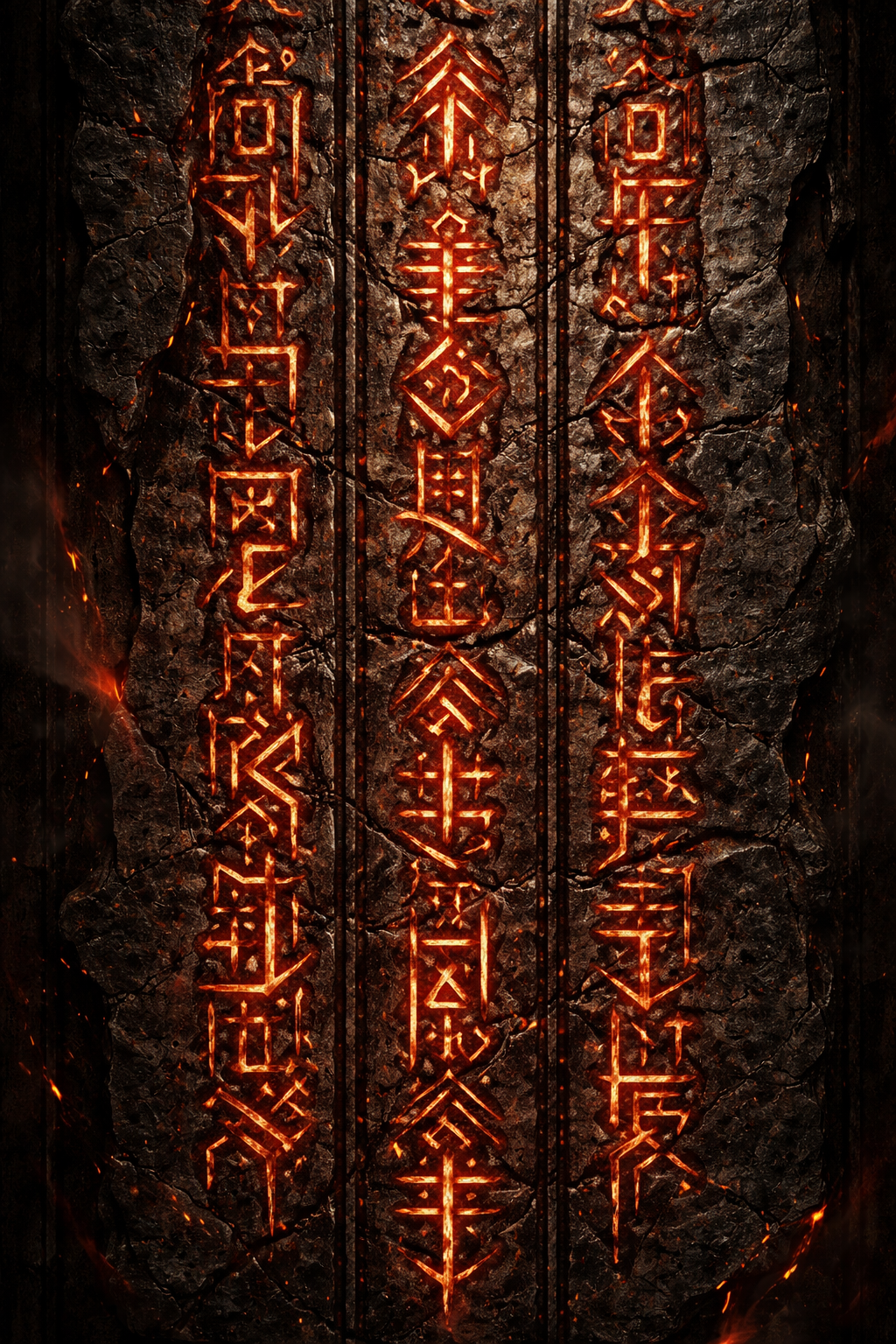
Infernal is written in a vertical, segmented script, read from top to bottom and right to left. Each line represents a complete semantic unit rather than a sentence in the mortal sense. Within a line, symbols are stacked and interlocked, forming compact blocks that encode meaning through position as much as shape. Altering the placement of a symbol can change not just the meaning of a clause, but who is bound by it and under what conditions.
Individual glyphs are angular, rigid, and sharply defined. Curves are rare and, when present, indicate exception clauses, conditional authority, or loopholes. Straight lines and corners dominate, reinforcing the language’s emphasis on structure and finality. Many glyphs resemble sigils or runes to mortal eyes, but this is a misconception; Infernal script is linguistic first and magical only as a consequence of its precision.
Written Infernal inherently carries binding weight. A statement inscribed in true Infernal script is more authoritative than one spoken aloud, as it removes tonal ambiguity and emotional variance. Contracts, laws, summoning circles, and infernal decrees are always written, never purely spoken. Spoken Infernal may persuade or assert, but written Infernal commits reality.
Infernal texts resist alteration. Ink, blood, or etched stone used to write Infernal often persists far beyond its natural lifespan, as the script reinforces its own existence. Attempts to erase or overwrite Infernal writing frequently fail unless performed by a being of equal or greater authority than the original author. In some cases, erased glyphs reappear over time, corrected by the infernal structure itself.
Spacing and separators are as important as glyphs. Gaps between segments indicate scope of authority, duration, and jurisdiction. Mortal scribes unfamiliar with Infernal frequently make fatal errors by compressing or expanding these spaces, unintentionally broadening or narrowing a clause’s reach. Devils exploit this relentlessly when allowing mortals to draft their own agreements.
There is no true shorthand in Infernal. Every attempt to abbreviate results in ambiguity, which the language rejects. As a result, Infernal documents are often dense, visually imposing, and exhausting to read. This is intentional. Infernal law assumes that only those willing to endure comprehension deserve agency.
In Tanaria, the Infernal writing system is not merely a method of recordkeeping. It is a mechanism of control. To write in Infernal is to accept responsibility for consequence, and to read it fully is to risk becoming bound by what is understood.
Geographical Distribution
Outside the Lower Planes, Infernal appears wherever devils exert influence, not where they merely pass through. On the Prime Material Plane, Infernal is most commonly found in written form rather than spoken. Grimoires, summoning circles, binding contracts, infernal seals, cursed artifacts, and legalistic magical frameworks frequently use Infernal due to its precision and metaphysical weight. Spoken Infernal among mortals is rare and usually limited to warlocks, cult leaders, diabolists, and scholars of forbidden theology.
Infernal inscriptions are also found in ruined temples, fallen civilizations, and sites of historical infernal pacts, often persisting long after the devils involved are gone. Because Infernal script carries binding and symbolic power even when partially damaged, fragments of the language can remain magically active for centuries.
In contrast to Abyssal, Infernal does not spread organically. It does not evolve through common use or cultural drift. Its presence is deliberate, imposed, and maintained by infernal authority. Where Infernal is found, it is a sign not of chaos, but of control, contracts, and long-term manipulation.
Phonology
Infernal favors low, resonant sounds and consonants formed deep in the throat. Many phonemes require tension in the jaw and diaphragm, making the language physically uncomfortable for mortals to speak for long periods. Native speakers, meaning devils, produce the sounds effortlessly, while mortals often suffer strained voices, bleeding gums, or vocal fatigue after extended use.
Vowels are short, clipped, and weighted, rarely flowing into one another. Long vowels exist but are typically used to indicate emphasis, command, or binding intent, not emotion. Misplacing vowel length can subtly change meaning or weaken a spoken contract.
Consonant clusters are common and intentionally difficult, often stacking gutturals, fricatives, and hard stops. Plosives and rolled or trilled sounds are frequent, especially in words relating to authority, ownership, or punishment. Sibilants are controlled and sharp, used to convey precision rather than menace.
Stress in Infernal is fixed and meaningful. Emphasis usually falls on the root morpheme, not prefixes or suffixes. Shifting stress can invalidate legal phrasing, alter the scope of a command, or reduce a binding statement to a mere declaration. Because of this, trained speakers learn Infernal rhythm before vocabulary.
Infernal lacks tonal distinctions in the musical sense, but it uses force and breath control as semantic markers. A word spoken with insufficient force may be interpreted as non-binding, while excessive force can be read as an attempted domination, triggering resistance or backlash from higher infernal authorities.
Overall, Infernal sounds measured, oppressive, and absolute. It is a language meant to be endured, not enjoyed, and every aspect of its phonology reinforces the idea that words are tools of power, obligation, and control.
Morphology
Infernal is a highly inflected, root-dominant language. Most words are built from a core root that encodes the fundamental concept, such as command, debt, ownership, or punishment. Prefixes and suffixes do not merely modify meaning. They define authority, scope, duration, and consequence. Removing or misusing an affix does not make speech informal. It makes it invalid.
Prefixes typically denote rank, jurisdiction, or source of authority. A command spoken with a lesser prefix cannot compel a superior devil, even if the verb itself is correct. Conversely, the same root spoken with a superior prefix can override lesser bindings already in place.
Suffixes describe binding conditions. These include permanence versus temporality, personal versus delegated authority, and whether an obligation transfers upon death or planar displacement. Certain suffixes mark statements as enforceable contracts, while others explicitly declare non-binding intent. Devils listen for these markers instinctively.
Internal vowel shifts are used to indicate state changes. A root describing possession, for example, may change its internal vowel pattern to indicate willing transfer, coerced seizure, or inherited ownership. These shifts are subtle and extremely easy for mortals to misuse.
Reduplication exists but is rare and dangerous. Repeating a root intensifies it, often exponentially. This is commonly used in punishments or absolute prohibitions, but improper reduplication can trigger infernal enforcement mechanisms without a controlling party, resulting in unpredictable consequences.
Compound words are long, formal, and common in legal or ritual contexts. Entire clauses may be compressed into a single word, especially in contracts or true-name invocations. These compounds follow strict ordering rules. Reversing elements does not change tone. It changes jurisdiction.
Infernal has no true synonyms. Two words that appear similar always differ in legal implication or metaphysical reach. Devils exploit this mercilessly. Mortals attempting fluency often understand vocabulary but fail at morphology, which is why Infernal contracts are infamous.
In Infernal, morphology is not grammar for communication. It is grammar for enforcement.
Syntax
Infernal sentences are built around a central assertion, which must be explicitly defined before any action, condition, or consequence can be stated. This assertion identifies the speaker’s authority, the scope of that authority, and the subject upon which it acts. Only once authority is established may commands, promises, or prohibitions follow. Statements that fail to declare authority are treated as non-binding observations.
Word order is largely fixed and follows a descending hierarchy: Authority → Subject → Action → Condition → Consequence. This structure ensures that every statement encodes who may act, who must comply, under what circumstances, and what occurs if compliance fails. Reordering these elements does not merely sound incorrect; it can invert meaning or shift responsibility in dangerous ways.
Infernal does not allow implied subjects or omitted agents. Every enforceable statement must explicitly name or designate all involved parties. Passive constructions exist but are tightly regulated, typically used only in infernal records where the actor is irrelevant or intentionally concealed. In spoken Infernal, overuse of passive structure is viewed as an attempt to evade accountability.
Negation is absolute and positional. A negative marker placed incorrectly can nullify an entire clause or unintentionally prohibit something the speaker intended to allow. Devils are acutely sensitive to negation errors and often allow mortals to trap themselves through careless placement.
Questions in Infernal are rare and structurally distinct. Rather than requesting information, most Infernal interrogatives function as tests of authority or knowledge. Asking a question improperly can be interpreted as conceding rank or acknowledging uncertainty, both of which devils consider weaknesses.
Conditional clauses are heavily layered and often nested. These are the backbone of infernal contracts. Each condition is ranked by priority, and conflicts resolve automatically in favor of the higher-ranked clause. This allows Infernal syntax to encode fail-safes, escape clauses, and punitive triggers within a single sentence.
In Infernal, syntax is not about clarity for the listener. It is about precision for reality. The language assumes hostility, scrutiny, and enforcement. Anything not explicitly stated is considered exploitable, and anything stated incorrectly becomes binding regardless of intent.
Vocabulary
Common Infernal words tend to function as conceptual anchors rather than flexible descriptors. Many are untranslatable without explanation, as they encode multiple ideas at once.
Authority & Hierarchy
- Zar – Authority; the right to command
- Zarith – Superior authority; ranked above the speaker
- Keth – Subordinate; a bound lesser
- Varr – Recognized equal under infernal law
- Threx – Usurper; illegitimate authority
Obligation & Contracts
- Bael – Binding agreement
- Baelreth – Contract enforced by punishment
- Uln – Debt or obligation owed
- Uln’kar – Inescapable debt; cannot be discharged
- Sekhar – Fulfillment of obligation
Ownership & Control
- Mal – Possession or ownership
- Malreth – Claimed by lawful right
- Vesh – Seizure by authority
- Kor – Dominion; territory or jurisdiction
Action & Enforcement
- Drath – Command
- Drathen – Command backed by punishment
- Kaal – Execution or enforcement of judgment
- Reth – Punishment; consequence
Time & Duration
- Nul – Immediate; presently binding
- Nul’eth – Eternal or permanent
- Saar – Conditional or delayed
- Saar’ven – Conditional with punitive trigger
Truth & Names
- Isk – Structural truth
- Isketh – Revealed or enforced truth
- Naeth – Name
- Naeth’isk – True name; core identity
Infernal deliberately lacks casual greetings, expressions of affection, or polite fillers. Even basic interactions are framed in terms of acknowledgment, recognition, or concession. For example, what a mortal might translate as “greetings” is more accurately rendered as acknowledgment of presence and status.
Because of this, mortals attempting to speak Infernal often sound unintentionally submissive, hostile, or binding. Devils exploit common vocabulary errors mercilessly, as even a single misplaced word can imply consent, debt, or recognition of authority.
Phonetics
The language favors guttural and uvular consonants, including hard stops, rasping fricatives, and compressed trills. These sounds create a grinding, authoritative cadence that is difficult to soften or disguise. Soft consonants are rare and usually indicate conditional or deferential clauses rather than emotional nuance.
Vowels are short, clipped, and weighted. Long vowels exist but are meaningful rather than stylistic, typically marking commands, bindings, or permanence. Incorrect vowel length can weaken a statement or alter its legal force. Diphthongs are uncommon and often unstable, used only in evolved true names or advanced contractual phrasing.
Stress is fixed and semantically significant. Emphasis almost always falls on the root morpheme of a word. Shifting stress to a prefix or suffix can unintentionally concede authority, reduce a command to a request, or invalidate a binding clause entirely. Rhythm is therefore taught before vocabulary when devils instruct others in Infernal.
Infernal is non-tonal, but it relies heavily on breath pressure and vocal force as semantic markers. Insufficient force implies uncertainty or lack of authority. Excessive force may be interpreted as an attempted domination, potentially provoking resistance or backlash from a higher-ranking infernal entity.
Pauses and breaks in speech are regulated. Silence between clauses indicates separation of jurisdiction or scope. Improper pauses can unintentionally merge clauses, creating broader obligations than intended. Devils are acutely aware of this and often allow mortals to destroy themselves through careless pacing.
Overall, Infernal phonetics are not meant to be expressive or beautiful. They are oppressive, exacting, and enforceable, reinforcing the idea that speech itself is an act of power and that every sound carries consequence.
Tenses
Infernal recognizes three primary binding states, which replace traditional tense usage.
Immediate / Active State
This state denotes actions, commands, or bindings that are currently in force. It is used for active contracts, standing orders, and ongoing obligations. Most spoken Infernal defaults to this state unless explicitly modified.
Completed / Irrevocable State
This state indicates actions or bindings that are fulfilled, concluded, or permanently resolved. Once a statement is placed in this state, it cannot be undone or reinterpreted. Devils use this tense to lock outcomes, declare debts settled, or finalize punishments.
Conditional / Latent State
This state applies to actions or consequences that are dormant until triggered. It is heavily used in contracts, threats, and layered agreements. Conditions are explicitly encoded, and when met, the clause automatically shifts into the Immediate or Completed state without further declaration.
Infernal does not allow vague future tense. Statements about the future must either be conditional or bindingly inevitable. A devil cannot say “this will happen someday” without specifying the condition or authority that makes it happen. Mortals attempting such phrasing often create unintended bindings.
Temporal modifiers exist but are secondary. Words indicating duration, delay, or repetition attach to the binding state rather than replacing it. This ensures that even long-term agreements remain enforceable regardless of time passed, planar travel, or death of involved mortals.
Because of this structure, Infernal contracts do not “expire” naturally. They must be explicitly moved into the Completed state or nullified by superior authority. Devils view mortal timekeeping as irrelevant unless it has been formally acknowledged within the language.
In Infernal, tense is not about when something happens. It is about whether reality is currently obligated to make it happen.
Sentence Structure
The canonical order is:
Authority → Subject → Action → Conditions → Consequence
Authority must be declared explicitly at the beginning of any enforceable sentence. This may be the speaker’s rank, a delegated mandate, or a cited superior authority. Without this declaration, the sentence is treated as non-binding commentary.
Subjects are never implied. All parties affected by a statement must be named or formally designated. Pronouns are rare and dangerous, used only when scope is unambiguous. Ambiguous reference defaults responsibility to the speaker.
Actions are stated in precise, root-driven verbs. Modifiers attach after the verb and never precede it. This prevents emotional or rhetorical framing from weakening intent.
Conditions follow actions and are ranked by priority. Nested conditions are common, especially in contracts. Conflicting conditions automatically resolve in favor of the higher-ranked clause as defined earlier in the sentence.
Consequences are mandatory for binding statements. A command without consequence is considered advisory. A promise without consequence is invalid. Consequences may be immediate, delayed, or conditional, but they must be explicit.
Negation is positional and absolute. A misplaced negation marker can nullify an entire clause or invert authority. Devils routinely allow mortals to self-bind through careless negation placement.
Questions exist but are structurally distinct. Infernal interrogatives typically function as tests of authority or acknowledgment of uncertainty. Asking a question improperly can concede rank.
Passive constructions are permitted only in records or when authority intentionally conceals agency. In spoken Infernal, excessive passive use is interpreted as evasion.
In Infernal, sentence structure is not designed to help the listener understand. It is designed to ensure that reality understands exactly what is being enforced.
Adjective Order
Adjectives in Infernal follow a fixed priority sequence that cannot be rearranged without altering meaning. The canonical order is:
Authority → State → Ownership → Quality → Quantity → Temporal Scope
Authority adjectives always come first. These indicate rank, legitimacy, or sanctioned power. An object or being described without an authority qualifier is considered unclaimed and legally unstable. Placing an authority adjective later in the sequence weakens or nullifies its effect.
State adjectives follow authority and define whether the noun is bound, free, corrupted, sanctioned, or condemned. These adjectives often determine whether interaction with the noun carries consequence. Misplacing a state adjective can unintentionally absolve or damn the subject being referenced.
Ownership adjectives specify possession, stewardship, or dominion. Infernal distinguishes sharply between temporary custody, lawful ownership, and absolute claim. These adjectives must precede descriptive qualities; otherwise, the description applies only superficially and does not confer legal control.
Quality adjectives describe inherent traits such as strength, purity, ruin, or deficiency. Unlike mortal languages, these descriptors are factual, not subjective. Calling something “weak” in Infernal is a legal assessment, not an opinion.
Quantity adjectives are exact and literal. Approximation is not permitted. Infernal does not allow vague quantities; uncertainty defaults against the speaker.
Temporal scope adjectives come last and define duration or permanence. These determine whether a noun’s status is momentary, conditional, or eternal. Improper placement can accidentally render a condition permanent.
Infernal does not allow stacked adjectives of the same category unless explicitly linked by a binding marker. Attempting to layer descriptors without proper structure can fracture the clause or produce unintended compound meanings.
In Infernal, adjective order is not about sounding correct. It is about establishing reality in the proper sequence. To describe something out of order is to misunderstand its place in the hierarchy, and Infernal punishes that mistake accordingly.
Structural Markers
Authority Markers These markers declare the source and scope of power behind a statement. They appear at the beginning of enforceable clauses and may reference personal rank, delegated authority, or an external mandate. Absence of an authority marker renders a statement advisory at best. Conflicting authority markers default to the higher-ranked source.
Clause Boundaries Infernal uses explicit boundary markers to separate clauses. These define jurisdictional limits and prevent unintended bleed-over between obligations. Improper or missing boundaries can merge clauses, unintentionally expanding scope or consequence. In written Infernal, these markers are visually distinct and non-negotiable.
Conditional Markers Conditions are introduced with specialized markers that rank triggers by priority. Each conditional marker encodes whether activation is voluntary, automatic, or enforced by infernal law. Nested conditions are common, and improper nesting can cause premature activation or nullification.
Consequence Markers Every binding clause requires a consequence marker. These define the nature of enforcement, escalation, and resolution. Consequence markers specify whether punishment is immediate, delayed, transferable, or perpetual. A clause without a consequence marker is unenforceable.
Negation Markers Negation in Infernal is absolute and tightly scoped. Negation markers must appear directly before the element they negate. Misplacement can negate unintended portions of a sentence, including authority or consequence. Devils frequently exploit mortal misuse of negation markers.
Jurisdiction Markers These markers define where a clause applies: infernal domain, planar boundary, individual entity, or conceptual space. Jurisdiction markers are critical in contracts involving summoning, exile, or cross-planar obligation. Omitted jurisdiction defaults to the speaker’s domain of authority.
Finalization Markers Used to lock a clause into the Completed or Irrevocable state. Once applied, a finalization marker cannot be removed by the original speaker. Only superior authority or explicit override clauses can alter a finalized statement.
In Infernal, structural markers are the skeleton of meaning. Words carry intent, but markers carry force. Devils read markers before vocabulary, because structure determines what reality is required to obey.
- Azhara
- Baelira
- Zaryth
- Kethrys
- Morvella
- Threxia
- Vashara
- Iskara
- Rethyra
- Naezira
- Zarielle
- Korvessa
- Baelrethia
- Ulthira
- Veshara
- Azhrael
- Baelkor
- Zarveth
- Kalthrix
- Morzael
- Threxan
- Valkorath
- Iskhar
- Rethzar
- Naezhul
- Zariel
- Korzath
- Baelreth
- Ultharion
- Veshkar


Comments