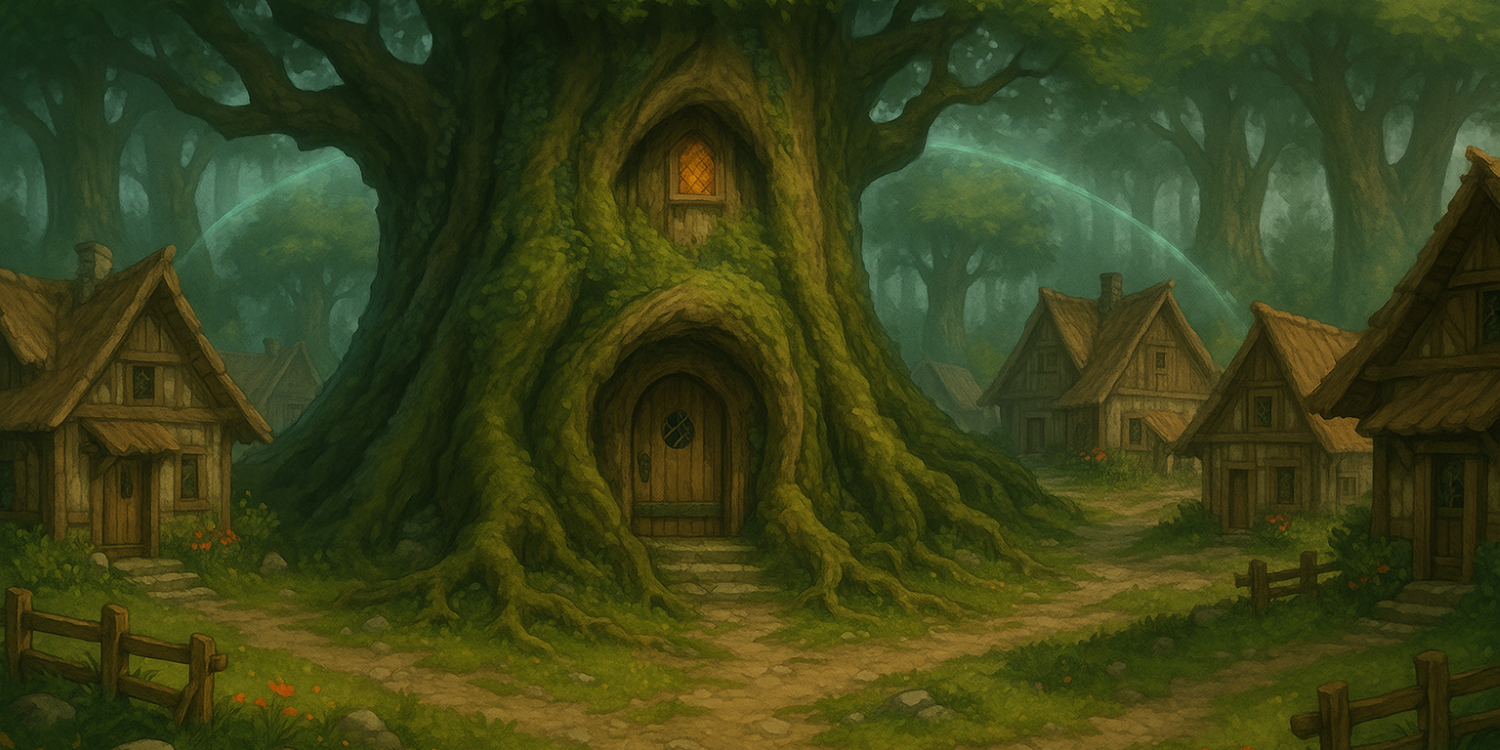
Xandarin
Xandarin is one of the few sanctuaries left in the scarred Eltawin Forest — a hidden village built into and around the Heartstump, the vast trunk of a fallen great tree whose roots still hum with latent power. Protected by the veil-ward crafted by Esmerelda, the Glade Mother, the settlement has survived for over sixty years, hidden from the plagues and horrors that swallowed the lands beyond.
Its founding came during the Pale Wars, when rangers and refugees from Aul’Daran were cornered by corruption and war. They sheltered under Esmerelda’s ward and carved a home among the living wood. Over time, the village grew, sustained by a delicate balance of secrecy, self-reliance, and reverence for the forest.
Though small — population just over one hundred — Xandarin plays an outsized role in the region’s resistance to corruption. The ward confuses maps and scrying, the forest itself seems protective, and the villagers maintain a network of scouts, wardens, and lore-keepers. Travelers who earn its trust find refuge, healing, and knowledge of ancient woodland magic lost elsewhere.
But Xandarin is not invulnerable. The River Heart corruption creeps toward its borders; blighted beasts probe the gaps; and external powers — from slaving bands to Shekiac scouts — occasionally test its defences. The veil must be maintained. Its wards must be renewed. And the villagers must be vigilant lest revelation be their undoing.
Demographics
Population: 123 (Humans 75%, Halflings 8%, Infernal-blooded 7%, Orc-blooded 4%, Dwarves 2%, Other 4%)
The people of Xandarin descend largely from Aul’Daran rangers and refugees, supplemented by wanderers, outcasts, and those drawn by the ward’s pull. Many infernal-blooded arise from the creeping corruption in the land itself, and some are descendants of orc-blooded scouts who chose the forest’s silence over empire’s chains. The culture is austere, communal, and deeply tied to forest rites, oral histories, and a sense of sacred duty.
Government
Xandarin’s governance follows the old woodland traditions — balanced, communal, and rooted in the belief that leadership is service rather than command. The hamlet is guided by a Council of Four, each responsible for one aspect of the settlement’s survival: the hunt, the hearth, the watch, and the lodge. Together they maintain the delicate balance between secrecy, survival, and the preservation of the Eltawin’s living spirit.
The Lodgemaster, currently Brann Tallowkin, serves as both steward and mediator. A tiefling of quiet strength and deep faith, Brann ensures the council’s decisions reflect the needs of the people rather than the whims of power. He oversees diplomacy, manages the hamlet’s limited trade with trusted outsiders, and presides over disputes. Though the others speak with equal voice, it is Brann’s calm pragmatism that binds the council’s differing perspectives.
The Hearthmaster is Esmerelda, the Glade Mother, an elder enchantress and the oldest living founder of Xandarin. She oversees the ward’s maintenance, the health of the people, and the management of food and stores. Once this duty belonged to Thessa Brookhand, a fisher and forager who perished two winters past, but Esmerelda has since resumed the role, guiding both hearth and ward with maternal resolve. Her word carries weight not through authority, but through the quiet reverence all hold for her wisdom and sacrifice.
The Huntmaster, Darrik Redbow, is the hamlet’s shield and spear. A scarred veteran and lifelong ranger, Darrik commands the rangers and scouts who patrol the forest’s edge. He organizes the hunts, leads forays against encroaching blightspawn, and ensures that the delicate balance of harvest and preservation is never broken. His methods are stern, his judgment unyielding, but his loyalty to Xandarin is absolute. Darrik’s word carries a soldier’s weight — harsh, but born of necessity.
Finally, the Watchmaster serves as both sentinel and judge, maintaining the peace within the hamlet and seeing that the Oath of Silence — the vow forbidding the revelation of Xandarin’s secrets — is upheld. This post rotates each year to prevent the accumulation of power. The current Watchmaster, Mira Vell, is a half-elf scout known for her perceptive nature and even hand. She mediates conflicts, oversees curfews, and ensures that Esmerelda’s ward remains undisturbed by internal strife or carelessness.
Together, the Council of Four rules by consensus, meeting beneath the Heartstump Lodge, where decisions are made by candlelight and recorded in living wood. Their leadership is not enforced through fear or decree, but through trust, tradition, and the shared knowledge that a single wrong choice could expose Xandarin to the eyes of a world it cannot afford to face.
Defences
Xandarin’s true defence is not its blades or bows, but the ancient ward that enfolds it — a living enchantment older than the Pale Wars, and perhaps even older than the Infernal Incursion itself. Woven into the very roots of the Heartstump, the ward is a remnant of the Eltawin’s primeval magic, reforged and maintained through generations by the Wardbound Circle under Esmerelda’s guidance. It is neither wall nor barrier, but a veil of living illusion that bends perception, twists sound, and turns paths upon themselves. To the uninvited, Xandarin simply does not exist. Travelers pass within bowshot of the hamlet and see only endless forest; scrying eyes and infernal auguries find nothing but static and shadow. The ward breathes with the land, waxing stronger when the forest thrives and faltering slightly when blight encroaches too near.
Beyond this hidden mantle, Xandarin maintains quiet vigilance. The Huntmaster, Darrik Redbow, commands a watch of skilled rangers who patrol the ward’s edge, tracking intruders and studying the movements of corrupted beasts. Hidden lookouts, carved into hollow trees or grown from living wood, serve as early warnings for any disturbance. Each villager is trained to respond to alarm signals — a pattern of horn calls or bird calls that echo across the canopy.
Though they possess weapons and courage enough to defend themselves, Xandarin’s greatest strength lies in its secrecy. The hamlet’s safety depends not on victory in battle, but on remaining unseen, untouched, and to the wider world entirely forgotten.
Industry & Trade
Xandarin subsists through crafts forged in harmony with the forest; trade is minimal but precise.
The hamlet produces goods its people need — and occasionally trades rare surplus with trusted outsiders. Their economy is closed and cautious, aimed more at preservation than expansion.
Mushroom Farming: Terraced underground cultivation of edible and medicinal fungi
Leather & Hidecraft: Tanned hides from local game, crafted into garments, boots, and tools
Woodcraft & Lore-wood: Small carvings, wands, warding sticks, and ritual tools
Herbalism & Salves: Forest plants and tinctures sold to trusted allies
Scout Guides / Pathfinding: Offering guidance along forest routes to friendly emissaries
Districts
Heartstump Lodge: Carved into the great stump; houses council hall, archive, infirmary
Ring Paths: Homes and workshops ring the Heartstump in concentric circles
Hearthfields: Gardens, mushroom terraces, small plots around homes
Edgewatch: Outlying dwellings and ward-marker sentinel posts
Slipway: Secret dock along a hidden feeder stream, masked by reeds
Assets
Wardbound Archive: Holds esoteric lore, maps, ritual tomes, warding scripts
Mushroom Caverns: Underground chambers supplying staple crops
Granary & Smokehouses: Preserves food and hides for lean times
Ashen Forge: Small smithy repairing blades and tools
River Shrine: Cairn on the ward’s perimeter for oaths and offerings
Wayfarer’s Rest: A modest inn for trusted travelers
Guilds and Factions
Unlike the larger towns and border settlements of Faelderin, Xandarin is too secret, and too unified to sustain competing factions. The community’s survival depends upon silence and cooperation, and thus any group that might divide loyalties has long since faded into memory. Every villager contributes to the ward’s preservation and the hamlet’s safety; there is no guild, no merchant league, and no hidden cult vying for influence. In Xandarin, to serve the hamlet is to serve the whole.
The only organized group that still bears a name and identity apart from the council is the Aul’Daran Rangers, a remnant of the ancient order that once patrolled the forests and borders of the old kingdom. These rangers are the descendants of those who scouted into the Eltawin during the Pale Wars, their line cut off from the main body of their order. To the outside world, they were lost — their oaths presumed broken and their names struck from the rolls of service. In truth, they endure in Xandarin, carrying out their ancient charge in isolation: to guard the wild places from corruption, to guide the lost, and to remember the oaths made to the land itself.
The Aul’Daran Rangers
Led by Huntmaster Darrik Redbow, the rangers of Xandarin serve as scouts, hunters, and protectors of the ward’s borders. They move like ghosts through the forest, marking trails known only to them and watching for any sign of blight, bandits, or infernal intrusion. Their discipline and silence are legendary — they speak little even among themselves, relying on gestures and the language of the woods. The people of Xandarin trust them absolutely, for they are both shield and warning, defenders who would rather vanish into the forest than allow the hamlet to be found.
History
Long before Xandarin was founded, the land upon which it stands was already sacred. The wards that shield the hamlet were woven in an age long past — not by mortal hands, but by those who stood against the fires of the Infernal Incursion. When infernal hosts first tore through the veil between realms, a circle of ward-weavers bound their magic into the roots of the Eltawin, the great forest that once stretched unbroken across the north. These wards were meant to protect the land’s heart from corruption, to preserve a sanctuary for life when all else fell to flame. At their center was Esmerelda, the woman now known as the Glade Mother, who has endured through centuries by means none fully understand — sustained, perhaps, by the very magic she once shaped.
The hamlet of Xandarin itself was not born until the Pale Wars, when the Eltawin was dying and the forest’s last defenders fled before the advancing blight. A small band of Aul’Daran rangers and refugees stumbled upon the fading remnants of Esmerelda’s ward and begged sanctuary. She answered not with words, but by opening the forest’s heart — guiding them beneath the shelter of the Heartstump, where they built their first homes in hollow roots and fallen boughs. In the years that followed, Xandarin grew from a desperate refuge into a hidden village, bound to the ward’s pulse and sustained by the Glade Mother’s quiet stewardship.
Though the decades since have changed kingdoms and names, Xandarin has remained untouched, its existence whispered only in legends of the “vanished wardens of Eltawin.” The world believes it long lost — and so it survives, hidden beneath the same ancient veil that predates even its founding, guarded still by the woman who wove it.
Points of interest
Heartstump Chamber: The core of the great tree, used for council, ritual, and ward-channelling
Glowfields: Terraced mushroom beds gleaming faintly under bioluminescent molds
Hollow Watch: A watchtower grown from living wood, high above the tree line
River Shrine Cairn: Boundary marker where ward energies converge with the River Heart
Wayfarer’s Rest: Hidden clearing inn for vetted travelers
Ashen Ruins: Nearby ruin overgrown by forest, rumored to contain relics from before the corruption
Architecture
Buildings in Xandarin grow with the forest, not against it. Walls are cedar planks and river stone, roofs sod-thatched or moss-covered. Homes are built between root arches and in the cavities of broken limbs. Doors are painted in azure, emerald, and amber — colors that carry warded sigils. The Heartstump dominates: spiraling knotwork, carved glyphs, lit from within by gentle glows. Wards, charms, and forest motifs decorate eaves and lintels. Everything is built to last quietly and harmonize with living wood.

Comments