Corntelyn
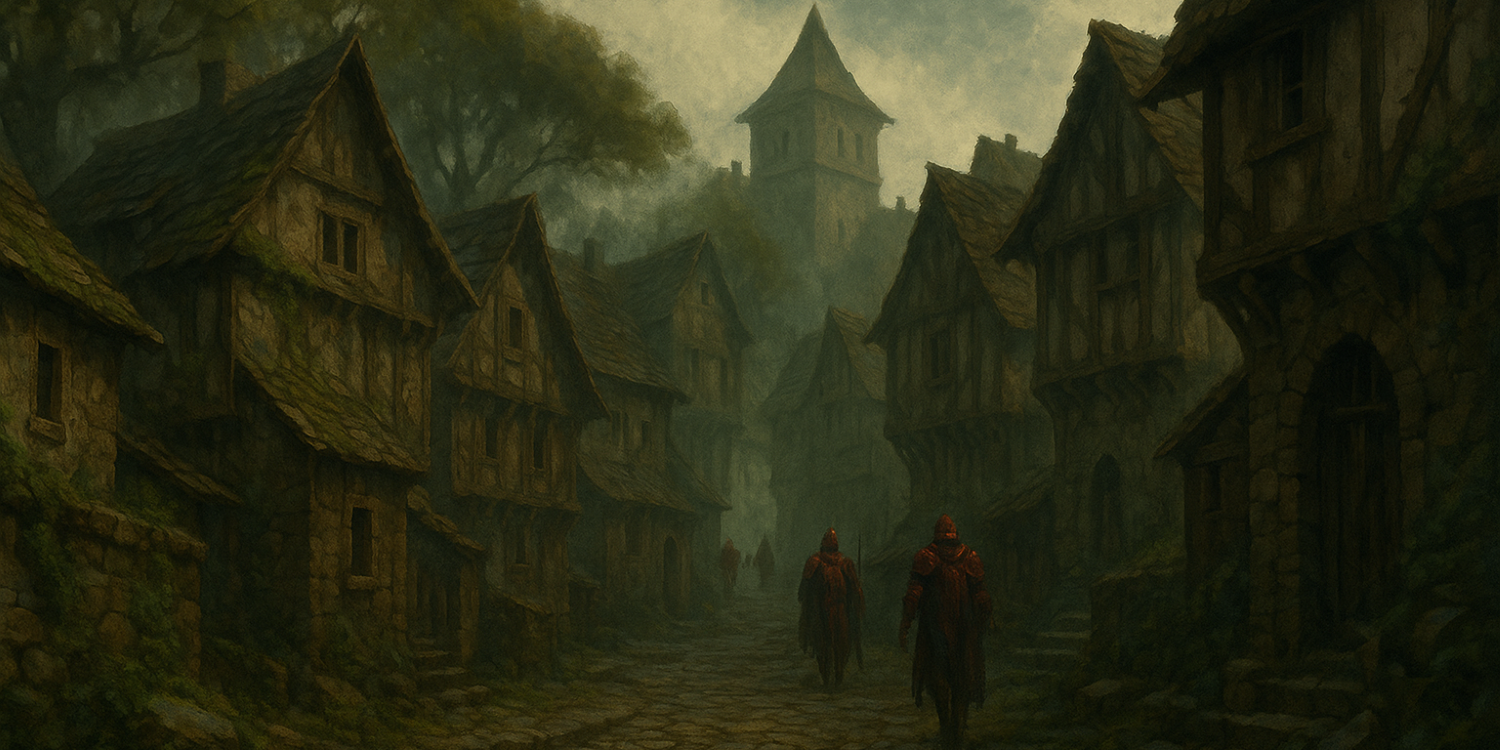
Corntelyn is a town that endures, rather than lives. It stands as one of countless southern holdings suffocating beneath Shekiac’s crimson boot—quiet, cowed, and forgotten by the greater powers that claim to rule it. Officially, the town falls under the authority of Baron Alrek Thandrin of the Rikken Hills, a decadent noble whose estate lies several days to the north. The baron rarely visits; his only concern is that Sergeant-Captain Drevan Voct delivers the expected tithes and keeps the records bloodless. This indifference grants Voct near-total autonomy, and he wields it with merciless precision.
Voct rules from the converted manor on the hill, his soldiers enforcing curfews and collecting taxes with mechanical efficiency. To the empire, Corntelyn is a reliable node in its southern tithe network — unremarkable, obedient, and profitable. Yet beneath that mask of compliance, the town festers with quiet defiance. Every whispered exchange, every flicker of lamplight after curfew might be more than it seems.
The Grey Kin move in that darkness. Once healers and spirit-wardens of the old Eltawin, their order has adapted into a secretive network of smugglers, spies, and preservationists. They protect those still loyal to the old faiths, shepherd fugitives through the broken woods, and hoard remnants of the ancient forest’s magic. In Corntelyn, their presence is subtle — an old charm in a doorway, a grey thread tied around a wrist, a healer’s hut that never truly closes. Their leader here, Elyana Vikary, hides in plain sight as a merchant’s daughter, quietly coordinating Kin efforts to retrieve relics and protect the town from infernal taint.
To outsiders, Corntelyn appears beaten. To those who listen closely, the town hums with restrained tension — the low, steady heartbeat of a people waiting for their moment to defy their masters once more.
Demographics
Population: 956 (Humans: 67%, Infernal-blooded 10%, Halflings: 6%, Elf-blooded 6%, Orc-blooded: 4%, Dwarves: 3%, Other 4%)
Corntelyn’s people are subdued yet enduring. Generations of imperial rule have bred caution, but beneath that lies a stubborn pride. Most households trace their ancestry to foresters, trappers, or herbalists once bound to the Eltawin. The infernal-blooded are tolerated here — often descended from old imperial soldiers left behind. The town’s mixed bloodlines reflect both conquest and survival, giving rise to a culture of quiet endurance rather than open rebellion.
Government
Corntelyn falls nominally under the authority of Baron Alrek Thandrin, lord of the Rikken Hills and hereditary vassal to the Shekiac Empire. From his distant estate of marble halls and velvet excess, Thandrin rules by indifference. He rarely visits his southern holdings, preferring the company of his courtiers and imported wines to the realities of governance. His only concern is that the imperial tithes arrive on schedule, their sums neat and untroubled by questions. As long as the taxes flow north, Corntelyn’s suffering is of no concern to him.
Day-to-day control rests in the iron hands of Sergeant-Captain Drevan Voct, commander of the local garrison. Acting in both military and civil authority, Voct enforces imperial law with pitiless precision. His word is law within the town, his banners the only symbol of power seen with any regularity. The reeve, Callen Mert, serves as Voct’s administrative shadow — a trembling bureaucrat responsible for maintaining ledgers, collecting taxes, and drafting the endless reports sent to the baron’s stewards. Though officially still a “free town” within the barony’s charter, Corntelyn’s council has long been stripped of any meaningful influence.
All decrees are posted under the imperial seal, all disputes settled by soldiers’ blades rather than judges’ pens. The townsfolk have learned the rhythm of obedience — quiet markets, punctual tithes, and bowed heads when crimson armour passes by. Yet behind the locked shutters and shuttered smiles, many curse Thandrin’s name in silence, believing that a ruler who forgets his people invites the forest — and the old powers that dwell within it — to remember them instead.
Defences
Corntelyn’s defences mirror its fractured rule — brittle, brutal, and built on fear more than stone. The town’s outer wall is little more than a crumbling ring of moss-choked stone, punctuated by a single leaning watchtower that doubles as an armoury. The old manor on the hill now serves as both barracks and command post for Sergeant-Captain Drevan Voct, whose authority runs unchecked beneath the indifferent gaze of Baron Thandrin.
Voct is a sworn member of the Hell’s Legion, but his troops are not. The so-called “legionaries” stationed in Corntelyn are mercenaries — hardened drifters, ex-soldiers, and infernal-blooded cutthroats bound only by coin and Voct’s command. They wear the crimson of Shekiac but fight for pay, not faith. Only Voct himself, his sergeant, and two corporals bear the true infernal brand of the Legion, ensuring obedience through fear and example.
The Hell’s Legion proper seldom passes through, sending inspection patrols from Talan perhaps twice a season. These visits are brief but cruel — marked by pyres, searches, and public executions meant to remind the town who truly rules.
Should real conflict ever come, Corntelyn would fall swiftly. Its walls would not hold, and its mercenaries would vanish into the woods. Yet for now, fear, coin, and the shadow of the Legion keep the peace — a peace as thin and cold as the mist that clings to its streets.
Industry & Trade
Corntelyn’s economy limps along on the remnants of old woodland craft. Trade is limited, but steady enough to sustain life under the empire’s tithe.
Herbal Gathering: Dried roots, mosses, and medicinal fungi from the old woods.
Woodcraft: Simple tools, bowls, and charms carved from Eltawin pine.
Mushroom Cultivation: Grown in old cellars; a quiet but reliable food source.
Tavern Trade: The Mouldy Stag serves locals and travellers alike.
Tithe Farming: Grain and root vegetables sent north as tribute.
Smuggling: Hidden routes ferry contraband relics and coded messages.
The town trades in forest products, minor crafts, and herbal goods. Much is bartered internally, with coin hoarded for imperial collectors. Smuggling thrives along the back roads, moving both goods and information northward.
Districts
Market Square: Modest open space with crumbling fountain; site of tax collections and public punishments.
Oldwood Lane: Narrow alley where herbalists and woodcarvers dwell; scents of resin and smoke.
The Crossroads: Tavern and stables cluster around the main road — the heart of gossip and intrigue.
The Hollow Quarter: Poorer southern edge where miners and smugglers hide their work.
Manor Rise: Hilltop estate now converted into a garrison and command post.
Assets
The Eastern Stag (The Mouldy Stag): Tavern run by Cascius Hunt; hub of local secrets.
Shrine of the Verdant Guardian: Ruined woodland shrine, still visited by elders at dusk.
Mert’s Exchange: Reeve’s counting-house, where tithes and permits are paid.
Weeping Anvil: Blacksmith’s forge run by Jonna Harvek, known for silent endurance.
Candler’s Guildhall: Produces tallow and beeswax candles, fronts for resistance meetings.
Oldwell: Central well etched with faint infernal runes — “purified” by the empire but faintly alive.
Guilds and Factions
The Grey Kin
In Corntelyn, the Grey Kin move like ghosts through the mists. Healers, herbalists, and quiet wardens of the old Eltawin ways, they tend the wounded and the lost beneath the empire’s notice. Their safe houses masquerade as apothecaries and tanner’s sheds, and coded messages are left in bundles of dried herbs. Locally led by Elyana Vikary, the Kin protect fugitives and preserve fragments of pre-Imperial knowledge — old rites, forgotten pacts, and seeds of the Eltawin’s rebirth. The Hell’s Legion suspects their presence but cannot root them out, for to the common folk they are indispensable.
The Bloodied Hand
The Bloodied Hand maintains a subtle but significant hold on Corntelyn’s underbelly. Once a sprawling thieves’ guild headquartered in the ruins of Xondar, they have fractured into regional cells scattered across Faelderin. In Corntelyn, their presence is marked by coded sigils scratched beneath shutters and a thriving black market in smuggled relics, counterfeit tithe seals, and forbidden charms. Their local leader, Theadric Talbot, masquerades as a drunken ex-militiaman, but in truth he coordinates smuggling runs between Corntelyn and the southern woodroads.
The Oblivion’s Watch
The Oblivion’s Watch, operating primarily from Lynwood to the north, maintains a discreet but profitable foothold in Corntelyn. Their slavers and bounty hunters pass through regularly, trading in “undesirables” — criminals, debtors, and the unregistered infernal-blooded. They often cooperate with Voct’s mercenaries, taking prisoners off his hands in exchange for bribes or supplies. Though officially outlawed, their operations are quietly tolerated by Baron Thandrin, who profits from their passage fees. In Corntelyn, their agents are recognized by black iron rings worn on the thumb and their habit of traveling with muzzled beasts in chained wagons.
The Silent Ring
The Silent Ring is a network of spies and information brokers whose true loyalties are known to few. Their agents move as merchants, priests, or wandering bards — selling secrets to whoever pays, though often their contracts originate in Egonia itself. In Corntelyn, they maintain a small circle hidden within the clergy of the Shrine of the Verdant Guardian, where coded prayers double as reports. Their purpose here is to watch both the Hell’s Legion and the Grey Kin, ensuring the empire’s internal wars remain balanced. To most, they are simply devout wanderers; to those who know better, they are a whisper away from execution.
The Hell’s Legion
Though Corntelyn’s detachment is small, the Hell’s Legion casts a long shadow. The town is under the direct military oversight of Sergeant-Captain Drevan Voct, himself a Legionnaire of rank and reputation. His two corporals and sergeant share the infernal mark, ensuring the garrison’s mercenary troops obey. The Legion’s presence here is both symbol and threat — its crimson banners a promise of retribution should rebellion stir. When full Legion patrols ride down from Talan, the townsfolk shutter their doors and hide their faith, for the Legion brings “purity,” and leaves only silence.
The Broken Pike Mercenary Company
The Broken Pike Company is a wandering band of sellswords who occasionally pass through Corntelyn, offering escort services, “security,” or discreet muscle for those who can afford them. Their captain, Varn Trell, is a hard-eyed veteran of the northern campaigns, known for his pragmatic neutrality — they fight for gold, not empire or rebellion. In truth, the company is a useful barometer of regional tension; wherever the Pike camps, trouble soon follows. In Corntelyn, they serve as both potential allies and dangerous opportunists, sometimes taking contracts from Voct himself, sometimes from those who would see him fall.
The Ember Chain
A rising slaver consortium spreading through the south, the Ember Chain traffics in both bodies and infernal contracts. Its handlers claim legitimacy under ancient imperial law, arguing that indenture is a “necessary civil practice.” In truth, they deal in the damned — selling debtors, prisoners, and sometimes even souls to infernal patrons. Corntelyn serves as a convenient waypoint for their caravans en route to Lynwood and the southern slave markets. The Hell’s Legion turns a blind eye, and some whisper Voct himself profits from their trade. Their sigil — a blackened chain coiled around a burning brand — is feared from here to the edges of Ishkahul.
The Gilded Vagrants
A ragged band of self-styled heroes, the Gilded Vagrants have made Corntelyn their temporary home. Led by Seris Vallane, a half-elf duelist with a flair for the dramatic, they are equal parts treasure-hunters, relic thieves, and troublemakers. Their antics — exploring forbidden ruins, provoking Voct’s soldiers, and drinking the Mouldy Stag dry — have earned them both admiration and resentment. Unbeknownst to most, the Vagrants are secretly in league with the Grey Kin, helping recover Eltawin relics under the guise of mercenary adventuring.
History
Founded in 647 AK, Corntelyn began as a frontier logging camp on the southern fringes of the Eltawin Forest, its settlers drawn by the abundance of straight, resin-rich pine and sturdy oak. Over the following decades, the camp grew into a prosperous timber town, supplying lumber for siege engines, shipyards, and fortifications across the eastern front during the Fifty-Year War (696–746 AK). At its height, Corntelyn’s sawmills thundered day and night, and its merchant wagons filled the roads like veins feeding the empire’s war machine. The forest thinned, the coffers swelled, and for a brief century, Corntelyn was known as “the Empire’s Axe.”
But prosperity came at a cost. When the Eltawin began to die — its roots poisoned by infernal corruption and overharvesting — the town’s fortune withered with it. The Shekiac Empire tightened its grip, converting the mills into tax offices and the guildhouses into barracks. By the time of the Infernal Catastrophe (1824 AK), Corntelyn was no longer a partner in imperial ambition but a subject of its dominion. The Pale Wars left its outskirts blighted and its population halved, and the Blind Queen’s Defiance (2383 AK) saw its brief uprising burned away in reprisal.
Now Corntelyn lingers in the shadow of its own history — a ghost of industry bound by imperial chains. Yet beneath its cobbled streets, where roots and ruins intertwine, the old forest stirs, remembering a time when men and trees stood as kin rather than conquerors.
Points of interest
The Old Shrine Glade: Overgrown ruin whispered to house a hidden relic beneath its roots.
Whispering Hollow: A small ravine south of town where voices echo without wind.
The Fallen Watch: Crumbled tower used by smugglers to signal across the road.
The Barrow Stones: Weathered standing stones said to predate the empire itself.
The Bleeding Tree: Gnarled pine that seeps red sap — locals claim it weeps for the forest.
Architecture
Corntelyn’s buildings are a study in slow decay. Walls of grey fieldstone slump beneath moss-slicked shingles, their timbers darkened by age and soot. Narrow windows and overhanging upper stories press close above the streets, giving the town a claustrophobic feel. Roofs sag under the weight of vine and rot, yet many doorframes bear intricate carvings of leaves, feathers, and beasts — remnants of pre-imperial craftsmanship. The manor-turned-garrison stands apart: repaired with crimson plaster and iron fixtures, it bleeds into the skyline like a wound. Only the ruined shrine remains untouched, its stones half-swallowed by roots yet humming faintly with forgotten power.

Comments