
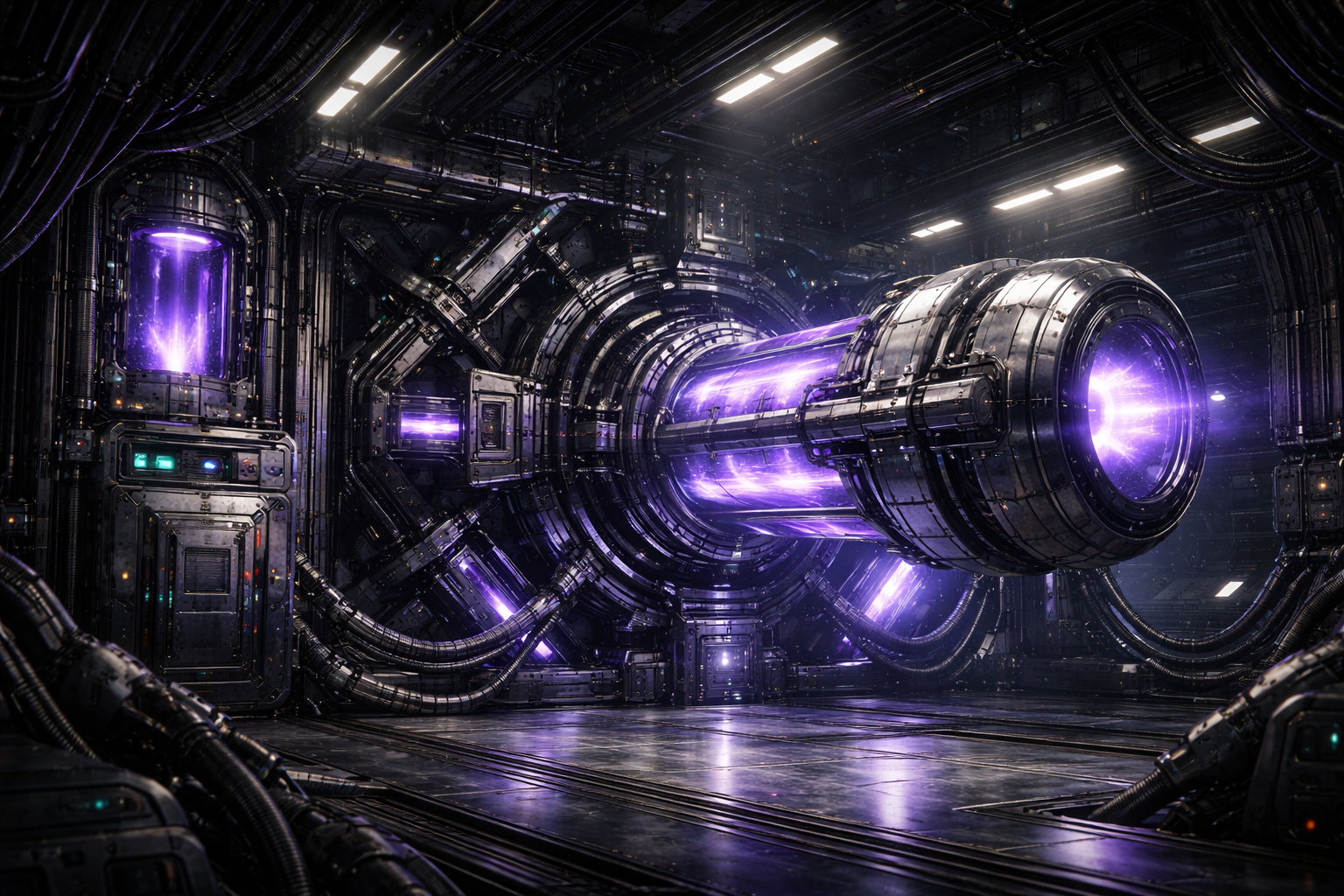
Warp Drives
Warp Drives are large-scale spacetime translation engines designed for interstellar travel rather than maneuvering, operating on principles that deliberately exploit stellar gravity rather than overcoming it. They are powered by a dense plutonium-based slurry, suspended in a stabilized, high-energy plasma state that appears deep violet or purple when active. This fuel is not naturally occurring in usable form; instead, it is produced by a dedicated, mono-purpose pixel printer integrated into the drive system itself. Unlike general fabrication units, this printer is narrowly optimized to refine raw matter into the precise isotopic mix and lattice state required for warp initiation, recycling waste heat and byproducts back into the fuel cycle to minimize loss.
A warp drive does not “move” a ship through space in the conventional sense. Instead, it establishes a controlled spacetime gradient anchored between multiple stellar masses, using their combined gravity wells as fixed reference points. For short interstellar jumps, this requires at least two stars: the departure star to initiate the distortion and a destination star to collapse it. For longer journeys, ships plot multi-star warp chains, routing through distant gravity wells in a single continuous translation. Rather than performing discrete jumps, the drive rides a carefully calculated sequence of gravitational assists, bleeding momentum and energy across the chain before releasing the ship into stable orbit around the final system’s primary star.
Because of the immense energies involved in creating and collapsing these spacetime gradients, warp drives are fundamentally incapable of short-range travel. They cannot initiate or terminate within planetary space, nor can they drop a vessel anywhere except into orbit around the largest mass in a system—almost always the primary star. Attempting to start or stop a warp outside of a stellar gravity well would require prohibitive energy and would almost certainly destroy both the drive and the ship. As a result, warp-capable vessels rely on conventional propulsion for all in-system travel, treating warp as a strategic, system-to-system capability rather than a tactical one.
In practice, this makes warp drives extraordinarily powerful but inflexible tools. They excel at crossing vast distances nearly instantaneously when conditions are met, yet demand careful planning, specialized infrastructure, and substantial fuel investment. Their dependence on stellar geometry and mass means that navigation is as much astrophysics as piloting, and that control over star systems—rather than space itself—defines the true reach of warp-capable civilizations.
Mechanically speaking these are basically 5 point fueled teleport gadgets for ships. In most galaxies any star to any star is functionally the same jump. Exceptions are only for particularly large gaps across empty space or when there is a choke point of unstable space the ship cannot navigate through.