
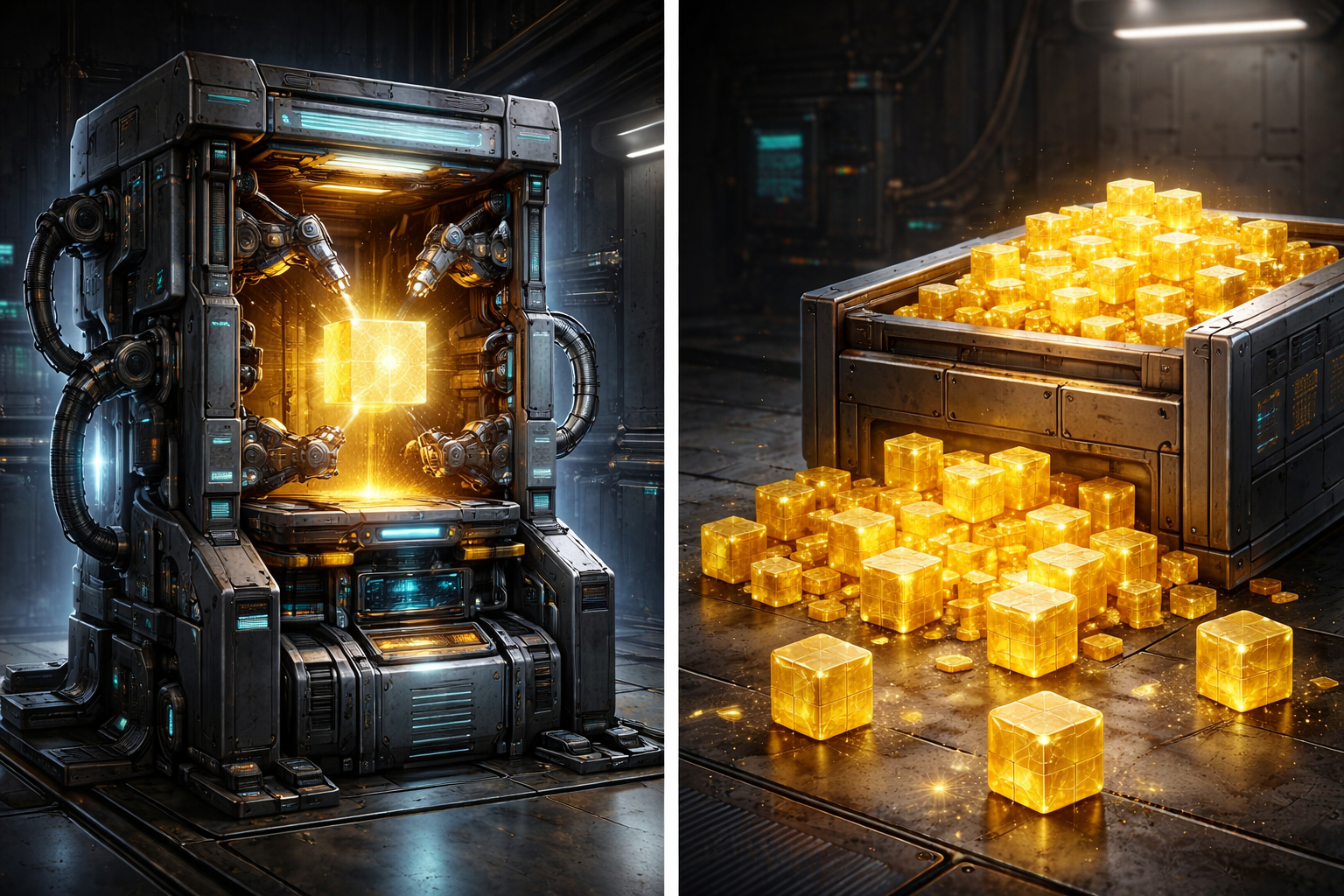
Pixel Printers
Pixel Printers are advanced fabrication systems. They function as self-contained manufacturing engines capable of converting most forms of raw matter into standardized energy–matter units known as pixels, which are then reassembled into finished objects. While often treated as simple “printing” devices, pixel printers are in fact adaptive construction systems, designed to interpret incomplete or imperfect schematics and resolve gaps through embedded heuristics, material modeling, and structural inference.
A defining feature of pixel printers is their ability to improvise during fabrication. When presented with partial plans, degraded data, or conflicting inputs, the printer can substitute materials, reinforce weak structures, or alter construction sequences to produce a viable result. This makes them uniquely suited for frontier and post-collapse environments, where perfect specifications are rare. The printer does not invent new designs, but it can competently finish a design that a skilled engineer has only outlined, embedding centuries of accumulated manufacturing knowledge directly into the process.
In practical terms, pixel printers serve as a bridge between advanced intent and limited local capability. They are widely used for producing tools, machinery, vehicles, and infrastructure components that would otherwise require large industrial bases and specialized labor. Their capacity to break down salvage, ore, and even complex manufactured goods into reusable pixels allows them to function as both fabricator and recycler.
Mechanically Pixel Printers are a 4 point gadget, making them expensive but still moderately upgradable.