
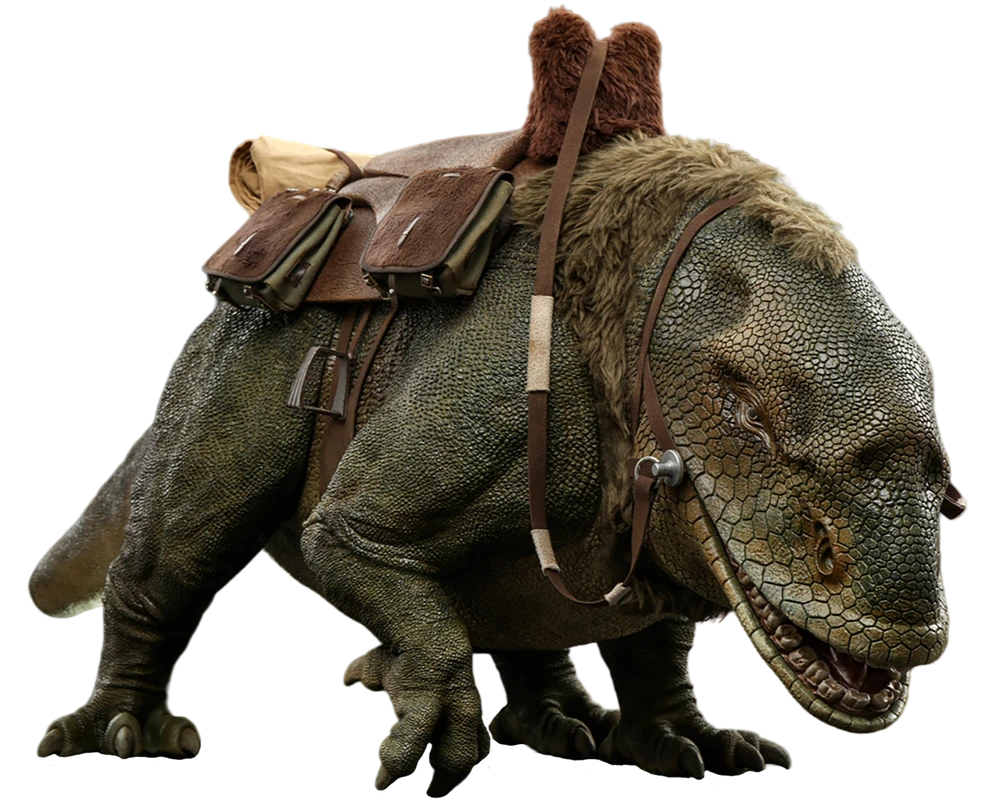
Dewback
Fauna: Reptilian: Squamata
Dewbacks were thick-skinned reptiles native to the desert planet of Tatooine, where they were used as beasts of burden, as well as mounts for specialized sandtroopers known as Dewback troopers. Dewbacks were capable of speeds as fast as 50 kilometers per hour for short periods of time—a speed at which a sandcrawler could be overtaken.
Basic Information
Genetics and Reproduction
- Once every year, dewbacks would cover the sands of Tatooine as they converged on the Jundland Wastes, which served as their traditional mating grounds. The Jundland Wastes served this role for both dewbacks and krayt dragons for one very important reason: The sands of the wastes were the ideal temperature for the incubation of eggs year-round. The dewback mating season would begin just after the krayt dragon mating season ended, thus ensuring that fewer of their own eggs would be destroyed.
- After arriving at the Jundland Wastes, male dewbacks would attract the attention of females by rolling on their backs and displaying their bellies, which would change to a color resembling that of a clear, blue Tatooine sky. Some time after mating, female dewbacks would dig holes in the sands of the wastes and begin to lay a large number of eggs. Once the laying of the eggs was finished the dewbacks would once again disperse into the deserts of Tatooine to return the next year.
- Dewbacks couldn't successfully mate if they were transplanted to a world where they could't replicate this ritual.
Growth Rate & Stages
Once the eggs hatched half a year after being laid, the young dewbacks would set out on their own with no parents to guide them.
Ecology and Habitats
| Optimal Habitat | Desert |
Dietary Needs and Habits
| Omnivore |
- Female dewbacks laid fifty to eighty-five eggs each standard year.
Biological Cycle
- During the hours between First Twilight and dawn, as temperatures dropped, the dewbacks would become sluggish because they were cold-blooded. To retain warm and conserve energy, the dewbacks huddled together.
Behaviour
- Rugged reptilian lizards native to the deserts of Tatooine, dewbacks were able to withstand the heat of the world's binary suns, as well as the dust that caused mechanical breakdowns in high-tech conveyances.
- They commonly made strange, lowing noises, similar to that of a bantha.
- While they had a reputation for being solitary animals, wild dewbacks were also known to roam the seemingly endless deserts of Tatooine in single-file packs of two to five, searching for food and moisture during the day.
- The omnivorous reptiles would spend their days digging through sand dunes with their large teeth and sharp talons for grasses, underground tubers, desert sages, scurriers, and baby womp rats.
Additional Information
Social Structure
| Social Group | Pack |
Domestication
| Domesticated |
| Wild |
- Dewbacks were considered relatively easy to domesticate.
- It was particularly easy if the animal was raised from the egg.
- An important part of being a good dewback owner was freeing the animal during mating season. Their mating ritual is so hardwired in the dewbacks that attempting to restrain it poses risks to the animal and to others. Although there was some chance that the dewback didn't return, they typically did, and most would consider losing the dewback easier than fixing the destruction caused during an escape attempt.
Uses, Products & Exploitation
- Used as mounts and for transporting goods because of their strenght and hardiness.
- Dewbacks were used on Tatooine by moisture farmers, local security forces, off-world military, travelers, scientists, and more.
- Locals often preferred dewbacks to banthas because the latter was prone to getting spooked by sandstorms. Of course, the major drawback of the dewbacks was that as the local temperature decreased at night time, the reptiles became sluggish.
- An owner might turn his long time dewback companion into a bag or boots upon its death, which was seen as honoring the animal with utility even after its death.
- The two subspecies that can't be domesticated were used as a resource in addition to retired domesticated dewbacks. Dewback ribs were a popular foodstuff in Mos Eisley and dewback hides were used to make clothing, accessories and tents.
- Some folks set up farms where they bred domesticated dewbacks to be used in food and clothing production, but this wasn't terribly common due to the connection many people had with the animal. These products were typically targeted at travelers who didn't have such a connection.
Geographic Origin and Distribution
Dewbacks can be found on other worlds, but the population on their native world is by far the largest.
Civilization and Culture
Culture and Cultural Heritage
- The combination of the dewbacks' capability and versatility made them highly respected across Tatooine. The appreciation that the people of Tatooine far and wide have for dewbacks has made them an integral element in the planet's collective culture.
History
The species got its name because of their habit of licking the morning dew from their backs with their flicking tongues.
| Homeworld | Tatooine |
Average Height
6' 7"
==========
Average Weight
1800 lbs
==========
Average Length
8' 2"
==========
Average Physique
- They had thick hides of scaly green skin, with long, rounded heads and short tails.
- They plodded through the desert sands on four clawed feet, and while capable of brief bursts of speed, typically became lethargic at night and in colder climates.
Body Tint, Colouring and Marking
| Skin color |
|
- Green was by far the most common color for dewbacks.
| Subspecies |
|
- Lesser dewback → The most common of the subspecies, they were known for their relatively gentle nature and were the most easily domesticated of all the subspecies.
- Mountain dewback → Much like lesser dewbacks, mountain dewbacks possessed a calm disposition and could be domesticated. However, unlike the lesser dewbacks, the mountain dewback preferred to wander the more mountainous regions of Tatooine. Hence the name.
- Grizzled dewback → The largest known subspecies of dewback and were further distinguished from their smaller cousins by their patchy hides. Because of what appeared to be an insatiable appetite, they were considered to be dangerous to the other inhabitants of Tatooine. They could often be found stalking the Jundland Wastes in search of prey.
- Cannibal dewback → Falling between lesser dewbacks and grizzled dewbacks in terms of size, they were considered to be extremely aggressive and impossible to domesticate. They were notorious for eating newly hatched dewbacks—a behavior that gained them their name. The deaths of many settlers could be attributed to the fact that there were few differences in the coloration of the hides of lesser dewbacks and cannibal dewbacks.