
High Draconic
Natively known as: yet'ath /ˈjetath/
...and he stood holding his hat and turned his wet face to the wind...
t͡si go tyat vi go et͡s dzigsh t͡si shunyzany tshit vi go dfany go izvonsh
Pronunciation: /t͡si go tjat vi go et͡s dzigʃ t͡si ˈʃuɲzaɲ tʃit vi go dfaɲ go ˈizvonʃ/
Yet'athi word order: and he his hat holding stood and his wet face the wind to turned
t͡si go tyat vi go et͡s dzigsh t͡si shunyzany tshit vi go dfany go izvonsh
Pronunciation: /t͡si go tjat vi go et͡s dzigʃ t͡si ˈʃuɲzaɲ tʃit vi go dfaɲ go ˈizvonʃ/
Yet'athi word order: and he his hat holding stood and his wet face the wind to turned
Writing System
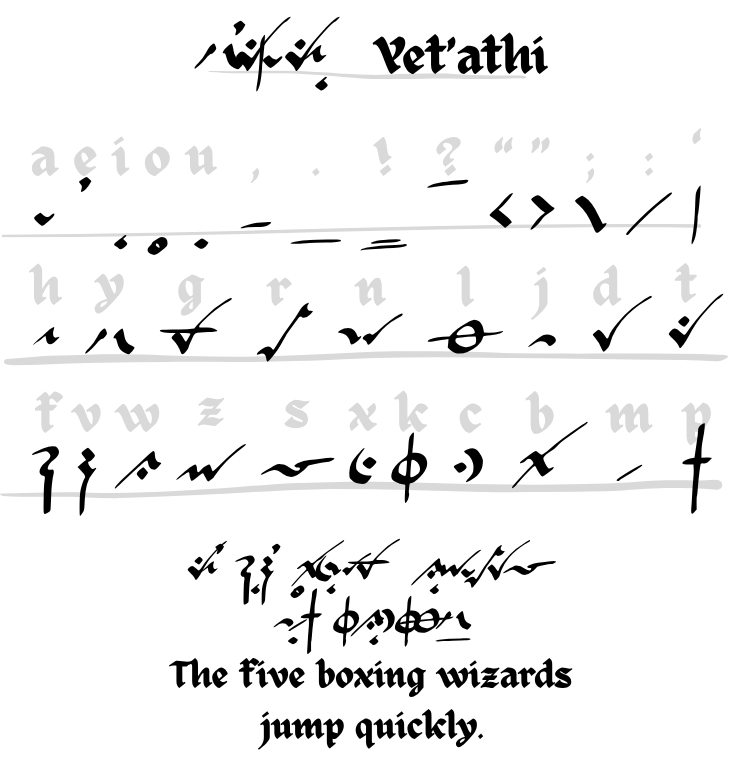
Yetathi script is learned by all Shulte in childhood, though most forget it quickly. Academics devote their lives to unearthing the history of the ancient script. It is widely believed though that the symbols for 'b,' 'm,' and 'p' were added at a much later date to accomidate loan-words from Shulte language. This is the most common version of the script taught to children today:
Phonology
Consonant inventory: d d͡z f g j k kʼ l n s sʼ t tʼ t͡s t͡ʃ v z ħ ɲ ʃ ʒ θ
Vowel inventory: a e i o u
| ↓Manner/Place→ | Labiodental | Dental | Alveolar | Palato-alveolar | Palatal | Velar | Pharyngeal |
|---|---|---|---|---|---|---|---|
| Nasal | n | ɲ | |||||
| Stop | tʼ t d | kʼ k g | |||||
| Fricative | f v | θ | s sʼ z | ʃ ʒ | ħ | ||
| Approximant | j | ||||||
| Lateral approximant | l |
| Front | Back | |
|---|---|---|
| High | i | u |
| High-mid | e | o |
| Low | a |
Morphology
Adjective → adverb = Prefix e-
Adjective → noun (the quality of being [adj]) = Prefix a-
Adjective → verb (to make something [adj]) = Prefix i-
Noun → adjective (having the quality of [noun]) = If starts with vowel: Prefix kn-
Else: Prefix kna-
Noun → adjective relating to noun (e.g. economy → economic) = If starts with vowel: Prefix adn-
Else: Prefix adne-
Noun to verb = If starts with vowel: Prefix θ-
Else: Prefix θu-
Verb → adjective (result of doing [verb]) = Prefix ɲe-
Tending to = If starts with vowel: Prefix ans-
Else: Prefix ansa-
Verb → noun (the act of [verb]) = If starts with vowel: Prefix j-
Else: Prefix je-
Verb → noun that verb produces (e.g. know → knowledge) = If starts with vowel: Prefix otz-
Else: Prefix otzu-
One who [verb]s (e.g. paint → painter) = Prefix fle-
Place of (e.g. wine → winery) = Prefix i-
Diminutive = If starts with vowel: Prefix θ-
Else: Prefix θi-
Augmentative = If starts with vowel: Prefix dl-
Else: Prefix dli-
Opposite = If starts with vowel: Prefix d͡z-
Else: Prefix d͡za-
Adjective → noun (the quality of being [adj]) = Prefix a-
Adjective → verb (to make something [adj]) = Prefix i-
Noun → adjective (having the quality of [noun]) = If starts with vowel: Prefix kn-
Else: Prefix kna-
Noun → adjective relating to noun (e.g. economy → economic) = If starts with vowel: Prefix adn-
Else: Prefix adne-
Noun to verb = If starts with vowel: Prefix θ-
Else: Prefix θu-
Verb → adjective (result of doing [verb]) = Prefix ɲe-
Tending to = If starts with vowel: Prefix ans-
Else: Prefix ansa-
Verb → noun (the act of [verb]) = If starts with vowel: Prefix j-
Else: Prefix je-
Verb → noun that verb produces (e.g. know → knowledge) = If starts with vowel: Prefix otz-
Else: Prefix otzu-
One who [verb]s (e.g. paint → painter) = Prefix fle-
Place of (e.g. wine → winery) = Prefix i-
Diminutive = If starts with vowel: Prefix θ-
Else: Prefix θi-
Augmentative = If starts with vowel: Prefix dl-
Else: Prefix dli-
Opposite = If starts with vowel: Prefix d͡z-
Else: Prefix d͡za-
Syntax
| Singular | No affix
vago /ˈvago/ dog |
| Plural | Prefix fe-
fevago /ˈfevago/ dogs |
| Dual | Prefix ve-
vevago /ˈvevago/ two dogs |
Vocabulary
Neuter
| Singular | Plural | Dual | |
|---|---|---|---|
| 1st person | ra /ra/
I (neut), me (neut), mine (neut) |
far /far/
we (neut), us (neut), ours (neut) |
var /var/
I (neut), me (neut), mine (neut), we (neut), us (neut), ours (neut) |
| 2nd person | ar /ar/
you (neut), yours (neut) |
araf /ˈaraf/
you (neut) all |
arav /ˈarav/
you (neut), you all (neut), yours (neut) |
| 3nd person | tʼo /tʼo/
it (neut), its (neut) |
t'olf /t'olf/
they (neut), them (neut), theirs (neut) |
t'olv /t'olv/
it (neut), its (neut), they (neut), them (neut), theirs (neut) |
Masculine
| Singular | Plural | Dual | |
|---|---|---|---|
| 1st person | ra /ra/
I (masc), me (masc), mine (masc) |
far /far/
we (masc), us (masc), ours (masc) |
var /var/
I (masc), me (masc), mine (masc), we (masc), us (masc), ours (masc) |
| 2nd person | ar /ar/
you (masc), yours (masc) |
araf /ˈaraf/ you (masc) all | arav /ˈarav/
you (masc), you all (masc), yours (masc) |
| 3rd person | go /go/
he, him, his, it (masc), its (masc) |
gof /gof/
they (masc), them (masc), theirs (masc) |
gov /gov/
he, him, his, it (masc), its (masc), they (masc), them (masc), theirs (masc) |
Feminine
| Singular | Plural | Dual | |
|---|---|---|---|
| 1st person | ra /ra/
I (fem), me (fem), mine (fem) |
far /far/
we (fem), us (fem), ours (fem) |
var /var/
I (fem), me (fem), mine (fem), we (fem), us (fem), ours (fem) |
| 2nd person | ar /ar/
you (fem), yours (fem) |
araf /ˈaraf/
you (fem) all |
arav /ˈarav/
you (fem), you all (fem), yours (fem) |
| 3rd person | ko /ko/
she, her, hers, it (fem), its (fem) |
kolf /kolf/
they (fem), them (fem), theirs (fem) |
kolv /kolv/
she, her, hers, it (fem), its (fem), they (fem), them (fem), theirs (fem) |
Numbers
Yet'athi has a base-12 number system:
1 - nye
2 - klo
3 - dze
2 - klo
4 - tʼut
5 - thos
6 - kni
6 - kni
7 - kʼat͡sh
8 - ti
8 - ti
9 - tyeyk
χ - lui
χ - lui
ε - ru
10 - kʼog
100 - dzhafs
10 - kʼog
1000 - sʼek
Phonetics
| Pronunciation | Spelling |
|---|---|
| θ | th |
| ʒ | zh |
| j | y |
| ʃ | sh |
| t͡ʃ | ch |
| d͡z | dz |
| ħ | h |
| ɲ | ny |
Sentence Structure
Main word order: Subject Object (Prepositional phrase) Verb. “Mary opened the door with a key” turns into Mary the door with a key opened.
Adjective Order
Adjective order: Adjectives are positioned before the noun.
Dictionary
All lore is from an "in character" perspective.

Comments