
Runecarving
I'm treating this page like enchanting; I'm only adding in runes that are new or changed. Some rules on placing runes have changed from the Kibbles version.
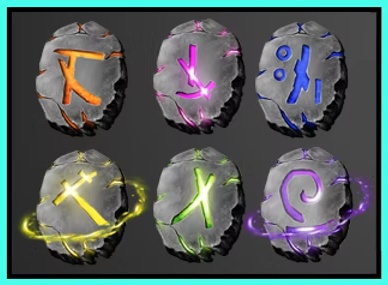
Runecarving is the art of marking special magical enhancements in the form of magical runes. These are symbolic representations that channel and focus power to confer a special magical effect to the item they are marked on.
When you place an rune on an item armor, or weapon, that object requires attunement. When a creature is attuned to it, the rune grants the wielder certain benefits as defined by the rune. An item becomes a magical item of the rarity of the rune placed on it when a rune is placed on it.
When you place a rune in a location, the rune only grants benefits to an area if that rune has location-specific properties. When this is true, the rune description outlines the distance and area the rune can affect. Location runes cannot overlap, and placing more than one in close proximity to one another will cause the runes to fail. The rune's description also details how far a new rune must be in order to avoid this.
The added difficulty for these rune craftings is shown on the table below, based on the highest rarity between the two adjacent runes. For every additional adjacent rune you attempt to add past 2, the difficulty also increases by +5.
Out of game, this is for balance. Placing runes in locations was never a part of the Kibbles ruleset, and the original ruleset has almost all runes require attunement (the only exceptions are the ones that let you cast a cantrip). So, having just one in effect without requiring attunement is already an increase in power. Having multiple potentially means you can have massive areas affected by stacking buffs that were never intended to even exist. So some limits are going to be required for this to work.
A complicated looking Rune composed of harsh angles.
You have learned how to apply your runes to creatures in the form of magical branding or arcane tattoos (your choice). Only runes that can be applied to weapons, armor, or items can be applied to creatures. When branded in this way, the creature or any weapon they wield benefit from the rune's magical properties. A branded creature no longer needs to attune to the rune for it's properties to apply. A creature can only be branded in this way once, but a brand can be overwritten by applying a new one.
You choose which expression of the rune is utilized when you carve the rune if multiple are applicable, but you can only choose one expression. For example, if the same rune would give a weapon bonus to damage rolls, but would give a piece of armor a damage resistance, you must choose which of the two passive boons is given to the creature.
Runecarving is the art of marking special magical enhancements in the form of magical runes. These are symbolic representations that channel and focus power to confer a special magical effect to the item they are marked on.
Related Tool & Ability Score
Rune carving comes in two different traditions; you can mark runes from either tradition, but they require different tool proficiency and ability modifiers.Ancient Tradition
The runes of the Giants, Dwarves, and other ancient traditions. Your ability modifier for this tradition is Wisdom, and you can select your related tool from Mason’s Tools or Painter’s Supplies.Academic Tradition
The runes of mages, scholars, and elves, these traditions are not necessarily any less ancient, but runecarvers of these traditions seek new knowledge and expression, rather than being rooted in the old ways. Your ability modifier for this tradition is Intelligence, and you can select your related tool from Calligrapher’s Supplies or Woodcarver’s Tools.Runecarving Saving Throw
Some runes require a saving throw, the following is the formula for calculating the saving throw. The saving throw is calculated at the time of creation based on the creators attributes and proficiency, and doesn’t change once it is created. A saving throw doesn’t include any expertise or other bonuses a crafter has to the crafting roll.- Rune DC = 8 + your related tool proficiency bonus + your Wisdom or Intelligence modifier (based on your Tradition).
- Rune Attack Roll Modifier = your related tool proficiency bonus + your Wisdom or Intelligence modifier (based on Tradition).
Materials
Runecarving uses primarily magical ink and essences to imbue their runes with the prerequisite magical properties. Crafting Roll:- Ancient Tradition Runecarver Modifier = your Mason’s Tools or Painter’s Supplies (your choice) proficiency bonus + your Wisdom modifier
- Academic Tradition Runecarver Modifier = your Calligrapher’s Supplies or Woodcarver’s Tools (your choice) proficiency bonus + your Intelligence modifier
Placing a Rune
You can place a rune a weapon, a set of armor, an item, or in a location.When you place an rune on an item armor, or weapon, that object requires attunement. When a creature is attuned to it, the rune grants the wielder certain benefits as defined by the rune. An item becomes a magical item of the rarity of the rune placed on it when a rune is placed on it.
When you place a rune in a location, the rune only grants benefits to an area if that rune has location-specific properties. When this is true, the rune description outlines the distance and area the rune can affect. Location runes cannot overlap, and placing more than one in close proximity to one another will cause the runes to fail. The rune's description also details how far a new rune must be in order to avoid this.
Adjacent Location Runes
Placing a location rune near another location rune is difficult. These fields of magic interfere with one another, causing their effects to change or amplify in ways that the physical rune is no longer equipped to support, thus these runes fail. It is possible to modify a new rune to dampen this effect, allowing both runes to exist near one another, but it is very difficult.The added difficulty for these rune craftings is shown on the table below, based on the highest rarity between the two adjacent runes. For every additional adjacent rune you attempt to add past 2, the difficulty also increases by +5.
Out of game, this is for balance. Placing runes in locations was never a part of the Kibbles ruleset, and the original ruleset has almost all runes require attunement (the only exceptions are the ones that let you cast a cantrip). So, having just one in effect without requiring attunement is already an increase in power. Having multiple potentially means you can have massive areas affected by stacking buffs that were never intended to even exist. So some limits are going to be required for this to work.
Adjacent Location Rune Modifier
| Rarity | Added Difficulty |
|---|---|
| Common | +5 |
| Uncommon | +7 |
| Rare | +10 |
| Very Rare | +14 |
| Legendary | +20 |
Runes on Magical Items
Placing a rune on a magical item is exceedingly difficult. Magical items resist modification, and their magic interferes with the rune. It can be done with additional difficult as per the table below. If the item has attunement, the rune still requires separate attunement.Item Rarity Rune Difficulty Modifier
| Rarity | Added Difficulty |
|---|---|
| Common | +5 |
| Uncommon | +7 |
| Rare | +10 |
| Very Rare | +14 |
| Legendary | +20 |
Removing a Rune
You can remove the magic stored in a rune by the same process you might salvage essence out of a magic item. A rune returns one essence equal to its rarity when harvested. The process takes 2 hours to complete, and doesn’t work if the rune is currently attuned to any creature. An essence can only be salvaged from fully powered runes; if a rune has been used recently and is recharging it's active feature, it cannot be salvaged. It can still be removed, but you will not gain any essences this way.Rune Tables
Academic Tradition
| Name | Materials | Crafting Time | Crafting Checks | Difficulty | Rarity | Value |
|---|---|---|---|---|---|---|
| Privacy | 1 scroll of Non-detection (Item only), 1 scroll of Mordenkainen's Private Sanctum (Location only), 1 scroll of Mind Blank (Item only), 1 scroll of Guards and Wards (Location only), 1 very rare divine essence, 2 rare arcane essences, 1 very rare magical ink | 16 hours (2 days) | 8 | DC 18 | Very Rare | 15,000 GP |
Privacy
Academic Rune, Very RareA complicated looking Rune composed of harsh angles.
- Passive Effect (Item). When marked on an item, the item is permanently under the effect of the Non-Detection spell. The spell level is determined by the carver's own level when the rune is created, equaling 1/2 the player's level rounded down. If a Dispel Magic spell is cast targeting the rune or the item bearing the rune, this effect is suppressed for 1 hour.
- Passive Effect (Location). When marked on a location, a 100 ft. by 100 ft. by 100 ft. cube centered on the rune is permanently under the effect of the Mordenkainen's Private Sanctum spell. You choose the specifications of the spell upon first placing the rune. If a Dispel Magic spell is cast targeting the rune or the item bearing the rune, this effect is suppressed for 1 hour; the spell level for this is determined by the carver's own level when the rune is created, equaling 1/2 the player's level rounded down. This rune must be 1 mile away from any other locational runes, otherwise they are considered adjacent.
- Active Effect (Item). While attuned to an item with this rune, you can use that item to cast Mind Blank on yourself without expending a spell slot. This spell only lasts for 10 minutes. Once the rune’s power is used, the rune’s active can’t be used again until the next dawn.
- Active Effect (Location). Upon placing this rune, the carver designates a command word and a password. When a creature touches this rune and speaks the command word, they may use the rune to cast the spell Guards and Wards without expending a spell slot, filling the space of the rune's area of effect. This spell lasts for 1 hour. Once rune’s power is used, the rune’s active can’t be used again until the next dawn.
Additional Runecarving Content
Skincarver
Feat, Prerequisite: Proficiency in a runecarving toolYou have learned how to apply your runes to creatures in the form of magical branding or arcane tattoos (your choice). Only runes that can be applied to weapons, armor, or items can be applied to creatures. When branded in this way, the creature or any weapon they wield benefit from the rune's magical properties. A branded creature no longer needs to attune to the rune for it's properties to apply. A creature can only be branded in this way once, but a brand can be overwritten by applying a new one.
You choose which expression of the rune is utilized when you carve the rune if multiple are applicable, but you can only choose one expression. For example, if the same rune would give a weapon bonus to damage rolls, but would give a piece of armor a damage resistance, you must choose which of the two passive boons is given to the creature.

Comments