
Thief OCC
Thief O.C.C.
Thieves (and assassins) are the rogues and cutthroats of the men of arms O.C.C.s.
They, unlike most of the other O.C.C.s, are skilled in stealth, subterfuge, trickery and robbery. The worst of the lot will use bushwhacking tactics, poisons, and torture. These thugs are involved in all kinds of skulduggery, and may slit their victim's throat or betray a comrade in a heartbeat.
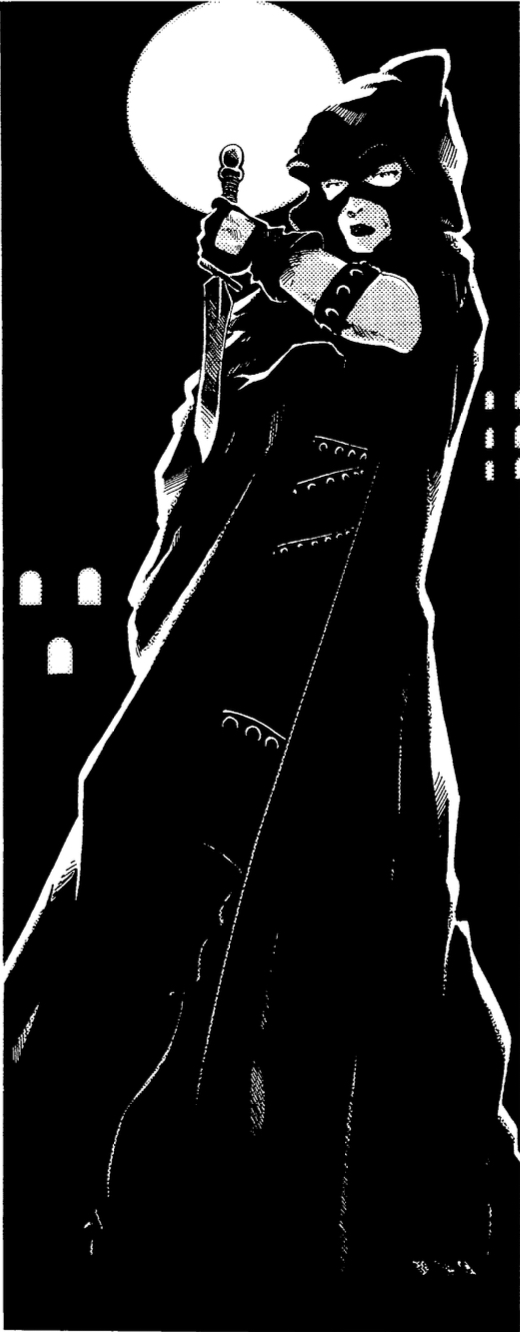
These miscreant brigands are usually considered bandits who engage in blackmail, mugging, rape, kidnapping, and murder. However, the typical thief is not a murderer or bully. Most are skilled in the arts of picking pockets, picking locks and finding secret compartments in order to steal valuables.
Some are simple robbers and fighters, some are masters of disguise and stealth, and others are cat-burglars skilled in climbing, stealth/prowl and acrobatics.
Still others have a diverse range of talents that may include forgery, escape artistry, and spying (intelligence gathering; a stool-pigeon or blackmailer). Those with a high M.A. and/or P.B. and a good to high intelligence may become conmen who use cunning, charm, finesse and sweet-talk to get them in positions to deceive, swindle and steal from their victims; not to mention to talk themselves out of trouble.
The thief in all his various incarnations is a criminal and typically treacherous and self-serving, but not quite the scum at the bottom of the barrel. Although it is said that "there is no honor among thieves," this really depends on the individual. Many selfish and cunningly evil thieves recognize the fact that they need "friends" and "accomplices." Consequently, they will not betray a friend, ally or associate, unless they feel they have no other recourse. With the possible exception of the unprincipled and aberrant thief, most of these selfish characters will "sell-out" their own mother when push comes to shove, or if the reward is great enough. Furthermore, while a loyal thief may stand and fight with his friends, and never consider stealing from them (it's bad business to steal from a friend or associate), many thieves won't think twice about holding out on them or skimming a little extra off the top - "What they don't know, won't hurt them," is a common motto of the thief.
In combat the thief tends to be a quick, dirty fighter, striking fast and below the belt. Most are concerned with making a quick escape rather than beating their opponent, although the strongest and most agile (high P.P.) may enjoy combat as much as any warrior. Many thieves are particularly adept at moving silently (prowl) to avoid confrontations and to skulk in the shadows, waiting for the right moment to strike. When they do attack a victim for the purpose of robbery, or even a foe in combat, most prefer to attack from behind or use the element of surprise to gain the upper hand. To this end, the clever thief will often have a diversion planned, whether it is a fire in the pantry, flash powder, smoke bombs, starting a brawl, or a partner causing a commotion away from the thief' s objective or opponent.
Thieves' Guilds
Many of the larger towns and cities will have one or more active thieves' guilds.
These guild organizations might be considered organized crime. It is the thieves' guild that handles a large majority of (if not all) smuggling and black market sales of exotic items (drugs, poisons, etc.) and contraband; items illegal in the community.
The guild also typically serves as a fence, buying and selling stolen goods and generally dominates the local underworld. Many guilds also own, operate or get a percentage of (or allow to operate in) such establishments as seedy and corrupt taverns, pawnshops, gambling houses, drug dens, houses of prostitution and other places of ill repute.
Many guilds are located in the seamy and poor sections of a community where the authorities are likely to have less of a presence (in some cases, none) and corruption and desperateness work to their advantage. Some are little more than a gang of thieves and bullies or petty criminals. Others are powerful and very organized criminal businesses. Some even grow to become powerful political and/or economic forces, with guild members established among the heads of government, and/or the police, and commerce, particularly the operations of saloons, gambling houses, and houses of ill repute.
Most guilds have a secret code, symbol, colors, word combination, etc., that identifies its members. Usually it is a combination of words and symbols. The dragon crest guild, for example, has a small tattoo of a crimson dragon placed on the left shoulder of its members, others use brands, scarring, color codes, clothes, etc.
Non-Members in Guild Territory
Thieves' guilds, even smallish ones, are not to be trifled with unless one does not mind waking up one night with a knife between his ribs. It is wise to either avoid antagonizing a thieves' guild or be prepared for gangland style retribution. Likewise, thieves' guilds are very territorial and do not appreciate non-guild members muscling in on their territory.
Characters involved in thieving, fencing, smuggling, assassination, spying, or other criminal operations in guild "territory" are likely to have one or all of the following happen to him. These things apply only to thieves and criminals active in guild territory (whose activities undermine the guild's profits and interferes with business). Those who are just passing through or vacationing have nothing to worry about.
1. It is suggested that the non-member should join the guild, or leave town immediately.
2. The guild demands a share, of the profit from non-members ' activities; a very large share, typically -50% to 75%. If the character refuses and does not leave town immediately, he is likely to be threatened, beaten, and all of his valuables taken.
3. Activities spied upon.
4. Continual pressure for the interloper to leave town or join the guild. Pressure includes long talks, threats, brawls, mugging, robbery, blackmail, trouble with the law, getting tarred and feathered, getting cheated, being accused of wrongdoings, and all kinds of trouble. If the interloper openly defies the guild or causes trouble for them, the interloper will be framed for a serious crime or attempts will be made on his life. Thieves' Guilds do not tolerate interlopers.
Non-members, including streetwise adventurers or those who have friends with connections to the guild, and thieves who aren't actively competing with the guild can buy or use any of the many services a guild may offer. This usually includes fencing (selling) stolen items, trading or purchasing stolen goods, acquiring poisons or drugs, and purchasing or exchanging information.
Some guilds (not all) may also offer forged documents or can put the inquiring person in touch with a forger and other specialists looking for work. Note that many guilds are extremely secretive and cautious, so many will not associate or cooperate with strangers or non-members. In such cases, the guild members plead ignorance to any knowledge of criminal activity and send the inquiring person away.
Remember, these are predominantly evil, dishonest people who make their living cheating, lying, and stealing from others. If they think they can get away with it, they won't hesitate attacking a stranger or non-member. Foolish adventurers and non-member thieves from out of town are among their favorite targets.
Membership in a Thieves' Guild
Joining the thieves' guild is a fairly simple thing. The newcomer needs to find a member who will sponsor him. This is easy for family members and friends of thieves because they are known to their sponsor, and probably a handful of other guild members. On some occasions, an independent or promising young thief will be approached by the guild and asked to join (or leave their turf).
Finding a sponsor can be very difficult for newcomers to the area, because nobody knows him or her, so there is no sense of camaraderie or trust among the thieves. It is not unusual for an unscrupulous rogue to claim to represent the guild, ask for a small sponsor's fee, proclaim the newcomer a guild member, and he goes out drinking while the stranger gets into trouble when he crosses the guild and discovers he has no membership. Even real guild members may lie and trick a newcomer.
Once sponsored, the new member must turn over 50% of his first big take (very often an assignment imposed by the guild to prove one's merit). After that, as a member, 20% of all future income is turned over to the guild master.
The advantages of joining a guild, besides avoiding beatings and trouble, is having access to the guild's knowledge and talent pools. A clever thief can always trick some ignorant or drunken fellow member into revealing information. Also, friendly members may volunteer information and offer warnings, advice and assistance, for a cut of the spoils. Best of all, guild members can sell or trade stolen goods to the guild without having to worry about finding a fence and purchase guild services for 25% less than the normal street price. Sometimes an even better bargain can be struck, reducing the fee by as much as 50%.
Thieves & Armor
Thieves are all men of arms who know how to fight and can wear any type of armor. Most tend to prefer light leather armor because it offers excellent maneuverability, stealth (no jingling or clunking of metal parts) and comes in dark brown, grey, and black colors, ideal for night work and remaining inconspicuous.
Studded leather is the favorite of most thieves, although some will wear heavier armor if they know they are going into a combat situation. Characters are -15% to prowl and - 20% to climb/scale walls in full splint or plate armor. -10% to prowl or climb in chain or scale mail, and -5% to prowl or climb in studded leather.
Hard and soft leather and padded armor have no penalties.
Thief O.C.C.
Alignment: Thieves are usually anarchist (selfish) or evil alignments (miscreant, aberrant, and diabolic). The nature of thieving (taking things from other people) is such that a thief cannot be a good alignment (principled or scrupulous).
The best (or nicest) possible alignment available to the thief O.C.C. is unprincipled (selfish). In this case, the thief would have some degree of a conscience, so he tries to victimize only evil, greedy, cruel and selfish aligned people (his justification for his questionable actions), and will never steal from friends.
Attribute minimum requirements: P.P. 9 or higher (the higher the better).
--
O.C.C. Skills
- Math: Basic (+10% )
- Pick Locks (+15%)
- Pick Pockets (+15%)
- Languages: Native Tongue at 98% plus two of choice (+10% each)
- Locate Secret Compartments/Doors (+15%)
- Streetwise (+14%)
- W.P. Two of choice
- Hand to Hand: Basic
Hand to hand: basic can be changed to hand to hand: expert for the cost of one "other" skill, or to martial arts or assassin (if evil) for the cost of two "other" skills.
O.C.C. Related Skills
Select two espionage skills (+10% on these two only) and six other skills of choice at level one, plus select one additional skill at levels three, six, nine and twelve. All new skills start at level one proficiency.
- Communications: Any
- Domestic: Any
- Espionage: Any, except Sniper and Track Humanoids.
- Horsemanship: General or Exotic only
- Medical: Brewing and First Aid only.
- Military: None
- Physical: Any, except Gymnastics and Wrestling.
- Rogue: Any (+10%)
- Science: Advanced Math only.
- Scholar/Technical: Any
- Weapon Proficiencies: Any
- Wilderness: None
Secondary Skills
The character also gets to select four secondary skills from the previous list at level one, and two additional skills at levels two, four, eight and twelve. These are additional areas of knowledge that do not get the advantage of the bonus listed in the parentheses. All secondary skills start at the base skill level. Also, skills are limited (any, only, none) as previously indicated in the list.
--
Starting Equipment:
Two sets of clothing, a cape or cloak or jacket (with or without a hood, and with 1D6+1 inside pockets), boots or moccasins, a pair of soft leather gloves, belt, bedroll, purse, backpack, one large sack, one medium-sized sack, three small sacks, a water skin, a set of skeleton keys and lock picking tools, 50 feet (15.2 m) of rope, grappling hook, 1D4+1 wooden or iron spikes, a small hammer, pocket mirror, and a tinder box.
Armor
Starts with soft leather (A.R. 10, S.D.C. 20).
Weapons
A pair of daggers and two additional weapons of choice; all are basic S.D.C. weapons of very good quality. Magic weapons and additional items must be acquired later. Thieves often favor small weapons that are easy to conceal.
Money
The character starts with 250 gold. Additional money will come from stealing and selling stolen goods - a thief will often get a better deal (10% more) trading stolen items for weapons and equipment rather than for cash. Thieves can rarely market their unique skills to the military or other respectable organizations and individuals.