
Mariner
Mariner O.C.C.
As distinguished from the sailor, the mariner is a character who is trained primarily in the technology of seafaring, from navigation to ship design to naval tactics and strategy.
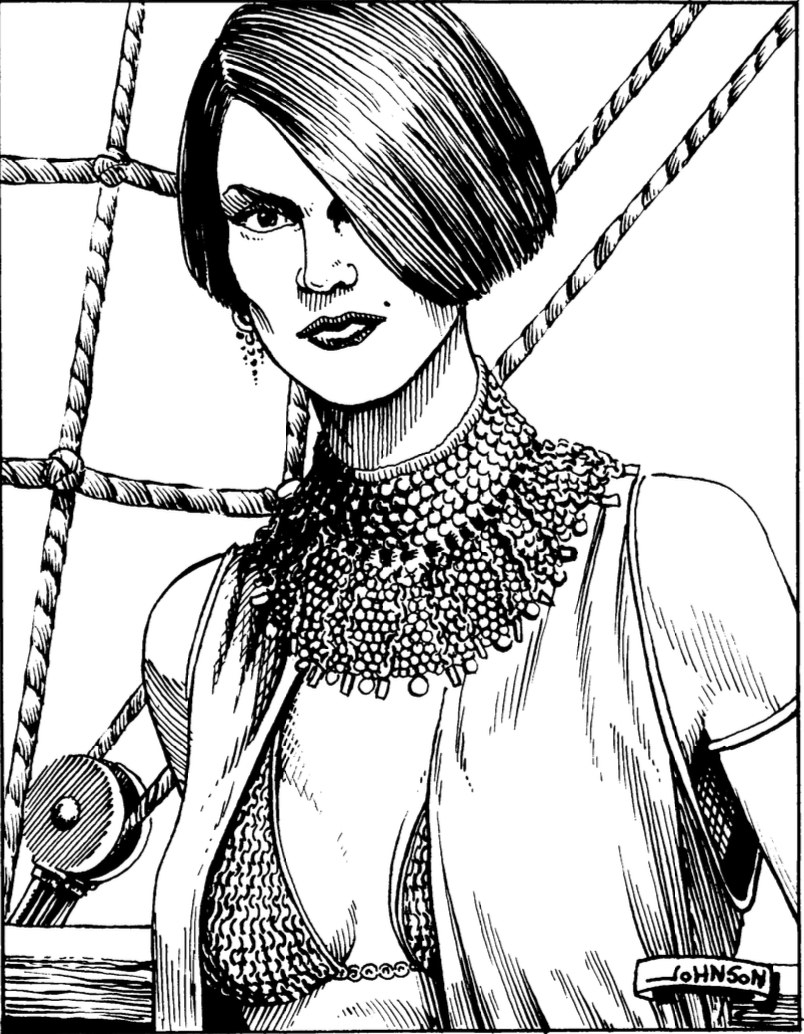
In other words, the mariner is a naval officer, a navigator or a captain, who has what it takes to command a ship, and to steer it safely across the dangerous seas of the Palladium World.
In most places, the training to be a mariner starts when the child enlists as a Cabin Boy, an early apprenticeship that starts when the character is as young as six years old. Alternatively, characters from the Western Empire or Timiro may have been formally educated in a naval academy, and on special training ships.
Starting rank is a matter of chance, since the character should have already spent years at sea prior to becoming part of the campaign.
Here' s an optional roll-up table for the character's latest/highest rank:
01-15 Cabin Boy. Although the character may have spent years at sea, the highest rank ever achieved was that of Cabin Boy. It will be difficult to get any assignment above that of Lieutenant, and many ships will only offer a berth as a common sailor ("so you can get more seasoning, boy ! ").
16-27 Cadet. The character is a recent graduate of a naval school or academy, and has yet to find a position on a ship. Opportunities will be limited, and the character will often be advised to start out by taking a berth as a common sailor. Still, the character probably has a rich or noble family, and could pull strings to get a decent position.
28-40 Ensign. Working for at least a year as a junior officer, the character has the necessary background to sign on next as a Lieutenant on any working ship. The pay won't be great, but promising young officers are usually in high demand.
41-55 Lieutenant. After a solid three years of working as a junior officer, the character has been promoted. It'll be fairly easy to find another slot as a Lieutenant, perhaps even with a better class of ship, but the real road to advancement is finding a position as one of the ship's mates.
56-70 Third Mate. Fourth in command of a ship, anyone having successfully served as a third mate will be considered officer material. The third mate usually works during the same shift as the Captain, so is in a good position to learn a great deal.
71-85 Second Mate. Working as third in command of the ship, the second mate usually ends up taking over at the worst times, when both the captain and the first mate are sound asleep. A good second mate can usually find another berth of the same rank.
86-95 First Mate. The character had the rare good fortune to act as second-in-command of a sailing ship. Getting another position with a rank this high is pretty unlikely, and moving up to captain is very unlikely unless the ship owners are downright desperate or something happens to the Captain.
96-00 Captain. By a twist of fate, the character ended up serving as a ship's commanding officer for at least a couple of months (all the other officers were killed, lost, or debilitated by illness). While the chances of getting another job as captain are pretty remote, prospective employers will be impressed with the character's seasoning and experience.'
--
Alignments: Any
Attribute Minimum Requirements: I.Q. 10, and P.P. 8 or higher.
O.C.C. Bonuses: None
--
O.C.C. Skills
- Astronomy & Navigation (+20%)
- Flag Signalling (+15%)
- Sailing (+15%)
- Seamanship (+15%)
- Rope Works (+5%)
- Swimming (+10%)
- Identify Sea Life (+10% )
- Castaway/Shipwreck Survival (+15%)
- Climb/Scale Walls
- Languages: Native Tongue at 98%, plus one of choice
- Literacy: One language of choice (usually native)
- Mathematics: Basic
- W.P. Blunt
- W.P. Two of choice
- Hand to Hand: Basic
Hand to hand: basic can be changed to hand to hand: expert for the cost of one "other" skill, or to martial arts or assassin (if evil) for the cost of two "other" skills.
O.C.C. Related Skills
Select five other skills at level one, plus select one additional skill at levels two, four, six, eight, ten and twelve. All new skills start at level one proficiency.
- Naval Skills: Any (+15%)
- Communications & Performing Arts: Any
- Domestic: Any
- Espionage: Any
- Horsemanship: General only.
- Medical: First Aid only
- Military: Any
- Physical: Any
- Rogue: Any
- Science: Any
- Scholar & Technical: Any (+10%)
- Weapon Proficiencies: Any
- Wilderness: Any
Secondary Skills
The character also gets to select four secondary skills from the previous list at level one, and one additional skill at levels three, seven, nine and eleven. These are additional areas of knowledge that do not get the advantage of the bonus listed in the parentheses. All secondary skills start at the base skill level. Also, skills are limited (any, only, none) as previously indicated.
--
Starting Equipment
One suit of ordinary (street) clothing, a casual uniform (leather-brimmed cap, jacket, shirt, leather belt, pants and shoes), a dress uniform (formal white, with metal insignia of rank, leather-brimmed cap, shirt, jacket, trim pants, leather belt, and polished black leather shoes), all kept in a personal trunk.
Personal kit is usually kept in a leather suitcase or backpack and includes navigational instruments, a personal diary, officer's papers (signed by each captain he served under), plus a textbook of navigation (which includes astronomical tables) and a book covering the rules of conduct where the character took initial training.
Also a personal oil lantern, along with writing supplies that include a pencil, pen and ink, and a supply of parchment or paper.
Armor
None.
Weapons
One dress sword (scimitar, cutlass or broadsword), one cutlass, and two daggers.
Money
The character starts out with 200 gold.