

Lore Summary
The primary setting of The Elder Scolls is the continent of Tamriel, meaning "Dawn's Beauty" in old elvish. It is a diverse land of challenge, adventure, and stories. It is also a land scarred by wars, catastrophes, and conspiracy. It is often nicknamed "The Arena" for this reason. The continent is part of a planet called Nirn. It has a sun called Magnus, two moons: Masser and Secunda, and its solar system exists within a pocket of reality called the Mundus. Surrounding Mundus are the demonic realms of Oblivion which lie in the darkness between stars. The stars themselves are called the Magna-Ge, which, alongside Magnus, are thought to be portals to the heavenly realm of Aetherius.
This guide is written as an introduction to the world of the Elder Scrolls with some ideas of my own mixed in. It includes fundamental information any civilian is likely to know during the place and time that my own Elder Scrolls story is set in. Absolutely none of this is need-to-know beyond the basic names of things, so feel free to skim around and focus on parts that interest you.
Thank you.
The Current Date is 2nd of Last Seed, 4E 10
(This calendar was created separately and is embedded in this article as fluff. If you decide to read any of it, please forgive any typos or errors. It is a pain to edit. To view the phases of the moons, select the smaller crescent icon on each date. The larger moon icons display the correct phases, but when expanded, always show the wrong ones after the first month.)
Tamriel's people are a tapestry of overlapping ethnicities, cultures, and nations. The Empire of Man, a civilization spanning four-thousand years, has fundamentally shaped the cultural landscape of the continent. In their pursuit of colonizing and assimilating the continent, The Empire legally recognizesonly ten "Core Races" which broadly categorize the most innumerable people into simple categories. In the minds of many of its citizens, the nine provinces of Tamriel are the natural borders of these races. In addition, there are numerous peoples who fall outside these defined categories, who are systemically denied citizenship or legal personhood.
The recognized races are further categorized into four "species", though this term is used politically without regard to any scientific understanding of the word. These species are:
 Descended from slaves who overthrew their masters, the Imperial race is a gestalt of the Nedic peoples who were forced into bondage by the barbaric Ayleid civilization. Since the founding of their first Empire, Imperials have developed an identity of their own as uniters of the continent, bringing the faith in the Nine Divines and the rule-of-law to all of Tamriel. Their reward for this good work is the best of all the cultures they have brought into the fold, bringing trade, cuisine, and fashion back to the homeland.
Imperials can themselves be largely be divided into two groups:
Descended from slaves who overthrew their masters, the Imperial race is a gestalt of the Nedic peoples who were forced into bondage by the barbaric Ayleid civilization. Since the founding of their first Empire, Imperials have developed an identity of their own as uniters of the continent, bringing the faith in the Nine Divines and the rule-of-law to all of Tamriel. Their reward for this good work is the best of all the cultures they have brought into the fold, bringing trade, cuisine, and fashion back to the homeland.
Imperials can themselves be largely be divided into two groups:
 The Imperial race hails from the province of Cyrodiil, the heartland of Tamriel. Once a dense and endless jungle, millennia of warfare have transformed this land into a paradise of lush forest and rolling farmland. Although its greatest trait is how a little bit of each province along its border lends its distinctivness. Foggy swamps along the south coast, dry grasslands in the west, and snowy mountains to the north and east.
The country is bisected by the massive River Niben, the widest in the world, it is easily navigable and well protected on both sides, the natural flow of wealth in Tamriel leads all to its heart. The Niben flows from the mighty Lake Rumare where the Imperial City towers over its eight islands. Its location, the perfect intersection of maritime and overland trade, is also highly defensible, making it the natural seat of power for any empire setting its sights on taming the mighty continent of Tamriel.
The Imperial race hails from the province of Cyrodiil, the heartland of Tamriel. Once a dense and endless jungle, millennia of warfare have transformed this land into a paradise of lush forest and rolling farmland. Although its greatest trait is how a little bit of each province along its border lends its distinctivness. Foggy swamps along the south coast, dry grasslands in the west, and snowy mountains to the north and east.
The country is bisected by the massive River Niben, the widest in the world, it is easily navigable and well protected on both sides, the natural flow of wealth in Tamriel leads all to its heart. The Niben flows from the mighty Lake Rumare where the Imperial City towers over its eight islands. Its location, the perfect intersection of maritime and overland trade, is also highly defensible, making it the natural seat of power for any empire setting its sights on taming the mighty continent of Tamriel.
 When the high-elven Direnni Clan conquered the human druids of the lands of High Rock, they imparted in them a culture of chivalry and ambition that drove their half-human offspring to overshadow them over the generations, forming a distinct culture of their own.
After centuries, the Breton race came to rule the land, spreading across the peninsula, carrying forth the Direnni ideals of chivalry and adventure wherever they went. Ambitious noble families of the Bretons have embedded themselves in the politics in every corner of the continent, while the common-folk seek to make their mark as adventurers, knights, soldiers, and pilgrims. The very notion of a party of intrepid adventurers, exploring the world, saving the day for coin and for glory has its roots in the mytho-historical tales of Breton tradition.
Despite their elven ancestry, most Bretons appear very much human. Fair skinned with dark hair and average builds, they might be mistaken for their cousins the Reachmen. Their elven heritage can only be glimpsed in the way their eyes seem to become more vivid depending on their mood and a natural affinity for magic. Some old clans who have stronger than average Direnni blood have more visible elven traits such as increased height, more angular features, and slightly pointed ears.
When the high-elven Direnni Clan conquered the human druids of the lands of High Rock, they imparted in them a culture of chivalry and ambition that drove their half-human offspring to overshadow them over the generations, forming a distinct culture of their own.
After centuries, the Breton race came to rule the land, spreading across the peninsula, carrying forth the Direnni ideals of chivalry and adventure wherever they went. Ambitious noble families of the Bretons have embedded themselves in the politics in every corner of the continent, while the common-folk seek to make their mark as adventurers, knights, soldiers, and pilgrims. The very notion of a party of intrepid adventurers, exploring the world, saving the day for coin and for glory has its roots in the mytho-historical tales of Breton tradition.
Despite their elven ancestry, most Bretons appear very much human. Fair skinned with dark hair and average builds, they might be mistaken for their cousins the Reachmen. Their elven heritage can only be glimpsed in the way their eyes seem to become more vivid depending on their mood and a natural affinity for magic. Some old clans who have stronger than average Direnni blood have more visible elven traits such as increased height, more angular features, and slightly pointed ears.
 The land of High Rock is a diverse realm of ancient ruins and shining spires. It is bisected by the Wrothgaran Mountains, separating the cold and dry east from the lush forrested west. Its southern peninsula is called Glenumbra, bordering with the eponymous Glenumbra Moors which stretches across its western shores. To the north is the land of Rivenspire, where the shadow of the Wrothgarans casts a craggy dry landscape believed to have been a battlefield of the ancients. The western region is Wrothgar, also known as The Reach, the ancient territory of the Orcish people as well as the Reachmen. A half-frozen mountainous region very much an extention of the climate of neighboring Skyrim.
The current capital of High Rock is Daggerfall, whose history stretches back to the earliest Nedic settlements in the continent. However, its truest treasure, the crown jewel of the Illiac Bay, is the mighty Adamantine Tower, also known as the "Direnni Tower", an ancient castle which has been built and rebuilt around the mysterious spire predating all other structures in the world. It is said to be the spot where the gods executed the trickster Lorkhan at the beginning of time.
The Illiac Bay region is one of the most storied lands in the world. Filled with numerous kingdoms and fiefdoms which famously entangle themselves in treachury, matrimony, muder, and all the games of court intrigue. Dozens of knightly orders have sought glory in this land beset by the plague of politics, and found adventure to spare. And ordinary people seek quieter ambitions, just for them.
The land of High Rock is a diverse realm of ancient ruins and shining spires. It is bisected by the Wrothgaran Mountains, separating the cold and dry east from the lush forrested west. Its southern peninsula is called Glenumbra, bordering with the eponymous Glenumbra Moors which stretches across its western shores. To the north is the land of Rivenspire, where the shadow of the Wrothgarans casts a craggy dry landscape believed to have been a battlefield of the ancients. The western region is Wrothgar, also known as The Reach, the ancient territory of the Orcish people as well as the Reachmen. A half-frozen mountainous region very much an extention of the climate of neighboring Skyrim.
The current capital of High Rock is Daggerfall, whose history stretches back to the earliest Nedic settlements in the continent. However, its truest treasure, the crown jewel of the Illiac Bay, is the mighty Adamantine Tower, also known as the "Direnni Tower", an ancient castle which has been built and rebuilt around the mysterious spire predating all other structures in the world. It is said to be the spot where the gods executed the trickster Lorkhan at the beginning of time.
The Illiac Bay region is one of the most storied lands in the world. Filled with numerous kingdoms and fiefdoms which famously entangle themselves in treachury, matrimony, muder, and all the games of court intrigue. Dozens of knightly orders have sought glory in this land beset by the plague of politics, and found adventure to spare. And ordinary people seek quieter ambitions, just for them.
 Latecomers to the land of Tamriel, the ancestors of this ancient people once commanded a mighty empire of their own in the western continent of Yokuda. When a massive civil war culminated in the sinking of their homeland, they fled to the isle of Herne off the coast of what was then Volenfell, a desert hellscape where the recently-vanished Dwemer had left a tumultuous power-vacuum. The Yokudans sent out Ra-Gada, or "Warrior Waves" to tame this new world and make-way for the nobility. A corruption of that phrase came to be the moniker by which they are known today: Redguard.
Redguards are not one race, but numerous ethnicities who fled together from the cateclysm which destroyed their home. Forced together, this new culture is defined by three major political factions today:
Latecomers to the land of Tamriel, the ancestors of this ancient people once commanded a mighty empire of their own in the western continent of Yokuda. When a massive civil war culminated in the sinking of their homeland, they fled to the isle of Herne off the coast of what was then Volenfell, a desert hellscape where the recently-vanished Dwemer had left a tumultuous power-vacuum. The Yokudans sent out Ra-Gada, or "Warrior Waves" to tame this new world and make-way for the nobility. A corruption of that phrase came to be the moniker by which they are known today: Redguard.
Redguards are not one race, but numerous ethnicities who fled together from the cateclysm which destroyed their home. Forced together, this new culture is defined by three major political factions today:
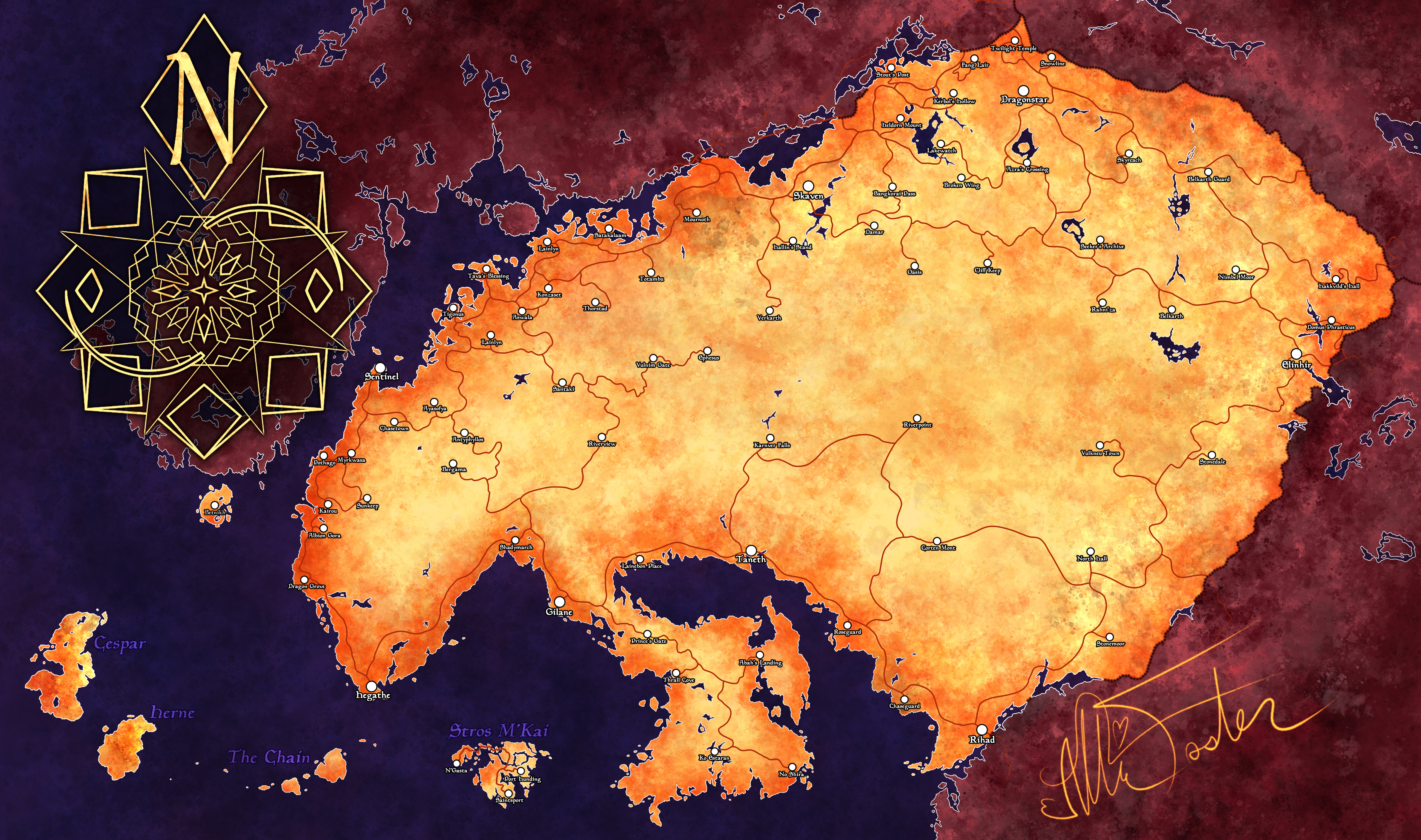 The new homeland of the Yokudan diaspora is Hammerfell, a hot and difficult world to survive in, but one the Redguards were well suited to taming. In its northeast is the vast Alik'r Desert, where golden dunes conceal ancient cities and mystic treasures. It is divided from the east by the Dragontail Mountains which arc south and then tilt northward to join the Dragon's Teeth Mountains along its eastern border with Skyrim. The realm of Craglorn sits below this intersection, where ancient secrets of the Nedes lie in wait. Bordering Cyrodiil are the dry lowlands of the Gold Coast, where the Imperial Colovians blend seamlessly into Forebear society, giving rise to the unique Brena culture.
Stretching from the western coast, across the Alik'r, over the Dragontails, and meeting the Bjoulsae River is the politically fractured Illiac Bay region, which inherited its affinity for politics and intrigue from the proto-Bretons who lived there before the warrior waves, making the Redguards and Bretons perfect rivals for control of this important trading hub.
The new homeland of the Yokudan diaspora is Hammerfell, a hot and difficult world to survive in, but one the Redguards were well suited to taming. In its northeast is the vast Alik'r Desert, where golden dunes conceal ancient cities and mystic treasures. It is divided from the east by the Dragontail Mountains which arc south and then tilt northward to join the Dragon's Teeth Mountains along its eastern border with Skyrim. The realm of Craglorn sits below this intersection, where ancient secrets of the Nedes lie in wait. Bordering Cyrodiil are the dry lowlands of the Gold Coast, where the Imperial Colovians blend seamlessly into Forebear society, giving rise to the unique Brena culture.
Stretching from the western coast, across the Alik'r, over the Dragontails, and meeting the Bjoulsae River is the politically fractured Illiac Bay region, which inherited its affinity for politics and intrigue from the proto-Bretons who lived there before the warrior waves, making the Redguards and Bretons perfect rivals for control of this important trading hub.
 Proud warriors with a lust for living loudly and in glory, the Nord race came to Tamriel from a continent to the far north called Atmora. The Atmorans fled an eternal winter which transformed their homeland into an inhospitable polar desert. They were welcomed initially by the Falmer, the long-forgotten snow elves, until the original Atmoran settlment was razed in the Night of Tears. When the Atmoran survivors returned, they came as conquerers. Dragons came to the land of Tamriel with them, their living gods. When the brutality of the Dovah grew too much to bear, even they were conquered by the Nords.
Fair of skin and hair, Nords are well-suited to the harsh cold of their chosen home. They live in community with eachother, singing and drinking on long arctic nights in storied mead halls, boasting of victories in battles of steel or of the heart. The northern men hold fast to their traditions, suspicious of clever magics and the deceptions of statescraft. Their kingdoms were forged by steel and mettle, and the scarce resources of their harsh lands are supplimented by raiding coastlines and pillaging.
Yet, it is a mistake to think of Nords as mere maurading barbarians. Nords value loyalty above all else, and readily ally themselves with any who respect them as equals. Even an elf can be brother to a nord if he'll drink with them and fight by their side.
Proud warriors with a lust for living loudly and in glory, the Nord race came to Tamriel from a continent to the far north called Atmora. The Atmorans fled an eternal winter which transformed their homeland into an inhospitable polar desert. They were welcomed initially by the Falmer, the long-forgotten snow elves, until the original Atmoran settlment was razed in the Night of Tears. When the Atmoran survivors returned, they came as conquerers. Dragons came to the land of Tamriel with them, their living gods. When the brutality of the Dovah grew too much to bear, even they were conquered by the Nords.
Fair of skin and hair, Nords are well-suited to the harsh cold of their chosen home. They live in community with eachother, singing and drinking on long arctic nights in storied mead halls, boasting of victories in battles of steel or of the heart. The northern men hold fast to their traditions, suspicious of clever magics and the deceptions of statescraft. Their kingdoms were forged by steel and mettle, and the scarce resources of their harsh lands are supplimented by raiding coastlines and pillaging.
Yet, it is a mistake to think of Nords as mere maurading barbarians. Nords value loyalty above all else, and readily ally themselves with any who respect them as equals. Even an elf can be brother to a nord if he'll drink with them and fight by their side.
 The northern province of Skyrim is bordered on three sides by the icy Druadach (or "Dragon's Teeth"), Jerall, and Velothi mountain ranges. Its northern coast is carved by long and winding fjords and glaciers flowing into the Sea of Ghosts. It is administered by eight Holds, each ruled by a Jarl who in-turn serves at the liesure of a High King. Its capital is the city of Sentinel, though the rival city of Windhelm held that position for millennia before Imperial colonization.
The relatively temperate and wooded south is divided between the coniferous Falkreath hold, considered an extention of Imperial Colovia, and the deciduous Rift which carves a path into neighboring Morrowind. In Eastmarch, volcanic springs warm weary travelers. To the north, glaciers spill out from the peaks of Winterhold before plateauing into the frozen lowlands of The Pale. The swamps of Hjaalmarch cast a fog across the mouth of the River Karth beneath the rocky cliffs of Haafingar Hold where the capital city overlooks the bay. To the west is the treacherous Reach, a twisting, terraced land of spires carved by deadly rapids which traditionally belong to the Reachmen tribes. Split between High Rock, Skyrim, and parts of Hammerfell, The Reach is the most brutally contested region in Tamriel to this day.
The northern province of Skyrim is bordered on three sides by the icy Druadach (or "Dragon's Teeth"), Jerall, and Velothi mountain ranges. Its northern coast is carved by long and winding fjords and glaciers flowing into the Sea of Ghosts. It is administered by eight Holds, each ruled by a Jarl who in-turn serves at the liesure of a High King. Its capital is the city of Sentinel, though the rival city of Windhelm held that position for millennia before Imperial colonization.
The relatively temperate and wooded south is divided between the coniferous Falkreath hold, considered an extention of Imperial Colovia, and the deciduous Rift which carves a path into neighboring Morrowind. In Eastmarch, volcanic springs warm weary travelers. To the north, glaciers spill out from the peaks of Winterhold before plateauing into the frozen lowlands of The Pale. The swamps of Hjaalmarch cast a fog across the mouth of the River Karth beneath the rocky cliffs of Haafingar Hold where the capital city overlooks the bay. To the west is the treacherous Reach, a twisting, terraced land of spires carved by deadly rapids which traditionally belong to the Reachmen tribes. Split between High Rock, Skyrim, and parts of Hammerfell, The Reach is the most brutally contested region in Tamriel to this day.
 Descended from the Aldmer who remained behind in the Summerset Isles. After seeing how Tamriel has changed every group of elves who ventured out from the mainland, they turned insular, obsessed with the purity of their race. This, too, changed them. They think themselves the closest modern equivalent to the Aldmer that is possible, but they are in fact something irrevocably removed from what their ancesters were so long ago.
The Altmer have the full range of human skin tones, but with gold undertones of varying intensity. Their eyes range from the vivid colors of gemstones, to the reflective glimmer of precious metals. They are statuesque, sometimes reaching over seven feet in height. Their natural affinity for magic also makes them weak to it, and their reputation for haughtiness and superiority often puts them at odds with outsiders.
An Altmer's exact appearance seems to have more to do with the environment in which they are born than genetics, with foreign-born Altmer taking on traits of the dominant population around them, even without a drop of local blood. In their pursuance of racial purity, Altmer born into noble families in their homeland tend to have exaggerated features, with large eyes, impossibly high cheek bones, and unnaturally elongated faces, while those of more common stock, or born outside the isles often appear almost like particularly tall and beautiful humans.
Descended from the Aldmer who remained behind in the Summerset Isles. After seeing how Tamriel has changed every group of elves who ventured out from the mainland, they turned insular, obsessed with the purity of their race. This, too, changed them. They think themselves the closest modern equivalent to the Aldmer that is possible, but they are in fact something irrevocably removed from what their ancesters were so long ago.
The Altmer have the full range of human skin tones, but with gold undertones of varying intensity. Their eyes range from the vivid colors of gemstones, to the reflective glimmer of precious metals. They are statuesque, sometimes reaching over seven feet in height. Their natural affinity for magic also makes them weak to it, and their reputation for haughtiness and superiority often puts them at odds with outsiders.
An Altmer's exact appearance seems to have more to do with the environment in which they are born than genetics, with foreign-born Altmer taking on traits of the dominant population around them, even without a drop of local blood. In their pursuance of racial purity, Altmer born into noble families in their homeland tend to have exaggerated features, with large eyes, impossibly high cheek bones, and unnaturally elongated faces, while those of more common stock, or born outside the isles often appear almost like particularly tall and beautiful humans.
 The High Elves hail from the Summerset Isles, an enchanted land of golden forests, mountain fortresses, coral coasts, and crystal cities. It is divided into three main islands:
 Believing themselves descended from shapeless spirits who were given form and purpose by the god Y'ffre, the Wood Elves have sworn to protect the forests of their homeland with their lives, eschewing any materials of wood or fiber in favor of bone and leather. They are natural shape-shifters, though doing so comes at the cost of their minds and is the ultimate tabboo.
They are shorter than average for elves, with women reaching up to six feet in height and men reaching up to five. Their eyes are the colors of natural stones, their skin a variety of human-like skintones, but with undertones which seem to emulate leaves, matching the season in which they were born. As much as they resist, many Bosmer naturaly mutate as they age, gaining animal-like features such as antlers, tufts of fur or feathers, or even hooves.
In the outer reaches of the province, where the Green Pact holds no sway, Imperial and Altmeri colonies are populated by a different class of Bosmer. Born into cosmopolitan values and intercultural connection, these provincial elves build cities of wood and stone with unmatched artistry in their craftsmanship. These elves tend to be on the shorter side and less often develop beastial traits than their Green Pact kin.
Believing themselves descended from shapeless spirits who were given form and purpose by the god Y'ffre, the Wood Elves have sworn to protect the forests of their homeland with their lives, eschewing any materials of wood or fiber in favor of bone and leather. They are natural shape-shifters, though doing so comes at the cost of their minds and is the ultimate tabboo.
They are shorter than average for elves, with women reaching up to six feet in height and men reaching up to five. Their eyes are the colors of natural stones, their skin a variety of human-like skintones, but with undertones which seem to emulate leaves, matching the season in which they were born. As much as they resist, many Bosmer naturaly mutate as they age, gaining animal-like features such as antlers, tufts of fur or feathers, or even hooves.
In the outer reaches of the province, where the Green Pact holds no sway, Imperial and Altmeri colonies are populated by a different class of Bosmer. Born into cosmopolitan values and intercultural connection, these provincial elves build cities of wood and stone with unmatched artistry in their craftsmanship. These elves tend to be on the shorter side and less often develop beastial traits than their Green Pact kin.
 The province of Valenwood is dominated by a massive, inter-connected collection of forrests known collectively as The Green. Within The Green, Bosmer (or "Boiche" in the Bosmeri tongue) are bound by the Green Pact, where no plantlife may be harmed in any way. As a result, Bosmer tribes build their homes by carefully shaping the living trees around them, weaving lattices out of branches fitted with frames of bone and decorated with stained glass and precious stones. Metalworking is a rare and highly specialized skill as fire is a carefully utilized resource in The Green. Blacksmiths build their workshops in deep underground vaults and caverns, with carefully engineered flumes to direct heat and smoke high above the canopy.
Valenwood can roughly be devided into four regions:
The province of Valenwood is dominated by a massive, inter-connected collection of forrests known collectively as The Green. Within The Green, Bosmer (or "Boiche" in the Bosmeri tongue) are bound by the Green Pact, where no plantlife may be harmed in any way. As a result, Bosmer tribes build their homes by carefully shaping the living trees around them, weaving lattices out of branches fitted with frames of bone and decorated with stained glass and precious stones. Metalworking is a rare and highly specialized skill as fire is a carefully utilized resource in The Green. Blacksmiths build their workshops in deep underground vaults and caverns, with carefully engineered flumes to direct heat and smoke high above the canopy.
Valenwood can roughly be devided into four regions:
 The ancestors of the Dark Elves, the Chimer, broke off from the Summerset Isles in the Merethic Era, pursuing a new religion centered around the Daedric Princes Azura, Mephala, and Boethia. They saw mortal life not as a failure of the Gods, but a challenge through which self-improvement was made possible. They made their homeland out of the most alien, inhospitable realm they could find, and have flourished for thousands of years.
In the middle First Era, the Chimer went to war with their underground neighbors, the Dwemer. At the culmination of this war, the Dwemer vanished from the world, and the Chimer were fundamentally changed, becoming Dunmer. Vivec, Almalexia, and Sotha Sil, a Tribunal of living gods rose to take the place of their Daedric "Anticipations" and guided their people in the new age, which lasted for thousands of years until their sudden downfall only 16 years ago.
Dark Elves have gray skin of varying shades with undertones of blue, violet, or green. They are of average height, reaching between 4 and 6 feet in adulthood, and have larger ears than most elves. Their eyes are typically shades of crimson and sometimes glow like embers when emotions are high.
Most Morrowind-natives belong to one of five Great Houses, powerful organizations which hold sway over all politics and business in the land:
The ancestors of the Dark Elves, the Chimer, broke off from the Summerset Isles in the Merethic Era, pursuing a new religion centered around the Daedric Princes Azura, Mephala, and Boethia. They saw mortal life not as a failure of the Gods, but a challenge through which self-improvement was made possible. They made their homeland out of the most alien, inhospitable realm they could find, and have flourished for thousands of years.
In the middle First Era, the Chimer went to war with their underground neighbors, the Dwemer. At the culmination of this war, the Dwemer vanished from the world, and the Chimer were fundamentally changed, becoming Dunmer. Vivec, Almalexia, and Sotha Sil, a Tribunal of living gods rose to take the place of their Daedric "Anticipations" and guided their people in the new age, which lasted for thousands of years until their sudden downfall only 16 years ago.
Dark Elves have gray skin of varying shades with undertones of blue, violet, or green. They are of average height, reaching between 4 and 6 feet in adulthood, and have larger ears than most elves. Their eyes are typically shades of crimson and sometimes glow like embers when emotions are high.
Most Morrowind-natives belong to one of five Great Houses, powerful organizations which hold sway over all politics and business in the land:
 The land of the Dark Elves is an alien and hostile place. Covered in fiery volcanoes, forrests of giant mushrooms, colossal insects, and sharp-toothed dinosaurs, this realm is unlike anywhere in the known world. It is bordered on the west by the Velothi Mountains and to the south by the swamps of Black Marsh. To its north is the Sea of Ghosts and to the east is the Padomaic Ocean.
 The People of the Root are an inscrutible and diverse culture of amphibious beings native to the impenetrable region known to outsiders as Black Marsh. Each Saxhleel tribe bears unique markings and morphologies which suit their environments perfectly. Most can breathe in fresh or brackish water for a time, and are heavily resistant to the diseases and toxins which have made their homeland nigh unconquerable to outsiders.
In the ancient Stone Nest Period, Saxhleel worshipped Sithis, the divine embodiment of death and decay, building great stone monuments to the mighty Void for His favor and mercy. The ancient rituals and and magically-infused machines rivaled even the Dwemer in power and sophistication. Yet this civilization mysteriously collapsed, casting the Argonian peoples into a centuries long dark age.
Today, they are guided and freed by the Hist, a hive mind embodied by a root-network of massive trees who control the Saxhleel's cycle of death and rebirth through their sap. They still revere Sithis, but today see entropy as the natural state of the world, embracing the ephemeral nature of life on Nirn. They prefer to live simple lives of fishing, farming, and supporting their communities. However, the constant antagonism of other races have forced the root-people to master magic and martial skills to defend their homes. Their rivalry with the Dunmer of the north is especially bitter after thousands of years of slave raids and cruelty.
Argonians live lifespans comparable to humans. Their appearance varies from reptillian to amphibious, with natural horns, feathers, and gills all common markers. They express emotions subtly through the dilation of their pupils, the swaying of tails, and expressions of scent glands which men and mer alike typically fail to notice, earning them a reputation as cold and unfeeling.
Even beyond their homeland, all Argonians feel the whispers of the Hist in the back of their minds, and meditate on that connection for guidance in their lives. Most seak out peaceful lives free of discrimination and are only forced into violence or adventure through circumstance. Though notable exceptions do exist, such as the infamous First Era pirate Red Bramman.
The People of the Root are an inscrutible and diverse culture of amphibious beings native to the impenetrable region known to outsiders as Black Marsh. Each Saxhleel tribe bears unique markings and morphologies which suit their environments perfectly. Most can breathe in fresh or brackish water for a time, and are heavily resistant to the diseases and toxins which have made their homeland nigh unconquerable to outsiders.
In the ancient Stone Nest Period, Saxhleel worshipped Sithis, the divine embodiment of death and decay, building great stone monuments to the mighty Void for His favor and mercy. The ancient rituals and and magically-infused machines rivaled even the Dwemer in power and sophistication. Yet this civilization mysteriously collapsed, casting the Argonian peoples into a centuries long dark age.
Today, they are guided and freed by the Hist, a hive mind embodied by a root-network of massive trees who control the Saxhleel's cycle of death and rebirth through their sap. They still revere Sithis, but today see entropy as the natural state of the world, embracing the ephemeral nature of life on Nirn. They prefer to live simple lives of fishing, farming, and supporting their communities. However, the constant antagonism of other races have forced the root-people to master magic and martial skills to defend their homes. Their rivalry with the Dunmer of the north is especially bitter after thousands of years of slave raids and cruelty.
Argonians live lifespans comparable to humans. Their appearance varies from reptillian to amphibious, with natural horns, feathers, and gills all common markers. They express emotions subtly through the dilation of their pupils, the swaying of tails, and expressions of scent glands which men and mer alike typically fail to notice, earning them a reputation as cold and unfeeling.
Even beyond their homeland, all Argonians feel the whispers of the Hist in the back of their minds, and meditate on that connection for guidance in their lives. Most seak out peaceful lives free of discrimination and are only forced into violence or adventure through circumstance. Though notable exceptions do exist, such as the infamous First Era pirate Red Bramman.
 Black Marsh, known officially as Argonia in Imperial records, is the homeland of the Argonians. Winding rivers cut through dense rainforest, bogs, and swamps. Venomous and diseased fauna ambush unweary travelers, while poisonous plants and fungi render every inch of this province a death-trap for outsiders. Protected by the Saxhleel people, and organized by the Hist hive-mind, the region is a mystery to the Empire. Some colonies have been able to survive in the border regions or along the coast, but the inner swamps have never truly been conquered.
 Believed to be relatives of the Bosmer, the Khajiit attribute their catlike forms to the goddess Azurah, who gifted their people with the greatest beauty in all the land. Khajiit are known to be whimsical, mysterious, and impulsive. They value wit and stealth and grace over brute force or intellect. Beyond their homeland, Khajiit bear the stigma of thieves and peddlers. The infamous narcotic Skooma is derived from the psychoactive crop Moon Sugar, which Khajiit have a particular taste for.
Khajiit follow the path of the Riddle'thar, a religious philosophy which teaches curiosity, cleverness, rest, and pleasure as virtues to strive for. The Riddle'thar warns of the corruption of Lorkhaj which resides in the hearts of all Khajiit, lest they give in to temptation and become Dro-m'Athra, corrupted shadows of the Void.
Central to Khajiiti worship are the god-moons Jone and Jode whose celestial dance dictates the forms a Khajiit will take at the moment of their birth. For every combination of phases between Nirn's two moons, a different Furstock is born. They vary from diminuative Alfiq, physically indistinguishable from common housecats, to mighty Pahmar-Raht: seven-foot bipedal powerhouses with tiger-like features. Between them is all manner of quadrupedal and bipedal forms. Notably, the Ohmes and Ohmes-raht appear very similar to wood elves, with many furless Ohmes resorting to facial tattoos to remind others of their true heritage.
Believed to be relatives of the Bosmer, the Khajiit attribute their catlike forms to the goddess Azurah, who gifted their people with the greatest beauty in all the land. Khajiit are known to be whimsical, mysterious, and impulsive. They value wit and stealth and grace over brute force or intellect. Beyond their homeland, Khajiit bear the stigma of thieves and peddlers. The infamous narcotic Skooma is derived from the psychoactive crop Moon Sugar, which Khajiit have a particular taste for.
Khajiit follow the path of the Riddle'thar, a religious philosophy which teaches curiosity, cleverness, rest, and pleasure as virtues to strive for. The Riddle'thar warns of the corruption of Lorkhaj which resides in the hearts of all Khajiit, lest they give in to temptation and become Dro-m'Athra, corrupted shadows of the Void.
Central to Khajiiti worship are the god-moons Jone and Jode whose celestial dance dictates the forms a Khajiit will take at the moment of their birth. For every combination of phases between Nirn's two moons, a different Furstock is born. They vary from diminuative Alfiq, physically indistinguishable from common housecats, to mighty Pahmar-Raht: seven-foot bipedal powerhouses with tiger-like features. Between them is all manner of quadrupedal and bipedal forms. Notably, the Ohmes and Ohmes-raht appear very similar to wood elves, with many furless Ohmes resorting to facial tattoos to remind others of their true heritage.
 The land of Elsweyr is a warm and sunny land with a long, storied history predating even human settlement in Tamriel. Once a confederation of petty kingdoms, the land is today divided into two nations with distinct geography and cultures.
 It is debated whether the "Pariah Folk", in the elven tongue, are truly related to goblins. According to their own mythology, the Orsimer are in fact elves, descended from Aldmer who followed the god Trinimac into the mountains to confront dissidents. When the dissident's patron, the Daedric Prince Boethiah, struck down Trinimac in battle, their god tore the shame out of His heart with his bare hands. In doing so, He transformed into Malacath, the God of the Ostracised. His followers saw how their warrior-god, embracing His defeat, used it to grow stronger. Thus, they followed His lead, transforming themselves willingly into the Orsimer.
Orc culture is highly patriarchal, practical, and devoted to the idea of improvement of the community. Traditional orcs grow up in mountain strongholds under a chief. Weakness is not tolerated. Neither is self-interest. All actions are made in service to the Stronghold. Outside of their stronghold, orcs identify themselves as the son (gro) or daughter (gra) of their respective stronghold. Others who grow up at the mercy of intolerant civilizations are derisively known as "city orcs". They often seek to assimilate into the larger culture, losing something of their own identities while never quite finding equality. Most earn their citizenship in the Empire through service in the Legion, earning land far away from human cities where they can spend their waning years in peace.
Typical orcs stand betwen five and seven feet tall and can live up to one hundred years. However, few stronghold orcs will live much beyond fifty, seeking an honorable death in battle rather than allowing themselves to grow feeble and become a burden to their Stronghold. Their skin varies in shade from mottled gray, to brown, to bright green. Their eyes are typically earth tones, and may glimmer faintly like quartz.
Orcs remember the ancient elven homeland of Aldmeris, but recognize that if such a place exists, it would cast them aside as all others have. Instead, the prevailing dream of orc-kind is in Orsinium, a homeland they can create forthemselves. This dream has been sought multiple times throughout history, with multiple cities bearing the name constructed high in the Wrothgarian Mountains. Each has eventually been torn down by fearful humans.
In its latest iteration, the city of Nova Orsinium, has seen a level of success unseen since the days of the Daggerfall Covenant. This Orsinium is constructed not of stone, but of steel, using innovative new techniques in architecture and metalurgy. Its land was won by honorable combat in answer to an ancestral claim that had gone ignored for generations by Imperial beareaucrats. Its King Gortwog was able to conquer a vast swath of the Wrothgarian Mountains through secret dealings during events about twenty six years ago. Its rapid expansion and cooperation with the Empire has earned it legitimate status in the Empire, and for the first time in history earned all Orcs equal status as citizens without the need for years of Legion service. Gortwog's next step toward orsimer equality is to see Orsinium recognized as an independent province within the Empire. His progress has been stymied for decades by an unfriendly Elder Council.
It is debated whether the "Pariah Folk", in the elven tongue, are truly related to goblins. According to their own mythology, the Orsimer are in fact elves, descended from Aldmer who followed the god Trinimac into the mountains to confront dissidents. When the dissident's patron, the Daedric Prince Boethiah, struck down Trinimac in battle, their god tore the shame out of His heart with his bare hands. In doing so, He transformed into Malacath, the God of the Ostracised. His followers saw how their warrior-god, embracing His defeat, used it to grow stronger. Thus, they followed His lead, transforming themselves willingly into the Orsimer.
Orc culture is highly patriarchal, practical, and devoted to the idea of improvement of the community. Traditional orcs grow up in mountain strongholds under a chief. Weakness is not tolerated. Neither is self-interest. All actions are made in service to the Stronghold. Outside of their stronghold, orcs identify themselves as the son (gro) or daughter (gra) of their respective stronghold. Others who grow up at the mercy of intolerant civilizations are derisively known as "city orcs". They often seek to assimilate into the larger culture, losing something of their own identities while never quite finding equality. Most earn their citizenship in the Empire through service in the Legion, earning land far away from human cities where they can spend their waning years in peace.
Typical orcs stand betwen five and seven feet tall and can live up to one hundred years. However, few stronghold orcs will live much beyond fifty, seeking an honorable death in battle rather than allowing themselves to grow feeble and become a burden to their Stronghold. Their skin varies in shade from mottled gray, to brown, to bright green. Their eyes are typically earth tones, and may glimmer faintly like quartz.
Orcs remember the ancient elven homeland of Aldmeris, but recognize that if such a place exists, it would cast them aside as all others have. Instead, the prevailing dream of orc-kind is in Orsinium, a homeland they can create forthemselves. This dream has been sought multiple times throughout history, with multiple cities bearing the name constructed high in the Wrothgarian Mountains. Each has eventually been torn down by fearful humans.
In its latest iteration, the city of Nova Orsinium, has seen a level of success unseen since the days of the Daggerfall Covenant. This Orsinium is constructed not of stone, but of steel, using innovative new techniques in architecture and metalurgy. Its land was won by honorable combat in answer to an ancestral claim that had gone ignored for generations by Imperial beareaucrats. Its King Gortwog was able to conquer a vast swath of the Wrothgarian Mountains through secret dealings during events about twenty six years ago. Its rapid expansion and cooperation with the Empire has earned it legitimate status in the Empire, and for the first time in history earned all Orcs equal status as citizens without the need for years of Legion service. Gortwog's next step toward orsimer equality is to see Orsinium recognized as an independent province within the Empire. His progress has been stymied for decades by an unfriendly Elder Council.
The year is 4E 10, equivallent to the year 3E 444. The political landscape is precarious and unprecedented. The Empire persists, but has no Emperor, and fears of a second Interregnum are on the minds of its citizens every day. There are a few recent events in living memory which are considered milestones to the current state of the world.
 Barely six months into the new era, a kingdom in Elsweyr called Rimmen declares its secession from the Empire. Deeming a show of force necessary to preserve the Empire, the Elder Council sends the Eleventh Legion to quell this insurrection. Traumatized by the Oblivion Crisis, discipline soon broke down among the Legion soldiers. Beyond their mission to passify the rebel army, they began pillaging the city and massacring its people. Three days of carnage was halted when the Empire's new potentate Ocato arrived on the scene to personally halt the bloodshed. A skilled battlemage, Ocato disintigrated the first soldier who dared to defy him. After sending the Legion back to Cyrodiil on foot, he teleported himself and Rimmen's queen to the Imperial City to discuss the Empire's unilateral surrender and terms of reparations to the kingdom.
When the Legion returned to Cyrodiil, they were stripped of rank and equipment and summarily discharged, whether they participated in the massacre or not. The legionaires were sent to their homes across the continent, unpaid and disgraced, with hopes of acheiving citizenship taken from them. Many became homeless, unable to afford to return home, or find work due to stigma. Some saw what was coming and defected before returning to Cyrodiil, keeping their equipment and terrorizing the people of northern Elsweyr as brigands to this day.
Ocato's decision to dissolve the Eleventh Legion and surrender to the rebel kingdom has become the emblematic issue of his reign. While most agree that the Legionaires' actions brought disgrace to the Empire, many people firmly believe that the Potentate showed weakness at a vital moment, opening the door for other sessessions and the end of the Empire's dominance in Tamriel. The more fringe elements of this reactionary wing have even begun to lionize the Eleventh as heroes and martyrs, and are eager to see the elf executed for his betrayal.
Seeming to agree with this fringe belief, the Elder Council threatened to dissolve the authority of the Ruby Throne entirely, to take complete control of the Empire for themselves. Someone loyal to Ocato leaked this ambitious gambit to the public before they could carry it out. Fearing a revolt, the Council was forced to negotiate with Ocato, resulting in the Magno Compromissum. The Council, defeated, was required to commit to appointing a new Emperor within 20 years, which the Potentate has the power to approve or veto. In exchange, the Potentate's executive authority over the Imperial Legion was vested in the Legion General, a position appointed by the throne, but now answers only to the Elder Council.
Barely six months into the new era, a kingdom in Elsweyr called Rimmen declares its secession from the Empire. Deeming a show of force necessary to preserve the Empire, the Elder Council sends the Eleventh Legion to quell this insurrection. Traumatized by the Oblivion Crisis, discipline soon broke down among the Legion soldiers. Beyond their mission to passify the rebel army, they began pillaging the city and massacring its people. Three days of carnage was halted when the Empire's new potentate Ocato arrived on the scene to personally halt the bloodshed. A skilled battlemage, Ocato disintigrated the first soldier who dared to defy him. After sending the Legion back to Cyrodiil on foot, he teleported himself and Rimmen's queen to the Imperial City to discuss the Empire's unilateral surrender and terms of reparations to the kingdom.
When the Legion returned to Cyrodiil, they were stripped of rank and equipment and summarily discharged, whether they participated in the massacre or not. The legionaires were sent to their homes across the continent, unpaid and disgraced, with hopes of acheiving citizenship taken from them. Many became homeless, unable to afford to return home, or find work due to stigma. Some saw what was coming and defected before returning to Cyrodiil, keeping their equipment and terrorizing the people of northern Elsweyr as brigands to this day.
Ocato's decision to dissolve the Eleventh Legion and surrender to the rebel kingdom has become the emblematic issue of his reign. While most agree that the Legionaires' actions brought disgrace to the Empire, many people firmly believe that the Potentate showed weakness at a vital moment, opening the door for other sessessions and the end of the Empire's dominance in Tamriel. The more fringe elements of this reactionary wing have even begun to lionize the Eleventh as heroes and martyrs, and are eager to see the elf executed for his betrayal.
Seeming to agree with this fringe belief, the Elder Council threatened to dissolve the authority of the Ruby Throne entirely, to take complete control of the Empire for themselves. Someone loyal to Ocato leaked this ambitious gambit to the public before they could carry it out. Fearing a revolt, the Council was forced to negotiate with Ocato, resulting in the Magno Compromissum. The Council, defeated, was required to commit to appointing a new Emperor within 20 years, which the Potentate has the power to approve or veto. In exchange, the Potentate's executive authority over the Imperial Legion was vested in the Legion General, a position appointed by the throne, but now answers only to the Elder Council.
 A few months into the Red Year, the Argonian Union demanded that the Dark Elves relinquish control of the Deshaan Province, the fertile southern reaches of Morrowind. This land has belonged to the Dunmeri Great House Dres for millennia, where it grew prosperous through the brutal enslavement of Argonians. Though the practice had just recently been abolished, the An-Xileel offered to provide aid to the ailing province in exchange for this first step toward reparation. King Helseth refused to acknowledge this ultimatum, believing the fledgeling An-Xileel government would not dare wage war on the Empire. Six months later, they proved there was no bluff.
The Hlaalu army was decimated in the initial attack, and within days, the Argonians had swarmed most of the mainland, driving the Dres back to their ancestral city of Tear, and waging total war against their former oppressors. While Mournhold is under seige, King Helseth fled to the Imperial City through a hidden teleport in his palace. The Empire withdrew its remaining forces, leaving Morrowind to its fate. Only Great Houses Redoran and Indoril rallied and were able to slow the tide of the war, until Great House Telvanni unexpectedly joined the fray.
The Telvanni have long refused to participate in Morrowind's affairs, fully capable of protecting themselves, even from the devastation of the Red Year. Most beleive it was the death of Lymdrenn Tenvanni and his family that their attention was brought to the invasion. Lymdrenn and his infant son were the last heirs of the Telvayn Clan who were the primary founders and namesake of the Great House.
Even the combined might of three Great Houses has not been enough to drive the reptillian army back. The bloody conflict has become a war of attrition. Helseth spends his days in the Imperial City, drumming up support to install himself as the new Emperor, citing the Elder Council's refusal to aid his people as just cause for a new regime. Meanwhile, House Hlaalu is slowly being dismantled by the other Great Houses, who see their king as a coward who abandoned their homeland.
The backdrop of this campaign is the ongoing Imperial Succession Crisis. Since the signing of the Magno Compromissum, Cyrodiil has become a powder-keg, waiting to erupt if an Emperor is not named on time. The remaining Empire is fiercely divided as several prominant figures have risen to the top as contenders.
A few months into the Red Year, the Argonian Union demanded that the Dark Elves relinquish control of the Deshaan Province, the fertile southern reaches of Morrowind. This land has belonged to the Dunmeri Great House Dres for millennia, where it grew prosperous through the brutal enslavement of Argonians. Though the practice had just recently been abolished, the An-Xileel offered to provide aid to the ailing province in exchange for this first step toward reparation. King Helseth refused to acknowledge this ultimatum, believing the fledgeling An-Xileel government would not dare wage war on the Empire. Six months later, they proved there was no bluff.
The Hlaalu army was decimated in the initial attack, and within days, the Argonians had swarmed most of the mainland, driving the Dres back to their ancestral city of Tear, and waging total war against their former oppressors. While Mournhold is under seige, King Helseth fled to the Imperial City through a hidden teleport in his palace. The Empire withdrew its remaining forces, leaving Morrowind to its fate. Only Great Houses Redoran and Indoril rallied and were able to slow the tide of the war, until Great House Telvanni unexpectedly joined the fray.
The Telvanni have long refused to participate in Morrowind's affairs, fully capable of protecting themselves, even from the devastation of the Red Year. Most beleive it was the death of Lymdrenn Tenvanni and his family that their attention was brought to the invasion. Lymdrenn and his infant son were the last heirs of the Telvayn Clan who were the primary founders and namesake of the Great House.
Even the combined might of three Great Houses has not been enough to drive the reptillian army back. The bloody conflict has become a war of attrition. Helseth spends his days in the Imperial City, drumming up support to install himself as the new Emperor, citing the Elder Council's refusal to aid his people as just cause for a new regime. Meanwhile, House Hlaalu is slowly being dismantled by the other Great Houses, who see their king as a coward who abandoned their homeland.
The backdrop of this campaign is the ongoing Imperial Succession Crisis. Since the signing of the Magno Compromissum, Cyrodiil has become a powder-keg, waiting to erupt if an Emperor is not named on time. The remaining Empire is fiercely divided as several prominant figures have risen to the top as contenders.
 The most obvious choice for the next Emperor would be its serving regent, and he has earned a fair number of loyalists who recognize his honesty and character. While lowborn, he is still fairly young for an Altmer, and could cement his position through marriage to a noble of sufficient blood. He was Uriel Septim VII's right hand mer, his Battlemage, Grand Vizier, and the Grand Chancellor of the Elder Council at different points in his career. Many believe that Uriel secretly left the Empire to him, should his secret heir Martin have somehow failed to take the throne. His greatest asset is the fact that he does not want to claim power for himself. Most rumors about him insist that he is eager to step down provided a suitable Emperor is named. Many see that humility as a sign that he is more fit to rule than any who would try to take it for themselves.
He faces several challenges. He was born to a minor noble house in the isle of Auridon in the now-independent Summerset Isles, but was disowned by his father for refusing a marriage arranged for him centuries before his birth and for studying magic outside his caste. As such, he is a Hulkynd in the eyes of his own people, with no claim to land or title whatsoever. In addition, he is a former member of the Mages Guild, which today suffers a great deal of stigma for refusing to aid the Legion during the Oblivion Crisis. He is considered an interloper, an agent of his friend the former Emperor, who placed him on the Elder Council, and eventually the Chancellorship as a means to control it. Because of their animosity towards him, and the power struggle the two offices have had since he became Potentate, Ocato is very unlikely to earn the Council's vote.
The most obvious choice for the next Emperor would be its serving regent, and he has earned a fair number of loyalists who recognize his honesty and character. While lowborn, he is still fairly young for an Altmer, and could cement his position through marriage to a noble of sufficient blood. He was Uriel Septim VII's right hand mer, his Battlemage, Grand Vizier, and the Grand Chancellor of the Elder Council at different points in his career. Many believe that Uriel secretly left the Empire to him, should his secret heir Martin have somehow failed to take the throne. His greatest asset is the fact that he does not want to claim power for himself. Most rumors about him insist that he is eager to step down provided a suitable Emperor is named. Many see that humility as a sign that he is more fit to rule than any who would try to take it for themselves.
He faces several challenges. He was born to a minor noble house in the isle of Auridon in the now-independent Summerset Isles, but was disowned by his father for refusing a marriage arranged for him centuries before his birth and for studying magic outside his caste. As such, he is a Hulkynd in the eyes of his own people, with no claim to land or title whatsoever. In addition, he is a former member of the Mages Guild, which today suffers a great deal of stigma for refusing to aid the Legion during the Oblivion Crisis. He is considered an interloper, an agent of his friend the former Emperor, who placed him on the Elder Council, and eventually the Chancellorship as a means to control it. Because of their animosity towards him, and the power struggle the two offices have had since he became Potentate, Ocato is very unlikely to earn the Council's vote.
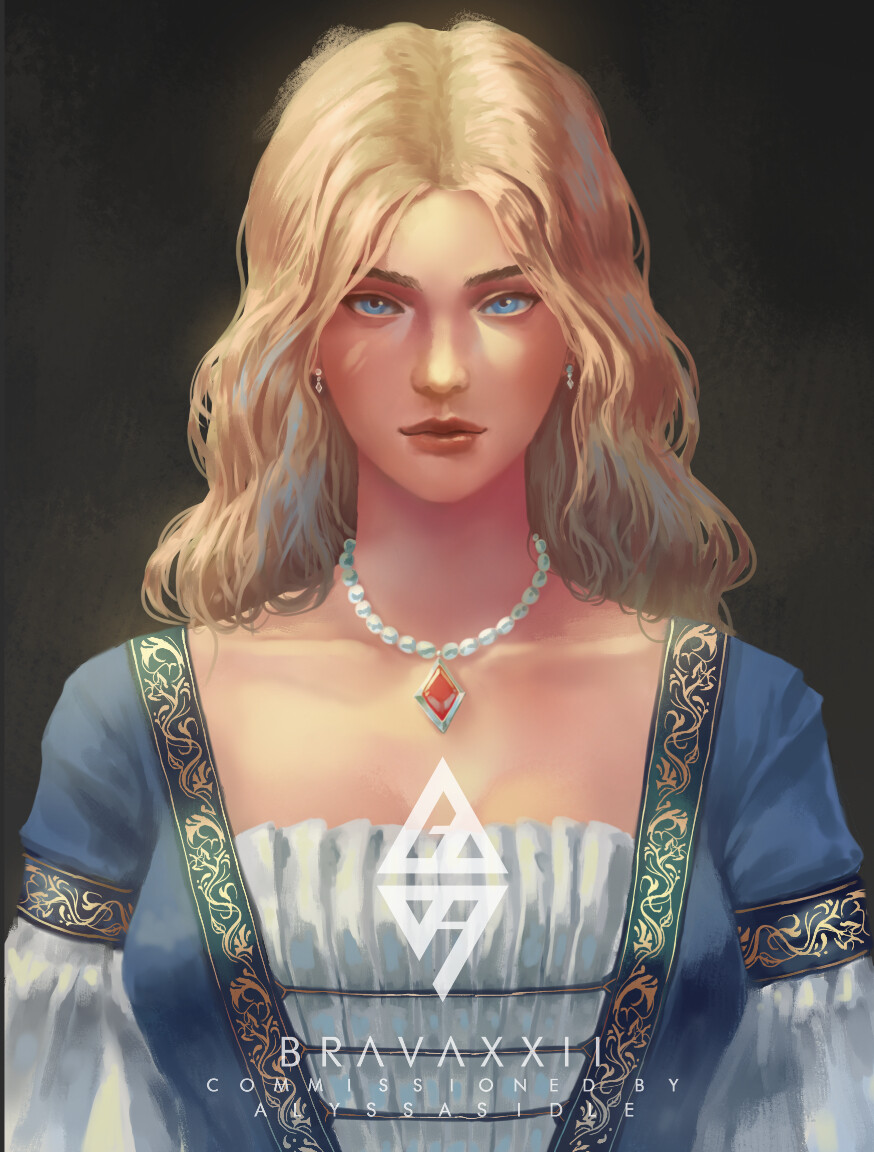 One of dozens of "Septims" among the nobility, Elysana holds the strongest claim among them as the late Emperor's second cousin and a fellow descendent of House Lariat. The potential for her to be Dragonborn would legitimize her rule if she were to be named Empress. Although, without the Amulet of Kings and no dragons around to slay, her Dragonborn status cannot be proven. Elysana is a favorite among the Elder Council and commands a powerful army which could take the throne by force if need be.
Both her greatest asset and obstacle is fear. While she was considered kind and docile as a teenager, her rise to power in Wayrest revealed her true cunning and merciless ambition. Through violence and intimidation she has quelled any resistance to her rule, and allied herself with the Orcish kingdom of Orsinium to bolster her strength. Most people educated in the politics of the Illiac Bay recognize the threat she poses to Tamriel's freedom should she take power.
One of dozens of "Septims" among the nobility, Elysana holds the strongest claim among them as the late Emperor's second cousin and a fellow descendent of House Lariat. The potential for her to be Dragonborn would legitimize her rule if she were to be named Empress. Although, without the Amulet of Kings and no dragons around to slay, her Dragonborn status cannot be proven. Elysana is a favorite among the Elder Council and commands a powerful army which could take the throne by force if need be.
Both her greatest asset and obstacle is fear. While she was considered kind and docile as a teenager, her rise to power in Wayrest revealed her true cunning and merciless ambition. Through violence and intimidation she has quelled any resistance to her rule, and allied herself with the Orcish kingdom of Orsinium to bolster her strength. Most people educated in the politics of the Illiac Bay recognize the threat she poses to Tamriel's freedom should she take power.
 The step-brother of Elysana and son of the famed heroine Queen Barenziah, who helped free the Empire from Jagar Tharn during the Imperial Simulacrum. Between being a full monarch of an Imperial province, the head of Great House Hlaalu, and the man who ended the hated practice of slavery in Morrowind, he has an impressively strong claim. If his latest claim to be the secret biological son of his step-father, and therefore a Septim, his pedigree would be unmatched among the other contenders. Since his exile to the Imperial City, he has also garnered a devoted following among the numerous Dunmer refugees in the heartland, who see him as a savior, using his wealth and influence to help them establish new lives.
There is no small amount of resistance to his claim. Most humans would not trust any elf, let alone a Dunmer on the throne, especially one so mired in bloodshed and mystery. He is linked to the death of his great uncle and his heir, which yielded the throne of Morrowind to him only a few years ago. His worship of the Daedra is also a point of contention. Among the other Great Houses he is seen as a coward who fled the war while his capital was under seige. They also argue that his breaking of tradition weakened the Dunmer people, causing the recent tragedies. He also promises to involve the entire Empire in the war with the Argonians, which the Empire may not be prepared for.
His claims grow weaker every day as House Hlaalu is stripped of its lands and power in the absense of its leadership.
The step-brother of Elysana and son of the famed heroine Queen Barenziah, who helped free the Empire from Jagar Tharn during the Imperial Simulacrum. Between being a full monarch of an Imperial province, the head of Great House Hlaalu, and the man who ended the hated practice of slavery in Morrowind, he has an impressively strong claim. If his latest claim to be the secret biological son of his step-father, and therefore a Septim, his pedigree would be unmatched among the other contenders. Since his exile to the Imperial City, he has also garnered a devoted following among the numerous Dunmer refugees in the heartland, who see him as a savior, using his wealth and influence to help them establish new lives.
There is no small amount of resistance to his claim. Most humans would not trust any elf, let alone a Dunmer on the throne, especially one so mired in bloodshed and mystery. He is linked to the death of his great uncle and his heir, which yielded the throne of Morrowind to him only a few years ago. His worship of the Daedra is also a point of contention. Among the other Great Houses he is seen as a coward who fled the war while his capital was under seige. They also argue that his breaking of tradition weakened the Dunmer people, causing the recent tragedies. He also promises to involve the entire Empire in the war with the Argonians, which the Empire may not be prepared for.
His claims grow weaker every day as House Hlaalu is stripped of its lands and power in the absense of its leadership.
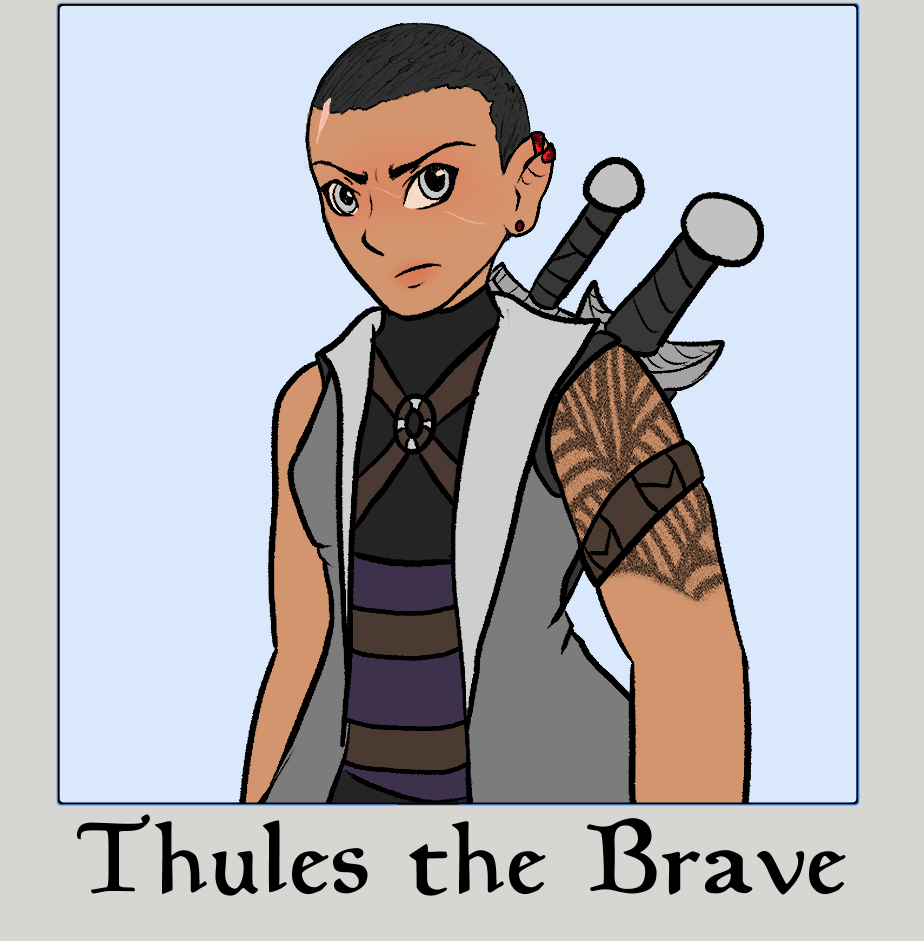 Known as Thules the Brave among his admirers, the young spellsword rose to fame for their skill in combat and leadership. He hailed from a small, forgotten village deep in the Blackwood where ancient Nibenese culture survived in isolation for millennia. When their village was destroyed by the daedra, Thules was the sole survivor. Swearing revenge, they traveled Cyrodiil, entering Oblivion Gates, and emerging victorious time and again. Some of his more ardent fans believe him to be the Hero of Kvatch who rescued Saint Martin from the initial daedric attack after the Emperor's assassination, but that would conflict with his own story, and he denies any association with the unnamed figure.
Though low-born, the Elder Council is quite favorable to Thules, as they're of Nibenese stock and a popular folk-hero. They are a favorite among the people of the heartland to ascend to the throne, even though they have voiced no such ambition. They are, however, highly critical of the current regime, blaming the decision to abandon the outlying provinces for their current hardships. Critical of both Ocato's weakness and the Council's cruelty, Thules the Brave stands for a just and equal Empire.
Despite his popularity, Thules faces a steep path to the throne, should he attempt it. His support is largely limited to the common people of Cyrodiil. Despite having some potential allies on the Council, they are also reluctant to show it publically, and vocally prefer Elysana's claim. He is also quite young and reputed to be very hotheaded, openly hostile to nobles and the Merchant's Guild, which has won him very few friends in power.
Known as Thules the Brave among his admirers, the young spellsword rose to fame for their skill in combat and leadership. He hailed from a small, forgotten village deep in the Blackwood where ancient Nibenese culture survived in isolation for millennia. When their village was destroyed by the daedra, Thules was the sole survivor. Swearing revenge, they traveled Cyrodiil, entering Oblivion Gates, and emerging victorious time and again. Some of his more ardent fans believe him to be the Hero of Kvatch who rescued Saint Martin from the initial daedric attack after the Emperor's assassination, but that would conflict with his own story, and he denies any association with the unnamed figure.
Though low-born, the Elder Council is quite favorable to Thules, as they're of Nibenese stock and a popular folk-hero. They are a favorite among the people of the heartland to ascend to the throne, even though they have voiced no such ambition. They are, however, highly critical of the current regime, blaming the decision to abandon the outlying provinces for their current hardships. Critical of both Ocato's weakness and the Council's cruelty, Thules the Brave stands for a just and equal Empire.
Despite his popularity, Thules faces a steep path to the throne, should he attempt it. His support is largely limited to the common people of Cyrodiil. Despite having some potential allies on the Council, they are also reluctant to show it publically, and vocally prefer Elysana's claim. He is also quite young and reputed to be very hotheaded, openly hostile to nobles and the Merchant's Guild, which has won him very few friends in power.
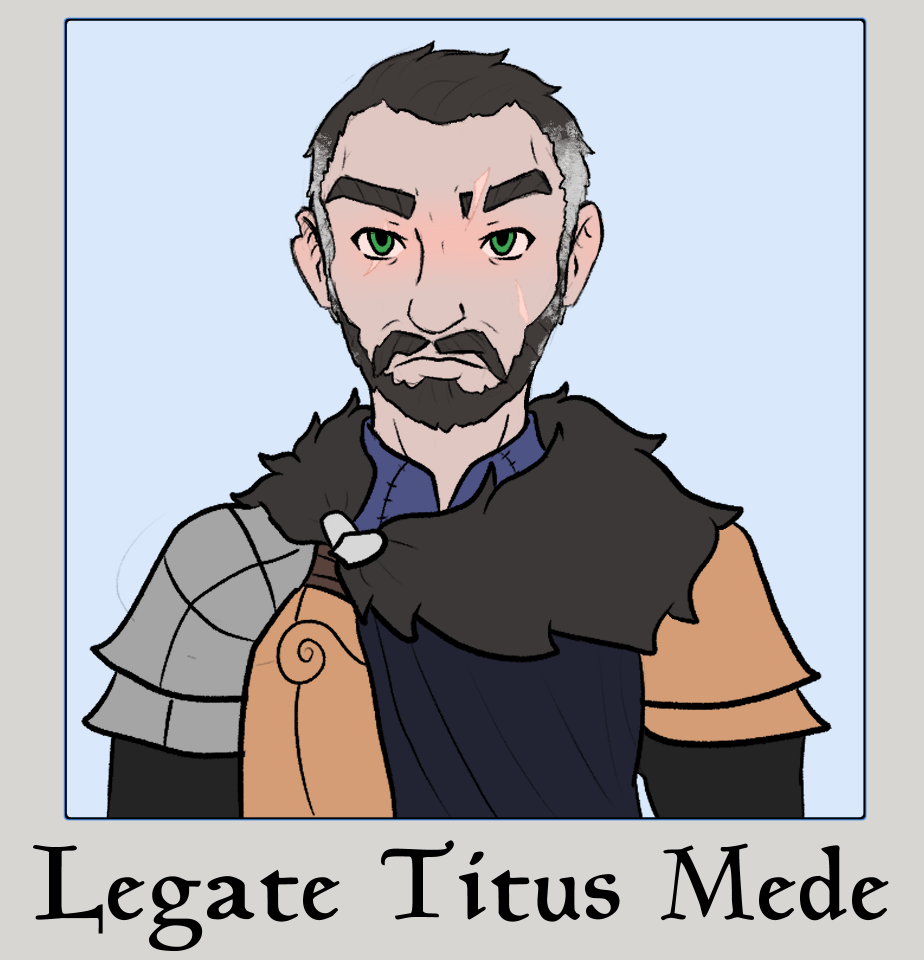 An honorable Legion soldier, Legate Mede of the Eleventh Legion did his best to contain the violence in Rimmen, even helping sneak its queen into her bunker. Despite his efforts, he was given the same blanket discommendation as the rest of them, and returned to his home village destitute and broken. Though he became a bandit to survive, he soon took over his band of outlaws, incorporating others of the Eleventh who had refused to partake in the massacre. United into a private army, Mede turned them toward defending and feeding first his village, and then the whole of the Colovian Highlands. For years he has developed a reputation as an honorable leader of men, protecting his territory with ruthlessness to enemies and compassion to his people.
He is a favorite among both the Nords of Skyrim and the Colovians of Cyrodiil to take the throne. Though he himself has not expressed any desire to take power, he is outspoken against both Ocato and the Elder Council. He believes a new Emperor should be named quickly in order to restore faith in the institution of the Empire, and has contempt for each of the other frontrunners.
Though Mede has only a fairly sizable number of brigands and disgraced Legionaries behind him, he does not have an army. He has little support from Nibenese Imperials or the nobility, seeing him as a lowborn mountain barbarian. He also bears the stigma of the Eleventh, with many people doubting any claims that he or his men tried to stop the massacre. He is feared for his reputed cruelty towards his enemies, which often outshines his altruistic mission and seems to contradict his claims of innocence.
An honorable Legion soldier, Legate Mede of the Eleventh Legion did his best to contain the violence in Rimmen, even helping sneak its queen into her bunker. Despite his efforts, he was given the same blanket discommendation as the rest of them, and returned to his home village destitute and broken. Though he became a bandit to survive, he soon took over his band of outlaws, incorporating others of the Eleventh who had refused to partake in the massacre. United into a private army, Mede turned them toward defending and feeding first his village, and then the whole of the Colovian Highlands. For years he has developed a reputation as an honorable leader of men, protecting his territory with ruthlessness to enemies and compassion to his people.
He is a favorite among both the Nords of Skyrim and the Colovians of Cyrodiil to take the throne. Though he himself has not expressed any desire to take power, he is outspoken against both Ocato and the Elder Council. He believes a new Emperor should be named quickly in order to restore faith in the institution of the Empire, and has contempt for each of the other frontrunners.
Though Mede has only a fairly sizable number of brigands and disgraced Legionaries behind him, he does not have an army. He has little support from Nibenese Imperials or the nobility, seeing him as a lowborn mountain barbarian. He also bears the stigma of the Eleventh, with many people doubting any claims that he or his men tried to stop the massacre. He is feared for his reputed cruelty towards his enemies, which often outshines his altruistic mission and seems to contradict his claims of innocence.
The universe of the Elder Scrolls is one of sword and sorcery. Of cutthroat politics. Deep and interconnected history. Of grand destinty and the freedom to shape one's own path. Its most fundamental aspect is the Unreliable Narrator, in that its histories are written by people in the world, with bias and agenda and limited information. There is no book, no expert, no article that tells the absolute truth. From the smallest child to the most ancient of gods, nobody has the whole picture. For every mystery revealed to the audience, deeper questions are meant to arise. This wiki and this campaign are written with that spirit in mind. Take everything you read with a grain of salt and see where your imagination takes you.
One thing to keep in mind: The majority of lore available was written from the perspective of The Empire, a human-dominated, but elven-inspired culture whose colonial ambitions have muted the voices of other cultures, particularly those of the Beastfolk races. Similar motifs appear in just about every spirituality in the world and beyond, but each culture has their own take, and a proper synthesis will always necessarily leave out the most marginalized or least documented beliefs.
 The universe of the Elder Scrolls is called the Aurbus. All realms of heaven and hell lie within it. Most religions posit that it is made up of two fundamental forces: Stasis, often called "Anu" and Entropy, often called "Padomay" (or "PSJJJ"). Where they overlap completely is sometimes called "Nir", but is more often left out of consideration by scholars.
The interplay of these two fundamental forces created the Et'Ada, the original spirits of the world, each representing a different concept such as "Time" or "Light" or "Lies" or "Revolution". The more physical, concrete of these concept/spirits are believed to be Anuic in nature, composed more of the stuff of Anu than Padomay. The more human of these are said to be Padomaic in nature. The greatest of these spirits are considered Gods who are served by innumerable lesser spirits.
Each of the Greater Et'Ada are embodied in an infinite Plane of Reality of their own. These overlapping layers of reality can sometimes be perceived as planets, moons, and other celestial objects by the limited perceptive abilities of mortal minds.
The universe of the Elder Scrolls is called the Aurbus. All realms of heaven and hell lie within it. Most religions posit that it is made up of two fundamental forces: Stasis, often called "Anu" and Entropy, often called "Padomay" (or "PSJJJ"). Where they overlap completely is sometimes called "Nir", but is more often left out of consideration by scholars.
The interplay of these two fundamental forces created the Et'Ada, the original spirits of the world, each representing a different concept such as "Time" or "Light" or "Lies" or "Revolution". The more physical, concrete of these concept/spirits are believed to be Anuic in nature, composed more of the stuff of Anu than Padomay. The more human of these are said to be Padomaic in nature. The greatest of these spirits are considered Gods who are served by innumerable lesser spirits.
Each of the Greater Et'Ada are embodied in an infinite Plane of Reality of their own. These overlapping layers of reality can sometimes be perceived as planets, moons, and other celestial objects by the limited perceptive abilities of mortal minds.
 The mortal realm. A space carved out at the center of Aetherius by the original spirits. This includes the sun Magnus, the planet Nirn, and eight other planets named after the Imperial gods. Deities with similar names, origins, or functions in the cosmos appear in nearly every religion on Nirn, suggesting there is some objective truth behind their many aspects. Some believe the planets are the bodies of the gods themselves, dormant from the labor of creating the realm, but dreaming their presense onto the world.
 The darkness of the night sky is known by innumerable names, including "Hell", but is most commonly called Oblivion today. Oblivion is the dark mirror of Aetherius. It is the void between the stars, both empty and somehow teaming with unholy life. It is the home to countless demonic spirits called Daedra, who refused to partake in the creation of Mundus, but still endeavor to influence or control it. The Daedra live out their eternal lives on planets of their own, realms created by their collective willpower, or by the castoff shells of living and dead gods.
The realms of Oblivion only feel echoes of the Earthbones emanating from the Mundus. Gravity, momentum, or even the flow of time have very flexible meanings in Oblivion. For instance, a mortal could wonder ageless across The Deadlands for centuries, only to return to Nirn thirty seconds after they left, or miss a millennium flipping through a tome in Apocrypha. Likewise, these realms are reflections of the minds which create them, evolving at a microscopic scale every second until they become unrecognizable in a matter of years.
There are countless planes of Oblivion, the vast majority of which no mortal has ever heard of, much less visited. Travel outside of Mundus is exceedingly difficult, but not unheard of, with the most powerful mages able to make an excursion every hundred years or so. These realms are strange beyond mortal comprehension, and each one poses unique and deadly challenges that will best all but the most well-prepared who make the journey. Occationally, a breach into Oblivion is discovered; a hidden, invisible portal from which daedric influence can leak out into the world. One example is at the bottom of a cliff overlooking a rocky sea. It can only be entered by falling through the breach located just above the tip of a jagged rock at terminal velocity. That particular portal is considered unreliable.
The darkness of the night sky is known by innumerable names, including "Hell", but is most commonly called Oblivion today. Oblivion is the dark mirror of Aetherius. It is the void between the stars, both empty and somehow teaming with unholy life. It is the home to countless demonic spirits called Daedra, who refused to partake in the creation of Mundus, but still endeavor to influence or control it. The Daedra live out their eternal lives on planets of their own, realms created by their collective willpower, or by the castoff shells of living and dead gods.
The realms of Oblivion only feel echoes of the Earthbones emanating from the Mundus. Gravity, momentum, or even the flow of time have very flexible meanings in Oblivion. For instance, a mortal could wonder ageless across The Deadlands for centuries, only to return to Nirn thirty seconds after they left, or miss a millennium flipping through a tome in Apocrypha. Likewise, these realms are reflections of the minds which create them, evolving at a microscopic scale every second until they become unrecognizable in a matter of years.
There are countless planes of Oblivion, the vast majority of which no mortal has ever heard of, much less visited. Travel outside of Mundus is exceedingly difficult, but not unheard of, with the most powerful mages able to make an excursion every hundred years or so. These realms are strange beyond mortal comprehension, and each one poses unique and deadly challenges that will best all but the most well-prepared who make the journey. Occationally, a breach into Oblivion is discovered; a hidden, invisible portal from which daedric influence can leak out into the world. One example is at the bottom of a cliff overlooking a rocky sea. It can only be entered by falling through the breach located just above the tip of a jagged rock at terminal velocity. That particular portal is considered unreliable.
The People
Tamriel's people are a tapestry of overlapping ethnicities, cultures, and nations. The Empire of Man, a civilization spanning four-thousand years, has fundamentally shaped the cultural landscape of the continent. In their pursuit of colonizing and assimilating the continent, The Empire legally recognizesonly ten "Core Races" which broadly categorize the most innumerable people into simple categories. In the minds of many of its citizens, the nine provinces of Tamriel are the natural borders of these races. In addition, there are numerous peoples who fall outside these defined categories, who are systemically denied citizenship or legal personhood.

- Human (or "Men")
- Elf (or "Mer")
- Beastfolk
- Goblen-ken
Humanity ("Men")
Humans migrated to Tamriel from three seperate continents: Yokuda, Atmora, and Akavir. The first human tribes in Tamriel, called the Nedes, were assimilated in the cultures of later arrivals, but their influence is still felt. Longer-lived species once enslaved humanity across the continent, but by banding together, they threw off the yoke and have become the dominant species of the continent today. Humans come of age between 18 and 20 years old, stand between 4 to over six feet at full height, and live up to just over 100 years of age in some cases. Their skin is colored by melanin to different degrees and have rounded years. Though the tribes of humanity are numerous and diverse, the Empire reecognizes four broad "races" commonly found in Tamriel.Imperial
- Colovians - Fair-skinned and hearty, these people hail from the Colovian Highlands in West-Cyrodiil. They are greatly influenced by the Nords and Redguards who border their territory. They are most known for being soldiers, carpenters, or hunters.
- Nibenese - Descended from the numerous river-tribes of East-Cyrodiil, the Nibenese have adapted to become the cosmopolitan face of the Empire. They are often merchants, diplomats, and nobles. Prominant Nibenese bloodlines have intermarried with nobility from each of the other provinces as well as the Akaviri, a race of men from a continent to the east who brought cultural, architectural, and metalurgical secrets to the Empire in the Second Era.
Breton
Redguard
- The Crowns - Often descended from Yokuda's nobility and their servants. Crowns are concerned primarily with the preservation of the old ways. Their religion, architecture, and politics reflect the old caste system and stands at odds with the rival powers of Tamriel who seek to force them to assimilate.
- The Forebears - Often descended from the warrior-caste who conquered the land of Volenfell. Their ancestors did more than destroy their neighbors, they also forged alliances, arranged marriages, traded, and exchanged precious knowledge in order to secure their foothold in the new world. As a result, Forebears are masters of the ancient warrior-traditions of Yokuda, but are also quite adept at navigating the politics and cultures which surround them. Most even worship the Imperial Divines as aspects of their own ancestral deities.
- The Lhotunics - When the Crown kingdom of Sentinel conquered the largely Forebear kingdoms of the Illiac Bay just thirty years ago, the two halves of Redguard culture threatened to tear this fledgling kingdom apart. King Lhotun sought to bring them together by forming a new faction which brought together Crown tradition with Forebear adaptability. To many, this faction is a welcome compromise to finally get past centuries of divisive politics. To true believers, however, it is a future which will be forged by the blood of those who stand in its way. The expansion of this faction is fiercely resisted by Crowns and Forebears alike.
Nord
Mer ("Elves")
The ancient Aldmer (the Old Elves) arrived in the Summerset Isles in the early Merethic Era in great colony-ships. They beleived themselves to be from a mythical continent called Aldmeris, which has never been rediscovered. The Aldmer were something between human and fey in nature, shaped and reshaped by the changing world around them until their one civilization became many. Elves are normally thinner and physically weaker than humans, but they make up for it in longevity and magical power. They come of age between 18 and 20 years old, and then grow old imperceptibly slowly, reaching the end of their young adulthood at around 100 and accelerating slightly to reach old age at around 200. Most healthy elves can expect to live to be about 300-400 years old, though some persist even further, even without using magic. There are a scarce few mages of elven stock who have had the time and resources to discover the secret to functional immortality, a secret which is jealously guarded by the lucky few who have acheived it. The greatest indicator of the alien nature of mer is not their pointed ears, but their eyes; always vivid and alien compared to humans and endlessly varied. In the modern politics of Tamriel, there are four extant cultures of Mer who remain prominent today, although others have come and gone in the churning of the Arena. Each carries the memories of Aldmeris in their own way.Altmer ("High Elves")
- Alinor - the largest isle. It has been carefully maintained for over 4000 years, a living time capsule preserving everything as it was when the ancient Aldmer ruled. Even its ruins have been carefully preserved over the millennia, frozen in the state of decay they were found in when the Aldmer first turned away from the wider world.
- Auridon - The thin, crooked island in the northeast. It is made up of the Abecean Mountain Range, which spills into mystic forests and ancient hidden realms of the Fey. Auridon is far less curated than its larger sibling, instead existing more as a massive nature reserve, its delicate ecology fiercely protected by magics more ancient than even the Aldmer knew how to conquer.
- Artaeum - Unseen on most maps, Arteaum is only glimpsed by sailors on foggy nights at sea. An island of rocky cliffs overlooking roiling waves in a perpetual storm. It exists unmoored in space and time, occationally returning to Tamriel only at the command of the Psijic Monks who rule it when they deem they are needed most.
Bosmer ("Wood Elves")
- Malabal Tor - the northern coast holds a region of dense jungle where sunlight is at a premium and tropical diseases lurk in the bite of insects.
- Greenshade, the western coast where jungle gives way to woodlands and the ravages of the Aldmeri Dominion can be felt the most. This alliance between the Bosmer and Altmer in the late Second Era harmed The Green more than any war ever had, destroying miles of forest to make room for farmland. Since the Dominion was defeated, this region has been contested by the Empire and the Boiche tribes who protect its young groves like their own children.
- Grahtwood - A mountainous region with rocky peaks surrounded by endless misty rainforest. It holds little value to outsiders, and has been kept relatively pristine, yet it carries the scars of an ancient daedric incursion, from which it has never fully recovered.
- Reaper's March - A territory disputed by neighboring Elsweyr and Cyrodiil at the end of the long rainshadow of the Dragontail Mountains. This dry savannah lies well beyond The Green where the cosmopolitan Bosmer have carved out their own cultural identity away from the strictures of the Green Pact.
Dunmer ("Dark Elves")
- Hlaalu - Friendly to the Empire and the most open to foreigners, House Hlaalu is concerned with wealth and business interests across Morrowind. It is said that no transactions occur without Hlaalu approval. As all members of Imperial governorship in the province are Hlaalu, it is the most powerful of the Great Houses.
- Redoran - Staunch defenders of tradition, fierce warriors, and skilled craftsman, House Redoran is the self-appointed warrior-caste of the Dark Elves. Their armor and architecture emulates the shells of insects, particularly beatles, and they have mastered the art of creating bonemold armors.
- Indoril - An alliance of priests, exorcists, and holy knights. House Indoril follows the traditions of the Temple. Indoril priests help perform ritual necromancy which allow the clans of the Dunmer to benefit from the wisdom and service of their ancestors.
- Dres - Farmers and plantation owners, Dres Lords have grown wealthy on saltrice plantations throughout Morrowind, particularly in the southern Deshaan Province. Until recently, the Dres practiced chattel slavery on an industrial scale, abducting and trafficing in Argonian and Khajiit slaves to keep their people fed and their purses full.
- In a historic move, the majority of Dres families relinquished their slaves 15 years ago at the beginning of a civil war in which they fought on the side of abolition. Though some Dres families refused to comply and live today in exile after their defeat. - Telvanni - A small, reclusive, yet formidable alliance of powerful mages. The lords of House Telvanni each control entire cities built around towers made from magically shaped giant mushrooms. Several Telvanni masters are ancient, having individually discovered the secret to halting their aging millennia ago. These most ancient Telvanni have grown disinterested in politics, turning their backs on the rest of their people and concerning themselves only with their own pursuits while apprentices scheme and murder one another to earn their favor.
- Vvardenfell - the Temple District of the province. Administered direclty by House Indoril, this island preserved the numerous ancestral tombs on behalf of families on the mainland. Other Houses continued to operate settlements established before it was designated off-limits in the late Second Era. In the Third Era, the Empire began colonial efforts to mine ebony, violating ancient treaty.
The isle is dominated by the actiive supervolcano known as Red Mountain, but sometimes personified as the folk-demon Dagoth Ur. Most settlements on the island were destroyed when Red Mountain erupted following an asteroid striking the city of Vivec. The site of the underwater crater, the Scathing Bay, still boils with the heat of the initial impact, filling the Inner Sea with an eternal fog. - Stonefalls - Just south of the Inner Sea is a firey region dominated by the twin mountains Ash Mountain to the northeast and Tormented Spire in the southwest. Mired in history, Stonefalls is one of the most contested territories in Morrowind, but is presently considered Hlaalu territory under the powerful Ra'athim clan ruling from Ald Ebonheart.
- Blacklight - the mountainous stretch west of the Inner Sea. Based out of the city of the same name, Blacklight is the district of House Redoran. Lush trees spill into the region from the Rift in western Skyrim.
- After the eruption of Red Mountain, much of the inner coast remains buried in ash as efforts to rebuild were focused in the Hlaalu District before the war began. Between blinding fog and harrowing ash-storms, the region has been largely abandoned. Glowing beacons mark safe paths through the murk. - Deshaan - Lush, swampy lowlands stretching across the southern reaches of the province. The ancestral home of House Dres is repleat with terraced saltrice plantations and fungal orchards.
- Except for the Dres capital of Tear and the provincial capital of Mournhold, most of Deshaan has been taken by the invading Argonians in the ongoing war. - Telvannis - The eastern peninsula stretching up and around the Inner Sea. Despite its name, it is home to House Indoril based in the great crypt-city of Necrom. Mutated fungal growths choke out the sun in parts further north, cast off from some Tevanni's experiments. To the south, high black cliffs overlook a roiling, treacherous sea.
- Telvanni Isles - The islands of the northeast are dominated by barren hills, drained of life by the mycelial network which feeds the massive fungal city of Port Telvannis tethering the two main islands of the archipelago. What goes on there is a mystery, even to Telvanni masters on the mainland. It is the seat of the Parliament of Bugs who command the begrudging loyalty of the Telvanni masters by unknown means.
Beastfolk
In addition to man and mer, many other sapient species call Tamriel home. From the cancrine Dreughs of the sea to the bullish Minotaurs who haunt labyrinthine ruins, Tamriel's indigionous people take on aspects of animals as varied as the lands themselves. Legends of their origins are numerous and contradictory, suggesting that each species came about independently. Despite their abundance across the continent, only two beast races have maintained relative independence under the heels of human and elf conquests over the millennia. These peoples alone may be recognized as citizens under the Empire, but even they face discrimination and injustice at the hands of their colonizers.Saxhleel ("Argonian")
- In the north, the region of Shadowfen is relatively navigable, allowing for generations of would-be conquerers to set up shop in the area. From the ancient Ayleid civilization to the modern Empire, a foreign presence has continuously plagued the region from the great canal-city of Stormhold. Local tribes have only recently found the will and orginzation to cast off the invaders in the wake of the Oblivion crisis, declaring an independent Argonian Union. In a few short years, the cosmopolitan city of Stormhold has been transformed into the nationalist An-Xileel movement's totalitarian vision of the future of their fledgling nation. Foreigners disappear every day.
- In the far south, the winding region of Murkmire has also played host to colonizers, including the Argonians themselves. This region was once home to the fox-like Lilmothiit people, who are now presumed extinct. The coastal Imperial colonies have existed in relative harmony with Saxhleel tribes since the First Era and have formed a collective cultural identity of their own. The provisional An-Xileel government use the port-city of Lilmoth as the country's only foreign-friendly port of call, taking advantage of the culture to extract needed resources for their ongoing war against the Dunmer.
- Most of Black Marsh has scarecely seen outsiders in centuries, with no formal regions that locals would ever recognize. In its most dense and inhospitable refuge is the secret entrance to the ancient capital of Helstrom. Three days' journey through winding, flooded caves, a dedicated amphibian can make their way into a city of stone and gold, glimmering in half-light beneath the canopy of the Nah-Hist. This fabled city has been the folly of many would-be conquerers who have met their end in search of its treasures within the Black Marsh.
Khajiit
- The northern region of Anaquina is a vast sea of gentle rolling dunes surrounding islands of sandstone mesas. Its people are nomadic and deeply spiritual, with few permanant settlements acting as waypoints for travelers. Anaquin trade caravans have established overland trade routes across the continent, though many regions forbid these caravans from entering cities.
- In the south, the tropical kingdom of Pellitine is a vibrant tapestry of colorful moon sugar plantations and glimmering cities warm with the scent of spices gathered from across the known world. Its people are welcoming to outsiders, content that their way of life will be preserved under the protection of a powerful criminal underground who regulate foreign trade and muscle out Imperial missionaries.
- In the north-eastern corner of Anaquina is a petty kingdom which has gained equal prominance in recent centuries. This great city of Rimmen acheived new heights in the late Second Era by welcoming Akaviri refugees fleeing persecution in neighbboring Cyrodiil. This blending of cultures was a boon to the kingdom, drawing tourism and trade from the world over to witness the last vestiges of the far-eastern culture which once guided the Empire after the fall of the Reman Dynasty. The kingdom is in disarray of late after it seceded from the Empire following the Oblivion Crisis and a subsequent massacre by the Imperial Legion. The Empire's regent recalled his troops out of shame, granting the kingdom independence and promising reparations which have made for cold comfort to the people of Rimmen as they rebuild their lives.
Goblin-Ken
The last clade of sapients are the Goblin-ken. Feared as violent, subhuman monsters by men and mer alike, these creatures are forced to live in the periphery of civilization in caves, ruins, and sewers. Goblins, Ogres, and Reiklings are among the most known of these creatures. Believed to be related only due to certain religious and linguistic similarities. Only through centuries of struggle, and the outright conquest of a sizable portion of High Rock, have the Orcs alone gained limited recognition as citizens of the Empire.Orsimer ("Orcs")
Recent History
The year is 4E 10, equivallent to the year 3E 444. The political landscape is precarious and unprecedented. The Empire persists, but has no Emperor, and fears of a second Interregnum are on the minds of its citizens every day. There are a few recent events in living memory which are considered milestones to the current state of the world.
Before the Crisis
- The Imperial Simulacrum - [3E 389 - 3E 399] (55 years ago) - Emperor Uriel Septim VII was kidnapped. His battlemage, Jagar Tharn of a once-respected noble house impersonated him for a disasterous period of ten years. During the Simulacrum, the provinces were pitted against eachother, the Elder Council was controlled by magic, and a legacy of racial division has left the peoples of Tamriel in a state of greater tension than ever in history.
- The Warp in the West - [3E 417] (27 years ago) - An Agent of Uriel Septim VII uncovered an artifact of incredible power unseen since it was used in the conquests of Tiber Septim in the first years of the current Empire. After its discovery, it ended up simultaneously in the hands of four of the regional kings of the independent Illiac Bay region, as well as with the Emperor himself. Somehow these timelines existed simultaneously as the entire region was thrown into a period of temporal chaos, emerging three days later with the region consolidated into just the four kingdoms, all under the authority of the Empire. The confusion surrounding these events contributes to a climate of mistrust over the legitimacy of its results. There is particular animosity surrounding the newly expanded Orcish kingdom of Orsinium whose pursuit of Provincial status within the Empire is greatly feared by the human nobility.
- The Nereverine Prophecy - [3E 427 - 3E 429] (17 years ago) - The Tribunal Gods of the Dunmer each disappeared amid the arrival of the mythical Nereverine. Supposedly the reincarnation of an ancient hero of the Chimer called Indoril Nerevar, the Nereverine united the Ashlander Tribes and the Great Houses for the first time in millennia to defeat the forces of a mad sorcerer calling himself Dagoth Ur. The sorcerer was responsible for an ongoing plague and had designs against both the Tribunal and the Empire. Evidence of the Tribunal's betrayal of Nerevar came to light after their disappearance.
- Morrowind Civil War - [3E 430 - 3E 431] (14 years ago) - King Hlaalu Helseth of Morrowind outlawed the practice of slavery, bringing his province in line with the moral standards of the wider Empire. The ensuing civil war ended when it was revealed that at least two of the Tribunal were dead, casting doubt on their divinity and over 3500 years of Dunmer history. The Tribunal Temple was reorganized, incorporating ancient practices preserved through the Ashlander tribes, becoming the Temple of the Reclaimations.
- The Oblivion Crisis - [3E 433 - 3E 434/4E 0] (11 years ago) - Emperor Uriel Septim VII and his heirs were assassinated. As a result, the hordes of Daedric Prince Mehrunes Dagon were able to invade every corner of Tamriel, waging absolute warfare against its people. Tens of thousands were slaughtered before Dagon was finally defeated. There are a number of competing theories about what exactly ended the crisis, but the most well-documented and popular theory is that Martin Septim, the illegitimate son of the late Emperor, sacrificed his life to become an avatar of the god Akatosh. This avatar took the form of a golden dragon that banished Dagon and his forces back to Oblivion before turning to stone in the ruins of the Imperial City. Whatever the case, the Empire now stands without an Emperor, at the precipace of an uncertain future.
After the Crisis
Fall of the Eleventh - [4E 1] (10 years ago)
by yifan
The An-Xileel Secession - [4E 1] (10 years ago)
On the heels of the Empire's surrender at Rimmen, the province of Black Marsh also declared its secession by way of delivering the heads of their imperial governors to the Imperial Palace. The Argonian homeland was in its most advantageous position in history, having completely turned the tide of the Oblivion Crisis due to forewarning from the Hist. Argonian shock-troops managed to not only drive back Dagon's demonic forces, but invade his plane of Oblivion instead. So heavy were Daedric losses, that they eventually abandoned attacking Black Marsh altogether. A nationalist and militant political faction called the An-Xileel took over the province while the rest of the world burned, forming the Argonian Union. Their land has for millennia eluded true conquest, the central reaches of its swamps having never succumbed to foreign rule. With little economic incentive to maintian holdings in the province, and reasonable fear of retaliation by the only nation to have defeated the daedra, both Ocato and the Elder Council quietly accepted the declaration. After this, the Elder Council reinstated the long-defunct Imperial Limitanae, an organization devoted to protecting the Empire's land borders, which it hasn't had since the days of Tiber Septim. Fearing their new neighbors, the Limitanae began rebuilding long-forgotten strongholds along the eastern border of Cyrodiil.The Summerset Gambit - [4E 2] (9 years ago)
The Altmeri archipelago, the Summerset Isles, also declared its independence the following year. The Legion General quickly retaliated with a massive blockade of the islands. The Empire held its breath for days, waiting for the standoff to erupt into full-scale war. The moment never came, however, after Ocato himself arrived at his homeland to negotiate. The exact deal that was struck is unknown to the public. When Ocato emerged from Castle Alinor, the high elves had won their independence, but in a first in the history of the isles, the Kings of the Isles had elected Queen Morgiah of Firsthold, a dark elf, as Altarch of the newly independent nation. Morgiah's marriage and subsequent reign in Firsthold has been mired in controversy and regular revolts. The xenophobic Altmer have fought tooth and nail for decades against the presense of this foreign interloper. Despite the resistance, her political and economic skills brought wealth and opportunity to her ancient kingdom. Now on the highest throne of the land, she has used her influence to quickly establish trade and treaties with their neighboring countries, bringing much-needed stability in the wake of the indignities of the Oblivion Crisis. She is friendly and well connected to the Empire, with a brother on the throne of Morrowind, and a step-sister on the throne of Wayrest in the Illiac Bay. Though these connections have thus far proven useful to the new kingdom, accusations of being a pawn of the Empire continue to grow louder in the Isles. Meanwhile, Ocato is again blamed by opponents for allowing yet another province to leave the fold. The Elder Council has allocated most of the Empire's funds meant to rebuild after the Oblivion Crisis toward reconstructing its network of abandoned and disrepaired forts, in an effort to entrench the Legion in all remaining corners of the Empire so that future secessionists will not go unchallenged.The Red Year - [4E 5 - 4E 6] (5 years ago)
The apocalyptic meteor Baar Dau, which had been suspended in the sky above Morrowind for millennia by the will of the living god Vivec, finally completed its journey years after the disappearance of the Triunal. With its original momentum preserved, it slammed into the base of the supervolcano Red Mountain. This set off a series of cataclysmic eruptions which buried the Dark Elf homeland in ash and fire. Quakes could be felt worldwide for months, and the sky was stained perpetually crimson most days of the year. Across Tamriel, crops failed, winter raged months early, and efforts to rebuild were set back by years. Sentiment against Ocato rose to new heights, but the Dark Elves became the preferred scapegoats for the Empire's misfortunes as refugees began crossing into Cyrodiil and Skyrim to escape the devastation. After months of rising tension, the Elder Council ordered the Limitanae to man fortresses along the entire Velothi Mountain Range, treating the province as if it were an enemy state. All dunmeri refugees are to be stopped and turned away. Those of human stock are to be processed and welcomed home. The Limitanae are too few in number and curtailed by rules of engagement enforced by Ocato to seriously stem the tide. Some soldiers and civilians have joined forces to enact crueler and less-legal methods of border enforcement. This Gray Watch patrols the wilderness at night, hunting refugees and murdering any Dunmer or Argonians they find. Though the Legion has been ordered to arrest these vigilantes, the Limitanae has domain around the border, and most officials turn a blind eye to their activities.The War of Accession - [4E 6 - Present] (4 years ago, ongoing)
The Players
Ocato of Firsthold
Altmer - Reigning Potentate of the Empire He/HimElysana Septim
Breton - Queen of Wayrest She/HerHelseth Ra'athim
Dunmer - King of Morrowind He/HimAnthules Theophane
Imperial - Hero of Nibenay He/TheyTitus Mede
Imperial - Sheriff of Colovia He/HimThe history of the world as it is reckoned by the people of Tamriel is divided into five Eras. Each marked by a major and consequential historic event.
Dawn Era
An hypothetical age of myth and creation. The Dawn Era refers to an infinite period preceding the beginning of linear time. It is unrecognized as a true historic era by scholarship, but it plays an important role in the creation myths of most world religions.Merethic Era
The Age of Mer is an era marked by the rapid expansion of elven kingdoms across Tamriel. It has no true beginning, as it predates most written records, but is often dated from 2500 years before the Common Era, believed to be when the first artificial structure in the known world, the Adamantine Tower, was constructed. The numbering of the Merethic Era counts backwards from the year 0 of the First Common Era, though no common calendar was used during this age.First Era
The Treaty of Valenwood was an unprecedented concession of power from the elven kingdoms of Tamriel to King Camoran, who successfully united the Bosmer tribes of Valenwood. In exchange for halting his seemingly unstoppable expansion into the continent, his fledgling kingdom gained a controlling stake in the Aldmeri Trade Network, which had previously excluded his people. In addition, the kings of the Summerset Isles, the Ayleid city-states, and the Falmer Confederation all agreed to implement a unified calendar system in line with Camoran's rule. The following year marked the beginning of the Common Era. Now retroactively remembered as the First Common Era (or simply First Era), this age saw a decline in elven hegemony across the continent. The First Empire in Cyrodiil began with the Alessian Rebellion in Cyrodiil. The first Breton kingdoms supplanted the Direnni in High Rock. The Atmorans completed their conquest of Skyrim and, after overthrowing the Dragon Cult which dominated their society, became the first Nordic Empire. Finally, the last newcomers to the continent, the ancestors of the Redguards conquered the land of Hammerfell. Near the end of this era, the Second Empire under the Reman Dynasty conquered most of the continent for the first time, cementing the role of Cyrodiil as the political fulcrum by which the wheel of history turns. The Remans drew the first provincial borders by which the cultures of Tamriel are sorted today.Second Era
The Second Common Era began after the assassination of Emperor Reman III in the year 1E 2920. Though the Second Empire continued for over four centuries after, it was under the control of the Akaviri Potentate, advisors to the throne originating from the far-eastern continent. Their rule established many institutions which are vital to Tamriel's infrastructure today, such as the establishment of the Guild Act, which formalized the relationship of Tamriel's numerous trade guilds with the state. Despite their accomplishments, the age of the Potentate was characterized by a deep distrust of the Empire's authority, and a drive to retake the throne. After the last Potentate was assassinated in 2E 430, the Second Empire finally collapsed, and the age of the Interregnum began. Cyrodiil's landscape was forever changed in the following centuries of constant war, as dozens of upstart empires vied for control of Tamriel's heart.Third Era
The devastation of the Interregnum finally came to an end after the Tiber Septim completed his conquest of the entire continent in 2E 896. The following year marked the beginning of the Third Common Era and the famous Septim Dynasty. This was the beginning of the modern age, a tumultuous but prosperous period of unprecedented unity across the known world. Septim rule has stood apart from its predecessors. This Dragonborn bloodline was believed to be gifted with prophecy and cursed with a touch of madness. Each and every Septim has left a lasting mark on the Empire, from vital infrastructure reforms to disasterous military campaigns. Even the long-lived elven monarchs, who have long begrudged any human authority over them, considered the Septims to be unique in temperment and destiny.Fourth Era
The Third Era came to an end with the Oblivion Crisis, a global Daedric invasion which began with the assassination of the last Septim Emperor in 3E 433. The following year became year 0 of the Fourth Era and the beginning of the current, uncertain age.The Cosmos
The universe of the Elder Scrolls is one of sword and sorcery. Of cutthroat politics. Deep and interconnected history. Of grand destinty and the freedom to shape one's own path. Its most fundamental aspect is the Unreliable Narrator, in that its histories are written by people in the world, with bias and agenda and limited information. There is no book, no expert, no article that tells the absolute truth. From the smallest child to the most ancient of gods, nobody has the whole picture. For every mystery revealed to the audience, deeper questions are meant to arise. This wiki and this campaign are written with that spirit in mind. Take everything you read with a grain of salt and see where your imagination takes you.
One thing to keep in mind: The majority of lore available was written from the perspective of The Empire, a human-dominated, but elven-inspired culture whose colonial ambitions have muted the voices of other cultures, particularly those of the Beastfolk races. Similar motifs appear in just about every spirituality in the world and beyond, but each culture has their own take, and a proper synthesis will always necessarily leave out the most marginalized or least documented beliefs.
Beyond this point is fluff. Not necessary for the campaign.
Aurbus
The Void
Though each plane of reality stretches on to infinity, the boundaries between them seem to breeak down at some unknown point. This is manifested as The Void, an infinite nothingness beyond the boundaries of the Aurbus where the laws of physics and magic appear to lose cohesion. The flotsam of a billion worlds floats among the nothingness, protected in fleeting pockets of reality, slowly dissolving into nothing. At the edges of these dying islands, a kind of cosmic algae seems to exist spontaneously, glowing an otherworldly bioluminescent turqoise, feeding off of the energy released as atoms break down before inevitably returning to the void which birthed it.Aetherius
The light behind the stars is known by many names, including "Heaven", but is most often given the elven monikur of Aetherius. This realm exists parallel to the blackness of space, seen in glimpses through the sun and stars. In different myths, it is a realm of the gods, an afterlife, the source of all Magic, or some combination thereof. There is some debate as to whether the numerous afterlives in different mythologies are seperate realms within Aetherius, or if Aetherius is one unified world which is perceived differently by mortal souls. Pieces of meteoric glass have fallen into the world from the heavens for millennia. Many ancient cultures, particularly the elven Ayleids, learned to harness these fragments of Aetherius to power spells and magical devices. Actually going to Aetherius is considered a nigh impossibility, requiring exponentially more magic than it takes to travel to Oblivion. Only a few well-hidden portals have ever been documented, all of which have been lost to history.Mundus
The Magnus System:
Heliocentric Theory is controversial. Most of the known planets were discovered by the ancient Dwemer, who firmly placed Nirn at the center of the cosmos. As their mathematical precision remains unrivaled to this day, this assumption commonly goes unquestioned. However, new evidence suggests that Nirn might not be the axis after all. The planets have not been directly observed except in the closed notes of the ancient Imperial Manonauts of the Second Era. Even the best modern telescopes and scrying magics only yield blurry images of the planets. The following are the major celestial bodies of the known Mundus, and the god they are named after, starting at the center:- Magnus - God of Magic - The Sun
- Arkay - God of the Cycle of Life and Death - A rocky world with a thin gray atmosphere often charged with auroras.
- The Revenant - a rocky moon associated with the undead. - Kynereth - Goddess of the Sky, the Sea, and the Elements - A rocky world with a thick gray-blue atmosphere and white clouds on the surface
- Nirn - The terrestrial world of mortals, covered mostly in liquid water. Its moons orbit eachother around a common center of mass, always together, though their phases are not in sync. Both are tidally locked to Nirn, always facing its surface.
- Masser (or Jode) - Nirn's largest moon - Covered in red, almost magenta-colored dust.
- Secunda (or Jone) - Smaller moon, gray and covered in craters. - Akatosh - God of Time - A rocky world covered in a thick rusty atmosphere, roiling in eternal storms. Lightning can be seen in its clouds through telescopes. It has pale, loose rings around it which seems to tint different colors in a predictable pattern, as if charting the unseen seasons of this world.
- Julianos - God of Knowledge - A gas giant and the largest of the worlds. Covered in stratified layers of clouds in the colors of red wines. It has twin storms on opposite ends of its equator which have raged since prehistoric times. Its orbit is tilted toward the sun at about 70 degrees.
- Stendarr - God of Justice and Mercy - A large rocky moon, easily bigger than Nirn. Its surface is marked by miles of deep scar-like ravines revealing black stone beneath the pale dusty surface. Its translucent atmosphere tints its surface blue-gray. It has a thin white ring - Zenithar - God of Craftsmanship and Commerce - A gas giant of dull, dark bluish-gray clouds, pocked with specks of black and streaks of white. Its dimness made it impossible to discern, outshined by its moons, making it the most recent planet to be discovered by astronomers.
- Mara - Goddess of Love - A rocky moon made of bright red, almost ruby-like stone. It orbits Zenithar at a 90 degree angle facing the sun, causing it to appear as an independent planet.
- Dibella- Goddess of Beauty - Tidally locked in orbit around Mara. Its rocky surface is covered in streaks of magenta, cyan, indigo, and emerald.
Oblivion
The Daedra
Daedra are immortal spirits believed to be predominantly Padomeic in origin. There are thousands of known varieties from Daedric Viruses to skittering Scamps to draconic Titans. Their bodies are shells created from Chaotic Creatia, the raw material of Oblivion itself. When these bodies die, their Animus, the closest thing a Daedra has to a soul, is sent into the Waters of Oblivion, tumultuous cosmic riptides cascading between their unseen worlds in the dark. They may spend millennia lost in this maelstrom before reforming their bodies on the world they have anchored themselves to. When they reform, the kind of daedra they are does not change, but the specifics of their bodies are theirs to decide. The most powerful of the Daedra are the Daedric Princes, gods of strife and trial. Unlike the lesser daedra which serve them, the appearance of a Prince is a pure manifestation of will. Sex, race, and euclidean geometry are mere aesthetic choices to a Prince, always subject to change. However, their forms can still be killed or banished to the Waters of Oblivion, at least under extraordinary circumstances. Like all Greater Et'Ada, their true essance is bound to a plane of their own which serves as their true body. From these planes, the Princes command vast empires across the sky, the politics of which are rarely divulged to mortals. As embodiments of abstract concepts such as Vanity, Vengence, or Excess, the Princes are both reflections and patrons of mortal behavior. They grow in power when mortals act according to their spheres, and can claim the souls of any who surrender to their will. Some Princes covet Nirn, endeavoring to own it piecemeal, or as a whole, while others are content merely to influence mortals, to cultivate worshippers, and reward those who act in their name. They exist as both kings driven by ego and ambition, and as inscrutable cosmic horrors, beyond all reason and understanding. The number of Princes is unknown. There are Princes whose spheres would seem to overlap, blurring the lines between them, which may suggest they are seperate manifestations of the same deity. There are likely more Princes unknown to mortal-kind lurking in the cosmos. The following is a list of Princes who are known to most mortals, though at least two more are known by scholars to exist:- Azura - Prince of Vanity/The Twilight
- Boethiah - Prince of Deceit/Conspiracy
- Clavicus Vile - Prince of Bargains/Wishes
- Hermaeus Mora - Prince of Forbidden Knowledge
- Hircine - Prince of the Hunt/Bloodsport
- Malacath - Prince of the Spurned and Ostracized
- Mehrunes Dagon - Prince of Plots/Revolution/Ambition
- Mephala - Prince of Manipulation/Lies
- Meridia - Prince of Light/Energy/Zealotry
- Molag Bal - Prince of Domination/Enslavement/Violence
- Namira - Prince of Revulsion/Rot/The Crawling Things Hiding in the Dark
- Nocturnal - Prince of the Night/Secrets
- Peryite - Prince of Pestilence/Vermin/Decomposition
- Sanguine - Prince of Hedonism/Debauchery/Excess
- Sheogorath - Prince of Madness
- Vaermina - Prince of Nightmares/Omens

Comments