

Ashvaarl
Defences
All five townships of Ashvaarl and the surrounding villages are protected by the Homeguard. The Homeguard is a military that serves the confederacy of Ashvaarl as opposed to any independent town. It was formed in 624 AC after the final township of Lumberlot was added to the political structure of the region. The Homeguard's purpose is the collective protection and preservation of the peoples of Ashvaarl. The original pressure to create the Homeguard was the defense of the city from outside threats. However, as time pressed on, they became more internal. While each township has its own political structure, the Homeguard acts as a universal police force to prevent criminal bodies from using the divisions between towns as an aid to their deeds.
Post-Sturznacht Denses
After the division of the townships of Ashvaarl due to the Night of Sinking, the Homeguard rooted deeper in its position as a police force and peace force. Numerous adventuring organizations, guilds, and orders arose to defend their homes from the monsters of the Aardefall. That territoriality was also faced towards neighboring towns as a populace in turmoil was equally a threat. As tensions bristled the divides further apart, the Homeguards of Lumberlot, Ordvest, Tamelon, and Vesgahr's Point focused on protecting the innocents within their own districts from crime and civil unrest. Havenclave was different though. With each noble estate containing its own troop of private security, the Homeguard took to the substantial walls to ensure that outsiders could not enter the island sanctuary.
Paramilitary Organizations
As the Homeguard became more focused on policing and peace, a number of paramilitary organizations rose in power across Ashvaarl. A number of the townships quickly began to rely on these other groups to protect them the dangers of the Aardefall.
Vesgahr’s Point: The Valor Lodge
The Valor Lodge was originally an adventurer guildhouse within Vesgahr’s Point. When the Sturznacht occurred, the guild leaders rallied all of their independent groups into a single organized unit that claimed power in the chaos. Uniforming themselves in billowing yellow and black stripes, the band quickly grabed attention and then martial control. The Valor Lodge seeks the glory of saving the town but do not themselves strike out into the dark for answers.
The Valor Lodge guards the palisade that separates the remaining neighborhood of West Berm from the ruins of the Heap. Their guards open the gates for Delvers to pass through the gate but only for one hour at the beginning and end of the day.. These times are known as the Dawn Admittance and the Dusk Admittance. The Valor Lodge has a contested power control with the Vesgahr’s Point Delver’s Committee as the two have opposing ideologies of what protecting Vesgahr’s Point means.
Ordvest: The Mantlethorns
The Mantlehorns are an aggressive fighting force that patrol the western ridge of the Aardefall to drive back on monsters seeking to creep through Ordvest in the night. Unfortunately, even a 95% success rate leads to tragedies as time moves on. The Mantlehorns have refused to patrol the northern stretches of their ledge as that was once walled off as part of Vesgahr’s Point. When their northern neighbor locked their doors and refused aid to Ordvest, Ordvest decided to sacrifice no additional warriors to protect The Heap.
Lumberlot: The Hounds of Zond
Little has been heard in Vesgahr’s Point (where the PCs of this campaign are based) about the Hounds of Zond other than their role similar to the Mantlehorns across the way.,
Tamelon: No Paramilitary
Because Tamelon’s judiciary served as the base of operations for the Homeguard, the greater proportion of officers found there managed to maintain order in the chaos following the Sturznacht. The Homeguard presence is more rigid than in other districts but there is not the divide of power between multiple competing factions.
History
From Clandestine to Confederacy
The settlement was initially founded in 44 AC as a ship repair port on a secret route into the Mistheld Sea. As far back as the Age Heroism, the peoples of the Mistheld Sea limited contact with outside communities. The two channels that connect the Mistheld Sea have been patrolled by warships, pirates, and all manner of local rulers seeking to either drive off outsiders or tax them into the depths.
The original port was placed in the Barrier Strait in the lands that would become Vesgahr’s Point. The location was chosen for two reasons. First, the secluded location helped hide the settlement from local scouts seeking out the clandestine operation. Second,the island of Havenclave blocked the community from the winds common to the Hartmeer.
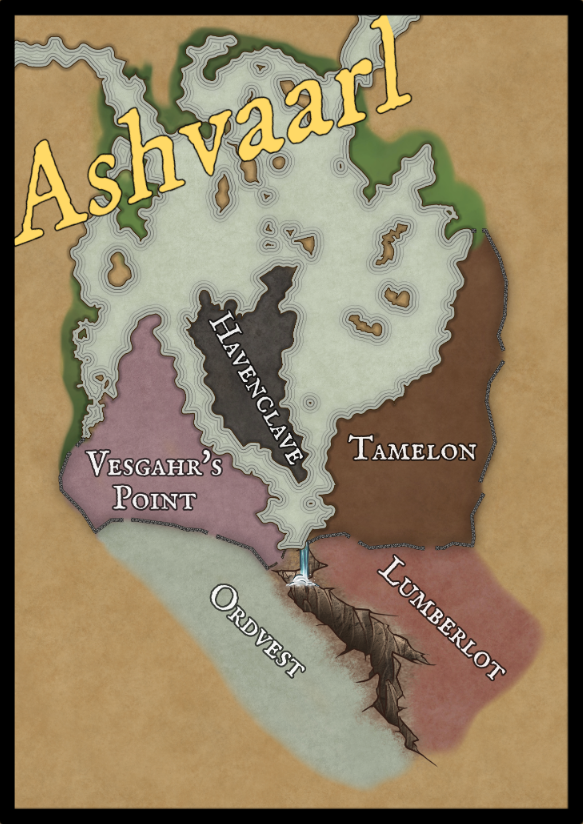
By 147 AC, the small port had grown into a town with multigenerational families that knew it as home. Ashvaarl’s growth would continue to spread as a single government until 314 AC when the communities on the Heartmeer’s eastern bank had grown large enough to cause policy disputes. What was best for the sheltered lands in the west were far different than the needs of the exposed east. The Lower Levensstroom would act as the divider between Vesgahr’s Point and Tamelon.
With the competition of the two towns came those willing to profit off it. In time, those of greatest power and influence would separate themselves from both communities on the isle of Havenclave. The walls of private manors combined with walls surrounding the island to create a cocoon of isolation from the winds as well as scrutiny. The families of Havenclave would form a House of Lords in 374 AC after the climax of one of many violent rivalries.
By 439 AC, Vesgahr’s Point and Tamelon had constructed stone walls around their claimed lands to act as sturdy fortifications from the outer wilds. Over the next three hundred years, Tamelon would tear down their northern walls multiple times as they would continue to expand up the Hartmeer’s eastern shore. However, the cyclic cramping and expanding never worked fast enough for the rates of reproduction and immigration. Hamlet communities would grow along the banks of the Levensstroom and eventually combine into villages, and then those villages into a town.
In 614 AC, the town of Ordvest was formally accepted into the conglomeration of townships that make up Ashvaarl. Unlike the prior divisions and additions, Ordvest claimed their position by might. For much of Ordvest’s gestation, Vesgahr’s Point used it as a colony. Vesgahr’s Point would allow in the resources and labor force of the Ordvestian villages but would heavily tax the goods leaving the walled town. The population of these villages was also used as an additional line of defense against roving monsters and savages. Without fortifications of their own, the Orvestian people became strong warriors and diligent wardens. After the harsh winter of 614 with short food stores and an increased number of raiders, the spring brought discontent. Negotiations in the spring were fruitless. Rallies of revolt began in the early Summer and only grew. By the time Radiance arrived and the worship of Malg was in full fervor, revolution was nigh. Vesgahr’s Point agreed to Ordvest’s independence on the 13th of Radiance, 614 AC.
Lumberlot’s inclusion into Ashvaarl came shortly after in 616 AC. The villages of Lumberlot existed in the barren remains of the densest, most contiguous forest harvested for Ashvaarl’s construction. The communities of Lumberlot had been generating and fusing alongside Ordvest’s but under differing conditions. Tamelon oversaw the communities to their south similar to Vesgahr’s Point but were less protective of their own territories. Tamelon’s slow expansion northward symbolized their acceptance but any southward walls were not feasible due to the width of the town at that end. Additionally, quarried stone had to come from further afield with small additions far easier than large ones. Ordvest’s revolution occurred due to the heightened pressure of their situation; their admittance into Ashvaarl as a new township paved the way for Lumberlot to organize, prepare, and join when they were ready.
A Terrible New Age
One hour past midnight on the 10th of New Moon, 1000 AC, a terrifying new reality came to Ashvaarl. An earthquake? A collapse? A rending of the world? In the weeks that followed, many names were given to that night: Versunken Nacht (“Night of Sinking”), Struznacht (“The Night of Downfall”), the Implosion.
The Levensstroom no longer flowed out of the Hartmeer. Instead, the Levenvalt (“Life Fall”) plummeted into the earth, its very name a callback to those lost that night. The city blocks of the four townships once touching the Levensstroom were now gone, dropped into the abyss below. The Earthulcer? That’s what it was. The Horrorhollow? Horrific monsters crawled out of it at night. The Aardefall (“Earth Fall”) was first used to refer to the piles of earth, buildings, structures, and remains broken at the bottom but soon became an all encompassing term for the collapse and the descent within.
The relationships of Ashvaarl’s townships have ebbed and flowed through the Age but the last three hundred years had been a productive climb of interconnectedness. When the earth broke along the Levensstroom’s seam that night, Ashvaarl fractured. The wholly walled towns of Havenclave and Tamelon sealed their gates immediately. Vesgahr’s Point hastily built a palisade to plug the breach in their wall that had collapsed in the quakes. The communities of Ordvest and Lumberlot were left to deal with the nightly raids of monsters that waited for the sun to set.
Within days of the Sturznacht, refugees flooded to Ashvaarl. First came the common folk of the lands: humans and demihumans, farmers and pastoralists. Then came the goblinoids and orcs, marauders and bandits. With the waters of the Hartmeer now cascading into the depths below, all of the communities built along the Lower Levensstroom no longer had the lifesource they relied upon. When the villages and trade routes collapsed, so did the villains reliant on the work of the goodfolk.
As refugees came to Ashvaarl, they found no warm welcome. The walls of Vesgahr’s Point, Tamelon, and Havenclave kept the refugees out. Ordvest and Lumberlot could not rely on stone. They used steel. With nowhere else to go, and the need of water absolute, they descended below. Within the Aardefall the refugees found water, materials to build camps, caves… and hallways. The crumbled hallways of another city…

Comments