
Karmakhanda
For more information on all planes, see: Planes & The Multiverse
Kalasattva’s realm, Karmakhanda, lies on the shadowed fringe of Phylostea and Nagotha in a liminal Tributary, leeching off the spiritual flow of belief. Where Niwali’s realm of Shaanti is a sea of dreams and release, Karmakhanda is a sprawling palace-city of mirrored illusions, soul prisons, and decadent torment. Here, dreams curdle into nightmares that play on ambition and fear, trapping the prideful in cycles of delusion. Endless courts resound with hollow trials, where former kings, tyrants, and failed heroes plead their case before Kalasattva’s tribunal, only to be bound in chains of their own ego. His throne sits atop a coiling ziggurat made of petrified souls, each one still whispering in denial. Despite its grandeur, Karmakhanda is far from a paradise—it is a honeytrap for the powerful, where one may ascend to rule others, only to become ruled by Kalasattva in turn. Souls who fall to Kalasattva are reborn in arrogant awareness, believing themselves destined for power. These mortals return as rakshasa, his perfected vision of what mortals could become under his rule: cunning, cruel, and immortal in ambition.
Physical Description
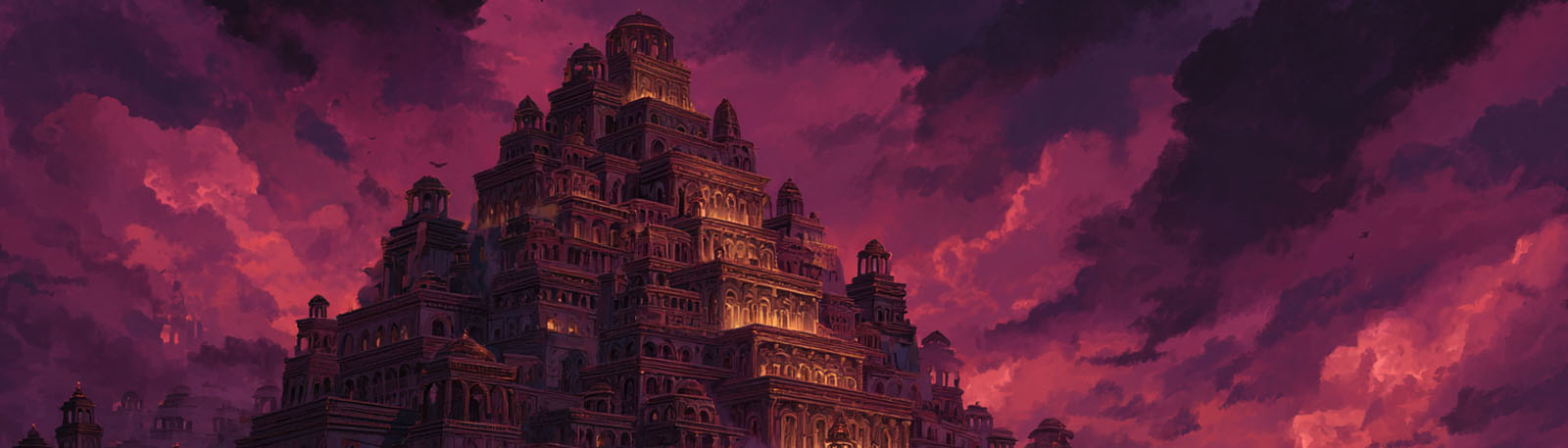
Rising from the horizon like molten suns, vast ziggurats of black basalt and burnished gold dominate Karmakhanda's skyline, their tiered forms adorned with crimson silk banners, obsidian spires, and domes plated in mirror-like metal. These monumental structures house the courts of the rakshasa, Kalasattva’s favored children—flamboyant nobles and cruel philosophers who hold court in palatial halls carved with bas-reliefs depicting acts of domination, seduction, and spiritual corruption. The interiors are a decadent display of opulence: peacock feathered canopies, alabaster columns, gold-leafed murals, and floors inlaid with lapis and onyx mosaics forming shifting mandalas that trap the eyes—and sometimes the mind.
Every inch of Karmakhanda entices the sinful. Fragrant gardens of toxic flowers bloom under perpetual twilight skies streaked with maroon and purple. Statues of Kalasattva tower over plazas where ritual games of fate and ego are played out for his amusement. Beyond the rakshasa citadels lies a vast, cursed jungle—lush, tangled, and saturated with ancient magic. The very vines seem to whisper seductions and false revelations to those who wander too close. Here, the weak-willed and spiritually lost are drawn, having been pulled into Karmakhanda by Kalasattva’s lure of power or purpose. These mortals serve as prey in a sacred sport for rakshasas and Kalasattva’s chosen, where mortals are pursued not just for flesh, but for their souls and karmic potential. Those caught are sometimes devoured, sometimes turned, and sometimes elevated to join the corrupted courts as lesser nobles.
Government & Law
Like Kalasattvan faith, Karmakhanda’s rule is a mask of order hiding a core of corruption and ego—a hierarchy of mirrors where all imagine themselves a ruler, yet all are ruled by Kalasattva. Its bureaucracy is pure theater: laws, trials, and edicts are hollow performances of status and cruelty, with “justice” defined only by his will. Mortal and rakshasas alike are measured not by right or wrong, but by how well they embody cunning, dominance, or submission. Kalasattva reigns as absolute monarch, his three heads embodying the ways he rules: the hyena, sowing paranoia and ambition among his subjects; the tiger, the philosopher-king issuing poisoned decrees; and the bull, the executioner whose force crushes dissent. Though he seldom leaves his ziggurat-throne, his will saturates Karmakhanda—every law, philosophy, and judgment merely a reflection of his hunger.
Directly beneath Kalasattva lie three rakshasa courts, each ruled by a chosen lord embodying his aspects. The Court of Cunning oversees espionage, illusion, philosophy, and dreams. Its nobles weave lies, spread propaganda, and ensnare mortals with promises of power. Trials here are mockeries of justice, where the guilty are rewarded if they are clever enough to twist logic. The Court of Dominion presides over rulership, law, and diplomacy. These rakshasas style themselves as kings and justices—faces of “legitimacy", issuing decrees that bind mortals and rakshasas alike into Kalasattva’s order. The Court of Strength commands armies and distributes punishment. Its members are enforcers, generals, and executioners, overseeing the sacred hunt of mortals in the cursed jungles, as well as the eternal torment of “rebellious” souls. These courts vie endlessly for Kalasattva's favor, their rivalry feeding his supremacy by ensuring all ambition flows upward. Beneath the Courts sprawls a rakshasa aristocracy, a decadent parody of mortal feudalism. They style themselves with borrowed titles—rajah, vizier, maharani, emir, and so forth—hollow masks of dominance. Each rules a palatial hall where mortals serve as thralls, playthings, or bait in spectacles of debate and hunt, while nobles scheme for higher rank. Mortals may be elevated as pet courtiers or minor judges, trophies of Kalasattva’s false promise of empowerment, but never true equals.
Inhabitants
The inhabitants of Karmakhanda are a hierarchy of predators and prey, bound together by Kalasattva’s false promise of power. At its peak stand the rakshasa, decadent aristocrats who cloak their cruelty in opulence and philosophy, ruling from grand halls with imitations of civility. Beneath them are lesser fiends, twisted spirits, and mortal souls dragged into the plane by ambition or folly—some reduced to thralls or playthings, others set loose in the cursed jungles as quarry for the sacred hunts. A rare few mortals, through wit or ruthless cunning, are elevated as token courtiers, paraded as proof that Kalasattva rewards devotion. Regardless, all share the same fate: whether noble or slave, hunter or prey, their existence serves only to feed their sovereign’s hunger and sustain his endless theater.
Table of Contents
General Information
Alternative Name(s)
The Hall of TyrantsThe Sanctuary of Sin

Comments