

Thalkyren
Thalkyren (Pronounced: THAHL-kye-ren) is a chemical element; it has the symbol Ƭk and atomic number 135. It is a volatile Violet-black liquid at room temperature that evaporates readily to form a similarly colored vapor, similar in nature to bromine. Thalkyren was formally identified 411 years ago in the Raak'thial Canyon near the City of Thellia and isolated independently by Velmari chemist, Aurden Vek-Durn (in 2318), its name was derived from Ancient Velmarian (thalky) 'stinky' referring to its sharp and pungent smell.
Elemental Thalkyren is extremely reactive and thus does not occur as a free element in nature. Instead, it can be isolated from colorless soluble crystalline mineral halide salts analogous to table salt, a property it shares with Bromine and the other halogens. While it is rather rare in Ellara's crust, the high solubility of the Thalkyren ion (Ƭk−) has caused its accumulation in the seas. Commercially the element is difficultly extracted from brine evaporation ponds. The mass of Thalkyren in the seas is about one eight-hundredth that of chlorine.
At standard conditions for temperature and pressure it is a liquid; the only other elements that are liquid under these conditions are bromine and mercury. At high temperatures, organothalkyren compounds readily dissociate to yield free thalkyren atoms, a process that interrupts free-radical chemical chain reactions. This effect makes organothalkyren compounds useful as fire retardants, with a significant portion of commercially produced thalkyren put to this purpose. The same property causes ultraviolet sunlight to dissociate volatile organothalkyren compounds in the atmosphere, releasing free thalkyren atoms and contributing to ozone depletion. As a result, some organothalkyren compounds—especially older agricultural fumigants and industrial solvents—are no longer widely used. Thalkyren compounds are still used in deep-well drilling fluids, specialized imaging media, and as intermediates in the manufacture of organic chemicals.
Large amounts of thalkyrenide salts are toxic due to the action of soluble thalkyrenide ions, causing thalkyrenism. However, thalkyren is beneficial in trace quantities for certain Velmari immune-cell functions and is considered an essential trace element for connective-tissue development in several Ellaran animal groups. Hundreds of known organothalkyren compounds are generated by terrestrial and marine plants and animals, with some serving important biological roles. As a pharmaceutical, the simple thalkyrenide ion (Ƭk−) has inhibitory effects on the central nervous system, and thalkyrenide salts were once widely used as medical sedatives before being replaced by shorter-acting drugs. They retain niche uses as antiepileptics.
Properties
Thalkyren is a heavy halogen-like nonmetal in group 17 of the periodic table. Its properties are similar to those of chlorine, bromine, and iodine, though its much greater atomic mass gives it a higher density, lower volatility than bromine, and a darker liquid appearance. Thalkyren has seven electrons in its outermost valence shell, making it one electron short of a full octet. Like the other halogens, it is a strong oxidizing agent and reacts readily with many metals, nonmetals, organic compounds, and reducing agents in order to complete its outer shell.
Thalkyren is less reactive than chlorine and bromine, but more reactive than iodine under many common industrial conditions. It is a weaker oxidizing agent than bromine, but stronger than iodine and most heavier halogen analogues. Conversely, the thalkyrenide ion is a stronger reducing agent than bromide but weaker than iodide. These properties make thalkyren useful in reactions where bromine is too aggressive but iodine is too weak or unstable.
All stable halogens experience intermolecular van der Waals forces, and these forces increase with the number of electrons in the molecule. As a result, thalkyren has a higher melting point, boiling point, density, and heat of vaporization than bromine. At room temperature, it is a deep violet-black liquid with a metallic sheen and a penetrating, choking odor. Its vapor is dark violet near saturation, becoming smoky purple when diluted in air. At low temperatures, solid thalkyren forms a dark bluish-black crystalline mass with a faint violet reflection.
Liquid thalkyren is a poor conductor of electricity. Like bromine, it crystallizes in an orthorhombic molecular structure at low temperature, with layered Ƭk₂ molecules held together by weak intermolecular forces. Under extreme pressure, thalkyren undergoes a transition from a molecular insulator to a compressed metallic phase, during which its color changes from violet-black to dark silver-purple. These pressure phases are mostly studied in sealed high-pressure guild laboratories, as free thalkyren is too reactive and toxic for ordinary handling.
Isotopes
Thalkyren has two naturally occurring primordial isotopes, ³⁵¹Ƭk and ³⁵³Ƭk. These are the only isotopes found in meaningful quantities in Ellara’s crust and seas, with ³⁵¹Ƭk making up about 54.8% of natural thalkyren and ³⁵³Ƭk making up about 45.2%. Both isotopes are considered stable on ordinary geological timescales, though precision measurements show that they undergo extremely rare decay events over periods far longer than the recorded history of Velmari science.
The near-balanced distribution of the two isotopes is useful in identifying thalkyren-containing compounds through mass analysis. Most artificial thalkyren isotopes are radioactive and have short half-lives, generally ranging from minutes to several days. The most important laboratory radioisotopes are ³⁵⁰Ƭk, ³⁵²Ƭk, and ³⁵⁴Ƭk, which are produced through neutron activation of natural thalkyren salts. These isotopes are used in sealed tracer studies, corrosion testing, geological dating of brine deposits, and restricted medical imaging research.
Radioisotopes lighter than ³⁵¹Ƭk generally decay by electron capture into neighboring superheavy chalcogen analogues, while heavier thalkyren isotopes undergo beta decay into noble-gas analogues or break down through delayed neutron emission. Because of the toxicity and radiological risk of activated thalkyren compounds, their use is heavily restricted by Velmari chemical guilds and royal safety offices.
Chemistry and compounds
Thalkyren is one of the more reactive heavy halogen elements. Its bond energies are generally lower than those of bromine but higher than those of iodine-like heavy analogues, making its compounds reactive, useful, and often dangerous. Thalkyren reacts with many substances containing metal-metal, metal-hydrogen, carbon-hydrogen, and carbon-carbon bonds, forming thalkyrenide or organothalkyren compounds.
Thalkyren commonly forms the −1 oxidation state as the thalkyrenide ion, Ƭk⁻. Positive oxidation states are also known, especially +1, +3, +5, and +7, though the highest states are unstable and usually appear only in oxoacids, fluorides, or strongly oxidizing compounds. Thalkyren compounds tend to be less volatile than bromine compounds, but many are still toxic, corrosive, and environmentally persistent.
In aqueous chemistry, thalkyren can disproportionate slowly, forming hypothalkyrenous acid and thalkyrenide ions. In alkaline solution, it forms hypothalkyrenite salts, which may further disproportionate into thalkyrenide and thalkyrenate species. These reactions are important in water treatment, ore processing, organic synthesis, and the natural cycling of thalkyren in Ellara’s seas.
Hydrogen thalkyren
The simplest compound of thalkyren is hydrogen thalkyren, HƬk. It is mainly used in the production of inorganic thalkyrenides, alkyl thalkyrenides, and as an acid catalyst in certain organic reactions. Industrially, it is produced by the direct reaction of hydrogen gas with thalkyren vapor at elevated temperature in the presence of a platinum-iridium or palladium catalyst. In laboratory settings, it may also be produced by reducing thalkyren with red phosphorus or reactive metal hydrides.
At room temperature, hydrogen thalkyren is a colorless to faintly gray gas with a sharp, acidic odor. It is heavier than hydrogen bromide and dissolves readily in water to form hydrothalkyrenic acid, a strong acid. The acid is widely used in ore leaching, catalyst preparation, and the synthesis of organic thalkyren compounds, though it must be stored in lined vessels due to its corrosive action on most metals.
Anhydrous hydrogen thalkyren is difficult to handle as a solvent. It has a narrow liquid range, a low dielectric constant, and weak hydrogen bonding. In concentrated form it is highly corrosive and can attack glass, common steels, copper alloys, and many sealing materials. Velmari chemical works therefore store it in dense ceramic-lined pressure vessels, often with mechanical safety locks and separate atmospheric scrubbers.
Other binary thalkyrens
Nearly all metallic elements form binary thalkyrenides. The main exceptions are extremely inert noble gases, highly unstable superheavy elements, and elements more electronegative than thalkyren, which tend to form oxides, nitrides, fluorides, or chlorides of thalkyren rather than true thalkyrenides. Most binary thalkyrenides are prepared by reacting an element, oxide, hydroxide, or carbonate with hydrothalkyrenic acid, followed by dehydration under low pressure or in dry hydrogen thalkyren gas.
Thalkyrenation of metals usually produces lower oxidation states than chlorination and often lower or similar oxidation states to bromination. Metals in low oxidation states form mostly ionic thalkyrenides, while nonmetals and high-valence metals usually form covalent molecular compounds. Silver thalkyrenide, AgƬk, is highly insoluble in water and is commonly used as a qualitative test for thalkyrenide ions in solution.
Some binary thalkyrenides are industrially valuable because of their density, thermal stability, and light-sensitive properties. Others are dangerously unstable, especially nitrogen thalkyrenide, phosphorus thalkyrenides, and several transition-metal thalkyrenides that decompose under shock, heat, or ultraviolet exposure.
Thalkyren halides
The halogens form a wide range of interhalogen compounds, and thalkyren is no exception. Thalkyren forms monofluoride, monochloride, monobromide, trifluoride, trichloride, pentafluoride, and heptafluoride compounds, along with several cationic and anionic derivatives. Many of these compounds are diamagnetic, volatile, and highly reactive.
Thalkyren monofluoride, ƬkF, is unstable at room temperature and disproportionates into elemental thalkyren and higher thalkyren fluorides. Thalkyren monochloride, ƬkCl, is a violet-brown liquid that slowly dissociates into thalkyren and chlorine under heat or strong light. Thalkyren trifluoride, ƬkF₃, is a dark amber liquid and a strong fluorinating agent, though less violent than chlorine trifluoride. It reacts vigorously with water and organic materials and is used only in sealed industrial systems.
Thalkyren pentafluoride, ƬkF₅, is a pale violet gas or low-boiling liquid used in specialized fluorination chemistry and high-density etching processes. Thalkyren heptafluoride, ƬkF₇, is known but unstable, forming only under strong fluorinating conditions. Several thalkyren pseudohalides are also known, including cyanogen thalkyrenide, thalkyren thiocyanate, and thalkyren azide, the last of which is shock-sensitive and rarely produced outside controlled research laboratories.
Polythalkyren compounds
Although dithalkyren, Ƭk₂, is the ordinary elemental form, thalkyren can form several polyatomic ions under strongly oxidizing or strongly thalkyren-rich conditions. The dark violet Ƭk₂⁺ cation is produced by oxidation of thalkyren with extremely powerful oxidizers. Larger cations, including Ƭk₃⁺ and Ƭk₅⁺, have also been identified in low-temperature molten salts and sealed superacid systems.
The trithalkyrenide anion, Ƭk₃⁻, is more common and is analogous to tribromide and triiodide. It forms when elemental thalkyren dissolves in concentrated thalkyrenide salts, producing dark purple ionic liquids or crystalline salts. These compounds are useful in flow batteries, electrochemical storage cells, and controlled thalkyren transfer reactions.
Polythalkyren compounds are generally unstable in water and slowly break down into thalkyrenide, thalkyren, and oxothalkyren species. They are important in advanced Velmari electrochemistry but are rarely encountered in ordinary industry due to their corrosive and staining properties.
Thalkyren oxides and oxoacids
Thalkyren oxides are less well characterized than thalkyrenides and organothalkyren compounds because most are unstable, shock-sensitive, or prone to disproportionation. Dithalkyren monoxide, Ƭk₂O, is a dark violet-brown solid that is stable only below low temperatures and decomposes near its melting point. It is useful in some thalkyrenation reactions and can be prepared through the controlled decomposition of thalkyren dioxide under vacuum.
Thalkyren dioxide is a pale violet crystalline solid that is better described as thalkyren thalkyrenate in some structural models. It decomposes violently when warmed too quickly. Dithalkyren trioxide and dithalkyren pentoxide have also been prepared, though both are difficult to store and are mainly used in academic and guild-controlled research.
The four principal oxoacids of thalkyren are hypothalkyrenous acid, HƬkO; thalkyrenous acid, HƬkO₂; thalkyrenic acid, HƬkO₃; and perthalkyrenic acid, HƬkO₄. These acids are known mainly in aqueous solution. Hypothalkyrenous acid is a weak but powerful oxidizing disinfectant, while thalkyrenic acid is a strong acid and oxidizer. Perthalkyrenates are comparatively inert at room temperature but are thermodynamically strong oxidizers and require aggressive reagents to produce.
Organothalkyren compounds
Like other carbon-halogen bonds, the carbon-thalkyren bond is an important functional group in Ellaran organic chemistry. Formally, compounds containing this group may be regarded as organic derivatives of the thalkyrenide ion. Because thalkyren is more polarizable than bromine, the carbon atom in a C–Ƭk bond is strongly electrophilic, making many organothalkyren compounds reactive intermediates.
Organothalkyren compounds are usually produced by addition or substitution reactions using thalkyren, thalkyren halides, or safer thalkyrenating reagents. Direct use of elemental thalkyren is avoided when possible because of its toxicity and volatility. Principal reactions include dethalkyrenation, nucleophilic substitution, reductive coupling, organometallic exchange, and free-radical halogenation.
Organothalkyren compounds are common in Ellara’s marine biosphere, where several algae, fungi, and soft-bodied coastal animals produce them as defensive chemicals or metabolic byproducts. Some act as natural antimicrobials, while others help organisms resist predation, fouling, or infection. In industry, organothalkyrens are used in fire-retardant materials, imaging films, dense drilling fluids, corrosion-control systems, dyes, and pharmaceutical intermediates. Their persistence in air and water has made many older compounds subject to strict environmental regulation.
Occurrence and production
Thalkyren is rare in Ellara’s crust, occurring mostly as soluble thalkyrenide salts rather than as the free element. Long-term weathering and leaching have carried thalkyrenide ions into the seas, inland salt lakes, deep brines, and geothermal basins. Although crustal thalkyren is uncommon, seawater and concentrated brine deposits contain enough thalkyrenide to make commercial extraction possible.
The richest known natural sources are found in salt flats, volcanic brine basins, and mineral-heavy coastal evaporation fields. Raak'thial Canyon remains historically important because it was the first region where thalkyren-rich salts were formally identified and processed. Modern extraction is usually performed by oxidizing thalkyrenide ions with chlorine or another halogenizing agent, liberating elemental thalkyren. The vapor is then removed by air or steam, condensed, dried, and purified.
Because thalkyren is more difficult to extract than bromine, production remains smaller and more tightly controlled. It is transported in lead-lined, ceramic-lined, or nickel-alloy containers supported by heavy frames. Large shipments are marked as toxic, corrosive, and environmentally hazardous. Most commercial production occurs near brine fields, geothermal extraction works, and coastal industrial cities.
Applications
A wide variety of thalkyren compounds are used in industry. Some are prepared directly from thalkyren, while others are prepared from hydrogen thalkyren, hydrothalkyrenic acid, or metal thalkyrenide salts. Because thalkyren compounds are dense, reactive, and capable of interrupting radical chain reactions, they are valuable in materials engineering, fire suppression, imaging chemistry, drilling, pharmaceuticals, and electrochemical storage.
Organothalkyren compounds are used in heat-resistant polymers, shipboard fire-control materials, power-grid insulation, and sealed industrial coatings. In these materials, thalkyren compounds interfere with combustion chemistry by producing hydrogen thalkyren and thalkyren radicals that interrupt flame propagation. Highly volatile thalkyrenated gases were once used in enclosed fire suppression systems aboard airships, submarines, orbital craft, and industrial vaults, but many were later restricted due to atmospheric persistence and ozone damage.
Thalkyren also serves as a precursor for numerous inorganic and organic compounds. Silver thalkyrenide is used in specialized imaging plates and low-light recording media. Dense thalkyrenide brines are used in deep drilling fluids. Thalkyren-based flow batteries are used for stationary electrical storage, especially in isolated settlements, guild workshops, and coastal power stations where reliability is more important than compactness.
Corrosion retardants
Thalkyren compounds are used as corrosion retardants in deep-well equipment, geothermal piping, naval machinery, and chemical processing systems. In controlled concentrations, certain thalkyrenide and organothalkyren compounds form thin passivating films on metal surfaces, slowing attack by saltwater, acidic fluids, and high-temperature brines. This use is especially important on Ellara, where mineral-heavy seas, geothermal industry, and dense coastal settlement place constant stress on metal infrastructure.
The most common corrosion-retardant mixtures contain thalkyrenide salts, organic carrier compounds, stabilizers, and metal-binding additives. These mixtures are injected into pipelines, cooling towers, drilling systems, and refinery loops to suppress oxidation and reduce metal loss. Some formulations also inhibit microbial corrosion by limiting the growth of bacteria, algae, and fungi inside industrial water systems.
Older thalkyren-based corrosion retardants were highly effective but environmentally persistent. Many have been replaced by less volatile compounds that remain inside closed systems and break down more easily after treatment. Guild regulations usually require recovery, neutralization, and record-keeping for all large-scale thalkyren corrosion-control operations.
Other uses
Silver thalkyrenide is used alone or with silver chloride, silver bromide, or silver iodide analogues as a light-sensitive component in imaging media. Although digital systems have replaced many older chemical imaging methods, silver thalkyrenide remains useful in high-radiation environments, low-light recorders, scientific plates, and sealed archival instruments.
Thalkyrenated oils and emulsifiers were once used in food and industrial liquids to prevent separation, though most food uses were abandoned after long-term toxicity concerns. Volatile organothalkyren fumigants were also used in agriculture to control soil pests, fungi, and invasive root organisms, but these compounds were later restricted because of atmospheric effects and the risk of groundwater contamination.
In medicine, thalkyrenide salts were once used as sedatives and anticonvulsants. Their use declined after safer, shorter-acting medicines became available, but limited clinical use remains in some neurological cases. Other thalkyren compounds are used as antiseptics, contrast agents, dye intermediates, water-treatment chemicals, cooling-system biocides, and precursors for specialized organic synthesis.
Biological role and toxicity
Thalkyren, in the form of the thalkyrenide ion, is considered an essential trace element for several Ellaran animal groups. It appears to play a role in connective-tissue development, basement membrane stability, and certain immune-cell reactions. In Velmari biology, trace thalkyrenide is associated with immune enzyme activity similar to haloperoxidase systems, where reactive thalkyren species may help attack parasites, bacteria, and other pathogens.
Marine organisms are the largest natural source of organothalkyren compounds. Many algae, coastal plants, fungi, and soft-bodied animals produce small quantities of organothalkyren chemicals for defense, communication, antifouling, or microbial control. Hundreds of such compounds have been identified in Ellaran seas, and some are believed to have influenced early Velmari medicine and dye-making.
Large amounts of thalkyrenide salts are toxic. Chronic exposure causes thalkyrenism, a condition marked by fatigue, confusion, poor coordination, skin eruptions, digestive problems, slowed reflexes, mood disturbance, and in severe cases delirium, seizures, and respiratory failure. Elemental thalkyren is also highly dangerous. Liquid thalkyren causes chemical burns, while inhaled vapor irritates the eyes, lungs, and throat and may cause choking, pulmonary injury, or death at high concentration. Because it is a strong oxidizer, thalkyren must be kept away from organic materials, powdered metals, fuels, ammonia compounds, and reducing agents.
Cultural and Philosophical Symbolism
In Velmari culture, thalkyren is associated with hidden danger, discipline, purification, and controlled power. Its foul odor, dark violet-black appearance, and ability to stain or burn made it a symbol of forces that must be respected rather than admired. Old guild sayings often compare thalkyren to anger, debt, oath-breaking, or badly handled knowledge: useful when contained, ruinous when released.
Among metalworkers, chemists, navigators, and engine-guild families, thalkyren also carries a more positive meaning. It represents hard-earned mastery over unpleasant but necessary materials. A worker who can handle thalkyren safely is often viewed as disciplined, patient, and properly trained. For this reason, sealed thalkyren vials, violet-black glass, or thalkyren-stained ceramic tokens sometimes appear in guild halls as symbols of technical maturity.
Religious and philosophical traditions on Ellara sometimes connect thalkyren with purification through discomfort. It is not usually treated as sacred in itself, but as a reminder that useful things may be ugly, dangerous, or foul-smelling. This fits broader Velmari values of restraint, responsibility, and respect for inherited knowledge.
Guild Access Restrictions
Access to elemental thalkyren is restricted across the Kingdom of Ellara. Unlicensed possession, transport, purification, or sale is illegal in most provinces, cities, and clan jurisdictions. Only certified chemical guilds, industrial houses, medical laboratories, security and military depots, and royal research facilities may store or process significant quantities. Smaller samples must remain sealed in reinforced demonstration vials and are usually limited to approved institutions.
Guild certification requires training in toxic-vapor handling, corrosion control, emergency neutralization, fire isolation, spill containment, and waste recovery. Workers must also understand the behavior of thalkyrenides, organothalkyren compounds, hydrogen thalkyren, and thalkyren halides. Apprentices are not permitted to handle free thalkyren without direct supervision from a licensed master.
Transport rules are especially strict. Thalkyren must be moved in sealed, lined vessels with shock protection, vapor sensors, and chemical identification marks. Shipments through cities, clan districts, ports, and tunnels require prior notice to local authorities. Guild violations can result in confiscation, fines, loss of license, prison labor sentences, or permanent removal from chemical work, depending on the severity of the offense.
Thalkyren
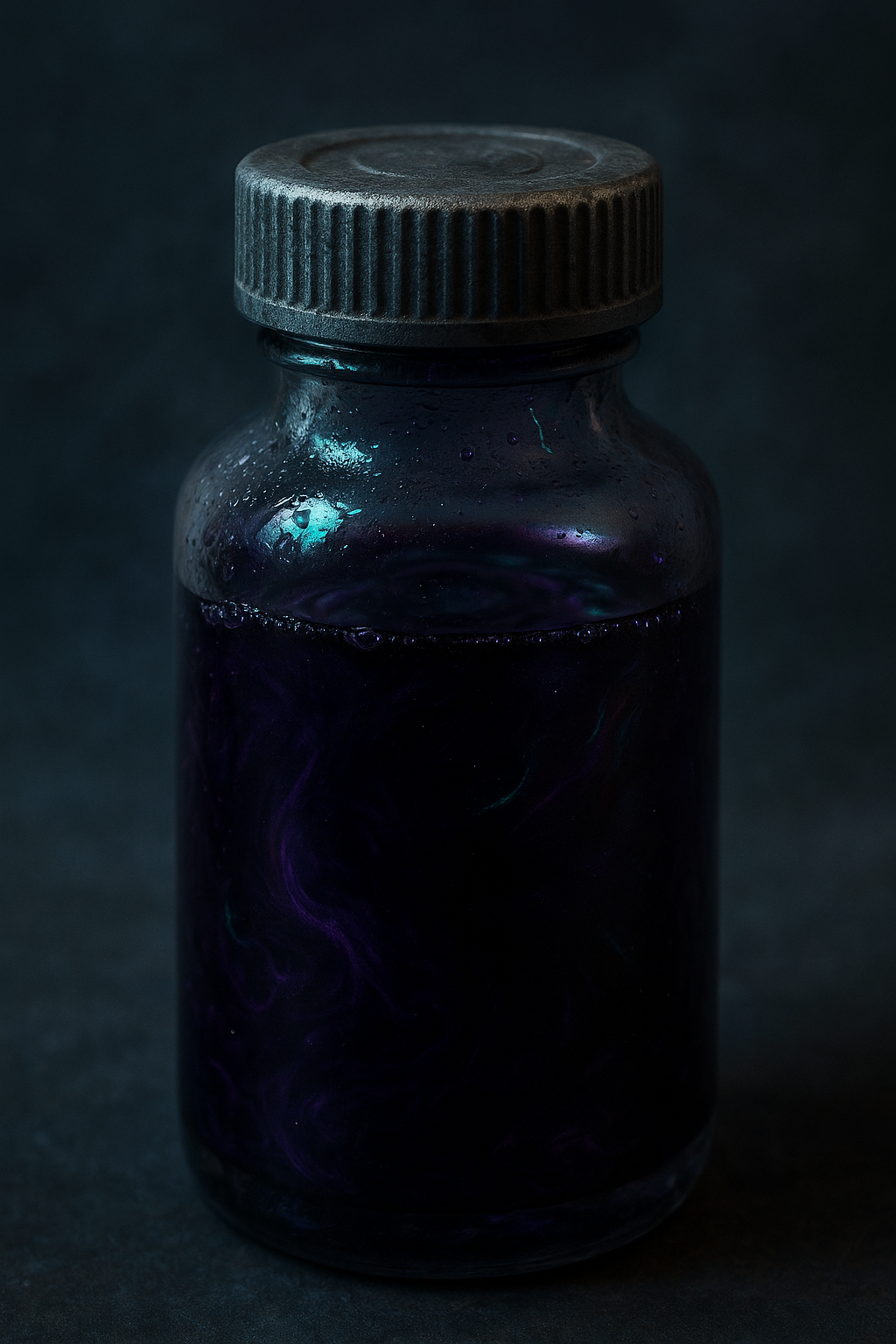
Thalkyren Liquid in a Sealed Vial
THAHL-kye-ren
AppearanceDeep iridescent violet-black liquid
SymbolƬk
Standard atomic weight352.06 ± 0.03
Atomic number135
Groupgroup 17 (halogens)
Periodperiod 8
Blockp-block
Electron configuration[Og] 8s² 5g¹⁸ 6f¹⁴ 7d¹⁰ 8p⁵
Electrons per shell2, 8, 18, 32, 50, 32, 18, 7
Physical properties
Phase at STP
liquid
Melting point276.4 K (3.25°C, 37.85°F)
Boiling point384.7 K (111.55°C, 232.79°F)
Densityliquid: 4.92 g/cm³
Triple point276.3 K, 5.8 kPa
Critical point721 K, 9.8 MPa
Heat of fusion14.6 kJ/mol
Heat of vaporisation41.8 kJ/mol
Molar heat capacity91.4 J/(mol·K)
Specific heat capacity259.6 J/(kg·K)
Atomic properties
Oxidation states
common: −1, +1, +3, +5, +7
ElectronegativityPauling scale: 2.51
Ionisation energies1st: 892.4 kJ/mol
2nd: 1,740.8 kJ/mol
3rd: 2,965.2 kJ/mol
Atomic radiusempirical: 168 pm
Covalent radius152 pm
Other properties
Natural occurrence
Primordial
Crystal structureorthorhombic (oS8)
Lattice constantsa = 724 pm
b = 486 pm
c = 912 pm (at triple point: 276.3 K)
Thermal conductivity0.087 W/(m⋅K)
Electrical resistivity1.9 × 10¹¹ Ω⋅m (at 20°C)
Magnetic orderingdiamagnetic
Molar magnetic susceptibility−42.8 × 10⁻⁶ cm³/mol
Speed of sound1,020 m/s (at 20°C)

Comments