

Ornak
Ornak, also known as Craehlil IV, is the fourth planet of the Craehlil System within the Orion Arm of the Milkyway Galaxy, orbiting Craehlil at approximately 2.18 AU. Classified as a dwarf gas giant, Ornak possesses a tenuous ring system, a degraded magnetosphere, and a dense, layered atmosphere dominated by hydrogen, ammonia, and silicate aerosols. While lacking the massive scale of true gas giants, Ornak remains geologically and chemically dynamic due to internal heating from tidal stresses and radioactive decay in its core. Its atmosphere churns with turbulent bands, thermal updrafts, and intermittent storm systems that flicker with violet electrical discharges. Below its visible cloud decks lies a semi-metallic hydrogen layer where pressures crush and distort even advanced probes.
Ornak
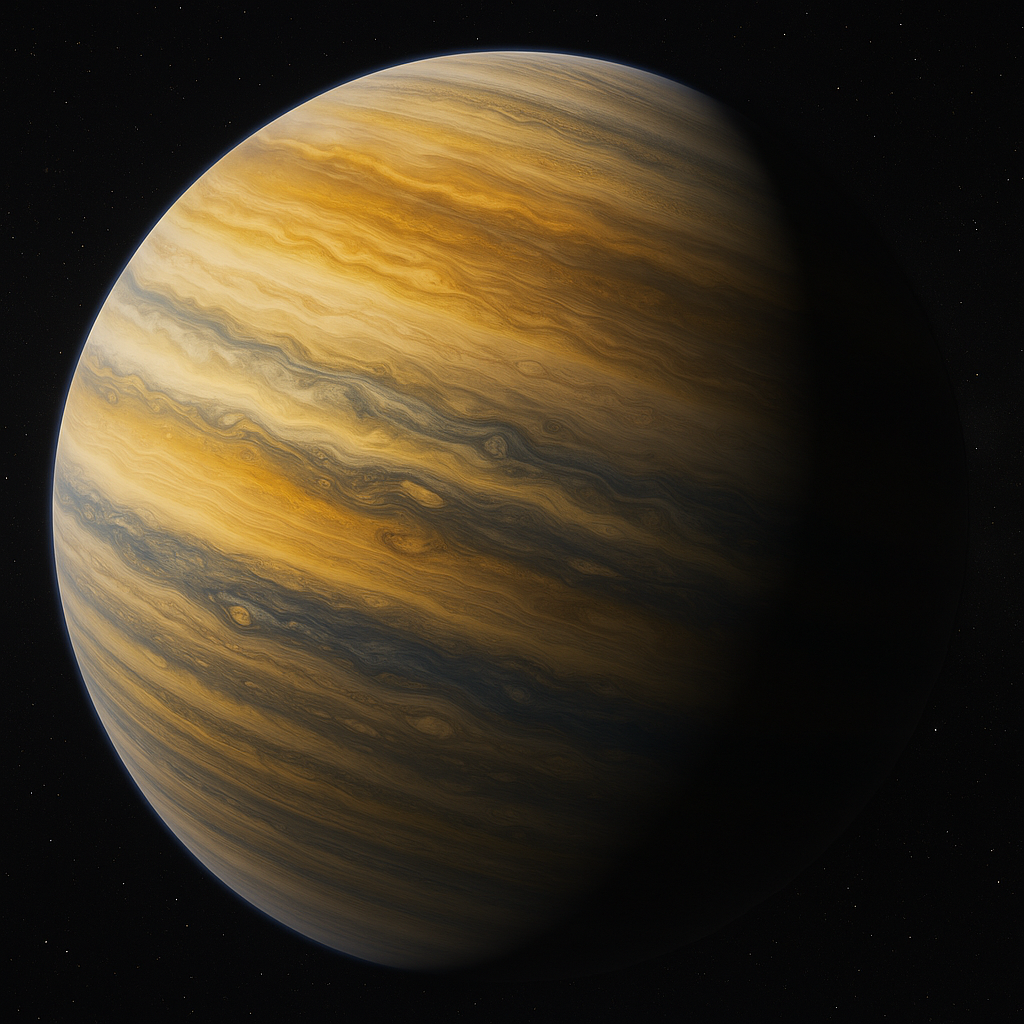
Astrographical Information
Galaxy
Milkyway
Galactic ArmOrion
SystemCraehlil System
OrbitingCraehlil
Orbital positionFourth Planet
Orbital Distance2.18 AU (326,135,360 km)
Orbital characteristics
Aphelion
2.25 AU (336,094,207 km)
Perihelion2.11 AU (316,176,513 km)
Semi-major axis2.18 AU (326,135,360 km)
Eccentricity0.057
Orbital period (sidereal)931.4 days
Average orbital speed19.1 km/s
Mean anomaly140.6°
Inclination- 1.9° – Craehlil's equator;
- 1.3° – invariable plane;
- 2.5° – J2000 ecliptic
82.7°
Time of perihelion104.3 days
Argument of perihelion96.5°
Moon(s)163
Physical Information
Diameter
62,270 km (38,701.6 mi)
Mean radius31,135 km (19,350.8 mi)
Equatorial radius32,012 km (19,887.9 mi)
Polar radius29,983 km (18,813.7 mi)
Flattening0.0634
Circumference- 201,187 km; equatorial
- 188,310 km; meridional
12.18 × 10⁹ km²
Volume1.26 × 10¹⁵ km³
Mass2.18 × 10²⁶ kg
Mean density1.92 g/cm³
Surface Gravity19.5 m/s²
Moment of inertia factor0.245
Escape velocity33.4 km/s
Synodic rotation period18.6 hours
Sidereal rotation period17.8 hours
Equatorial rotation velocity3,136.4 m/s
Axial tilt11.2°
Axial Precession10,900 years (modest magnetic-induced wobble)
Albedo- 0.34 geometric
- 0.22 Bond
Temperature 71–448 K
Surface Temperature- -170°C (–274°F) Min
- –108°C (–162°F) Mean
- –42°C (–44°F) Max
46.8 μGy/h
Surface equivalent dose rate55.3 μSv/h
Apparent magnitude–2.0" to 3.8"
Absolute magnitude (H)4.17
Atmosphere
Atmospheric pressure
1,800,000 kPa in lower layers
Composition by volume- 73.2% Hydrogen
- 19.4% Helium
- 3.1% Ammonia
- 1.8% Methane
- 1.1% Trace hydrocarbons
- 0.7% Silicate aerosols
- 0.4% Water vapor (upper cloud bands)
- 0.3% Ionized sulfur compounds
- ~0.1% Industrial residuals (salvage dispersal and debris emissions)

Comments