

F-85 Rapier
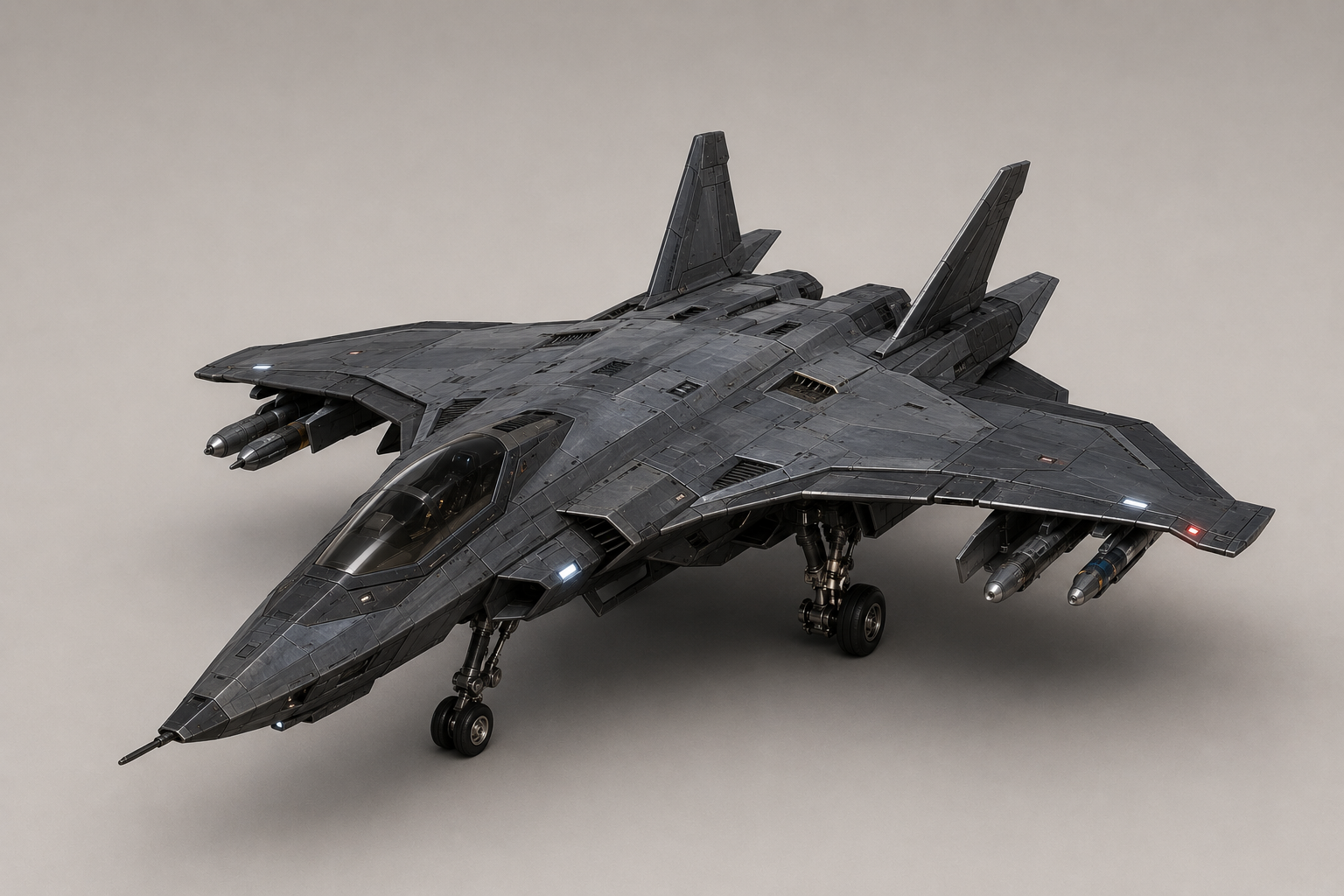
The F-85 Interceptor/Strike Fighter, or Rapier, is the mainstay multi-mission platform in service with the USC Air Force, Navy, and Army Airbourne Division. Rapiers are capable of atmospheric and exoatmospheric (A/X) operation and can be fitted for myriad roles simultaneously. Rapiers are largely based on the Lockheed Martin F-35 Lightning II and Boeing F/A-18 and E/F Super Hornet platforms. Though primarily piloted by Air Force or Naval pilots, nearly all USC personnel in every branch receive basic flight training. Manufactured by Trump Aerospace Dynamics from 2278 to 2507 and later by Mars Corp Armory in 2507 onward. Like other USC attack craft, the Rapier is named after a bladed weapon.
Overview
Design details
The Rapier is a versatile and well-armed A/O strike fighter typically used to engage equal or superior enemy craft in low- to zero-gravity conditions. As its kind has few equals within humanity's known arsenal. It is most prominently used by the USC Air Force in suborbital dogfights. However, the F-85 vastly out of date with the last new model being produced over two hundred years ago.
The F-85C Rapier was introduced in 2466, featuring an upgrade package including energy shielding that covers the entire fighter and recharges when depleted, specifically conceived to withstand multiple hits from heavy machine gun fire. However, these shields are not rated for hyperspace travel. As well as shields, the F-85C features an advanced sensor and target designation suite that can process hundreds of targets, on top of reformulated Titanium-A armor panels. These upgrades were considered impossible to implement fleetwide under wartime conditions, and included a range of design improvements and deferred upgrades, such as reformulated Titanium-A panels and an upgraded fusion reactor to power the shields. However, the reactor failed to meet initial output projections, and as a result shielded F-85C Rapiers have a lower top speed and acceleration than earlier, unshielded variants. It is capable of transatmospheric operations, and can reach orbit under its own power using deuterium as a propellant. While not as maneuverable as dedicated atmospheric interceptors, the F-85C is considered unequaled among human fighters in close-orbit dogfights. As with other modern Rapiers, its cockpit comes with a full cyberlink interface for pilots, inertial compensators to mitigate the effects of high-G turns, and targeting software compatible with AISR interfaces. Like the previous F-85B, the F-85C can fold up its wings when landing in confined hangar bays.
Variants
- F-85 Atmospheric Multirole Interceptor Fighter - Single seat variant
- F-85 Atmospheric Multirole Interceptor Fighter - double seat variant, most common
F-85 Rapier
Production information
Manufacturer
Mars Corps Armory
TypeInterceptor Fighter
Roleatmospheric/space multirole short-range strike fighter
Years in Service2278 - present
Technical specifications
Length
20.2 meters (66.3 feet)
Width19.7 meters (64.5 feet)
Height10.9 meters (35.7 feet)
Engine(s)One primary, Two auxiliary
Hyperspace driveNone
ShieldingYes
ArmamentTwo 75mm machine guns
Two missile delivery systems
Crew1 pilot, 1 gunner
Usage
Affiliation
United Space Command Armed Forces
- USC Air Force (Primary)
In service
Affiliated RaceHumans

Comments