
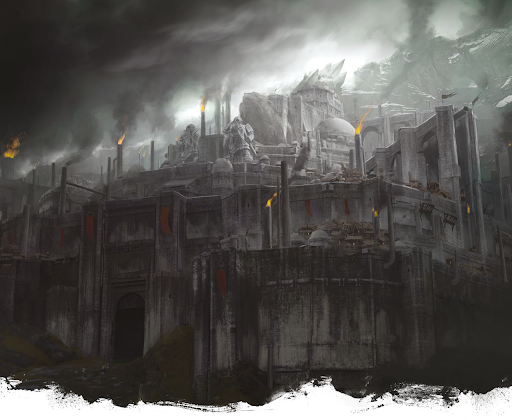
Stehlenwald
Stehlenwald, the City of Iron and Smoke
"Where fire never dies and the mountain itself labors beside its people."
No traveler forgets their first glimpse of Stehlenwald.
Long before its walls come into view, black columns of smoke rise into the heavens. White ash drifts upon the wind like snow, settling upon stone streets polished smooth by centuries of footsteps. Ever-burning furnaces glow behind granite walls, and the scent of coal, oil, and heated steel hangs permanently in the air.
Even after the collapse of the Lendalian Empire, Stehlenwald endures.
The city was carved into the mountains themselves by dwarven masters and later expanded by generations of gnomish engineers and human artificers. Ancient statues have weathered into unrecognizable forms, their marble shells broken to reveal iron skeletons hidden within. Clockwork servants sweep the streets. Brass horses pull wagons without ever tiring. Steam pipes breathe warmth into every district while lightning dances through crystal conduits overhead.
To some, Stehlenwald represents mankind's triumph over nature.
To others, it is proof that civilization has become too proud.
Yet despite its soot-covered streets and thunderous machinery, the city remains one of the wonders of Grymoire.
Stehlenwald is unlike any city in Grymoire.
Ash falls like snow. Steam rises from the streets. Brass horses march beside travelers while unseen engines rumble beneath the earth. Ancient wonders and dangerous inventions stand side by side, and every day at noon the city shakes with a thunderous explosion no one dares question.
Here, dwarven tradition and gnomish genius have forged something extraordinary—a city that survived the fall of empires and still refuses to stop working.
Whether you seek forgotten technologies, legendary smiths, political intrigue among the guilds, or mysteries buried deep beneath Mount Eisenkrag, Stehlenwald welcomes all.
Just mind the lightning.
And don't stand too close to the pipes.
Government
Stehlenwald is governed by the Provisional Council of Nine, a coalition formed after the decline of the Lendalian Empire.
Seats are held by representatives of:
- The Stonefather Clans.
- The Engineers Guild.
- The Ironworkers Guild.
- The Merchant Consortium.
- The Hearthkeepers.
- The Military Command.
- The Artificers League.
- The Academy of Natural Philosophy.
- The Office of Civic Affairs.
Political disputes are constant, but the city values practical solutions over ideology.
Their unofficial saying is:
"Steel does not care for politics."
Culture
Stehlenwald values:
- Craftsmanship over birthright.
- Duty over glory.
- Ingenuity over tradition.
- Work over luxury.
Most citizens see idleness as shameful.
Children learn trades early, and inventors are respected almost as much as priests.
Even festivals revolve around craftsmanship, with smithing competitions, clockwork races, and grand exhibitions of invention.
Failure is tolerated.
Refusing to try is not.
Common Sayings
"By stone and steam."
"Steel remembers."
"Nothing worth building is built quickly."
"A broken machine teaches more than a perfect one."
"Keep your fingers clear and your pride clearer."
Districts
The Four Tiers
The First Tier — The Market District
Massive gates open into the lowest district of Stehlenwald.
Merchants, taverns, hostels, warehouses, and guard stations dominate the streets. Visitors rarely venture beyond this level.
At night, strange clockwork cleaners emerge from hidden alcoves to scrub soot from the cobblestones and collect refuse before dawn.
The district remains surprisingly clean considering the ash constantly falling from above.
Notable Locations
- The Ashgate Bazaar
- Black Lantern Square
- The Brass Tankard Inn
- Ironveil Station
- Hall of Foreign Merchants
The Second Tier — The Forge District
Here the city truly comes alive.
The endless ringing of hammers echoes between stone buildings. Foundries roar day and night while steam vents hiss overhead. Dwarven smiths shape masterpieces from steel and mithral while eccentric gnomes transform them into complicated machines.
Industrial accidents are common.
Steam explosions, alchemical fires, and runaway constructs are simply considered part of daily life.
Notable Locations
- The Great Foundries
- The Ironworkers Guild
- The Steamwright Hall
- The Den of Disasters
- Professor Leguntor's Laboratories
The Third Tier — The Residential District
Most surface dwellers make their homes here.
Stone houses carved into the mountainside sit beside iron balconies and hanging gardens. Water channels and heated walkways keep the district habitable even during harsh winters.
Though dwarves favor stone, many elves and humans have introduced timber structures and parks, much to the irritation of traditionalists.
The district is quieter than the lower tiers, though the constant vibrations of machinery are never absent.
Notable Locations
- Hearthstone Quarter
- Copper Row
- Lantern Gardens
- The Hall of Memories
- Shrine of the Hearthkeepers
The Fourth Tier — The High Tier
The rulers of Stehlenwald govern from above.
Here stand the guild halls, military headquarters, ministries, and the magnificent Quartz Palace. Waterfalls descend from hidden mountain reservoirs, creating curtains of mist that soften the otherwise severe architecture.
Only nobles, guildmasters, and government officials regularly reside here.
Ancient statues line the avenues, preserved and maintained far better than those below.
Notable Locations
- The Quartz Palace
- Hall of Ministers
- The Grand Archives
- The Imperial Observatory
- The High Guard Barracks
The Underdeep
Below the city lies another Stehlenwald.
Known simply as the Underdeep, these tunnels contain:
- Mines and ore veins.
- Steam reservoirs.
- Underground rail systems.
- Forgotten imperial workshops.
- Ancient dwarven ruins.
- Hidden settlements and refugee districts.
Entire neighborhoods exist beneath the mountain without ever seeing the sun.
Rumors persist of abandoned constructs that still follow commands issued centuries ago.
Waterworks
The mountain provides life to Stehlenwald.
Melting snow from Mount Eisenkrag flows through aqueducts and reservoirs before disappearing into vast underground networks. Steam engines powered by these waters heat homes and drive countless machines.
Even in winter, warm pipes beneath the streets prevent heavy snow from accumulating.
Coal and refined gases fuel much of the city's industry, though wood-burning has been heavily restricted since the days of the Lendalian Empire.
Many engineers dream of cleaner sources of energy.
Others believe such dreams are impossible.
The Lightningworks
One of Stehlenwald's greatest marvels is also its most dangerous.
Crystal tubes running through the walls of many buildings occasionally erupt with blue arcs of contained lightning. Throughout the morning, the electricity races faster and faster, filling the city with a low hum.
At precisely midday, every day without fail, an enormous explosion echoes from the Forge District.
Then the lights cease.
This phenomenon originates within the infamous Den of Disasters, where the brilliant and eccentric Professor Leguntor oversees experiments into harnessing elemental lightning.
The energy powers:
- Clockwork constructs.
- Steam engines.
- Elevators and rail systems.
- Crystal lamps.
- Experimental weapons and devices.
The daily discharge leaves strange side effects.
Static shocks are common.
Blue halos appear around objects.
Animals become restless.
And moments before the noon explosion, many swear the sky darkens and the scent of ozone fills the air.
No one knows exactly what Professor Leguntor is attempting.
And no one is entirely certain that he does.Notable Locations
Gateside Plateau
Outside the great walls lies the Gateside Plateau, a sprawling region of farms, orchards, and scattered villages that provide much of Stehlenwald's food.
Closer to the walls stand miserable camps of the injured, the poor, and those whose minds have been broken by accidents or tragedies within the city. Most dwell in tents and crude shelters built directly against the outer walls.
The farther one travels from the city, the richer the farms become and the grander the homes.
When danger threatens, the City Guard descends from the mountain to defend the plateau.
The Gate Tier
Hübsches Gelding
The finest shopping district in Stehlenwald.
Warm gas lanterns illuminate winding streets lined with tailors, clockmakers, jewelers, and toolsmiths. Brass signs driven by tiny gears spin and clatter overhead, creating a strangely hypnotic atmosphere.
The Brass Abbey
Warehouses and storage facilities dominate this district. Legitimate trade flourishes by day, while illicit deals are struck behind locked doors after dark.
Mercenary companies patrol the streets and guard caravans transporting valuable goods throughout the city.
The Stehlenwald Stalls
The bustling open-air market of the city.
Almost anything can be found here:
- Rare spices.
- Mechanical curiosities.
- Exotic weapons.
- Strange alchemical concoctions.
- Questionable inventions.
Visitors often leave with more than they intended—and occasionally with less.
The Artisan Tier
The second tier is the industrial heart of Stehlenwald.
The ringing of hammers never ceases.
Steam hisses from pipes.
Sparks fill the air.
Here reside the greatest smiths, masons, engineers, and artificers in Grymoire.
The Den of Disasters
Perhaps the most infamous building in the city.
Once abandoned, the stone structure now erupts with a thunderous explosion every day at noon.
Blue lightning races through crystal tubes emerging from the building and spreading throughout the city. Yet no guards investigate, and no officials ask questions.
Most citizens have simply accepted the daily blast as part of life.
Many use it to tell the time.
The Home Tier
This district houses the majority of surface residents.
Stone homes and apartments line quiet streets warmed by steam pipes beneath the cobblestones. Small businesses and family-owned taverns cater to local residents.
The Stehlenwald City Guard maintains its headquarters here, allowing rapid access to every tier of the city.
The Lord's Tier
The highest district of the Overcity is a monument to dwarven artistry.
Towering spires of marble and granite rise above the smoke below. Lightning-filled glass conduits cast blue light over pristine streets patrolled by heavily armed guards.
Some officers carry rare blackpowder pistols and rifles.
Governance Grave
A maze of offices and bureaucratic halls.
Licenses, permits, taxes, certifications, and legal documents pass endlessly through these buildings. Merchant guilds, trade consortiums, and government ministries maintain headquarters here.
Few places in Stehlenwald inspire greater dread than a summons to Governance Grave.
The Quartz Palace
Seat of the Provisional Council of Nine.
The palace is fashioned from white marble adorned with brass, copper, and gold trim. Two colossal statues guard its entrance.
One depicts a dwarf holding a pickaxe and gemstones.
The other raises a hammer and a tankard in celebration.
Within these halls, the future of Stehlenwald is decided.
The Underways and Undercity
Beneath the mountain stretches a second city.
The Underways are a labyrinth of ancient mines, rail lines, pipes, steam chambers, reservoirs, forgotten districts, and hidden settlements. Some tunnels have stood since before recorded history.
Green chemical lamps illuminate the darkness, as open flames are forbidden. The gas that powers the city above also flows through these tunnels, and a single spark could doom thousands.
Merchants, miners, and engineers constantly labor below, maintaining the city's lifeblood.
Entire communities live underground and rarely see the sun.
Many dwarves view these halls as the true Stehlenwald and look upon their surface-dwelling kin with mild contempt.
And deeper still lie sealed doors.
Ancient shafts.
Collapsed passages.
And things that should never have awakened.
History
History
The Founding of Stehlenwald
Long before the rise of the Lendalian Empire, the mountain now called Mount Eisenkrag was riddled with tunnels excavated by ancient dwarven clans. These first delvers uncovered veins of iron, silver, mithral, and other precious ores hidden deep beneath the earth. What began as temporary camps and mining halls slowly transformed into permanent settlements carved into the stone itself.
Generations later, gnomes arrived, bringing with them ingenious tools and uncommon ideas. Together, dwarf and gnome built the first walls of Stehlenwald to protect their growing home from the monsters and wild beasts that prowled the mountains.
As the mines expanded, so too did the settlement. New caverns became roads and districts, while ambitious artisans began carving structures directly into the mountainside. Thus, Stehlenwald became two cities in one: the Undercity below and the Overcity beneath the open sky.
The Era of Expansion
Peace ended with the coming of humanity.
During the Era of Expansion, the ancestors of the Lendalian people pushed northward into the mountains. Fearing conquest, the people of Stehlenwald transformed their home into a fortress unlike any the world had seen. New walls rose. Additional tiers were carved from the mountains. Fortifications of adamantine and black stone guarded every approach.
For decades, war raged.
Human armies attempted to infiltrate the city through forgotten mine shafts and hidden tunnels, but the dwarves knew every inch of the mountain. The defenders discovered rich veins of adamantine and perfected the use of black powder, introducing cannons and impenetrable armor to the battlefield.
Steel and stone proved stronger than torch and blade.
Yet even Stehlenwald could not defeat hunger.
Years of conflict strained both sides until, at last, the dwarves and humans forged peace. A pact of joint rule was established, and Stehlenwald became part of the newly rising Lendalian Empire while maintaining much of its independence and traditions.
The Age of Industry
Under the Empire, Stehlenwald became the beating industrial heart of Lendalia.
Steamworks, clockwork machinery, rail systems, and advanced metallurgy transformed the city into a marvel unmatched in Grymoire. Dwarven master smiths and gnomish inventors ushered in an era of innovation, and the city's influence spread throughout the continent.
Its factories armed armies.
Its foundries built empires.
Its engineers dreamed of replacing magic itself.
The Great Beast and the Deep Horrors
Then came ruin.
When the Great Beast emerged and unleashed its corruption upon the world, Stehlenwald suffered not only above ground but below. Twisted creatures infested forgotten tunnels and ancient caverns. Entire sections of the Underways were sealed behind steel gates, never to be opened again.
Strange noises echo in abandoned mines.
Miners disappear.
Old maps no longer match the passages below.
The Hearthkeepers dismiss tales of horrors in the deep as superstition and panic, but every citizen knows there are places beneath Stehlenwald where no sane soul willingly travels.
Geography
Geography
Stehlenwald rises like a grand staircase along the side of Mount Eisenkrag. Four massive tiers climb upward beneath towering walls of granite and black marble.
The city itself feels enclosed, its streets winding through stone corridors and narrow passages. Visitors often compare Stehlenwald to a vast fortress or labyrinth.
Beneath the visible city lies another world.
Ancient tunnels, rail systems, mines, reservoirs, workshops, and forgotten districts stretch deep beneath the mountain. Entire communities live underground, believing the Overcity to be noisy and overcrowded.
For dwarves and gnomes, however, the stone halls are home.
Even our most well-forged weapons have no hope against the darkness within these walls.

Comments