

Bugbear
Bugbears are born for battle and mayhem. Surviving by raiding and hunting, they bully the weak and despise being bossed around, but their love of carnage means they will fight for powerful masters if bloodshed and treasure are assured.
Basic Information
Anatomy
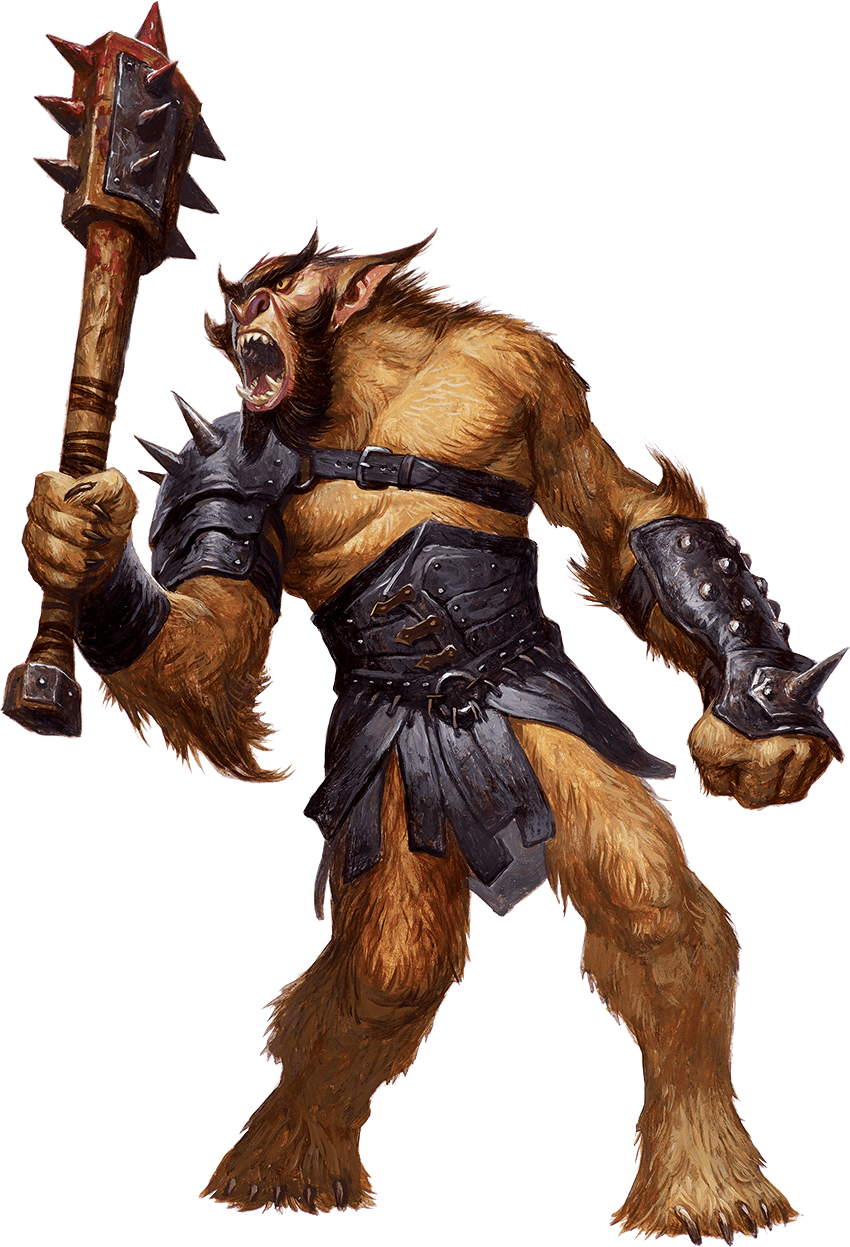
Bugbears resembled hairy, feral goblins standing around 7 feet tall. They took their name from their noses and claws, which were similar to those of bears. However, these claws are not long nor sharp enough to be used reliably as weapons of war.
Unlike other goblinoids, bugbears are covered in coarse hair over most of their bodies; the chest and stomach being the least likely to have hair. Their skin is usually yellow to reddish brown, with their hair being between brown and red.
Ecology and Habitats
Bugbears can thrive in any climate, though they would be most comfortable in temperate regions. They would typically prefer mountainous regions, due to the increased likelihood of caves and tunnels where a clan could ultimately lair. If mountains are not common in an area, bugbears may still be found in dense forests or among ruins where they can easily ambush game or people.
Dietary Needs and Habits
Bugbears are carnivores.
Despite lurid tales such as bugbears eating children who stay out too late at night, they are no more likely to eat people indiscriminately than humans are.
Behaviour
Despite their intimidating builds, bugbears move with surprising stealth. They are fond of setting ambushes and flee when outmatched. They are dependable mercenaries as long as they are supplied food, drink, and treasure, but a bugbear forgets any bond when its life is on the line. A wounded member of a bugbear band might be left behind to help the rest of the band escape. Afterward, that bugbear might help pursuers track down its former companions if doing so saves its life.
When they’re not in battle, bugbears spend much of their time resting or dozing. They don’t engage in crafting or agriculture to any great extent, or otherwise produce anything of value. They bully weaker creatures into doing their bidding, so they can take it easy. When a superior force tries to intimidate bugbears into service, they will try to escape rather than perform the work or confront the foe. Even when subsumed into a goblinoid host and drawn into war, bugbears must often be roused from naps and bribed to get them to do their duties.
This indolence offers no clue to how vicious the creatures are. Bugbears are capable of bouts of incredible ferocity, using their muscular bodies to exact swift and ruthless violence. At their core, bugbears are ambush predators accustomed to long periods of inactivity broken by short bursts of murderous energy. Ferocious though they may be, bugbears aren’t built for extended periods of exertion.
Additional Information
Social Structure
Since bugbears aren’t a particularly fecund race, their overall population is small and spread over a wide area. Bugbears live in family groups that operate much like gangs. The individuals in a group typically number fewer than a dozen, consisting of siblings and their mates as well as a handful of offspring and an elder or two. A gang lives in and around a small enclosure, often a natural cave or an old bear den, and it might have supplementary dens elsewhere in its territory that it uses temporarily when it goes on long forays for food.
In good times, a bugbear gang is tight-knit, and its members cooperate well when hunting or bullying other creatures. But when the fortunes of a gang turn sour, the individuals become selfish, and might sabotage one another to remove opposition or exile weaker or unpopular members to keep the rest of the gang strong. Fortunately for the race as a whole, even young and elderly bugbears have the ability to survive alone in the wild, and the cast-off members of a gang might eventually catch on with a different group.
Left to their own devices, bugbears have little more impact on the world than wolf packs. They subsist by crafting simple tools and hunting and gathering food, and gangs sometimes come together peacefully to exchange members and goods between them.
Geographic Origin and Distribution
Like their goblinoid kin, bugbears can be found all across Toril. However, they are mostly limited to the Material Plane, the Feywild, and Acheron when it comes to planar presence.
Average Intelligence
Bugbears, like other goblinoids, had a reputation for being dim-witted and brutish. This claim was not unfounded, and like their kin, bugbears had easily provoked tempers and were prone to rages. Few bugbears overcame this flaw and their culture's brutal nature.
Perception and Sensory Capabilities
Darkvision and heightened sense of smell both leave the bugbear ideally suited as hunters and scouts.
Civilization and Culture
Naming Traditions
Bugbears typically have glutaral sounding names, some of which are derived from goblin names.
Example Male Names: Dror, Hokulk, Kahigig, Kyuuns, Slodag, Xorkag
Example Female Names: Abgha, Dergu, Ekgurghed, Hagurgig, Tarfu, Zugbutha
Example Clan Names: Bra'Kathu, Dug'rdug, Hew'dyd'nt, Mud'uuna, Prett'iset, Wak'o'wak
Major Language Groups and Dialects
In addition to speaking Common and the Goblin tongue like other goblinoids, bugbears possessed their own language.
Common Customs, Traditions and Rituals
In an act of worship that also sometimes attracts favorable attention from their gods, bugbears sever the heads of defeated foes, cut away or stitch open the eyelids, and leave the mouths hanging open. The heads are then placed on spikes or hung from cords around a bugbear den. The heads themselves are trophies that honor Hruggek, and their ever-staring eyes are an homage to sleepless Grankhul.
The heads of leaders and mighty opponents are particularly sacred, and offering up such a trophy can provide a bugbear gang with a special boon. A gang that gains the favor of Hruggek and Grankhul in this way might find that the head will emit a shout when an enemy gets too close (in the fashion of an alarm spell). Sometimes the heads of people who have information the bugbears need speak their secrets amid blubbered pleas for mercy (as with the speak with dead spell).
Common Myths and Legends
Malevolent Worship of Malign Gods
Bugbears worship two deities who are brothers, Hruggek and Grankhul. Hruggek is the fearsome elder sibling, possessed of legendary might and prowess in battle. Bugbears believe their strength and bravery come from him. Cunning Grankhul is the younger one, and in the stories bugbears tell, he gifted them with stealth but in return he sapped their vigor, so that bugbears sleep in his stead while he remains eternally alert and awake.
According to bugbear legends, Hruggek and Grankhul often fight alongside each other, preying upon all they encounter as is their right as superior warriors. Hruggek takes the heads of those he kills and puts them on spikes in his den, where they utter pleas for mercy and sing paeans to his might. Grankhul watches over Hruggek when he sleeps, but if he must be elsewhere, he whispers commands to the severed heads to wake Hruggek if any danger threatens him.
Bugbears admire the qualities of both brothers. Because of Hruggek, they consider bravery and physical superiority to be their natural state. Thanks to Grankhul, they can use their size and strength to work as stealthy assassins rather than blundering around like ogres.
Bullying, murder, and engaging in battle are all holy acts for bugbears. Garroting an unsuspecting creature and defeating foes in open battle are seen as acts of worship, in the same way that dwarves consider metalsmithing to be sacred to Moradin.
The bugbears recognize two other gods, both of which they disdain and fear: Maglubiyet and Skiggaret.
Maglubiyet, the leader of the goblinoid pantheon, forced both brothers to submit to his rule, but instead of killing them, he showed mercy and even honored them in a way by setting them free — under his control — so that bugbears could continue to employ their talents against his enemies. Bugbears understand that by venerating Hruggek and Grankhul, they also give tribute to Maglubiyet, even though they don’t openly pay homage to their overlord. When bugbears are called to join a host, bugbears believe Maglubiyet has again corralled the brothers into a divine battle, and they honor their gods by following suit.
Skiggaret is the bugbear version of the bogeyman, as hateful and terrifying to them as bugbears are in the eyes of many other races. His name is rarely spoken, and never above a whisper. Skiggaret’s influence manifests at times when bugbears are forced to act in a cowardly fashion; a bugbear that knows or feels itself to be in mortal danger is affected by a form of madness and will do anything, including trying to flee, in order to stay alive. Bugbears believe that this feeling of fear comes from being possessed by Skiggaret, and they don’t relish experiencing it. After the madness has passed, bugbears don’t dwell on things that were done in the presence of Skiggaret. Talking about such acts might call him back.
Blessings of the Bugbear Gods
Bugbears have no use for priests or shamans. No one needs to tell them what their gods want. If the brother gods are angry with them, they let the bugbears know with bolts of lightning (Hruggek) or by striking them blind or dead (Grankhul).
Interspecies Relations and Assumptions
Bugbears were often found in the company of other goblinoids, particularly goblins, since tribes made up mostly of hobgoblins and bugbears tended to be wiped out quickly by other races as a precaution. Some bugbears also operated independently, though tribes ruled by hobgoblins were better organized and less savage. This was in part because bugbears had little patience for diplomacy or negotiation, preferring violent solutions to conflicts unless obviously overpowered.
Among other, non-goblinoid races, however, bugbears suffer from a horrible, but well-deserved, reputation as being just below mercenaries and just above mindless monsters. In other words, not to be trusted and likely to turn into a fight; this attitude suits the bugbears just fine. They are too lazy to care what others think of them.
6 - 8 ft
250‒350 lb
Large, hairy, wedge-shaped ears, heightened sense of smell, tough hide, claws, strong but nimble

Comments