

Fae Pox
The faefolk laugh. Humanity dreams.
Classification
Type: Magical Dream-borne Disease
Severity: Moderate to Severe
Contagious: Yes
Known Cure: Yes
Last Major Epidemic: 16 years before the present day
Overview
Fae Pox is among the oldest recorded magical illnesses still affecting Eryndel.
While considered little more than an inconvenient childhood sickness among fairies, the disease mutates dramatically after infecting humans.
In Fairfolk it produces a week of overwhelming joy, creativity, celebration, and emotional excess.
In humans...
It slowly steals the will to awaken.
No epidemic has shaped modern Vindrath more profoundly.
Transmission & Vectors
For centuries physicians believed Fae Pox spread through:
- saliva
- kisses
- shared food
- tears
- blood
Quarantines were built around these assumptions.
Some appeared to work.
Many failed spectacularly.
Modern scholars remain divided.
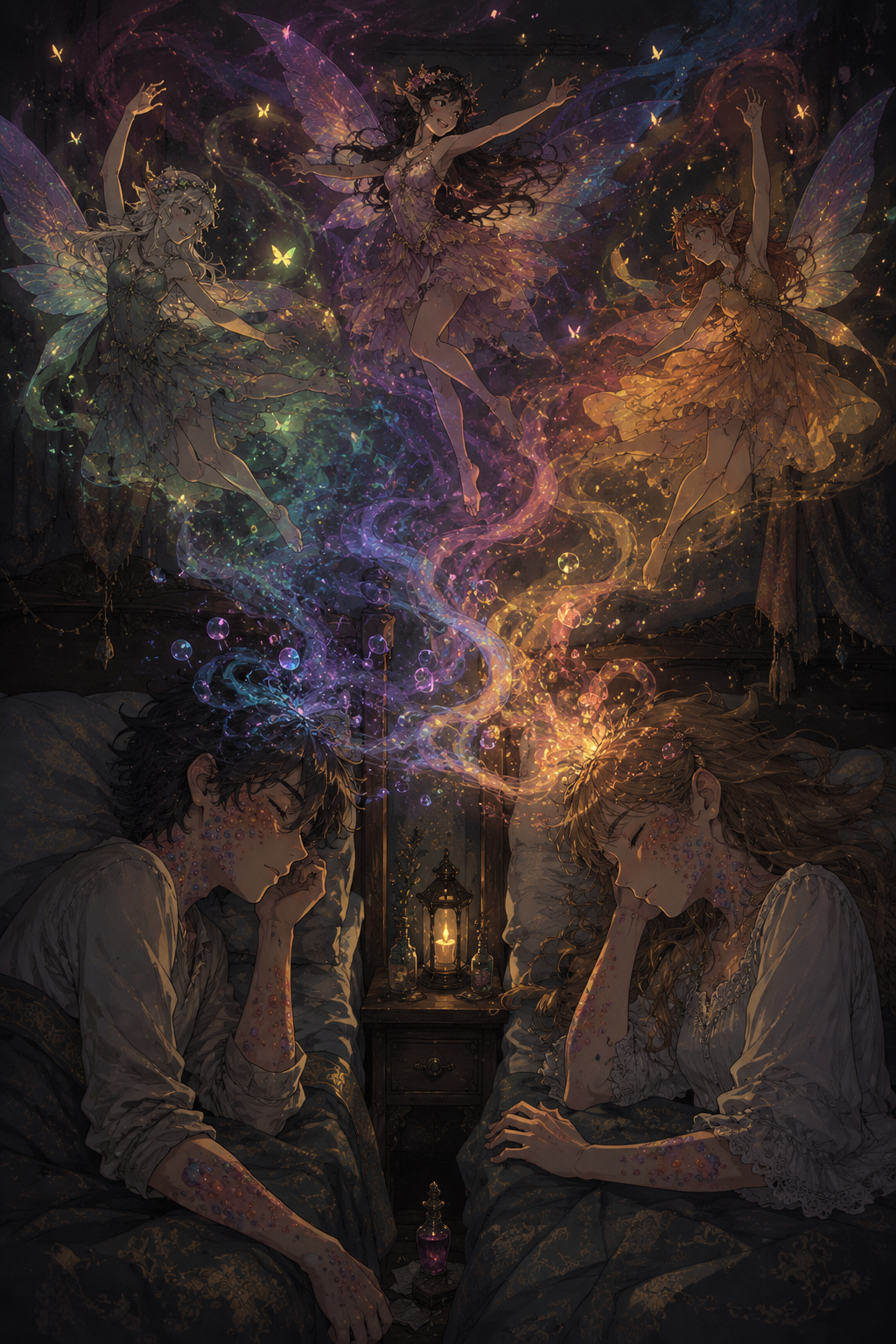
Priests of the Old World argue the disease is transmitted through dreams themselves.
Whenever an infected individual sleeps, nearby minds become entangled within the same dreamscape.
The longer one shares another's dreams...
The greater the chance of infection.
No mundane test has ever confirmed this.
Yet the theory explains outbreaks conventional medicine never could.
Victims become infectious shortly before the first visible symptoms appear.
Causes
Most theologians believe Fae Pox originated as a harmless fairy illness thousands of years ago.
The disease appears naturally intertwined with the Weave.
Among Fairfolk its purpose remains uncertain.
Some believe it evolved to synchronize communities during festivals.
Others claim it is Elyria's reminder that joy itself is contagious.
At some point in history...
Humans became susceptible.
Whether the disease changed...
Or humanity did...
No one knows.
Symptoms
Fairies
Symptoms begin within one day.
- brilliant multicolored blisters
- uncontrollable laughter
- heightened imagination
- spontaneous singing
- excessive generosity
- inability to focus on responsibilities
- vivid shared dreams
Most recover completely within a week.
Many remember the dreams fondly.
Humans
Early symptoms:
- unusual fatigue
- weakness
- loss of appetite
- colorful skin blisters
- melancholy
- vivid dreams
Later symptoms:
- sleeping for extended periods
- emotional withdrawal
- dream fixation
- difficulty distinguishing dreams from memory
- reduced speech
- near-catatonic inactivity
Most patients continue eating and drinking only when gently encouraged.
Families often describe them as:
"Present... but already somewhere else."
Treatment
Two accepted treatments exist.
Clerical Rite
Priests and Clerics perform purification rituals designed to sever the dream connection.
This remains the most effective treatment.
Unfortunately, during major outbreaks there are never enough practitioners.
Dream Draught
The most common remedy.
Primary ingredients include:
- powdered Aether Crystal
- wormwood
- bitter herbs
- distilled spring water
- silverleaf sap
The potion temporarily strengthens the sleeper's connection to their own spirit, preventing foreign dreams from taking root.
It is inexpensive enough for most towns to stock regularly.
Many travelers carry a vial as precaution.
Prognosis
Without treatment:
Most humans slowly deteriorate over several weeks.
Some recover naturally.
Others remain permanently withdrawn.
Death usually results indirectly through dehydration, malnutrition, or secondary illness rather than the disease itself.
Fairies almost always recover completely.
Ironically, many describe the illness as one of the happiest weeks of their lives.
Sequela
Recovered patients often report lingering effects.
These include:
- recurring dreams shared with strangers
- difficulty sleeping alone
- heightened empathy
- occasional inability to determine whether certain memories truly occurred
A small number claim they continue seeing people first encountered while dreaming during their illness.
Most physicians dismiss these reports.
Few priests do.
Affected Groups
Only two peoples are known to contract Fae Pox.
- Humans
- Fairies
Other Fairfolk appear naturally resistant.
No explanation has been universally accepted.
Children and the elderly suffer the highest mortality among humans.
Communal professions are especially vulnerable.
- monasteries
- orphanages
- hospitals
- barracks
- boarding houses
Anywhere many people sleep together...
The disease flourishes.
Hosts & Carriers
Fairies serve as the disease's natural hosts.
Most experience little lasting harm.
Many continue spreading the illness unknowingly while celebrating festivals or traveling between settlements.
Certain dream-feeding moths have also been suspected of carrying traces of the disease, though no study has confirmed the claim.
Prevention
True prevention remains impossible.
Because the actual method of transmission is still disputed, most preventative efforts focus upon reducing exposure.
Common practices include:
- sleeping separately
- nightly purification prayers
- carrying prepared Dream Draught
- blessing households
- avoiding infected settlements
Some communities perform preventative rites over entire neighborhoods during outbreaks.
Whether these rituals work through divine intervention or simply coincidence remains fiercely debated.
Epidemiology
Fae Pox spreads with terrifying speed once it enters densely populated cities.
Unlike ordinary illnesses, its progression ignores walls, locked doors, and careful hygiene.
Hospitals frequently become centers of infection.
Families attempting to care for sick relatives often succumb themselves.
The disease spreads most rapidly where large numbers of people sleep within close proximity.
Cities.
Military camps.
Pilgrimages.
Festival grounds.
Monasteries.
No quarantine has ever completely contained a major outbreak.
History
The earliest written descriptions originate from fairy settlements nearly three thousand years ago.
At that time the illness appears little different from a seasonal celebration.
Human outbreaks become increasingly common following the Sundering, though no one understands why.
The most devastating epidemic occurred sixteen years before the present day in Gearhaven.
Within weeks thousands became bedridden.
Entire factories ceased operation.
Rail lines halted.
Hospitals overflowed.
Clerics performed mass purification rites over entire districts, often without the permission of those inside.
The crisis eventually ended through a combination of widespread Dream Draught distribution and relentless religious intervention.
The memory never faded.
Many citizens concluded a simple truth:
Magic had nearly destroyed their city.
Whether that conclusion was fair mattered little.
It permanently reshaped Vindrath's relationship with magic.
Cultural Reception
Among Fairfolk, Fae Pox is treated almost humorously.
Children are tucked into bed with songs and sweets while parents patiently wait for the inevitable week of impossible excitement to pass.
Humans view the disease very differently.
Entire generations still remember empty streets, silent factories, and families watching loved ones disappear into endless sleep.
The phrase "Don't tempt the dreams." remains a common warning throughout Gearhaven whenever someone experiments with unfamiliar magic.
Meanwhile, priests quietly preserve an older saying:
*"Dreams are doors.
Fae Pox merely forgets to knock."*
Dreams are doors. Fae Pox merely forgets to knock.
Join me for more at Tales of Eryndel: The Fractured Weave on Substack!!

Comments