
Thule
Thule is a domain of seaweed-entangled beaches and endless #ords, where nature’s rawness is apparent across every season, be it the eternal night of winter or the unrelenting dawn of summer. From the emerald waters of Shallow Bay in the south to the Lands of Fog and Ice in the north, the nation and its people are as primal and proud as a sea cliff enduring the ocean’s thunderous might.
Nestled among the ocean cliffs of Bowman’s Perch loom the brine-spattered stone walls of Highsalt, Thule’s vast capital. It’s a cold place, soaked in the damp mist of the Boreal Sea, whose architecture bears similarities to styles common to the southern nations, but with an air of pagan idolatry that many travelers find unsettling.
Built atop an ancient salt mine called the Ivory Labyrinth, Highsalt has a long history that stretches through the shroud of time to when the tribes of the north were willful opponents untethered to crown or country. Before the first cyclopean stones were laid for the capital’s foundation, the cliffs of Thule’s southern coast were considered places of sacrifice sacred to the native people and their oracles, the Children of the Shallows. These folk were shamans dedicated to the Rider, goddess of the sea and all its creatures—a titanic mare, draped in a mane of seaweed, whose gaunt frame was encrusted with barnacles and starfish.
The corpse of Yggdrasil rests deep within Thule’s northern territory. The ancient World Tree splintered when the Oligarchs battered their way into Heaven during their war with the old gods. Now, the tree’s remains poison the north with discordant Od. Dying Yggdrasil calls to its ancestral caretakers, slowly obliterating their minds and gathering them to its cracked stump, where they climb like cicada nymphs until they find a place among the splinters and sap to impale themselves on the holy ash. There, their terrible transformation begins.
Unfettered by the World Tree’s demise, the north’s seasons spin dangerously out of control. Spring’s torrential rains batter Thule for months, only to break into summer droughts that tear the moisture from every shred of greenery, turning great forests into deadly tinderboxes. In the fall, a putrid rot grips life as if to drag it into the jaws of hell itself, whereas winter’s cold bites past the bone to the very marrow, and endless snow blankets everything in a sea of silent, sparkling death. In addition, with each passing day, more things relegated to dusty tomes and old legends slouch outward from the unforgiving wilderness to harry the north’s besieged people.
Druids of the Elden Tree fled south with the cuttings of Yggdrasil when it was shattered by the Oligarchs. Those four cuttings alone can restore the rightful balance of the seasons. But what they are exactly, and what form they might take, remains unclear. Yet, with a foreign ruler upon the throne of Highsalt, its neighbors engulfed in open warfare, and armies of chittering nightmares descending from the far north, Thule can do little but wait out the violence to come.
The Great Roads
In past times, few roads cut through Thule. Most people traveled on foot or by horseback along a few isolated wagon ruts. Once a king arose, however, his troops needed roads for swift travel, and so began a many-year project of road building. Three main roads stretch from Highsalt northward into Thule: the Deeproad in the central regions, the Eastroad along the east coast, and the Westroad along the west coast. The practical Salters need little ornamentation or fancy titles; they tend to name things after their purposes.
Many smaller roads branch out from these three main ones, leading to villages, inns, and farm homes, but rain and snowmelt tends to wash out these less-well maintained tracks.
The majority of Thule lies open. The population outside of Highsalt clusters into a few notable towns but otherwise spreads out in smallfamily units whose farmhouses and steadings stand well apart from one another amidst rocky fields. Most rural Thulians primarily practice farming, making for a hard life. They must regularly clear the fields of the numerous rocks that always seem to return after the rains and snows, although the volcanic soil is good for growing nutritious crops. The south values Thule’s potatoes and tubers, staples that travel well and can feed armies on the go.
The Deeproad
Running through central Thule, the Deeproad reaches from Highsalt all the way to Grimstead. Towns and villages stud this main road along its way, as well as guardhouses with stables where the military can swap horses.
The village of craftspeople, Fallowfield, lies down this road, as do the medicinal hot springs of Mistvale before it finally terminates past Grimstead, Thule’s northernmost castle.
The Eastroad
The Eastroad runs from Highsalt north along the east coast of the Boreal Sea and through a number of towns and comfortable steadings before finally terminating at Crown Keep.
Busier than the Westroad, the Eastroad’s coast sees less ice and wind. The towns along its way display more prosperity than most in Thule, with a higher proportion of industry.
The majority of immigrants from the southern wars seek refuge in these Eastroad towns, for they more closely resemble the civilization they’re used to.
The Westroad
The main road that runs along the western coast of Thule, the Westroad runs past a number of small fishing villages and terminates in Frostrime. A barren road, poorly maintained with few travelers, it begins not far north of Highsalt at Densmere, a small town along the Deeproad whose inhabitants once worked the now-closed White Mines.
Two competing bandit gangs plague the Westroad. Since the road is so rarely traveled by merchants, however, these gangs instead hold up lone travelers and the local farmer families who brave the road to bring their crops to market in Fallowfield.
Duke Cicero promises to send out guards to deal with these gangs but has yet to do so. He simply can’t spare the manpower, so he instead calls for mercenaries willing to take the job for little pay and a cut of the bandit’s treasure.
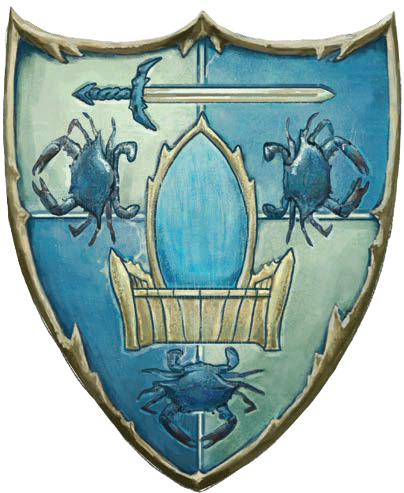
The Children of the Shallows believe the blue crabs that scuttle forth from the tide pools along the coastline of Thule to be their ancestors returning to visit. To harm one or even to interrupt its path is considered both extremely bad luck and a crime.