The Norns
Arbiters of Fate
Wheel-spinners, lot-casters, thread-hens, stitch-wives, doom-hags, scourge-nurses, grandmothers dear, hearth-nuns, kindly dames
The Norns were the spinners of Fate, weaving its threads into an elaborate tapestry that could be fully beheld only by one who stood outside of time. They provided rhyme and reason to the otherwise neutral flow of the Od. While they often seemed distant, cruel, and uncaring, they brought meaning to chaos. Mortals can endure much, so long as there is a reason for their suffering. Without the Norns, mortals must find their own meaning—a terrifying responsibility. And they must do so soon, before the Oligarchs impose meaning all their own.
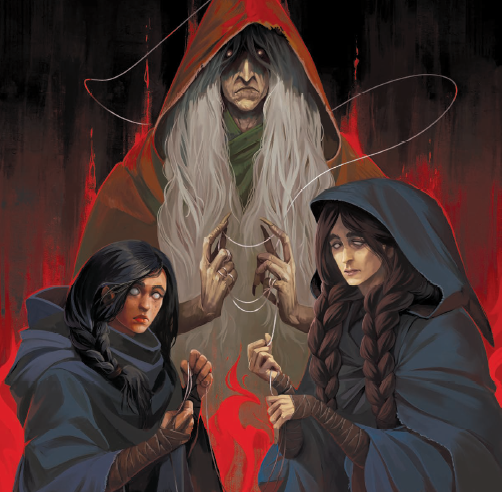
The Norns appeared to mortals as three sisters: Urd, Verdandi, and Skuld. Between them, they wove the threads of Fate. Urd stored the threads of the past (“That Which Has Passed”) and often appeared as the eldest of the three, her silver hair hanging loose down her crooked back. Verdandi worked the present, the threads just being made (“That Which Is” she usually appeared as a woman just entering her middle years, her brown hair fashioned in multiple long braids. Skuld looked to the future (“That Which Is Yet to Come”) and wore the guise of a young maiden with her golden hair in a single short braid. But none of these ages were assured: sometimes, Skuld would appear as the oldest and Urd the youngest, and sometimes, Verdandi bore the strains of age and Skuld the responsibilities of adulthood, and so on.
Mortals sometimes witnessed them working with silver shears and needles, but sometimes they cut the threads with their teeth and stitched them with their fingernails. It was believed that the former technique displayed their even-temperedness, when no calamities were written into the weave; the latter betrayed their agitation at the misfortunes they wove into their pattern.
Few mortals could divine the reasons the Norns wove the scenes they did into their tapestry. They did not seem to weave out of ire or love; they simply wove. What happened, happened, and although they knew the whole of it, they did nothing to alter it. Did they create Fate, or were they its instruments? None can say for sure, though without them, Fate has become a wild thing, untamed and ungovernable.
Their abode lay amid the roots of Yggdrasil. They were, at times, witnessed in unlikely places, though. A traveler on a stormy night might have sought refuge in an abandoned steading, only to discover three sisters sewing by the fire. A mendicant who climbed a remote mountain and reached the snowy top may have discovered three yak herders gossiping and weaving by their campfire. In most cases, they would pay no heed to the mortal visitor, but in some stories, the visitor was invited to sit by the fire and listen in on their chatter, giving them insight into the workings of the world.
Whereas the other gods were symbolized by animals or plants, the Norns were not. They were neutral, standing apart from the natural world. That they were the only gods who wore the semblance of mortal humans perhaps provides a clue. Some suggest that they are their symbols—the vessels, instruments, and mayhap even the weavers of Fate in their stead.
Sacrifices were rarely made to the Norns, for they were not believed to heed them. Very little could cause them to alter their weaving. Nonetheless, mortals persisted on the off chance that, if the sisters noticed a particular sacrifice, they might add a knot into the weave or fray a thread, leaving an opening in the flow of Fate. Minor sacrifices took the form of tattoos or scarification. Major sacrifices involved the self-amputation of a finger, a hand, an arm, an eye, an ear, or a tongue.
Some say the Norns had no foreknowledge of their deaths, that the Oligarchs’ unprecedented act could happen only because Outsiders cloaked them from Fate’s eye. But some also say that Skuld knew and did not warn her sisters. Instead, she introduced a new pattern into her tapestry just as the Oligarchs confronted her.
Once the Oligarchs had slain the Norns, they trampled upon their tapestry, tore it to shreds, flung it onto the shattered stump of Yggdrasil, and lit it afire. The ashen embers caught the winds and spread throughout the world, lighting upon a scattering of people and objects. They became imbued with the faint Fate that remained and an echo of the original purpose woven in by the Norns. What that purpose might be, none can now say.
They speak of Garm, who crept to the roots of Yggdrasil and witnessed the Norns at work. He saw their tapestry, divined his place within it, and became a broken man. Oh, he did not die a painful death or suffer the pox or become crippled. No, he became a king and was showered with untold wealth. The most beautiful women in the land joined his harem and entertained him every night. What broke him was the knowledge that his life was not his own, that none of the good things that came to him were his to earn. What is a man if he is not his own maker?