Outsiders
The practice of theurgy requires summoning and bargaining with mysterious and puissant entities from beyond the boundaries of our reality. Their names and ways must be known, and they must be given something in return for the Vitiations they endow. The most powerful of theurges can form a pact with them, enthralling them to their will for an indefinite period of time, but the wisest know that forcing a being into servitude invariably comes with a price. The common people call these creatures demons or fae, and shun and fear anyone who has any sort of congress with them, but theurges know them by the more accurate and general term: Outsiders.
What Are Outsiders?
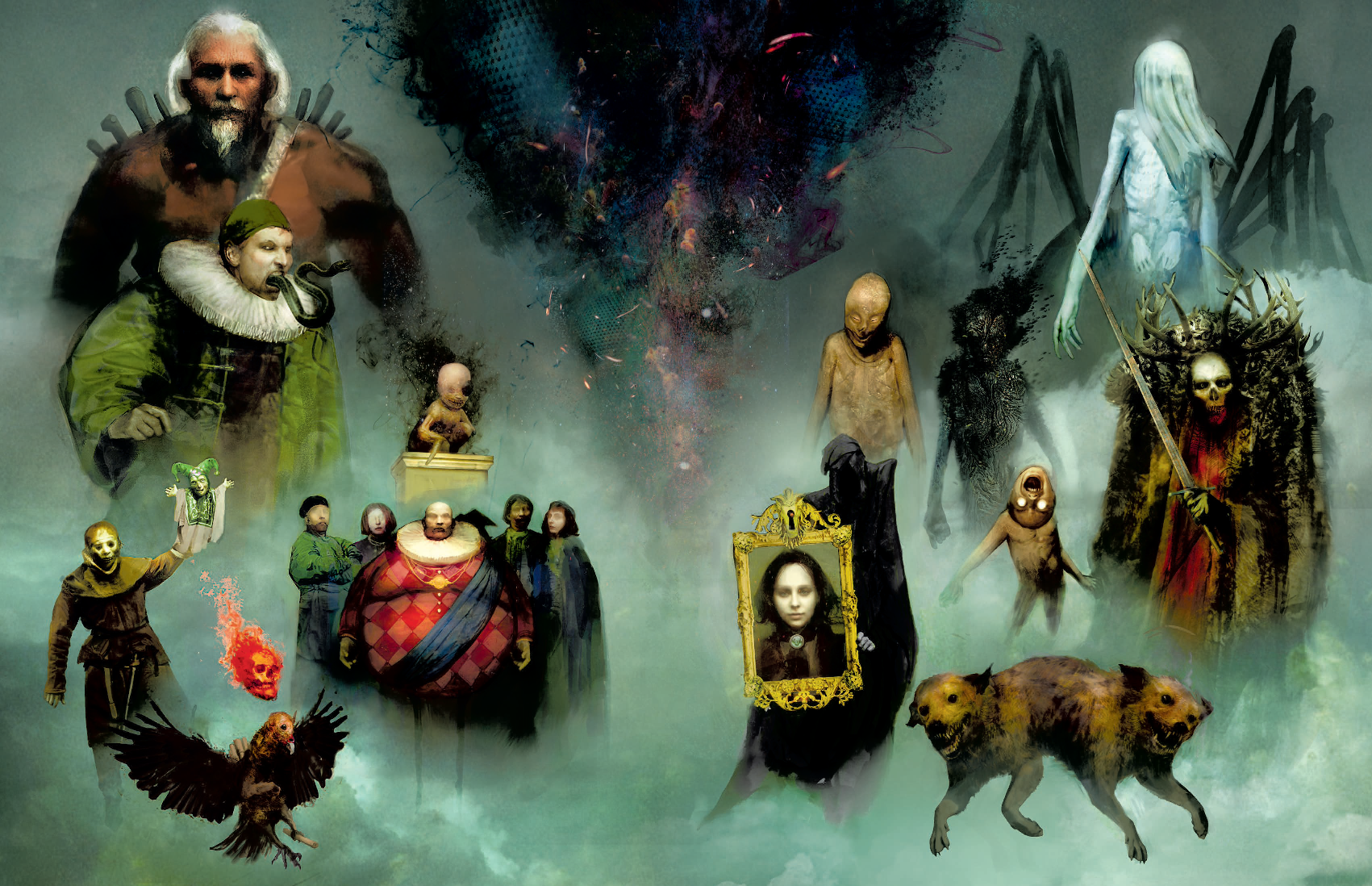
The only true answer is: no one knows for certain. They are definitely sentient beings, and they seem obsessed with bargaining and dealing with humanity to achieve goals only they ultimately know. Fate ignores them, either blind to their influence or because acknowledging them might give them greater power to weave it to their own ends. They seem to have a consistent physical form in most cases, but this condition may be just an illusion or a mere interface with our reality: a puppet that allows them to talk and bargain with the “children” on this side. For the theurge and those aware of these entities, some facts are known or surmised:
- They are singular entities. A particular Outsider can’t (in most circumstances) be in two places at once or bound to two masters at the same time.
- The laws of nature do not apply to them—or at least apply to them differently. They can share these gifts with those who give them something in return. These abilities are what are called Vitiations.
- There is a great hierarchy and political system of Outsiders too byzantine and strange for humanity to comprehend, but knowing even a bit can help in dealing with them.
- Outsiders come in many shapes and forms: horrible, sublime, strange, impossible, familiar, or incredible. No two Outsiders are the same.
- They (mostly) seem to desire to be brought forth from the Od (where they dwell?) so that they might achieve their own esoteric, strange, and dark goals.
- Ancient tomes and knowledge from long ago can reveal the names and habits of specific Outsiders lost to human memory. A quest for this knowledge can be as important and destiny-changing as one for a lost artifact of magical power.
- The True Name of an Outsider is perilous knowledge. The more powerful the Outsider, the more hidden this knowledge will be and the more dangerous it is to have or use.
- They always make a pact or deal. None of the power they offer comes without a reckoning.
- Outsiders can manifest into a physical form but do so rarely. They offer powers, but never physically enter combat for their masters. They may summon lesser servants for this purpose, however.
- Those who have Rapport with an Outsider can attempt to summon or communicate with them by reaching out into the Od. They might not always respond, though a Pacted Outsider almost always does, unless its physical manifestation has been temporarily banished or destroyed, or circumstances prevent or discourage it from communicating.
- At their discretion, Outsiders can visibly manifest to whomever they wish. They may be visible only to the theurge with whom they are dealing, or to someone else—or everyone else—present. They tend to prefer secrecy, however, and generally do not show themselves to others without good reason or some sort of compulsion.
- In their most basic manifestation, they can’t be harmed by Mortal weapons, but neither can they harm others. They can appear and disappear at will. They will not use this ability to (for example) startle foes in combat or distract opponents, though, unless they are under a pact or deal compelling them to do so.
- Common people and the authorities typically react with fear and anger when confronted by an Outsider or anyone who is clearly associating with these beings. There is no sanctioned guild or organization allowed to practice theurgy in most places.
Stations of the Damned
Within each of their six courts, Outsiders vary in their degrees of power and authority. As always, these labels represent human simplifications of something more complex and beyond our grasp. Their hierarchy has three stations.
- Imp: Messengers, servants, thralls, and spies for their betters. Imps are numerous, and if one is lost, another can easily be found among the ranks of the Outsiders. Any character on the Path of Od & Ritual begins the game by having Rapport with an imp. Although they are the lowest of the courts’ aristocracy, they are aristocracy and command numerous lesser Outsiders.
- Villein: These creatures rank higher than imps and offer more power. Of course, they expect more in return for that power. They are also more difficult to access, and if a known villein becomes Pacted to a particular theurge, they can no longer be accessed by other theurges. Wars have been fought over this.
- Lord: Lords have a dizzying array of titles, names, and shapes. These beings are not gods, but they may seem so to lesser creatures. The Vitiations they offer are very powerful. Only the most prepared and experienced theurge should attempt to contact them, and pacting one of these potentates could be the quest or goal of a lifetime.
The Six Courts
Outsiders appear to be gathered into political or social groupings based upon traits they have in common, much like human societies. Alliances, animosities, and opinions exist among them, and some say that wars have been fought between them. Together, these groupings are known as the Six Courts, as they comprise the aristocracy of the Outsiders, or at least what the Outsiders would have folk believe to be their aristocracy. Each court has access to Vitiations that support their view of reality. Rumor has it that Outsiders change courts on rare occasions, and regardless of the seemingly monolithic nature of the esoteric circles within which they choose to identify, plenty of conflict occurs among members of the same court, as do exceptions to the “rules” of a particular court. Thus, little of what folk know of them may be trusted.
The Court of Ignorance

That the Court of Ignorance is a proponent of ignorance is as clear as the name of the court itself. However, as is often the case with Outsiders, the full reality of its true purpose is concealed behind the name and is more nuanced than what first impressions would indicate. The Court of Ignorance certainly takes great pleasure in—and has as a high priority—the destruction of accumulated knowledge. Dead sages and burned libraries are delightful ends for the Outsiders ironically known to theurges as Scholars. The real story is that the Court of Ignorance doesn’t want to destroy or pervert knowledge; these Outsiders want to hoard it. Theurges who gain favor with this court earn access to hidden intelligence and lost lore, can see and hear things far away, and know things that have remained unknown for centuries—so long as they are willing to destroy the truth humanity has carefully acquired for itself.
The Court of Joy

Madness. Madness is the realm of the Court of Joy. Not simply dysfunction of the mind, but a world where madness is proper and correct, and those who follow the narrow path of rationality are the fools. The Court of Joy lives in the place most terrifying and dear to humanity: in the mind of the person perceiving members of this court. They use this stance from within the very thoughts of those encountering them to express their mastery of manipulation. Those who study the esoterica of the so-called Jesters come to realize that the human mind is a poor instrument for understanding the reality that lies beyond this one, a reality more real and powerful than what we choose to perceive. To grasp this hidden but imminent world, a person must break that instrument, shatter their own mind, to comprehend the swirling vortex theurges call the Od. Of course, others observing from the outside would say that, once the mind breaks, doesn’t the theurge perceive whatever they choose, real or not?
The Court of Peace

To call the Court of Peace the “Court of Death” is a horrid oversimplification, though that is the facade its Outsiders presume to wear for those who merely dabble in the arcane. They are happy to tell someone they will aid in the bringing of peace to one’s enemies—an eternal peace. The truth, for those who have exposed the deeper secrets of the Court of Peace, is that these Outsiders are committed to far more than efficient and successful slaughter; they are obsessed with the act of inciting bloodshed and committing violence as works of art. Each member of this court has an endless competitive drive to create a magnum opus of brutality that will eclipse their previous efforts and those of their peers. The Court of Peace is the Court of Murder—murder as art.
The Court of Silence

The Court of Silence is the court of raw, boundless, primal fury. The voice of Silence is the howl of the winds, the roar of the beast, the rage of the volcano, the rumble of thunder, and the screams of inchoate ferocity of wild things beyond the circle of humanity, but it is always without words. The Court of Silence expresses itself only with the absence of words, and those who seek to plumb the mysteries of this court would be wise to do so without speaking, for the Court of Silence hates any form of higher locution. Its Outsiders disdain the abstract building blocks of higher language and prefer to speak what is, to them, the only true language: unbounded emotion and unfettered animal instincts. The true being deeply (or not so deeply) hidden in every civilized person is the beast, and the urbane exterior that culture forces upon humanity is merely a fragile patina that quickly crumbles when exposed to real experience.
The Court of Truth

Most people who know of the Outsiders know that they are liars, whereas theurges know that Outsiders spout falsehoods as easily as humans breathe or blink, and those sorcerers who study the Court of Truth know what it knows—or, at least, what it believes: that all of human reality is a lie, and only by truly grasping this fact can one begin to see what is really true. The Court of Truth deals in deception, and those who seek deals with its denizens are charlatans, assassins, thieves, courtesans, and illusionists. Outsiders of the Court of Truth have an open disdain for the senses of mortals and the weaknesses of human perception, for they know that this shallow and flawed awareness is easily manipulated. In fact, the boons granted by this court allow its followers to do just that.
The Nameless Court

The denizens of every other court wear disguises to facilitate their congress with those mortals who seek deals and pacts with them—and to soften the blow of the impossibility they represent. The Nameless Court is cloaked in no such way. Its members present themselves as pure manifestations of the chaos at the heart of the Od because they wear no mask. Their ultimate goals and purposes are unknowable, as are their True Names (or so it is told among the dusty enclaves of the wisest theurges). They present no human motivation or emotion that mortals can decipher, and yet they still make deals as other Outsiders do, they still follow the rules that were laid down or discovered by the sorcerers of old, they still may be bargained with or pacted, and they still may betray those theurges who drink too deeply and too long from their well of potency.