

Wizard
What Is a Wizard?
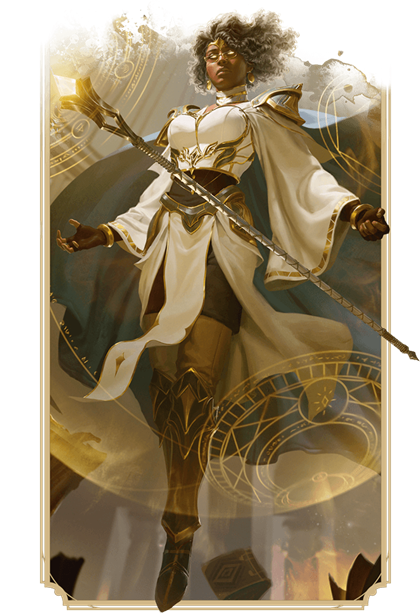
Wizards are scholars of the arcane who wield magic through study, discipline, and intellect ratherthan instinct or divine favor. Their power comes from painstaking research—deciphering ancient tomes, recording precise formulas, and mastering the fundamental laws that govern reality itself. To a Wizard, magic is not a gift; it is a science, an art, and a lifelong pursuit.
Some Wizards see magic as a tool to protect civilization, catalog knowledge, or unravel the mysteries of the multiverse. Others seek power, immortality, or forbidden truths best left forgotten. Whatever their goals, Wizards approach magic with careful preparation and deliberate control, shaping spells with precision rather than impulse.
In an adventuring party, Wizards are planners, problem-solvers, and arcane authorities. Their vast spellbooks allow them to adapt to nearly any challenge, whether that means devastating enemies, reshaping the battlefield, or solving problems no blade could ever cut through. Knowledge is their greatest weapon—and few wield it as dangerously as a Wizard.
Becoming a Wizard.
As a Level 1 Character
- Gain all the traits in the Core Wizard Traits table.
- Gain the Wizard’s level 1 features, which are listed in the Wizard Features table.
As a Multiclass Character
- Gain the Hit Point Die from the Core Wizard Traits table.
- Gain the Wizard’s level 1 features, which are listed in the Wizard Features table. See the multiclassing rules to determine your available spell slots.
Warlock Progression
| Level | Proficiency Bonus | Class Features | Cantrips | Prepared Spells | 1 | 2 | 3 | 4 | 5 | 6 | 7 | 8 | 9 |
|---|---|---|---|---|---|---|---|---|---|---|---|---|---|
| 1 | +2 | Spellcasting, Ritual Adept, Arcane Recovery | 3 | 4 | 2 | — | — | — | — | — | — | — | — |
| 2 | +2 | Scholar | 3 | 5 | 3 | — | — | — | — | — | — | — | — |
| 3 | +2 | Wizard Subclass | 3 | 6 | 4 | 2 | — | — | — | — | — | — | — |
| 4 | +2 | Ability Score Improvement | 4 | 7 | 4 | 3 | — | — | — | — | — | — | — |
| 5 | +3 | Memorize Spell | 4 | 9 | 4 | 3 | 2 | — | — | — | — | — | — |
| 6 | +3 | Subclass feature | 4 | 10 | 4 | 3 | 3 | — | — | — | — | — | — |
| 7 | +3 | — | 4 | 11 | 4 | 3 | 3 | 1 | — | — | — | — | — |
| 8 | +3 | Ability Score Improvement | 4 | 12 | 4 | 3 | 3 | 2 | — | — | — | — | — |
| 9 | +4 | — | 4 | 14 | 4 | 3 | 3 | 3 | 1 | — | — | — | — |
| 10 | +4 | Subclass feature | 5 | 15 | 4 | 3 | 3 | 3 | 2 | — | — | — | — |
| 11 | +4 | — | 5 | 16 | 4 | 3 | 3 | 3 | 2 | 1 | — | — | — |
| 12 | +4 | Ability Score Improvement | 5 | 16 | 4 | 3 | 3 | 3 | 2 | 1 | — | — | — |
| 13 | +5 | — | 5 | 17 | 4 | 3 | 3 | 3 | 2 | 1 | 1 | — | — |
| 14 | +5 | Subclass feature | 5 | 18 | 4 | 3 | 3 | 3 | 2 | 1 | 1 | — | — |
| 15 | +5 | — | 5 | 19 | 4 | 3 | 3 | 3 | 2 | 1 | 1 | 1 | — |
| 16 | +5 | Ability Score Improvement | 5 | 21 | 4 | 3 | 3 | 3 | 2 | 1 | 1 | 1 | — |
| 17 | +6 | — | 5 | 22 | 4 | 3 | 3 | 3 | 2 | 1 | 1 | 1 | 1 |
| 18 | +6 | Spell Mastery | 5 | 23 | 4 | 3 | 3 | 3 | 3 | 1 | 1 | 1 | 1 |
| 19 | +6 | Epic Boon | 5 | 24 | 4 | 3 | 3 | 3 | 3 | 2 | 1 | 1 | 1 |
| 20 | +6 | Signature Spells | 5 | 25 | 4 | 3 | 3 | 3 | 3 | 2 | 2 | 1 | 1 |
Wizard Class Features
As a Wizard, you gain the following class features when you reach the specified Wizard levels. These features are listed in the Wizard Features table.
Level 1: Spellcasting
As a student of arcane magic, you have learned to cast spells.
Cantrips. You know three Wizard cantrips of your choice. Whenever you finish a Long Rest, you can replace one of your cantrips from this feature with another Wizard cantrip of your choice.
When you reach Wizard levels 4 and 10, you learn another Wizard cantrip of your choice, as shown in the Cantrips column of the Wizard Features table.
Spellbook. Your wizardly apprenticeship culminated in the creation of a unique book: your spellbook. It is a Tiny object that weighs 3 pounds, contains 100 pages, and can be read only by you or someone casting Identify. You determine the book’s appearance and materials, such as a gilt-edged tome or a collection of vellum bound with twine.
The book contains the level 1+ spells you know. It starts with six level 1 Wizard spells of your choice.
Whenever you gain a Wizard level after 1, add two Wizard spells of your choice to your spellbook. Each of these spells must be of a level for which you have spell slots, as shown in the Wizard Features table. The spells are the culmination of arcane research you do regularly.
Spell Slots. The Wizard Features table shows how many spell slots you have to cast your level 1+ spells. You regain all expended slots when you finish a Long Rest.
Prepared Spells of Level 1+. You prepare the list of level 1+ spells that are available for you to cast with this feature. To do so, choose four spells from your spellbook. The chosen spells must be of a level for which you have spell slots.
The number of spells on your list increases as you gain Wizard levels, as shown in the Prepared Spells column of the Wizard Features table. Whenever that number increases, choose additional Wizard spells until the number of spells on your list matches the number in the table. The chosen spells must be of a level for which you have spell slots. For example, if you’re a level 3 Wizard, your list of prepared spells can include six spells of levels 1 and 2 in any combination, chosen from your spellbook.
If another Wizard feature gives you spells that you always have prepared, those spells don’t count against the number of spells you can prepare with this feature, but those spells otherwise count as Wizard spells for you.
Changing Your Prepared Spells. Whenever you finish a Long Rest, you can change your list of prepared spells, replacing any of the spells there with spells from your spellbook.
Spellcasting Ability. Intelligence is your spellcasting ability for your Wizard spells.
Spellcasting Focus. You can use an Arcane Focus or your spellbook as a Spellcasting Focus for your Wizard spells.
Expanding and Replacing a Spellbook
The spells you add to your spellbook as you gain levels reflect your ongoing magical research, but you might find other spells during your adventures that you can add to the book. You could discover a Wizard spell on a Spell Scroll, for example, and then copy it into your spellbook.
Copying a Spell into the Book. When you find a level 1+ Wizard spell, you can copy it into your spellbook if it’s of a level you can prepare and if you have time to copy it. For each level of the spell, the transcription takes 2 hours and costs 50 GP. Afterward you can prepare the spell like the other spells in your spellbook.
Copying the Book. You can copy a spell from your spellbook into another book. This is like copying a new spell into your spellbook but faster, since you already know how to cast the spell. You need spend only 1 hour and 10 GP for each level of the copied spell.
If you lose your spellbook, you can use the same procedure to transcribe the Wizard spells that you have prepared into a new spellbook. Filling out the remainder of the new book requires you to find new spells to do so. For this reason, many wizards keep a backup spellbook.
Level 1: Ritual Adept
You can cast any spell as a Ritual if that spell has the Ritual tag and the spell is in your spellbook. You needn’t have the spell prepared, but you must read from the book to cast a spell in this way.
Level 1: Arcane Recovery
You can regain some of your magical energy by studying your spellbook. When you finish a Short Rest, you can choose expended spell slots to recover. The spell slots can have a combined level equal to no more than half your Wizard level (round up), and none of the slots can be level 6 or higher. For example, if you’re a level 4 Wizard, you can recover up to two levels’ worth of spell slots, regaining either one level 2 spell slot or two level 1 spell slots.
Once you use this feature, you can’t do so again until you finish a Long Rest.
Level 2: Scholar
While studying magic, you also specialized in another field of study. Choose one of the following skills in which you have proficiency: Arcana, History, Investigation, Medicine, Nature, or Religion. You have Expertise in the chosen skill.
Level 3: Wizard Subclass
You gain a Wizard subclass of your choice. A subclass is a specialization that grants you features at certain Wizard levels. For the rest of your career, you gain each of your subclass’s features that are of your Wizard level or lower.
Level 4: Ability Score Improvement
You gain the Ability Score Improvement feat or another feat of your choice for which you qualify. You gain this feature again at Wizard levels 8, 12, and 16.
Level 5: Memorize Spell
Whenever you finish a Short Rest, you can study your spellbook and replace one of the level 1+ Wizard spells you have prepared for your Spellcasting feature with another level 1+ spell from the book.
Level 18: Spell Mastery
You have achieved such mastery over certain spells that you can cast them at will. Choose a level 1 and a level 2 spell in your spellbook that have a casting time of an action. You always have those spells prepared, and you can cast them at their lowest level without expending a spell slot. To cast either spell at a higher level, you must expend a spell slot.
Whenever you finish a Long Rest, you can study your spellbook and replace one of those spells with an eligible spell of the same level from the book.
Level 19: Epic Boon
You gain an Epic Boon feat or another feat of your choice for which you qualify.
Level 20: Signature Spells
Choose two level 3 spells in your spellbook as your signature spells. You always have these spells prepared, and you can cast each of them once at level 3 without expending a spell slot. When you do so, you can’t cast them in this way again until you finish a Short or Long Rest. To cast either spell at a higher level, you must expend a spell slot.
Wizard Subclasses
A Wizard subclass is a specialization that grants you features at certain Wizard levels, as specified in the subclass.
Abjurer (PHB 2024)
Abjurers specialize in protective and defensive magic, mastering wards, counterspells, and barriers that blunt enemy attacks. Their magic reinforces allies, suppresses hostile spells, and turns raw arcane force aside.
Often serving as guardians, sentinels, or arcane defenders, Abjurers believe survival is the foundation of victory. When magic threatens to spiral out of control, an Abjurer stands firm against it.
Diviner (PHB 2024)
Diviners peer beyond the present, unraveling fate, probability, and hidden truths. Through visions, omens, and foresight, they manipulate outcomes before events ever unfold.
To a Diviner, knowledge is power in its purest form. By knowing what will happen—or what might—they shape reality with uncanny precision and terrifying inevitability.
Evoker (PHB 2024)
Evokers focus on raw magical force, shaping destructive energy into devastating spells. Fireballs, lightning, thunder, and radiant blasts are their tools of choice.
Though often seen as reckless, skilled Evokers wield power with discipline, sculpting their spells to spare allies while annihilating foes. When overwhelming force is required, Evokers answer without hesitation.
Illusionist (PHB 2024)
Illusionists bend perception, memory, and belief itself. Their magic deceives the senses, creating false images, sounds, and even realities that feel entirely real.
Masters of misdirection and psychological warfare, Illusionists thrive on confusion and control. To them, the mind is the most vulnerable battlefield—and the easiest to exploit.
Additional Wizard Subclasses (Other 5e Sources)
Conjurer (PHB 2014)
Conjurers specialize in summoning creatures, objects, and energies from across the multiverse. Their magic bridges worlds, pulling allies—or horrors—into existence.
Whether calling elemental forces or teleporting across space, Conjurers treat reality as flexible and negotiable. Distance, scarcity, and isolation mean little to them.
Enchanter (PHB 2014)
Enchanters manipulate emotions, thoughts, and desires, subtly reshaping behavior without force. Their spells charm, compel, and dominate, often without their targets realizing it.
To an Enchanter, control is more elegant than destruction. A whispered suggestion can achieve what a fireball never could.
Necromancer (PHB 2014)
Necromancers study the boundary between life and death, wielding magic that drains vitality, commands undead, and defies mortality.
Feared and misunderstood, Necromancers see death as a resource and a mystery to be mastered. Whether driven by curiosity or ambition, they walk paths others dare not tread.
Transmuter (PHB 2014)
Transmuters alter the physical properties of matter and energy, reshaping the world at a fundamental level. Stone becomes flesh, lead becomes gold, and bodies are reforged through magic.
Adaptable and experimental, Transmuters thrive on transformation. To them, nothing is fixed—everything can be improved, refined, or repurposed.
Bladesinger (Tasha’s Cauldron of Everything)
Bladesingers blend swordplay and spellcasting into a fluid, deadly art. Originating among elven traditions, this style emphasizes agility, precision, and magical rhythm.
Dancing through combat, Bladesingers strike with steel and spell in perfect harmony. They are living proof that Wizards need not hide behind the front line.
Order of Scribes (Tasha’s Cauldron of Everything)
Scribes view magic as living knowledge, bound within words, runes, and thought itself. Their spellbooks become sentient companions, adapting spells on the fly.
Versatile and innovative, Scribes reshape spells’ damage types and delivery with ease. To them, the written word is the most powerful magic of all.
War Magic (Xanathar’s Guide to Everything)
War Mages train for battlefields where magic and steel collide. Their style blends offense and defense, emphasizing resilience, tactical positioning, and rapid reactions.
Often serving as military arcanists or arcane tacticians, War Mages are pragmatic Wizards who know that survival often matters more than elegance.
Chronurgy Magic (Explorer’s Guide to Wildemount)
Chronurgists manipulate time itself—accelerating, delaying, and rewriting moments before they solidify.
Their magic bends causality, turning failure into success and reshaping outcomes after the fact. To a Chronurgist, time is not a river—it is a tool.
Graviturgy Magic (Explorer’s Guide to Wildemount)
Graviturgy Wizards control gravity, mass, and spatial pressure. Their spells crush enemies, anchor allies, and distort movement across the battlefield.
By mastering unseen forces that bind the cosmos together, Graviturists dominate positioning and momentum. When gravity itself turns against you, escape becomes impossible.
Main info Wizard:
Hit Die: d6 per Wizard level
Primary Ability: Intelligence
Armor: None
Weapons: Simple weapons
Tools: None
Skills: Choose 2 — Arcana, History, Insight, Investigation, Medicine, Nature, or Religion
Saves: Intelligence, Wisdom
Combat Role: Battlefield controller, artillery caster, utility specialist, arcane problem-solver
Key Mechanic: Spellcasting, Spellbook & Prepared Spells, Ritual Casting, Arcane Recovery, School Specialization
Starting Equipment: Choose one:
• A: 2 daggers, arcane focus (quarterstaff), robe, spellbook, scholar’s pack, and 5 gp
• B: 55 gp
Complexity: Medium
Best For Players Who: Enjoy deep spell preparation and tactical planning; want the largest and most flexible spell list in the game; like solving problems through knowledge, foresight, and clever spell use; and prefer long-term magical mastery over innate or granted power


Comments