

Druid
What Is a Druid?
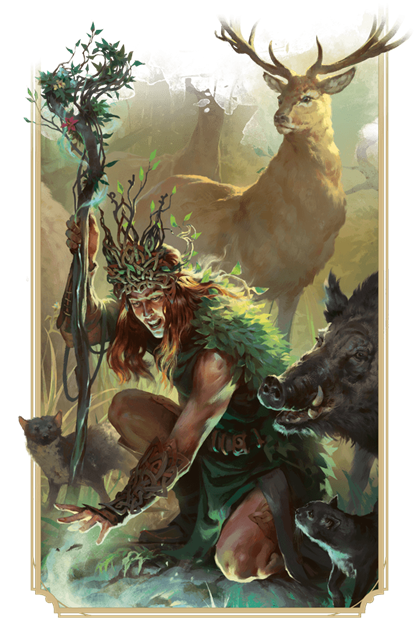
Druids are spellcasters who draw their power from nature itself—the living world of beasts, plants, elements, and seasons. They believe that civilization is only one part of a far greater balance, and that the natural world must be protected, guided, or restored when that balance is threatened.
Through ancient rites, meditation, and communion with the wild, Druids command primal magic. They heal wounds with verdant energy, call down storms and flame, awaken the fury of the elements, and even transform into animals to better understand the world they protect.
Unlike clerics, whose power flows from the gods, Druids draw strength directly from nature or from nature deities who embody it. Many belong to secretive circles that guard sacred groves, ancient ruins, or untouched wilderness. Others wander as lone wardens, answering only to the land itself.
To a Druid, nature is not a resource—it is a living force, deserving of reverence, respect, and fierce protection.
Becoming a Druid
As a Level 1 Character
- Gain all the traits in the Core Druid Traits table.
- Gain the Druid’s level 1 features, which are listed in the Druid Features table.
As a Multiclass Character
- Gain the following traits from the Core Druid Traits table: Hit Point Die and training with Light armor and Shields.
- Gain the Druid’s level 1 features, which are listed in the Druid Features table. See the multiclassing rules in chapter 2 to determine your available spell slots.
Druid Progression
| Level | Proficiency Bonus | Class Features | Wild Shape | Cantrips | Prepared Spells | 1 | 2 | 3 | 4 | 5 | 6 | 7 | 8 | 9 |
|---|---|---|---|---|---|---|---|---|---|---|---|---|---|---|
| 1 | +2 | Spellcasting, Druidic, Primal Order | — | 2 | 4 | 2 | — | — | — | — | — | — | — | — |
| 2 | +2 | Wild Shape, Wild Companion | 2 | 2 | 5 | 3 | — | — | — | — | — | — | — | — |
| 3 | +2 | Druid Subclass | 2 | 2 | 6 | 4 | 2 | — | — | — | — | — | — | — |
| 4 | +2 | Ability Score Improvement | 2 | 3 | 7 | 4 | 3 | — | — | — | — | — | — | — |
| 5 | +3 | Wild Resurgence | 2 | 3 | 9 | 4 | 3 | 2 | — | — | — | — | — | — |
| 6 | +3 | Subclass feature | 3 | 3 | 10 | 4 | 3 | 3 | — | — | — | — | — | — |
| 7 | +3 | Elemental Fury | 3 | 3 | 11 | 4 | 3 | 3 | 1 | — | — | — | — | — |
| 8 | +3 | Ability Score Improvement | 3 | 3 | 12 | 4 | 3 | 3 | 2 | — | — | — | — | — |
| 9 | +4 | — | 3 | 3 | 14 | 4 | 3 | 3 | 3 | 1 | — | — | — | — |
| 10 | +4 | Subclass feature | 3 | 4 | 15 | 4 | 3 | 3 | 3 | 2 | — | — | — | — |
| 11 | +4 | — | 3 | 4 | 16 | 4 | 3 | 3 | 3 | 2 | 1 | — | — | — |
| 12 | +4 | Ability Score Improvement | 3 | 4 | 16 | 4 | 3 | 3 | 3 | 2 | 1 | — | — | — |
| 13 | +5 | — | 3 | 4 | 17 | 4 | 3 | 3 | 3 | 2 | 1 | 1 | — | — |
| 14 | +5 | Subclass feature | 3 | 4 | 17 | 4 | 3 | 3 | 3 | 2 | 1 | 1 | — | — |
| 15 | +5 | Improved Elemental Fury | 3 | 4 | 18 | 4 | 3 | 3 | 3 | 2 | 1 | 1 | 1 | — |
| 16 | +5 | Ability Score Improvement | 3 | 4 | 18 | 4 | 3 | 3 | 3 | 2 | 1 | 1 | 1 | — |
| 17 | +6 | — | 4 | 4 | 19 | 4 | 3 | 3 | 3 | 2 | 1 | 1 | 1 | 1 |
| 18 | +6 | Beast Spells | 4 | 4 | 20 | 4 | 3 | 3 | 3 | 3 | 1 | 1 | 1 | 1 |
| 19 | +6 | Epic Boon | 4 | 4 | 21 | 4 | 3 | 3 | 3 | 3 | 2 | 1 | 1 | 1 |
| 20 | +6 | Archdruid | 4 | 4 | 22 | 4 | 3 | 3 | 3 | 3 | 2 | 2 | 1 | 1 |
Druid Class Features
As a Druid, you gain the following class features when you reach the specified Druid levels. These features are listed in the Druid Features table.
Level 1: Spellcasting
You have learned to cast spells through studying the mystical forces of nature. See chapter 7 for the rules on spellcasting. The information below details how you use those rules with Druid spells, which appear on the Druid spell list later in the class’s description.
Cantrips. You know two cantrips of your choice from the Druid spell list.
Whenever you gain a Druid level, you can replace one of your cantrips with another cantrip of your choice from the Druid spell list.
When you reach Druid levels 4 and 10, you learn another cantrip of your choice from the Druid spell list, as shown in the Cantrips column of the Druid Features table.
Spell Slots. The Druid Features table shows how many spell slots you have to cast your level 1+ spells. You regain all expended slots when you finish a Long Rest.
Prepared Spells of Level 1+. You prepare the list of level 1+ spells that are available for you to cast with this feature. To start, choose four level 1 spells from the Druid spell list.
The number of spells on your list increases as you gain Druid levels, as shown in the Prepared Spells column of the Druid Features table. Whenever that number increases, choose additional spells from the Druid spell list until the number of spells on your list matches the number on the table. The chosen spells must be of a level for which you have spell slots. For example, if you’re a level 3 Druid, your list of prepared spells can include six spells of levels 1 and 2 in any combination.
If another Druid feature gives you spells that you always have prepared, those spells don’t count against the number of spells you can prepare with this feature, but those spells otherwise count as Druid spells for you.
Changing Your Prepared Spells. Whenever you finish a Long Rest, you can change your list of prepared spells, replacing any of the spells with other Druid spells for which you have spell slots.
Spellcasting Ability. Wisdom is your spellcasting ability for your Druid spells.
Spellcasting Focus. You can use a Druidic Focus as a Spellcasting Focus for your Druid spells.
Level 1: Druidic
You know Druidic, the secret language of Druids. While learning this ancient tongue, you also unlocked the magic of communicating with animals; you always have the Speak with Animals spell prepared.
You can use Druidic to leave hidden messages. You and others who know Druidic automatically spot such a message. Others spot the message’s presence with a successful DC 15 Intelligence (Investigation) check but can’t decipher it without magic.
Level 1: Primal Order
You have dedicated yourself to one of the following sacred roles of your choice.
Level 2: Wild Shape
The power of nature allows you to assume the form of an animal. As a Bonus Action, you shape-shift into a Beast form that you have learned for this feature (see “Known Forms” below). You stay in that form for a number of hours equal to half your Druid level or until you use Wild Shape again, have the Incapacitated condition, or die. You can also leave the form early as a Bonus Action.
Number of Uses. You can use Wild Shape twice. You regain one expended use when you finish a Short Rest, and you regain all expended uses when you finish a Long Rest.
You gain additional uses when you reach certain Druid levels, as shown in the Wild Shape column of the Druid Features table.
Known Forms. You know four Beast forms for this feature, chosen from among Beast stat blocks that have a maximum Challenge Rating of 1/4 and that lack a Fly Speed. Whenever you finish a Long Rest, you can replace one of your known forms with another eligible form.
When you reach certain Druid levels, your number of known forms and the maximum Challenge Rating for those forms increases, as shown in the Beast Shapes table. In addition, starting at level 8, you can adopt a form that has a Fly Speed.
When choosing known forms, you may look in the Monster Manual or elsewhere for eligible Beasts if the Dungeon Master permits you to do so.
Beast Shapes
| Druid Level | Known Forms | Max CR | Fly Speed |
|---|---|---|---|
| 2 | 4 | 1/4 | No |
| 4 | 6 | 1/2 | No |
| 8 | 8 | 1 | Yes |
Rules While Shape-Shifted. While in a form, you retain your personality, memories, and ability to speak, and the following rules apply:
Temporary Hit Points. When you assume a Wild Shape form, you gain a number of Temporary Hit Points equal to your Druid level.
Game Statistics. Your game statistics are replaced by the Beast’s stat block, but you retain your creature type; Hit Points; Hit Point Dice; Intelligence, Wisdom, and Charisma scores; class features; languages; and feats. You also retain your skill and saving throw proficiencies and use your Proficiency Bonus for them, in addition to gaining the proficiencies of the creature. If a skill or saving throw modifier in the Beast’s stat block is higher than yours, use the one in the stat block.
No Spellcasting. You can’t cast spells, but shape-shifting doesn’t break your Concentration or otherwise interfere with a spell you’ve already cast.
Objects. Your ability to handle objects is determined by the form’s limbs rather than your own. In addition, you choose whether your equipment falls in your space, merges into your new form, or is worn by it. Worn equipment functions as normal, but the DM decides whether it’s practical for the new form to wear a piece of equipment based on the creature’s size and shape. Your equipment doesn’t change size or shape to match the new form, and any equipment that the new form can’t wear must either fall to the ground or merge with the form. Equipment that merges with the form has no effect while you’re in that form.
Level 2: Wild Companion
You can summon a nature spirit that assumes an animal form to aid you. As a Magic action, you can expend a spell slot or a use of Wild Shape to cast the Find Familiar spell without Material components.
When you cast the spell in this way, the familiar is Fey and disappears when you finish a Long Rest.
Level 3: Druid Subclass
You gain a Druid subclass of your choice. A subclass is a specialization that grants you features at certain Druid levels. For the rest of your career, you gain each of your subclass’s features that are of your Druid level or lower.
Level 4: Ability Score Improvement
You gain the Ability Score Improvement feat or another feat of your choice for which you qualify. You gain this feature again at Druid levels 8, 12, and 16.
Level 5: Wild Resurgence
Once on each of your turns, if you have no uses of Wild Shape left, you can give yourself one use by expending a spell slot (no action required).
In addition, you can expend one use of Wild Shape (no action required) to give yourself a level 1 spell slot, but you can’t do so again until you finish a Long Rest.
Level 7: Elemental Fury
The might of the elements flows through you. You gain one of the following options of your choice.
Level 15: Improved Elemental Fury
The option you chose for Elemental Fury grows more powerful, as detailed below.
Potent Spellcasting. When you cast a Druid cantrip with a range of 10 feet or greater, the spell’s range increases by 300 feet.
Primal Strike. The extra damage of your Primal Strike increases to 2d8.
Level 18: Beast Spells
While using Wild Shape, you can cast spells in Beast form, except for any spell that has a Material component with a cost specified or that consumes its Material component.
Level 19: Epic Boon
You gain an Epic Boon feat or another feat of your choice for which you qualify.
Level 20: Archdruid
The vitality of nature constantly blooms within you, granting you the following benefits.
Evergreen Wild Shape. Whenever you roll Initiative and have no uses of Wild Shape left, you regain one expended use of it.
Nature Magician. You can convert uses of Wild Shape into a spell slot (no action required). Choose a number of your unexpended uses of Wild Shape and convert them into a single spell slot, with each use contributing 2 spell levels. For example, if you convert two uses of Wild Shape, you produce a level 4 spell slot. Once you use this benefit, you can’t do so again until you finish a Long Rest.
Longevity. The primal magic that you wield causes you to age more slowly. For every ten years that pass, your body ages only one year.
Druid Subclasses
A Druid subclass is a specialization that grants you features at certain Druid levels, as specified in the subclass. Druids form loose associations, which they call circles.
Circle of the Land (PHB 2024)
Druids of the Circle of the Land are deeply bound to specific environments—forests, deserts, tundras, swamps, and more. Their magic reflects the rhythms, dangers, and beauty of the lands they protect.
These Druids are masters of spellcasting, drawing additional power from their chosen terrain. Often serving as guardians of sacred places, they act as living extensions of the land’s will.
Circle of the Moon (PHB 2024)
Druids of the Circle of the Moon embrace Wild Shape as their primary calling. They shift swiftly and violently into powerful beasts, using tooth and claw to defend nature.
These Druids are ferocious frontline combatants, blurring the line between spellcaster and warrior. In battle, they become the storm the enemy never sees coming.
Circle of the Sea (PHB 2024)
Druids of the Circle of the Sea draw power from oceans, storms, tides, and the crushing depths. Their magic embodies both the serenity and the terror of open waters.
Often sailors, coastal guardians, or stormcallers, these Druids command waves, lightning, and wind—protecting shorelines or unleashing the sea’s wrath upon those who despoil it.
Circle of the Stars (PHB 2024)
Druids of the Circle of the Stars look beyond the earth to the heavens above. They read fate in constellations and channel cosmic energy through ancient star maps.
Blending nature magic with celestial power, these Druids become living conduits of astral light, guiding allies and shaping destiny through the patterns of the night sky.
Additional Druid Circles (Other 5e Sources)
Circle of Wildfire (Tasha’s Cauldron of Everything)
Druids of the Circle of Wildfire understand that destruction is a necessary part of rebirth. Fire clears the old so that new life may flourish.
These Druids wield flame both as a weapon and a healing force, accompanied by a wildfire spirit that embodies renewal through destruction. To them, ash is simply the soil of tomorrow.
Circle of Dreams (Xanathar’s Guide to Everything)
Druids of the Circle of Dreams draw power from the Feywild, acting as protectors of natural sanctuaries and safe havens.
They focus on healing, teleportation, and subtle magic, watching over travelers and sacred places alike. Their presence brings peace, restoration, and the soft glow of fey magic.
Circle of the Shepherd (Xanathar’s Guide to Everything)
Druids of the Circle of the Shepherd serve as guardians of beasts and fey creatures. They bolster summoned allies and protect the spirits of the wild.
These Druids are leaders and protectors, standing amid allies—both mortal and summoned—guiding them through battle with primal authority.
Circle of Spores (Guildmasters’ Guide to Ravnica / Tasha’s Cauldron of Everything)
Druids of the Circle of Spores embrace decay as a natural and necessary force. Through fungi and rot, they channel the cycle of life and death.
Often unsettling to others, these Druids command spores, necrotic energy, and symbiotic growths, proving that even decay has purpose.
Main info Druid:
Hit Die: d8 per Druid level
Primary Ability: Wisdom
Armor: Light armor, Shields
Weapons: Simple weapons
Tools: Herbalism Kit
Skills: Choose 2 — Animal Handling, Arcana, Insight, Medicine, Nature, Perception, Religion, or Survival
Saves: Intelligence, Wisdom
Combat Role: Control, healing, summoning, and battlefield adaptation
Key Mechanic: Spellcasting & Wild Shape
Starting Equipment: Choose one:
• A: Leather armor, shield, sickle, druidic focus (quarterstaff), explorer’s pack, herbalism kit, and 9 gp
• B: 50 gp
Complexity: High
Best For Players Who: Want a flexible nature-based spellcaster who can control the battlefield, support allies, and adapt by transforming into animals

Comments