
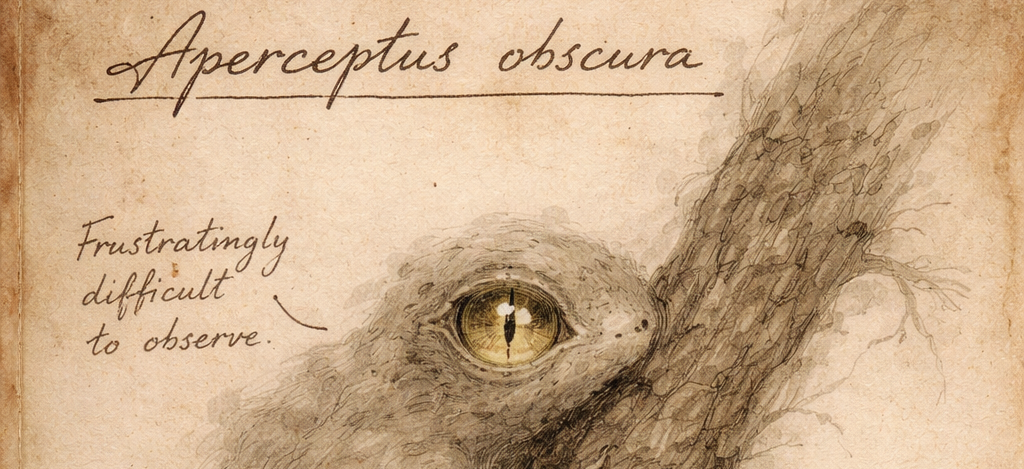
Aperceptus
General Description
The Aperceptus, formally designated Aperceptus obscura, is a theorized creature of Enderlin whose existence remains unconfirmed, yet is theorized to exist by some natural philosophers and scholars.
Unlike known creatures that rely on camouflage or mimicry, the Aperceptus appears to employ a far more unusual survival strategy: it does not hide from sight—it hides within the limits of perception itself.
Observers rarely report seeing the creature directly. Instead, they describe unsettling anomalies:
- A space where detail seems strangely absent
- Movement that vanishes when directly observed
- The persistent feeling of being watched, without visible cause
These accounts suggest that the Aperceptus exists in a state that avoids recognition rather than visibility, exploiting the natural imperfections of sight and cognition.
A Creature Beyond Sight
All sighted beings possess limitations in perception.
The eye contains natural blind spots, and peripheral vision lacks clarity. More importantly, the mind constantly fills gaps in visual information, smoothing irregularities so that the world appears stable and continuous.
The Aperceptus appears to exploit this process.
Rather than becoming invisible, it positions itself in areas the brain instinctively ignores—regions where detail is incomplete or ambiguous. In doing so, it avoids the moment when the mind identifies something as a distinct object.
To an observer, the creature does not vanish.
It simply fails to be noticed.
Physical Characteristics
Though no confirmed specimen has ever been captured, consistent reports allow for a tentative description.
Size and Form
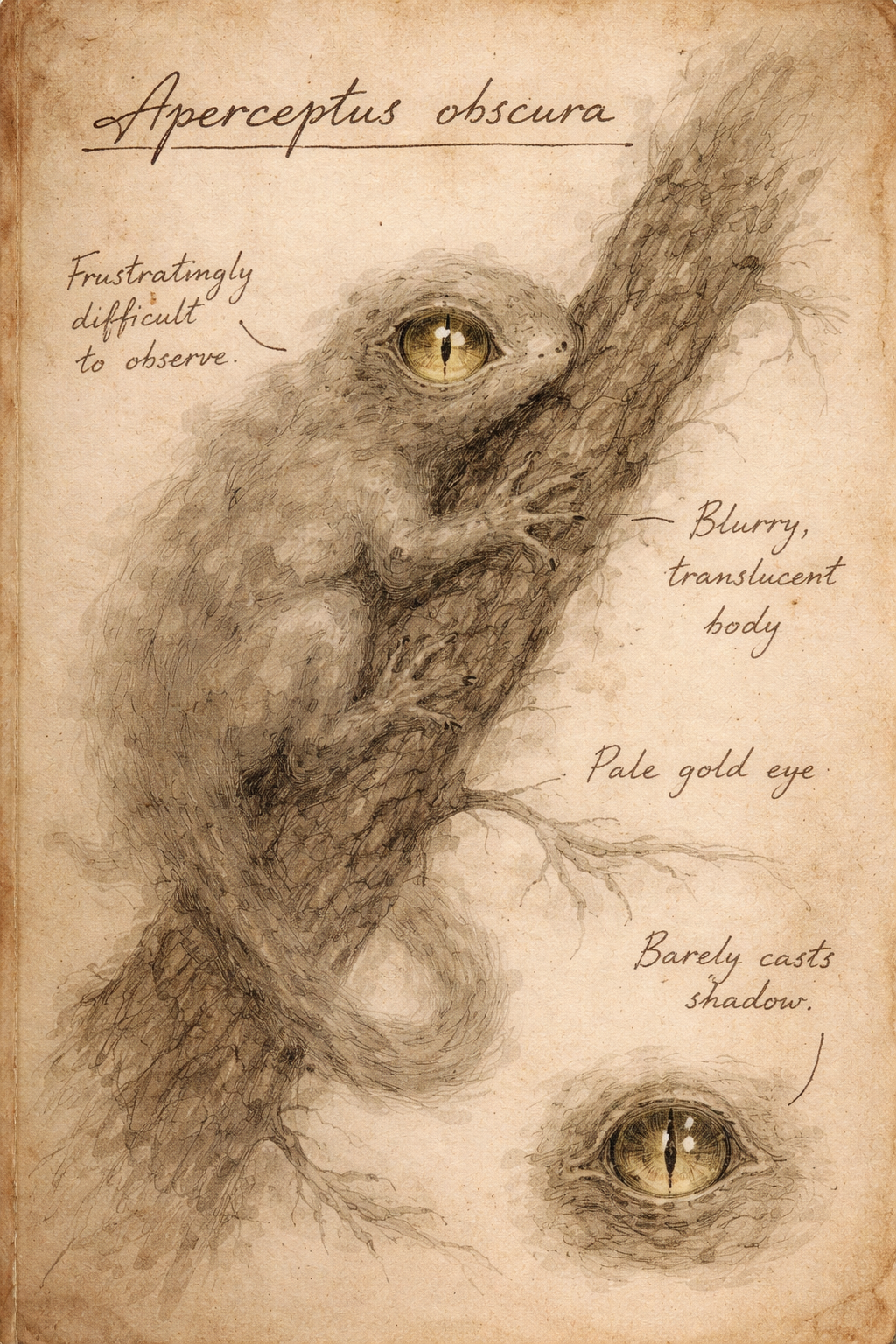
- Likely small, comparable to a large insect, lizard, or small arboreal animal
- Body appears minimal and lightweight, adapted for precise movement
- Capable of clinging to surfaces such as stone, bark, and foliage
Skin and Light Interaction
The Aperceptus is believed to possess highly specialized skin that interacts with light in unusual ways:
- Partially translucent or light-diffusing tissue
- Greatly reduced shadow formation
- Minimal visual contrast with surroundings
Without strong shadows or outlines, the creature produces fewer cues for the eye to detect.
The Eye of the Aperceptus
The most defining feature of the creature is its eye.
Accounts consistently describe a large, reflective eye, pale gold or grey in color, with a narrow vertical pupil. This organ appears disproportionately large compared to the rest of the body.
Scholars believe this eye serves as the core of the creature’s ability.
Function
- Detects subtle shifts in light and movement
- Tracks the direction and focus of other creatures’ gaze
- Allows the Aperceptus to adjust its position in real time
It is theorized that the eye acts as a kind of perceptual anchor. Without it, the creature may be unable to maintain its concealment.
In essence, the Aperceptus does not simply hide—it constantly reacts to being observed, ensuring it remains just outside recognition.
Behavior and Movement
The Aperceptus is believed to move with extreme precision and restraint.
- Movement is slow and deliberate
- It favors the edges of vision, where detail is weakest
- It adjusts its position as an observer shifts their gaze
This behavior creates the illusion that the creature is never directly seen, even when it is present in plain view.
Rather than fleeing, the Aperceptus relies on remaining unrecognized, even at close range.
Habitat
Most reports place the Aperceptus in:
- Dense temperate forests
- Rocky highlands
- Areas with complex light patterns and shifting shadows
These environments provide ideal conditions for its form of concealment, where broken light and layered textures make perception less reliable.
The southern regions of Enderlin are considered the most likely origin of the species.
Ecological Role
The exact role of the Aperceptus within its ecosystem remains uncertain.
Two primary theories exist:
Predatory Hypothesis
The creature uses its concealment to approach prey unnoticed, striking before detection is possible.
Defensive Hypothesis
It evolved primarily to avoid predators, relying on its perceptual camouflage rather than speed or strength.
It is possible that the Aperceptus fulfills both roles, acting as a small but highly effective ambush predator.
Scholarly Debate
The existence of the Aperceptus remains controversial.
Skeptics argue that all reported encounters can be explained by:
- Natural visual errors
- Fatigue or stress
- Misinterpretation of environmental movement
However, proponents point to the remarkable consistency of independent accounts, particularly descriptions of:
- The large reflective eye
- The sense of something present but unseen
- The disappearance of movement upon direct focus
To some scholars, this consistency suggests not illusion—but a species uniquely adapted to exploit perception itself.
Implications
If the Aperceptus truly exists, it represents a profound discovery.
Most creatures evolve to survive within the physical world—through strength, speed, or camouflage.
The Aperceptus suggests something far more unusual:
An organism shaped not only by the environment, but by the way other creatures perceive it.
It is, in essence, a creature that has evolved to hide inside the mind as much as the world.
Conclusion
The Aperceptus obscura remains one of the most enigmatic creatures ever proposed in Enderlin.
No specimen has been captured. No definitive proof has been recorded.
And yet, across forests, cliffs, and quiet places where the eye struggles to focus, the same reports persist:
A flicker of movement.
A gap where something should be.
The unmistakable feeling that something is there—
just beyond the moment of recognition.
Theoretical/hypothesized appearance of the Aperceptus obscura:

Comments