

Beofalls Harbor
Harbor Control System
The Control Tower
Centrally located on the Beofalls waterfront, the Harbor Control Tower is the tallest structure in the city, serving as the brain of the entire port. At its summit lies the Harbor Control Room, which features panoramic windows enchanted with long-range magnification. These windows allow controllers to identify approaching vessels and monitor harbor activity miles away with absolute clarity. Within this chamber, highly trained specialists (the Controllers) calculate routes and communicate instructions to every ship via specialized magical stones, maintaining a 360-degree vigil over the sea and every berth in the harbor.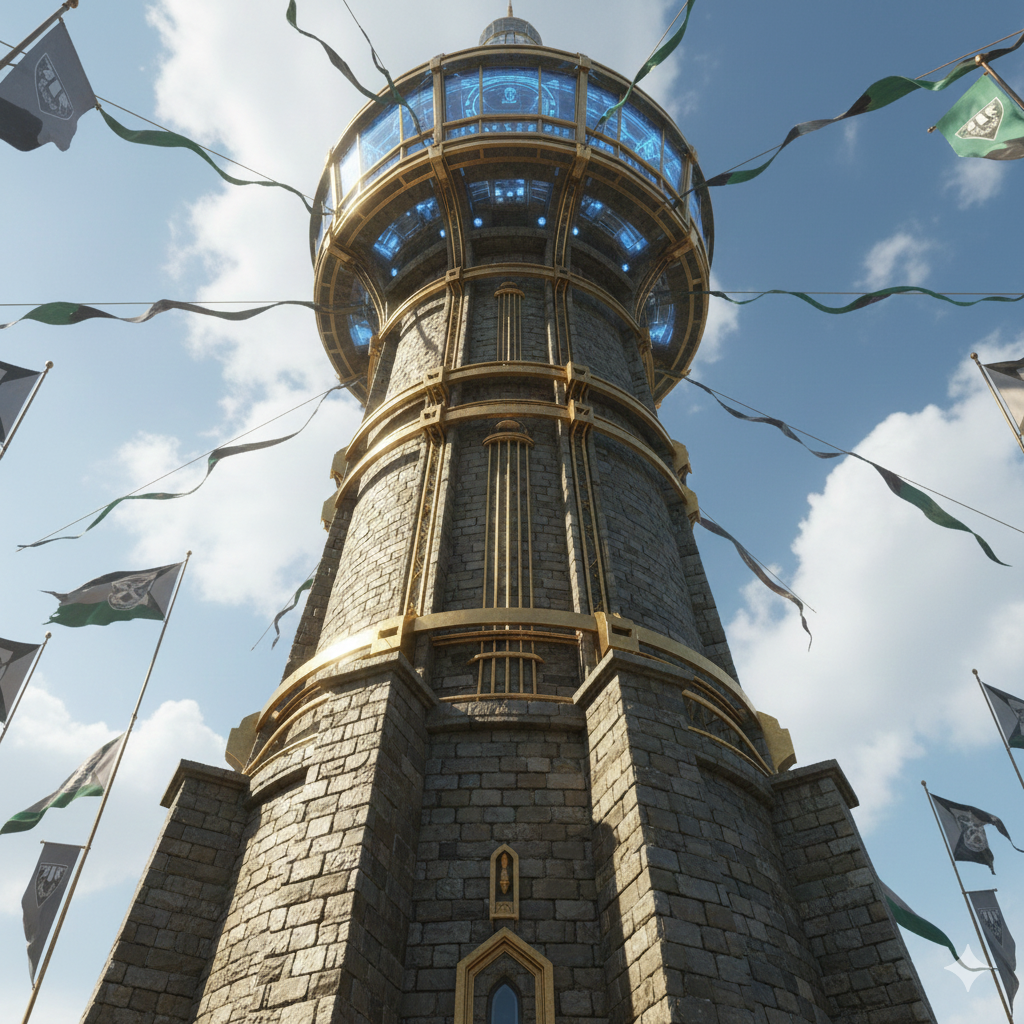
The Sea Towers
Four massive Sea Towers are stationed in the water at the entrance to the harbor, serving as the physical checkpoints and the first point of contact for all incoming traffic. Each tower is equipped with multi-level gangplanks designed to accommodate ships of varying sizes, from shallow-draft merchant cogs to massive multi-decked galleons. It is the responsibility of the Tower Sentries to keep a constant lookout for approaching vessels. Upon spotting a ship, the Sentry must quickly assess its size and draft to determine which gangplank level is most appropriate. The Sentry then signals the ship using a specialized visual system, directing the captain to the specific approach path that aligns with the chosen gangplank.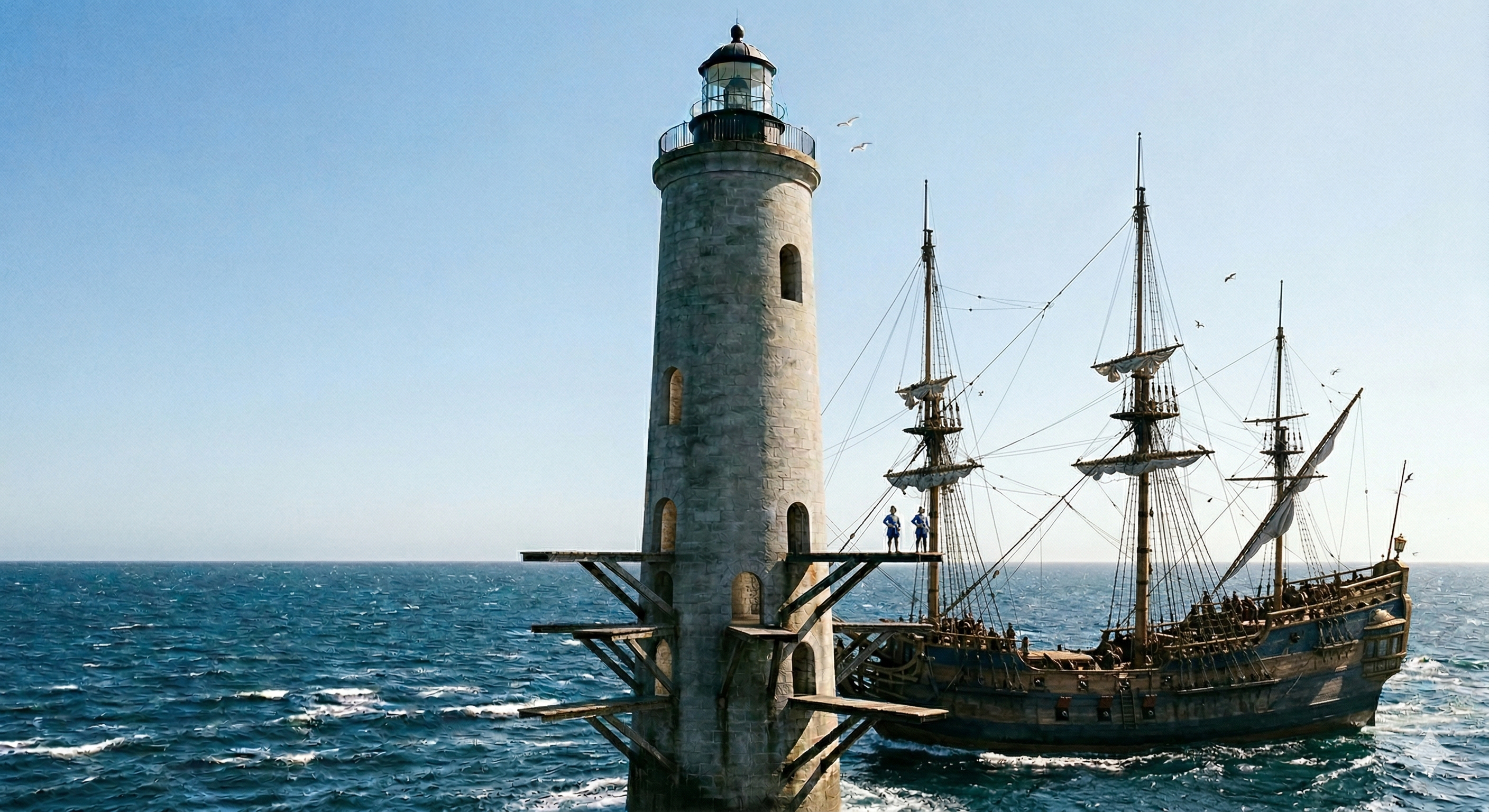
Verification Process and "Ship-Walk"
As a ship glides alongside the signaled gangplank, the Captain performs a "Ship-Walk," pacing along the deck to remain parallel with the Sentry on the stationary tower gangplank. During this exchange, the Sentry verifies the ship's manifest and the captain's Beofalls Port Authority License. The Sentry then uses a sending stone to transmit the ship's unique identification number and the captain's license number to the Control Tower. This data allows the Tower to log the ship's arrival and ensures the Controllers know exactly which Sea Tower to respond to with the vessel's specific Quay assignment. If a Captain is unlicensed, a specialized Harbor Captain boards from the Sea Tower to take the helm, remaining aboard until the ship exits the harbor at the end of its stay.Communication & Signaling
The system relies on a double-verification method using both visual signals and magical audio. Once the Tower confirms the ship's data, the Sentry issues a colored Quay Flag (or a checkered diplomatic flag) and a temporary Sending Stone.Sending Stone Protocol
The Beofalls Port Authority coordinates all traffic through a specialized application of the Sending spell. Unlike the standard version of the spell, these stones facilitate communication based on identity rather than personal familiarity.- Establishing the Link: Upon receiving a temporary stone from a Tower Sentry, a captain must initiate contact with the "Control Tower." This initial message serves to link the captain’s identity and their ship's name to the harbor’s central communication hub.
- Targeted Messaging: Once identified, Controllers can direct messages to a specific stone simply by speaking the captain’s or the ship's name. Conversely, any captain addressing their message to "Control Tower" will have their transmission broadcast to all active Controllers, ensuring collaborative oversight.
- The 25-Word Rule: Every message is strictly limited to 25 words. While the recipient's name is "free" and does not count against this limit, the captain’s mandatory identifying first word does count toward their 25-word total.
- Security & Enforcement: The "First-Word Identifier" protocol is mandatory for all captains. Unauthorized use of these stones or failure to maintain a clear "Nominal Identity" (at least one identifying word at the beginning of the message) may result in sanctions against the captain, which sanctions appear on their BPA license record.
Standardized Messaging
The following standardized scripts are given in the Harbormaster's Guide to Entry as recommendations that help keep captains within the 25-word limit of the Sending spell. Per the Guide, any captain or officer attempting to bypass the Control Tower and communicate directly with another department (except their assigned berth/drydock foreman or another ship when necessary) is subject to Licensing Division Sanctions.| # | Perspective | Recipient Name | Script Content |
|---|---|---|---|
| 1 | Sentry | Control Tower | Sentry: [Vessel Name] at Sea Tower [Number]. Carrying [Cargo Type/Passengers/Diplomatic]. Verified by Sentry [Surname]. Awaiting quay assignment. |
| 2 | Sentry | Control Tower | Sentry: [Vessel Name] at Sea Tower [Number]. Slated for DRYDOCK maintenance. Verified by Sentry [Surname]. Awaiting drydock assignment. |
| 3 | Tower | Sentry | Tower: Acknowledged, [Vessel Name]. Assign [Color] Quay Flag. Proceed to harbor entry. |
| 4 | Captain | Control Tower | [Surname/Ship]: Entering jurisdiction. Am Captain [Name] of [Vessel Name]. Requesting route and berth/drydock assignment. |
| 5 | Tower | [Captain Name] | Tower: Captain [Surname], proceed via Route [Letter-Number]. You are assigned to [Berth/Drydock] [Number] at [Quay Name]. |
| 6 | Tower | Customs Master | Tower: Incoming [Vessel Name] at [Quay Name], [Berth/Drydock] [Number]. [Cargo Type] manifest. Prepare for boarding and inspection. |
| 7 | Tower | Foreman | Tower: Incoming [Vessel Name] at your station. Estimated arrival ten minutes. Clear the lane. |
| 8 | Foreman | Control Tower | Foreman: [Berth/Drydock] [Number] is vacant. Outbound vessel cleared. Crew and gear ready for next arrival. |
| 9 | Tower | [Captain Name] | Tower: Captain [Surname], you are Clear to Berth. Maintain current route. Foreman is standing by. |
| 10 | Tower | [Captain Name] | Tower: Captain [Surname], HOLD POSITION. Maintain minimum five-hundred-foot distance from harbor entrance. Awaiting traffic clearance. |
The Grand Quays
The Grand Quays are the primary berthing infrastructure of the Beofalls harbor, designed to maximize the "Maritime Momentum" that defines the city's trade. Unlike traditional docks, these are massive stone piers anchored directly into the deep sea bed.- Engineering and Spacing: The quays jut straight out into the harbor at wide intervals, ensuring that the channels between them are broad enough for two large vessels to pass one another while other ships remain berthed on either side.
- The Deep-Water Advantage: They take advantage of a natural drop-off in the harbor's sea floor, allowing even the deepest-draft multi-decked galleons to moor directly alongside the stone piers rather than anchoring in the bay.
- Arch Alignment: While each quay is straight, the shoreline of the Low-Quay ward was engineered with a subtle outward curve. This creates a fan-like arched formation, ensuring the Harbor Control Tower has an unobstructed line of sight down the length of every pier.
- Functional Design: The quays are built to a standard dock height to facilitate the use of the BPA's specialized wheeled municipal gangplanks.
Docking Protocols & the 500-feet Rule
Safety within the harbor is governed strictly by the 500-Foot Rule. All incoming ships must hold their position at least 500 feet away from their assigned Quay to allow other vessels to navigate the channels freely. A ship may only begin its final docking maneuvers once the Berth Foreman, the head of the specific dock crew, raises a green flag at the assigned berth. Upon docking, ships are required to use BPA-provided municipal gangplanks rather than their own. These specialized structures feature dedicated stairs for personnel and reinforced ramps for heavy cargo, allowing for the fastest possible turnaround. These specialized gangplanks are placed on wheels so the dock crew can simply wheel it up to the ship and attach it to the bulwark.
In Beofalls, a ship may not move from the 500-foot hold marker to the berth until two separate conditions are met. Relying on only one is a breach of safety protocol and a "Navigational Deviation" on a captain's record.
- The Visual Signal (The Foreman): The Berth Foreman raises a Green Flag at the physical dock. This indicates the berth is physically clear of the previous vessel and the docking crew is ready.
- The Arcane Signal (The Tower): The Control Tower transmits the "Clear to Berth" message. This indicates that the two lanes of cross-traffic between the hold line and the quay have been cleared by the Controllers, granting the captain a safe window to cross.
Loading & Unloading Procedures
Synergy with the Customs Master
When the Control Tower assigns a ship to a berth, a Controller uses a sending stone to relay a message to the Customs Master's Office. The message tells the Customs Master of an inbound ship and the berth to which it has been assigned. The Customs Master then assigns some inspectors. The inspectors make their way to the berth and hold back while the berth crew helps the ship dock. Once the ship has docked, the lead inspector ascends the steps of the gangplank. The ship's captain must present the inspector with a copy of the manifest.
The inspectors get to work inspecting the cargo of the ship. As the inspectors clear each piece of cargo, the ship's crew and any dock workers begin unloading the cargo. The lead inspector stays topside to oversee this and also to direct any passengers on the ship to the Customs Master's Office for screening.
The process of loading cargo onto a ship is significantly easier. The inspectors simply make sure that there isn't anything being loaded that isn't on the ship's outgoing manifest. They also check for stowaways.
Passenger Screening
In order to speed up the process of clearing customs, the process of screening passengers is handled at the Customs Master's Office, rather than by the inspectors on the ship. Passengers disembark from the ship and make their way to the Customs Master's Office. There, inspectors check their travel papers and make an inspection of any luggage/cargo they are carrying.The Beofalls Shipyards
Vessels bound for repair follow specific directives to a numbered drydock and receive a Sending Stone but no colored flag. The Drydock Foreman signals that the dock is ready to receive the ship by raising a green flag to half-staff, indicating the locks are open. Once the ship has entered and docked, the crew closes the locks and evacuates the water. Only once the ship is fully settled and the dock is dry does the Foreman raise the flag to full-staff, signaling that it is safe for the crew to disembark.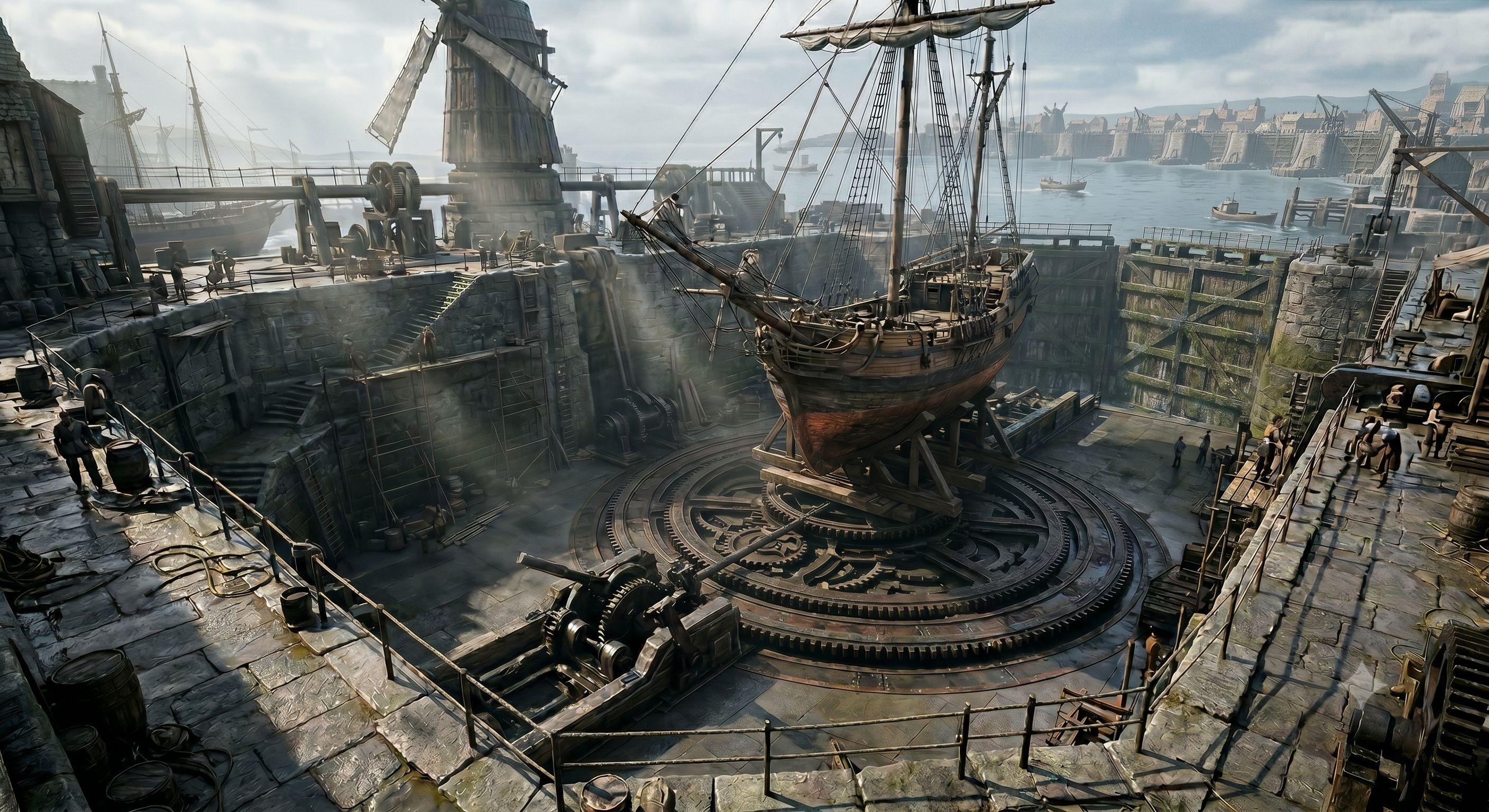
Diplomatic Protocols
Diplomatic vessels utilize the Diplomatic Quay, the only area designed for long-term mooring. Sentries verify diplomatic credentials or letters from heads of state before authorizing the checkered flag. To preserve Harbor Captains for high-turnover merchant traffic, Caelorn requires all diplomatic vessels to be helmed by a captain already licensed by the BPA.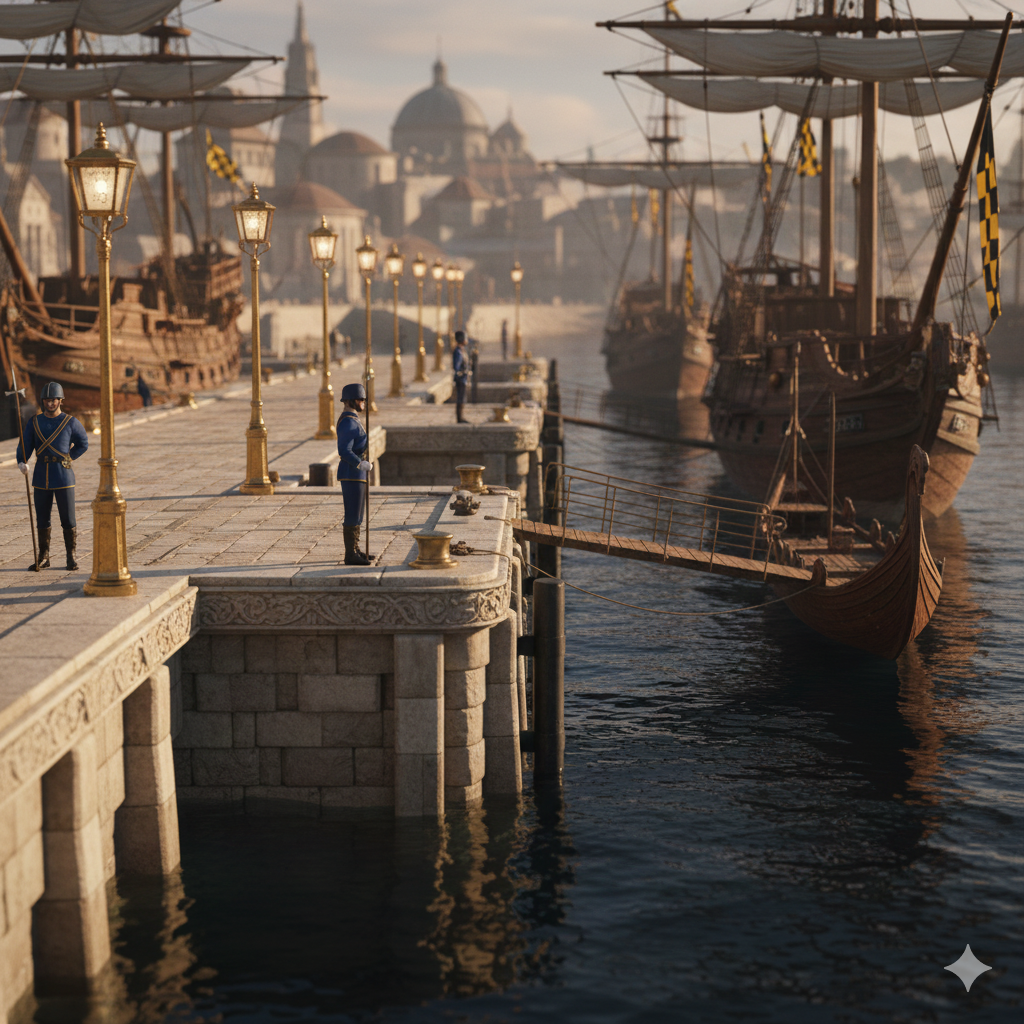
Personnel & Shift Logistics
The BPA maintains a "Never-Empty" policy for the Sea Towers. While the Authority maintains its own ferry vessels for administrative use, most personnel rotations are conducted using the merchant traffic itself for efficiency. An incoming Sentry or Harbor Captain beginning a shift boards an outgoing ship at the city docks and rides it out to the Sea Tower, disembarking as the vessel exits. Conversely, an outgoing Sentry or Harbor Captain ending a shift catches an inbound ship at the Sea Tower to be carried back to the shore. A Sentry is strictly forbidden from departing the Sea Tower until their replacement has successfully boarded. Harbor Captains cannot disembark until their vessel leaves the harbor, unless it is the final vessel of their shift, in which case they may steer the ship into its berth and swap with an incoming pilot.In Beofalls, we do not wait for the tide; we command the ships that ride it.—The Harbormaster's Guide to Entry, 4th Ed.
| Flag Signal | Quay Name | Cargo & Function |
|---|---|---|
| RED | The Iron & Timber Quays | Heavy Industry: Ores, raw metals, coal, and lumber. |
| BLUE | The Weaver's Quays | Dry Goods: Textiles, finished clothing, and packaged merchandise. |
| WHITE | The Granary Quay | Agriculture: Bulk grains, flours, and massive food exports. |
| ORANGE | The Alchemical Quays | Hazardous: Volatile oils, chemicals, and apothecary reagents. |
| PURPLE | The {assenger Quays | Passengers & Mixed: Civil transport and non-hazardous general trade. |
| YEL/BLK CHECK | The Diplomatic Quay | State Affairs: Envoys, Draconic Confederacy, and long-term mooring. |
Comments