
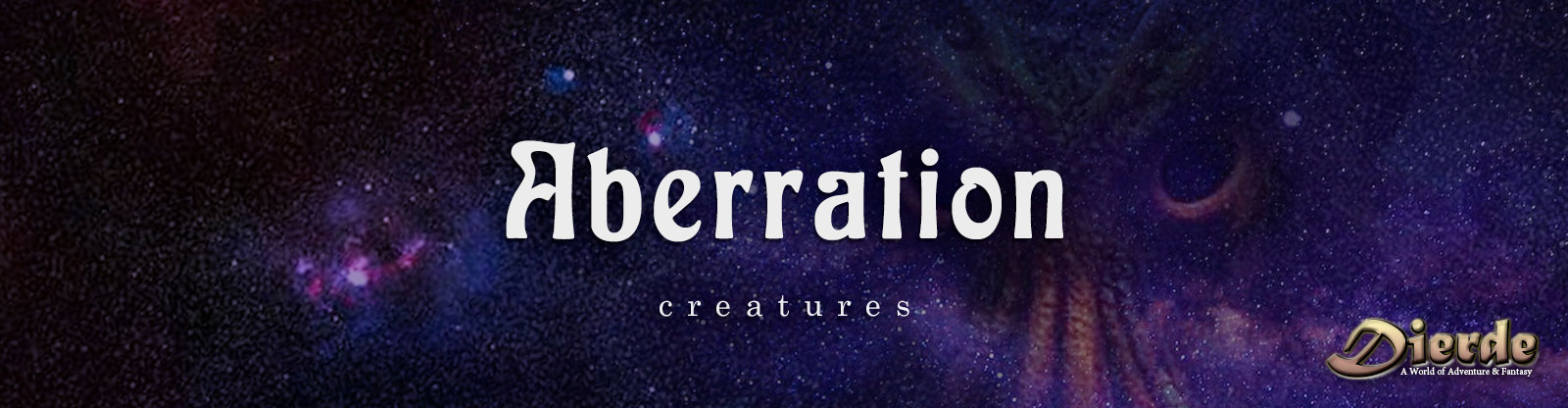
Spellweaver (/ˈspɛl.wɛː.vər/)

The Spellweavers of Toril are part of an ancient race of magic users who once created an empire that spanned the planets and planes of the Multiverse, connected by Nodes and portal networks that linked all the different colonies of the empire together in one massive hive.
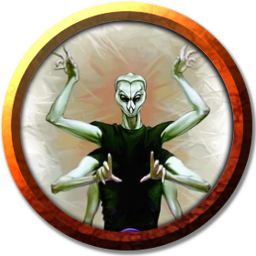
Spell-Weavers, also known as the Anu-naki, are strange and powerful creatures from another dimension. They are gaunt and hairless, with chalky white skin and six arms. They are exceptionally rare and mysterious, and are typically only encountered when they steal magic items for unknown purposes.
Spell-Weavers usually act alone, but on rare occasions, they will work together in small groups to achieve their goals. They are highly skilled in magic, and can use it to hide or disguise themselves in humanoid society. Spell-Weavers have no spoken language, and instead communicate with each other through telepathy and sign language. They will sometimes utter a strange series of whistles and clicks as verbal components when they cast spells.
Telepathic communication with Spell-Weavers is extremely difficult and dangerous for most other races. It can result in temporary insanity, lasting up to seven days with effects similar to the mage spell "confusion." In some cases, the insanity can be permanent.
All Spell-Weavers possess a "Rod of Synergy," a chromatic silver rod encrusted with magical gems of different colors. The gems store vast amounts of Spell-Weaver memories and magical energy for spell casting. The secrets of controlling these rods are lost to all other races, and any attempts to use them have resulted in insanity or death.
NOTES:
- Spell-Weavers are incredibly strong and agile, and they are able to wield multiple weapons at once.
- They are also highly resistant to magic, and they can even absorb magical energy to fuel their own spells.
- Spell-Weavers are natural predators, and they are known to hunt and kill other creatures for food.
- They are also skilled in the use of poisons, and they have been known to use them to incapacitate their enemies.
Basic Information
Anatomy
Spellweavers, also known as Weavers, were a race of highly intelligent humanoids originating from an alternate Prime Material plane. Gifted with an unprecedented mastery of the Art, they built an empire that spanned the multiverse before meeting a tragic and almost instant end.
Weavers were alien-looking creatures: their frail bodies sported six arms, and an exceptionally long neck around which they could easily turn their head completely. Their skin was smooth and hairless and was usually gray, with patches of beige, pink or yellow. They sported a genderless, vaguely bird-like figure; and a pair of large, dark eyes. Their blood was metallic blue in color, reminiscent of quicksilver. The skin of young spellweavers was a dark shade of gray, and would lighten up as they got older.
Description
Characteristics
An adult Spellweaver is of humanoid shape with 6 arms (6 is a recurring and important part of the Spellweaver existence), and a vaguely insectoid face and general appearance including chitinous skin. In general they average 5 feet in height with long spindly limbs and neck, their skin colouration is usually grey tinged with blue or green with the occasional coloured patch on their abdomen. Juvenile Spellweavers look even more insectlike than adults, with their elongated limbs even more exaggerated against their shortened bodies.
These slender, mysterious creatures gather in small cabals, and are most commonly encountered while they search for magic items to add to their collection. However, solitary spellweavers are even more common. In groups, they plan and execute raids to steal magic items they desire, using scrying to scout out their foe, then attacking while invisible. They only communicate with each other telepathically, but sometimes they leave written notes behind for others to find. However, these notes are entirely incomprehensible, either gibberish or else nonsensical. Spellweavers stand around 5 feet tall and weigh around 120 pounds.
Genetics and Reproduction
Reproduction
Spell-Weavers reproduce through a unique process that involves a combination of self-sacrifice and magic. When a Spell-Weaver reaches the end of its natural lifespan, it enters a cocoon and performs a ritual that transforms it into six new adult Spell-Weavers. The new Spell-Weavers share the memories and mental abilities of their parent.
The cocoon is made from a special material that is only found in very rare Spell-Weaver bases. The ritual itself requires a large amount of magical energy, which is typically gathered from magical items.
The process of reproduction is very dangerous for the Spell-Weaver. If the cocoon is interrupted or the ritual is not performed correctly, the Spell-Weaver will be transformed into a seething mass of flesh-eating beetles. These beetles are known as scarabs, and they are a major threat to the Spell-Weavers.
There is only one known malady that can afflict Spell-Weavers during the reproduction process. This malady is called "The Darkness," and it transforms the Spell-Weaver into one or more star-shaped gems. These gems are unnaturally attuned to magic, and they can be easily enchanted. However, releasing the enspelled magic requires the destruction of the gem.
The Spell-Weavers have never been able to fully understand The Darkness. They believe that it is a magical disease that attacks them during their most vulnerable time. However, they have never been able to find a cure.
| Stage | Description |
|---|---|
| Cocooning | The Spell-Weaver enters a cocoon and performs a ritual that transforms it into six new adult Spell-Weavers. |
| Metamorphosis | The new Spell-Weavers emerge from the cocoon and share the memories and mental abilities of their parent. |
| Dangers | The process of reproduction is very dangerous for the Spell-Weaver. If the cocoon is interrupted or the ritual is not performed correctly, the Spell-Weaver will be transformed into a seething mass of flesh-eating beetles. |
| Maladies | The only known malady that can afflict Spell-Weavers during the reproduction process is called "The Darkness." This malady transforms the Spell-Weaver into one or more star-shaped gems. |
Biological Cycle
Lifecycle
“Now I am my death and my decay, and soon I shall be nothing… but the scheme of my causes will repeat itself, and generate me again. I lived six times to breed six new lives, and I shall be the same, identical life. I shall be born again as six recurrences of myself.”Although spellweavers might have appeared immortal to other races, their lifespan was only six centuries. Age didn't affect a weaver's physical abilities, and the race had no children: they were born as full-functioning adults through a peculiar ritual. At some point during their long life, spellweavers would instinctively sense that their life would be ending soon. When this happened, an elder weaver would create a magical "coffin" through a ritualistic hibernation trance which consumed a near-priceless amount of magic items. The trance usually lasted for about one month, but had been known to sometimes last for centuries instead—a time during nothing could wake them up. Upon waking up, the weaver would be physically restored and rejuvenated, their skin darkening and their lifespan increasing by another six centuries.
Behaviour
Personality
Claiming their civilization was older than the birth of the deities, the Weavers believed themselves to be above the gods and didn't care for divine magic. Spellweavers continuously looked for magic items, necessary to power their furnaces and to accomplish important rituals. While they were open to trading, they weren't opposed to using force or persuasion to accomplish their goals.Combat
Spellweavers often initiated combat themselves, organizing thoroughly planned raids against targets of high magical power. Raids could be prepared months in advance, using scrying magic and spies to get information on their target. They usually involved teleporting the weaver and its allies in the enemy base, using invisibility to move close to their target, tying any guards, and teleporting back as soon as the deed was done. Targets of such raids were either magic items, or powerful spellcasters whose soul they siphoned with their chromatic disk.Additional Information
Social Structure
Society
While all spellweavers were masters of magic, some were classified by sages in multiple categories depending of their specialties: Battle Weavers were masters of melee combat, using their six arms to wield multiple blades in a deadly ballet. They hunted down the best combatants in existence, aiming to capture worthy souls in their disk. Thought Weavers were masters of the mind, dominating their enemies with psychic powers. They were usually the masterminds behind successful raids and complex schemes. Hex Weavers drew power from the Shadowfell itself. They usually followed their own plans, puzzling even other weavers and sometimes pitting them against each other. After the Disjunction, it was rare for multiple spellweavers to work together. When this happened, it was usually to form a raiding party aiming to seize a particular magic item.Goals
Spellweavers spent most of their time trying to rebuild their ancient civilization. In order to do this they sought out the ruins of their former colonies—called "nodes"—which often took the form of huge pyramids of stone and steel. Once found, the weavers repaired and reactivated them. Weavers usually built a single node per continent, world, or plane of existence—making their discovery a true rarity. Reactivated nodes were linked together through a network of planar portals and housing huge furnaces capable of draining the souls of mortals and the power of magic items. After the fall of their empire no furnace could be found that wasn't destroyed, but weavers kept looking for them, as a live node furnace had a power that could rival that of the deities themselves. In addition to items powering their furnaces and rituals, the weavers looked for rare magical gems containing pieces of "memories" of a specific magical formula called the "Code of Reversion", created before the fall of their empire. Any weaver who found and memorized all parts of the Code would be able to cast the corresponding spell, which effect would be to revert the entire multiverse to the point in time when the Code was created—before the fall of their empire.Empire
At the peak of its power, the spellweaver empire was mostly peaceful. Highly intellectually advanced, they kept the role of watcher over the multiverse, only occasionally subjugating more primitive creatures to perform chores and hard labor. Above all, spellweavers liked to study semantics, and traveled the multiverse to study other cultures, their symbols, languages and codes. Through those studies they developed uncanny telepathic abilities and incredible magical talents. When encountering a race that posed a threat to them, the weavers gifted them with powerful magical items and artifacts, and let them implode from within. After the fall of the empire, some weavers continued to keep this tradition alive.The "Collective," the Spell-Weaver Empire
A number of years ago, a great scholar named Criswell, discovered and deciphered a series of ancient Shadurian texts that illuminated the beings that are known today as the Spell-Weavers and learned some of their darkest secrets. Over 25,000 years ago, in an alternate dimension of existence, there was a great city called Schavra, which was home to the Anu-naki. The vast city was centered around a massive, 1000 foot-tall pyramid constructed from iron and stone, which was powered by a powerful magical furnace. Using the energies of the pyramid, the Anu-naki travelled many worlds and planes. Once there, the Anu-naki built new colonies called "Nodes;" each with its own pyramid. Every colony, and its pyramid, was interconnected by a complex matrix of magical portals. The Anu-naki Empire was unlike most empires; in that it was based on acquisition of knowledge, not military conquest. The "Collective"; as the Anu-naki called their civilization, became a intellectual society which only occasionally subjugated other races or beings for use as menial labor. The Anu-naki were interested in two major fields of study in their everlasting quest for knowledge. First was the study of "Semantics," and second was the Study of "Magical Synergy." In pursuit of these two topics, Anu-naki scholars traveled across the universe; visiting many worlds and making contact with every imaginable civilization, to learn from them the secrets of semantics and magical synergy. For thousands of years, the weavers learned innumerable languages and symbols; including hundreds on the world of Oris alone. Through these pursuits, the Anu-naki learned the ability to cast or "weave" multiple spells at once and to use telepathy over extremely long distances. Sages theorize that the Anu-naki's grand plans to acquire the knowledge of Magical Synergy led to their ultimate downfall. At their height of their knowledge, success, and power; the Anu-naki began a grand experiment to alter the very fabric of space and time throughout the universe. However, this grandiose and dangerous experiment resulted in failure, causing a catastrophe of colossal proportions. Starting in Schavra, the magical furnace within every Anu-naki pyramid exploded in a chain-reaction; obliterating the pyramids, and the cities which surrounded them. In one, tragic moment, the entire Anu-naki Collective came to a tragic end. To the Anu-naki; this terrible event came to be known as the "Disjunction."Spell-Weavers Today
After the tragedy of the Disjunction; the Anu-naki society was completely devastated. But a few of their members survived and swore to rebuild their once, great collective. Before the Disjunction, the secrets of the experiment were psychometrically bound into these gems as a security measure and then scattered across the universe. When put together; the gems revealed something the Anu-naki called the "Code of Reversion." The Code referred to an intricate magical formula used by the Anu-naki to bring about the Disjunction. This quest for the Code of Reversion, became the driving force of all surviving Spell-Weavers. All surviving Anu-naki believe they will someday find this formula and, using the magic of Chronomancy, engineer those same codes to restore their collective and prevent the Disjunction. In furtherance of this quest, the Spell-Weavers are ever seeking out magical gems imbued with "codes" that only they can decipher. It is for this reason, that Spell-Weavers will sometimes "steal" gems with magical powers; for they believe those same gems will aid them in their eternal quest to re-build their lost civilization. Sometimes Spell-Weavers will add their stolen gems onto their Rods of Synergy; which the creatures carry with them at all times.
Life and Society
There is little evidence of Spellweaver society left on Toril, most cultural practices disappeared along with the bulk of the Spellweaver population, and any remaining documented evidence was destroyed along with E.I.L.1 and E.ril.
A few things can be inferred from the few surviving Spellweavers and their descendants. Firstly is that Spellweavers communicated entirely using an advanced form of telepathy that few other races exhibit, and while Spellweavers possess the physiology to speak it appears to be taboo among their race.
Spellweavers appear to have little to no societal structure in the few settlements that remain, roles and responsibilities are incredibly fluid depending upon need and ability, although this may not be representative of the past Spellweaver civilisation.
All Spellweavers are obsessed with collecting magic and language, the magic is required for the rebirth cycle of Spellweavers and is consumed as part of this process. The Spellweavers appear to believe that the languages of the Multiverse each contains a piece of a code from a language of power that created the original Universe. By piecing together this code they believe they can reorder reality and rebuild what once existed before.
Spellweavers have an ingrained disdain of the divine and deities. Spellweavers have never been known to worship a divine being and only one Spellweaver has been known to share their power with lesser beings through pacts in the manner employed by deities.
Lastly, Spellweavers prefer to let others perform the manual labour required to build and maintain their civilisations. In the past the Spellweavers enslaved many lesser beings to do the menial tasks, for warfare and when slaves were in short supply the Spellweavers created colossal golems that were capable of immeasurable feats of strength and endurance.
Uses, Products & Exploitation
Uses
Spellweaver remains had magical properties. Notably, a spellweaver skull was amongst the ingredients of an antidote against the zombie plague which hit Chult in the late 15 century DR.Geographic Origin and Distribution
Lairs
After the Disjunction, some weavers built lairs in all sorts of places. These lairs contained between one and eight 10 ft (3 m) tall pillars of stone or wood covered in indecipherable magical runes. The goal of the lairs was unknown, and seldom studied as doing so could provoke side effects ranging from mild headaches to severe mental damage.
Regions
Millennia ago, the Spellweavers had colonies all over Toril; including the lands that would one day become Anauroch, the Moonsea North, and Mulhorand. Over time these colonies fell to some mysterious disease that afflicted all Spellweavers across the Multiverse and prompted the experiment known as the Disjunction which ultimately decimated the remains of their race.
Now only scattered individuals of the Spellweaver are left, those that have escaped or not yet succumbed to the disease, and those that were away from the Nodes when the Disjunction was performed.
Perception and Sensory Capabilities
Abilities
The body and mind of spellweavers were incredibly in tune with arcane magic. As a result they displayed an incredible mastery of the Art, using powerful telepathy, invisibility, and accomplishing feats such as casting up to six spells at once. Their senses highly attuned to magic allowed them to detect magic and invisibility 100 ft (30 m) around them. Their natural dominion over magic was akin to that of sorcerers, and they could disregard the use of verbal and material components when casting spells. Due to their alien minds, spellweavers were immune to mind-affecting spells and to scrying effects targeting their mind. Although immunized to fear, weavers would still retreat if they felt it was the logical choice to make. Any creature attempting to communicate with a spellweaver telepathically would suffer terrible backlashes. The telepathic powers of spellweavers extended to a limited version of psychometry, allowing them to read the "memories" of certain magical objects—especially specific magical gems. Some spellweavers were able to create a temporary region of planar impenetrability around themselves once per day, preventing scrying and teleporation in a 200 ft (61 m) radius.
Chromatic disks
Every spellweaver owned a chromatic disk which they kept with them at all times. More than simple objects, the disks were extensions of the weavers themselves, and were created by exuding blood and fluids during meditation, coalescing them in the form of a 6 in (0.15 m) diameter disk made of metallic resin harder than steel. These disks were nigh-indestructible, but would explode should anyone beside a weaver try to use them.
Chromatic disks were so named because they glowed with a bright light that slowly shifted through the spectrum of visible colors. Spellweavers could somehow control this color shift, which they used to communicate to each others alongside telepathy.
Chromatic disks were magical batteries, not unlike a pearl of power but many times more powerful. They could also be used to trap the soul of their foes, an ability usually used on powerful spellcasters.
Civilization and Culture
Major Language Groups and Dialects
Language
A study of the Breeding Tablet, one of the most infamous spellweaver documents ever discovered. Spellweavers had an incredibly complex language made of clicks and whistles. However, they never used it, and only knew of it from distant memories, as an ancient law forbade their kin from speaking in an effort to develop their telepathic abilities. Even when hurt, they would never emit words—only high-pitched squeals or grunting. The only remaining traces of the original spellweaver language was its written form, passed through generations as node hieroglyphs. When communicating together, weavers used three different channels:- their telepathy, which could reach up to 1,000 mi (1,600 km) away
- their chromatic disks, whose colors they could shift
- a complex sign language using their six arms and their long neck
History
According to spellweavers—mostly from their written history—their civilization was a great empire that spanned the multiverse and predated the creation of the gods and primordials, in times long forgotten.
The empire stood against a terrible enemy from the Far Realm, trying to prevent a seed of chaos from entering the cosmos. They partly failed and the seed ruptured, destroying their homeland and scattering it across the planes. According to them, this event created the Astral Sea and the Elemental Chaos.
Weavers referred to this catastrophe as "the Disjunction", to the golden age preceding it as "the Time of Nodes", and to the following ages as "the Scrabbling".
According to sages studying them, it was unclear if the history told by the spellweavers was true. Some speculated that they had tried to acquire total knowledge of all existing communication across reality, while others believed the fall of the empire was due to a grandiose but failed attempt to alter reality itself across the multiverse. According to those sages, every furnace exploded one after the other in a chain reaction that destroyed the empire in a single moment. Only a few weavers were away from the nodes at the time, and became the ancestors of all subsequent members of the race.
In the Year of the Maelstrom, 1101 DR, the city of Treshla was destroyed by a pod of beholders seeking to eradicate a spellweaver base located in the city's catacombs. As a consequence, the spellweavers went further underground, and settled north on the fallen kingdom of Barakuir. According to rumors, some spellweavers still lurked in tunnels far below Treshla.
During the Year of Lightning Storms, 1374 DR, gold dwarves from the Great Rift allied themselves with a colony of spellweavers to help fight duergar and their beholder allies in the war for the reclamation of Shanatar.
History
The history and motivations of the Spell-Weavers is largely unknown to outsiders. The very rare cases in which sages have been able to decipher the alien Anu-naki language hint at a vast, ancient empire that mysteriously vanished thousands of years ago.
Those unlucky few who have successfully made telepathic contact with the spell weavers have later recounted strange, horrific visions of huge, iron pyramids; hundreds of feet tall.
Bas reliefs from ruined ziggurats of ancient Sha'Dur depict six-armed figures that sages have identified as spell weavers. Ancient Shadurian texts refer to these beings as the "Anu-naki."
The Shadurians believed these creatures to be a race of gods, who helped lift Sha'Dur out of barbarism and taught its people magical secrets with which they built their civilization.
Finally, there have been discoveries of mysterious stone structures built by Spell-Weavers, scattered across the Sha'Dur Mountains of Azoria.
History
The complete history of the Spellweaver Empire is lost in the history of the Multiverse. Indeed most Spellweavers believed the Disjunction was a failed attempt to gather together and manipulate a secret language borne from a time and place before the Multiverse came into existence, the fact that they are even aware of the primordial Universe suggests their race may have originated from it as well. On Toril, the Spellweavers setup a Node in the Old Empires region and a number of colonies elsewhere across the planet all linked by a gigantic portal network that ultimately connected to the Node and from there to other Nodes across the Multiverse. The Spellweavers of E.I.L1 (all Nodes are given a complex planar, spheric, geographic, and numeric notation that indicates it’s location) encountered the sarrukh of Okoth after a millennia alone on Toril. As is typical for Spellweaver interactions, the Spellweavers attempted to enslave the sarrukh for menial labour (and failed), then they attempted to bring about the downfall of the sarrukh by seeding their civilisation with powerful magic (allowing them to alter shape and form). The end result was the creation of an apex magical race known as the phaerimm and the splintering of Okoth and scattering of the sarrukh, but not before most of the Spellweavers witnessed their own demise from a strange disease they termed “the Darkness”. The Darkness was a strange malady that interrupted the natural death and rebirth cycle of the Spellweavers, so that when the Spellweavers entered their cocoons to die and be reborn those afflicted were transformed into star shaped gems as black as midnight. The disease showed no obvious signs of infection nor any obvious method of transmission, the Spellweavers of E.I.L.1 were so badly afflicted that their numbers dwindled to the point that their civilisation began to collapse. If not for their servitor golems, the Spellweavers would have been defenceless. The Spellweavers that survived abandoned E.I.L.1 to magical servitors and retreated to colonies elsewhere in Toril (in an effort to limit the disease and stop it spreading to other Nodes). It wasn’t long before the sarrukh of Okoth claimed the Node for themselves, and the sarrukh abandoned it sometime after when their civilisation was torn apart by civil strife brought about by the Spellweaver’s interference. It would be a thousand years before the Spellweavers would encounter the sarrukh again, this time after the Spellweavers of the colony of E.ril discovered the sarrukh of Isstosseffifil on the shores of the Narrow Sea. The Spellweavers attempted to destroy the sarrukh from within by sending magically transformed Spellweavers among them to form a secret society known as the Ba’etith. The Ba’etith helped the sarrukh craft a series of magical artefacts known today as the Nether Scrolls. These artefacts provided a source of magic that was far safer and more easily accessible than the abundant raw magic that Toril was overflowing with. The Nether Scrolls attracted the phaerimm once more to the sarrukh and the two races warred incessantly for control of this new source of magic. In an effort to destroy the phaerimm, the sarrukh redirected the Narrow Sea and inadvertently destroyed E.ril and it’s inhabitants as well as locking away the phaerimm from this region of Toril for many thousands of years. The few survivors of E.ril were those transformed into sarrukh, many of whom were now anchors for the Weave itself and part of the Nether Scrolls they had created. The most famous survivor was known as Ssr’nak’tu to the sarrukh, but his truename was Jergal. He fled and travelled the world to escape his pursuing sarrukh and phaerimm, to get vengeance upon the sarrukh, and to try and locate his remaining kin on Toril, ultimately he failed and was trapped in stasis for centuries while the Spellweaver Empire destroyed itself performing a ritual known as the Disjunction. The Disjunction destroyed all Nodes in a cataclysmic magical backlash that saw all the magical furnaces powering the Nodes go into meltdown, leaving large craters upon the land, and all the Spellweavers at the Nodes were slain (which included 95% of the entire population). The few remaining Spellweavers left alive on Toril are those that survived the disease known as the Darkness, and the destruction of E.ril at the hands of the sarrukh, and the destruction of E.I.L.1 during the Disjunction.Common Myths and Legends
Religion
Spellweavers didn't worship any deity—they were strict atheists, and actively shunned any religious practice. They believed themselves above the gods, denying their divinity and mysteriously hinted at some undermining secret behind their powers. The closest thing to religious rituals weavers had was a pious reverence towards their ancestors. They would often meditate to reminisce about the golden age of their empire and to better understand the will of the previous generations. In addition, numbers were sacred to spellweavers—especially the number six. They had six lives, could regenerate six times, and their numbering system revolved around the number six instead of ten.Rumors & Legends
The Forgotten One
Both the spellweaver and thri-kreen races were rumored to have a connection to the divine self of Jergal, the "Lord of the End of Everything".Cause of the Disjunction
While none knew the exact cause of the Disjunction—not even the weavers themselves—two theories were prevalent amongst sages: Some believed that the spellweavers discovered the prime form of communication, words capable of shaping reality itself, and tried to ascend a whole part of their civilization to godhood at the same time. Proponents of this theory believe that the gods, in order to prevent this, caused a magical backlash that destroyed all nodes. Others believed that the spellweavers discovered that at the beginning of things, all planes and worlds were united in a single, balanced reality—before being broken by the whims of the gods. Proponents of this theory thought that the weavers tried to return reality in this balanced state, by building nodes as "anchors" of sorts to bring the planes back together. But the power of "infinite infinities" being merged back together was too great, and the procedure failed with terrible consequences.Goals
The end goal of the spellweaver race after the fall of their empire was unknown to all but them. However, some sages believed that they still tried to reunite the planes together—an event of apocalyptic proportions that would kill all, including the gods themselves.
Lore
Spell weavers are a race of enigmatic spellcasters whose empire once spanned the multiverse. During the Time of Nodes, spell weaver colonies (called Nodes), consisted of huge five-sided pyramids of stone and steel connected through a complex matrix of magical portals. Usually there was but one such node per world, from which the spell weavers observed the myriad cultures that surrounded them. Spell weavers occasionally subjugated more primitive creatures to carry out menial chores and hard labor. The few races they encountered that posed a threat to the spell weaver’s empire were given powerful magical items and artifacts, allowing those cultures to destroy themselves from within.
In the Realms, a spell weaver colony existed in the northern reaches of Faerûn at the base of a cliff on the northwestern shores of the Narrow Sea (Modern: Ascore). Their haven, known to the spell weavers as Eril, was founded millenia before the great kingdoms of the elves and dwarves and coincided with the dominion of the great sarrukh empires. The sarrukh of Isstosseffifil became aware of the spell weavers of Eril as their realm expanded and the two entities clashed almost immediately. Outnumbered by the sarrukh servitor creatures that assailed them in waves, the spellweavers of Eril are thought to have used their mastery of plane-spanning portals to bring the race known as the phaerimm to Toril, manipulating them into instant conflict with Isstosseffifil.
At the same time, the spell weavers commenced a more subtle, longer-term gambit against their sarrukh foes, infiltrating Isstosseffifil with magically transformed spell weavers who became the instigators of that mysterious group known as the Ba’etith. The formation of the Ba’etith was the catalyst for the creation of the Golden Skins of the World Serpent, better known as the Nether Scrolls, and it was intended that easy access to this focused source on the raw stuff of magic would see both the sarrukh and the phaerimm enter into a final confrontation leading to their mutual annihilation. This latter scheme came about because the spell weavers of Eril had become concerned not only by the power of their original sarrukh foes, but also by the voraciousness and strength of magic exhibited by their phaerimm dupes.
As the warfare between the sarrukh and the phaerimm escalated, unbeknownst to the spell weavers of Eril and their hidden members among the ranks of the Ba’etith, the sarrukh elders of Isstosseffifil resolved to unleash titanic magics to change the course of the Narrow Sea and destroy their phaerimm enemies. Their desperate act succeeded in not only decimating the ranks of the phaerimm, driving the few survivors deep into the Underdark, but also causing massive ecological change to their own territory, causing the empire of Isstosseffifil to collapse. Unwittingly however, the sarrukh had also managed to strike a mortal blow against their hidden spell weaver enemies. The re-routing of the Narrow Sea saw the spell weaver colony of Eril destroyed by a massive inundation and when the waters receded, the barest outline of the great pyramids that they had built there could be discerned.
The spell weavers of Faerûn never recovered from this catastrophe, as only a handful survived the destruction of Eril with most of those leaving Toril to reconnect with their brethren on other worlds. One spell weaver that did not flee was named Jergal, the leader of the spellweavers that had infiltrated the Ba’etith, although to the sarrukh he was known as Ssr’nak’tu. Vowing revenge on Isstosseffifil, he sought to bring death to the surviving sarrukhs of that realm only to find that they had retreated behind wards that even the magic of the spell weavers could not penetrate. His failure proved only to reveal his hidden presence to both the lich kings of Oreme and the phaerimm of the Underdark, earning him and his race the undying hatred of both the sarrukh and the thornbacks.
His vengeance against Isstosseffifil denied and harried by phaerimm assaults, Jergal elected to leave the environs of the now humbled Isstosseffifil and sought out other sarrukh enclaves to bedevil and bring low. With him he took a trove of magical lore that would in time form the foundation of the Nether Scrolls, for he realised that this now thwarted spell weaver gambit could yet bear fruit in the centuries and millennia to come if a spell weaver empire was to rise anew.
In the years that followed, Jergal continued to weave his machinations around the powerful races of Faerûn. Learning the secrets of magically longevity by means of long periods in stasis like the sarrukh of Mhairshaulk, Jergal continued to be the hidden hand behind the Ba’etith even as the sarrukh influence over that group was replaced by the hegemony of the batrachi and then in turn, the aearee. The completion of the Golden Skins of the World Serpent in around -30000 DR saw the usefulness of the Ba’etith to Jergal’s schemes come to and end. He manipulated the dragon “lord” Nagamat and his wyrm allies to swarm together into the first Flight of Dragons, leading to the destruction of the aearee home-nest of Viakoo (Modern: Orsraun Mountains) and the slaying of the Ba’etith leaders.
Leaving two copies of the Golden Skins of the World Serpent in the abandoned, hidden Ba’etith stronghold of Shair’ulk (Modern: Hall of Mists), Jergal travelled to the fortress of Hss’tr’lar (Modern: Thaymount) and then south with the remaining copy to the ancestral lands of the sarrukh of Okoth, where he commenced a long period in stasis, correctly believing that Faerûn was going through a period of great upheaval and turmoil brought about by his machinations of the dragons.
There he slept for thousands upon thousands of years and when he roused himself from his state of magical somnolence, he awoke to a very different Faerûn, dominated by races that he barely knew, wielding power and mastery of the Art that he could scarcely believe. Shaking off his torpor, Jergal travelled east from the great lake of salt that had bordered ancient Okoth, coming to the lands of the Imaskari and commencing his age-old game of deceit, manipulation and destruction. Unleashing a plague on the unsuspecting Imaskari, which lead to the historical period known as Shartra or “darkness” in the Imaskari tongue, Jergal’s hand was revealed when an age-old enemy was unleashed against him. Unbeknownst to Jergal the Imaskari had captured and bred phaerimm for centuries, using these fearsome servitor creatures to advance their own mastery of magic. The racial memory of the servitor phaerimm was intact despite their thrall status to the mages of Imaskar and they advised their masters of Jergal’s presence among them. In this regard, Jergal was undone by his greatest work: the Golden Skins of the World Serpent. This fabled artifact resonated with magic that was unmistakeable and the phaerimm had tasted of its original proto-form millenia ago and never forgotten it.
Hounded by the now aroused Artificers of Imaskar and their phaerimm servants, Jergal fled back west into the Shaar, abandoning the Golden Skins of the World Serpent in his desperation to escape and attempting to access one of the sarrukh portals dotted around the ancient environs of Okoth. Finally cornered by his foes south of the present-day Council Hills, Jergal was seemingly destroyed by his enemies when he sought to escape via such a portal while actually resorting to one of his stasis spells. The interplay of this stasis magic, the planar nature of the portal he was in close proximity to and the Weave-rending spell assaults of his pursuers saw Jergal trapped deep beneath the blistering sands of the eastern Shaar, unconscious and unfeeling, for over a century. His conquerors recovered the Golden Skins of the World Serpent that Jergal had discarded and over time and with much trial and loss, bent this artifact to their will, forming the fabled Seven Imarskana.
When Jergal awoke from his stasis gone awry, he instantly knew that while he had been trapped, the great spell weaver empire located throughout the multiverse had crumbled in an instant during an event known as the Disjunction. The spell weavers on other planes and on other worlds had attempted to elevate the entire race to the ranks of the divine but had failed spectacularly in doing so. This failed ascension sparked a magical backlash that rippled through the multiverse, causing each Node to explode and obliterate the pyramidal colonies surrounding it and all their inhabitants within seconds. Only the few members of the race who were away from the Nodes survived, becoming the ancestors of all modern spell weavers and beginning the age known to spell weavers as the Scrabbling. And yet, despite this seemingly massive failure, Jergal found within himself a small, spark of divinity, suggesting that at least in some way, the Ascension had succeeded. In his particular case, given his unique situation, not only had he obtained a spark of divinity, but his environment had contrived to both mummify him and infuse him with the stuff of the Negative Material Plane, transforming him into a hunefer.
Struggling to cope with his fledgling divinity and undead status, Jergal went on a rampage through the Eastern Shaar, slaying any creatures he encountered. The thri-kreen of the region, despite the passage of millennia, still describe this time as the “Doom of Four Claws” in their alien tongue. Eventually, Jergal’s sanity reasserted itself and he decided to return to his ancient homeland, for the effects of the Disjunction had awakened in him a need to reconnect with his spell weaver heritage and try and rebuild the spell weaver empire. To do so Jergal would need to reassemble the Code of Reversion, a ritual designed to allow a single spell weaver to cast a multi-part spell to reverse time in the entire multiverse to just before the Disjunction and then improve upon that experiment and once again attempt a mass divine ascension of the race.
Returning to the environs of Eril, Jergal discovered that other, lesser races had built their own civilizations along the Narrow Sea and the mountains and forests that bordered it. The Proud People, the elves and dwarves, had achieved a level of sophistication that made Jergal take pause and he realised that to achieve the
monumental task of restoring the Time of Nodes, he would need to nurture and grow the divine spark within him. Given this, he decided to focus on the primitive humans of the Narrow Sea and make them learn to fear him and then harness that fear into worship and power.
The humans living along the shores of the Narrow Sea, the ancestors of the mighty archwizards of Netheril, practiced a primitive form of totem worship, venerating the beasts of land and sea. Within a human generation, Jergal’s mysterious presence among them as a silent slayer, bringer of strife and embodiment of death saw the shamans begin to appease him with sacrifices and direct worship, growing his deific power and forming the foundation of the later Netherese pantheon. In addition, the faraway thri-kreen of the Eastern Shaar had formed a cult of worship with Jergal as its focus (although to the thri-kreen he was Chi’kraltaar, the “Sand Slayer”), which further boosted his deific power.
Poised to embark upon his grand scheme to return the spell weaver race to a position of pre-eminence, Jergal was confronted in his lair beneath the ruins of Eril by dwarves of the surrounding mountains, who had come upon the ruins and explored them in hope of finding treasure. Giving battle, Jergal slew many of them but was unable to prevent them plundering one of his gem caches that contained special sstar gems, integral to the Code of Reversion ritual. In his rage he pursued the fleeing dwarves, harrying and slaying them one by one as he stalked them across the mountains to the east, and then deep underground as they sought to flee his implacable vengeance. Cornering the few survivors of his ire deep underground, on the edge of a great volcanic rift, Jergal was confronted by the dwarven lord Delzoun who had come to rescue his kin and followers. In the titanic battle that followed, both Delzoun and Jergal’s mortal form were destroyed as they plunged together into the lava sea that formed their everlasting tomb.
The destruction of Jergal as a hunefer paradoxically saw him ascend and become a full-fledged deity, stripping away his mortal spell weaver motivations and compulsions and establishing him as a god of death, tyranny and necromancy. Uncontrained by his physical form, Jergal began whispering into the minds of his most powerful and influential mortal worshippers, cementing his deific position and growing in power.
Among the humans of the Narrow Sea, now united as the realm of Seventon under the leadership of Nether the Elder, shamans of Jergal rose to power in each village thanks to their power over life and death and their mastery of necromancy. As Nether grew in power, he renamed the fledgling kingdom “Netheril,” which meant “Nether’s Land” in their tongue and his shaman followers began to teach promising Netherese the Art of necromancy.
The emergence of a human culture skilled in the Art and focused on necromancy just beyond the borders of Eaerlann became a growing concern for Durnal Corym Skyflower and the Caerilcarn. On the durnal’s orders, Eaerlanni diviners began to discretely observe the Netherese in -3854 DR. By -3830 DR, after extensive debate amongst the Caerilcarn, Corym decided to the best course of action to counter the Cult of Jergal was to provide the Netherese with an alternative approach to the study of magic, so he directed the wizards of Glaurachyn to begin tutoring promising Netherese students in the Art. With new avenues to the study of magic now open to the Netherese, the Cult of Jergal began to recede in influence, with necromancy reduced to being one of nine strands of a larger spellcasting tradition.
Undismayed, Jergal sought to grow his burgeoning power by spreading strife throughout the region and the lesser races living there, encouraging tyranny and bringing death and destruction. In this manner Jergal attempted to lure the Eaerlanni elves to their doom by tempting them with powerful new magic, harking back to his spell weaver manipulations of old. In -3654 DR, after bypassing the wards and the arakhor that guarded the mist-shrouded halls of the Ba’etith, Jergal regained the Golden Skins of the World Serpent he had placed there and hid them amidst the ruins of Aryvandaar (specifically the fourth Dlardrageth Armory, after creating a weakness in the wards cloaking the fourth Dlardrageth Armory through the Border Ethereal). Jergal’s intent was to sow the seeds of Eaerlann’s destruction by deceiving those who sought to reclaim the ancient magics of the Vyshaantar Empire into discovering these legendary artifacts and the secrets they held within them, leaving him free to grow his power among the Netherese. His labours in this regard would bear deadly fruit with the Slaughter of Sharrven in -2770 DR.
The dwarves of Delzoun also enjoyed his fell regard, with Jergal manipulating and supporting the rise of the lich-king Thanar and the machinations of Clan Runeaxe, culminating in the establishment of the Realm of Cold Death, within the heart of Delzoun’s northern forests. The conflict between Thanardoom and Delzoun would bedevil the dwarves of the Northkingdom for generations, giving fledgling Netheril the opportunity to grow and evolve unhindered by the concerns of the Stout Folk and served to further the spread and power of necromancy in the region. His manipulation of the liches of the Realm of Cold Death saw the last descendant of his slayer Delzoun pass away in -2018 DR, and the kingdom of Delzoun fall into chaos for a time.
In addition, Jergal remained a behind-the-scenes manipulator of the sarrukh, rightly judging them as the most competent weapon in his arsenal to combat the rapacious phaerimm and attempt to safeguard his base of worship among the Netherese. In this fashion, Jergal allowed Issarnathass, the most active and astute of the lich-kings of Oreme to have a hand in the evolution of the Art of the Netherese. Issarnathass, or “the Terraseer” as he became known to the archwizards of Netheril, divined over time aspects of Jergal’s involvement and drawing on age-old sarrukh lore deduced Jergal’s former nature and his methods of deceit and manipulation. So while the Terraseer’s actions lead to the greatest of Netheril’s magical achievements, for the famed mythallars were ironically akin to the magical constructs used to power spell weaver nodes in ages past, one of Issarnathass’ objectives became to raise the Netherese to amazing heights of magic and move away from the worship of deities, lessening Jergal’s deific power base. Over time, this slow but significant erosion of Jergal’s worship among the necromancers of Netheril caused the King of the Walking Dead to ponder his divinity and seek a means to safeguard same.
Towards that end, the Lord of the End of Everything began identifying candidates among the most powerful of the Netherese archwizards that could serve as vessels for a portion of his deific power and act as his champions, proselytizing his faith and spreading it into surrounding lands. By the Year of Great Rains (-696 DR), Jergal had identified the infant Karsus as the planned focus of his scheme, along with eleven other individuals with great potential or mastery in the Art. These individuals included the famed Ioulaum Halargoth, as well as names such as Alithar Chonis (said by some to be a descendant of the fabled Jeriah Chronos), Tharlagaunt Bale, and Elah Nydra. With the hidden aid of the Lord of the End of Everything, these individuals grew rapidly in power, with the younger ones soon matching the prowess of Ioulaum.
By the Year of Mortal Consequences (-421 DR), Jergal had completed his seduction of the selected archwizards, convincing them to undergo the transformation to lichdom and putting them firmly in the grip of the Lord of Bones. Only Ioulaum had the forsight and strength to resist the whispers of the Lord of the End of Everything, but even he finally embraced lichdom in the Year of Brains (-371 DR). In -408 DR Karsus uncovered the secrets of heavy magic, a crucial ingredient in Jergal’s planned ritual and by the Year of Good Courage (-345 DR), all the candidates could wield heavy magic and Jergal’s preparations could commence. Deluding the dwarves of Ascore into believing that their Art could stop the inexorable spread of the desert sands lapping at their walls, dwarven and Netherese workers laboured side by side to contruct thirteen red stone pyramids there, linking them by bringing together quiescent old, magical wards that were a remnant of the spell weaver city of Eril. While the pyramids were under construction. Jergal regularly dream-visited his chosen archwizards, outlining the expansion of his divinity and their role in making him the pre-eminent deity of death and necromancy throughout Faerun while attaining immortality and a fragment of divinity for themselves.
At this time, Issarnathass of Oreme, who had observed this secretive cabal of archwizards for many years, finally divined that the hand of Jergal was behind this collective and sought to defy the god. He convinced the ancient Ioulaum to reevaluate the offer of power that the Lord of Bones now openly put to his chosen wizards and also preyed upon the hubris and paranoia of an increasingly unbalanced Karsus, deceiving him into believing that Jergal sought to steal the archwizard’s power, not give up any of his own.
In the Year of Sundered Webs (-339 DR), all of Jergal’s candidates assembled in Ascore with the exception of Ioulaum, who heeded the Terraseer’s warning and fled to his lair in the Northdark, and the increasingly insane Karsus who refused to leave Eileanar. Desperate, the Lord of the End of Everything decided to proceed without Ioulaum and Karsus and began his ritual. At the same time, Karsus in his arrogance cast his Karsus’s avatar spell causing the destruction of Mystryl, his almost instant death and the ascension of Mystra. In the midst of his own attempt to redefine his divinity, Jergal saw his mighty ritual go awry with the faltering of the Weave and the ensuing death of seven of his chosen archwizards. The surviving three, the aformentioned Tharlagaunt Bale, Alithar Chonis and Elah Nydra, were flung far from Netheril by the magical backlash of the failed spell and the latter two sought other deific sponsors and protectors to husband the spark of divinity relinquished to them by Jergal.
Alithar lived on for centuries more, having struck an alliance of sorts with the somnolent deity Moander, until he fell afoul of the elves of the Wolf Woods of present-day Cormyr and fell in battle against them and was buried there. Elah nurtured her divine spark with the blessing of Selune and became the minor deity known as Bright Nydra to the Marsh Drovers of the Tunlands. It is thought that she struggled with ore frelinquished her mantle of divinity and was wholly subumed by Selune prior to the raising of the Standing Stone. Tharlagaunt Bale became a feared assassin in and around the lands south of the Dragonmere ere he came together with two companions and sought his revenge on Jergal, rising to full-fleged godhood as the deity Bhaal in the centuries that followed the fall of Netheril.
The fall of Netheril acted as the catalyst for the remnants of Jergal’s followers to fragment into rival sects, and as his worship and accompanying power waned, the Lord of the End of Everything was stripped of all ambition, hubris and vigour. Tired of the machinations of the powerful, and longing for a taste of the nihilism that had been the central tenet of his faith, Jergal surrendered his power willingly and his portfolios were claimed by newer gods, namely Bane, Bhaal, and Myrkul, which is a story told elsewhere.
Interspecies Relations and Assumptions
Relationships
Nerra
Weavers had a strong relationship with nerra, humanoids with mirror-like skin who helped build the portals connecting their bases. Some sages believed that the nerra were an artificial race created by the Weavers.Other races
Spellweavers were not against using other races as servants, or allying themselves with powerful factions if it served their plans. They favored working with races opposed to the gods, and with elemental forces such as efreet. If they needed to negotiate with other races, the Weavers would often call a meeting in the City of Brass.Sources
Source(s):
- Mike Mearls, Greg Bilsland and Robert J. Schwalb (June 15, 2010). Monster Manual 3 4th edition. (Wizards of the Coast), pp. 202–205. ISBN 0786954902.
- Tito Leati (December 2005). “Ecology of the Spell Weaver”. In Erik Mona ed. Dragon #338 (Paizo Publishing, LLC), pp. 62–68.
- Ed Bonny, Jeff Grubb, Rich Redman, Skip Williams, and Steve Winter (September 2002). Monster Manual II 3rd edition. (TSR, Inc), pp. 187–188. ISBN 07-8692-873-5.
- Ed O'Connell (November 1990). “The Dragon's Bestiary: A weaver of spells and disaster”. In Roger E. Moore ed. Dragon #163 (TSR, Inc.), pp. 82–83.
- David Wise ed. (December 1994). Monstrous Compendium Annual Volume One. (TSR, Inc), p. 103. ISBN 156076838X.
- Will Doyle (2016). Drums of the Dead (Book 2) (DDEP07-02) (PDF). D&D Adventurers League: Tomb of Annihilation (Wizards of the Coast), pp. 4, 18.
- Ed Greenwood, Eric L. Boyd (March 2006). Power of Faerûn. (Wizards of the Coast), p. 28. ISBN 0-7869-3910-9.
- Eric L. Boyd (November 1999). Drizzt Do'Urden's Guide to the Underdark. Edited by Jeff Quick. (TSR, Inc.), p. 106. ISBN 0-7869-1509-9.
- Steven E. Schend, Dale Donovan (September 1998). Empires of the Shining Sea. Edited by Julia Martin. (TSR, Inc.), p. 159. ISBN 0-7869-1237-5.
- Ed Greenwood, The Hooded One (2010-05-16). Questions for Ed Greenwood (2010). Candlekeep Forum. Retrieved on 2022-07-31.
5E Statistics
 Spellweaver
| Size | Medium |
| Type | Aberration (Humanoid) |
| Alignment | Unaligned |
General Information
| Vision | Darkvision |
| Activity cycle | Any |
| Diet | Herbivore |
| Average lifespan | Seven cycles of 600 years each |
| Homeland(s) | Spellweaver ruins |
| Intelligence | Genius |
| Language(s) | Spellweaver (telepathy only), Node hieroglyphs (written form only) |
| Favored climate | Any |
| Favored terrain | Any |
General Information
| Average Height | 5 ft (1.5 m) |
| Average weight | 100 lb (45 kg) |
| Skin color(s) | Shades of gray, occasional patches of beige, pink or yellow. |
| Hairstyle(s) | Hairless |
| Typical build | Scrawny |
| Distinctions | Metallic blue blood |
History
| First Appearance | Empires of the Shining Sea |
Session Reports
- Session 061: Back to the Crypt, Again Report
- Session 062: The Dead Beholder Report
- Session 064: Fighting Pollution Report
- Session 066: A Wizard and His Spellweavers Report
- Session 067: The Wizard's Cellar Report
- Session 069: The Mark of the Adventurer Report
- Session 070: Exploding Fire Skeletons Report
- Notebook of Tharros found in Floating Keep on Spellweaver Cadavar
- Notes of Tharros found in Floating Keep on Spell Weaver Experiment
- Notes of Tharros found in Floating Keep on Life Longevity
- Notes of Tharros found in Floating Keep on Draconic Prophecy Spellweaver on Forgotten Realms Wiki