

Dragon Knight

Type
Military
Dragon Knight Class Features
Homebrew
Dragon Knight
You have been imbued with power by a dragon you have earned a deep trust and connection with. Through this connection, you gain many powers associated with such a dragon.
hit dice:
1d10
hit points at 1st level:
10 + your Constitution modifier
hit points at higher levels:
1d10 (or 6) + your Constitution modifier for level above 1st
armor proficiencies:
Light armor, Medium armor, and Shields
weapon proficiencies:
Simple weapons and martial weapons
tools:
None
saving throws:
Strength, Wisdom
skills:
Choose two from: Arcana, Athletics, Deception, History, Insight, Nature, Perception, and Religion
starting equipment:
[ul
(a) Scale armor or (b) leather armor
(a) One martial weapon and a shield or (b) two martial weapons
(a) Five javelins or (b) a light crossbows and 20 bolts
(a) a dungeoneer’s pack or (b) an explorer’s pack
A draconic focus made from a material such as a dragon’s claw, scale or tooth
[ul
spellcasting:
By 2nd level, you are capable of channeling your link to your draconic patron into magic.
You prepare the list of dragon knight spells that are available for you to cast, choosing from the dragon knight spell list. When you do so, choose a number of dragon knight spells equal to your Wisdom modifier + half your dragon knight level, rounded down (minimum of one spell). The spells must be of a level for which you have spell slots.
For example, if you are a 5th-level dragon knight, you have four 1st-level and two 2nd-level spell slots. With a Wisdom of 14, your list of prepared spells can include four spells of 1st or 2nd level, in any combination. If you prepare the 1st-level spell Cure Wounds, you can cast it using a 1st-level or a 2nd-level slot. Casting the spell doesn't remove it from your list of prepared spells.
You can change your list of prepared spells when you finish a long rest. Preparing a new list of dragon knight spells requires time spent in prayer and meditation: at least 1 minute per spell level for each spell on your list.
Spell save DC = 8 + your proficiency bonus + your Wisdom modifier
Spell attack modifier = your proficiency bonus + your Wisdom modifier
Charm Person
Chromatic Orb
Compelled Duel
Comprehend Languages
Detect Evil and Good
Detect Magic
Disguise Self
Earth Tremor
Feather Fall
Fog Cloud
Gentle Repose
Healing Word
Ice Knife
Jump
Longstrider
Magic Missile
Mage Armor
Protection from Evil and Good
Shield
Thunderwave
Witchbolt
Zephyr Strike
Wrathful Smite
Arcane Lock
Blindness/Deafness
Calm Emotions
Cloud of Daggers
Dust Devil
Earthbind
Enhance Ability
Enthrall
Flame Blade
Flaming Sphere
Gust of Wind
Hold Person
Lesser Restoration
Levitate
Magic Mouth
Magic Weapon
Mirror Image
Earthen Grasp
Misty Step
Pass without Trace
Pyrotechnics
Scorching Ray
See Invisibility
Shatter
Spiritual Weapon
Warding Wind
Catnap
Fear
Fireball
Fly
Gaseous Form
Haste Lightning Bolt
Life Transference
Clairvoyance
Phantom Steed
Remove Curse
Mass Healing Word
Spirit Guardians
Thunder Step
Wall of Sand
Wind Wall
Erupting Earth
Magic Circle Minute Meteors
Counterspell
Revivify
Intellect Fortress
Confusion
Dominate Beast
Elemental Bane
Fire Shield
Ice Storm
Sickening Radiance
Stoneshape
Stoneskin
Storm Sphere
Wall of Fire
Banishment
Dimension Door
Staggering Smite
Control Winds
Dawn
Teleportation Circle
Immolation
Mass Cure Wounds
Steel Wind Strike
Transmute Rock
Wall of Stone
Banishing Smite
Destructive Wave
Hold Monster
Scrying
By 2nd level, you are capable of channeling your link to your draconic patron into magic.
Preparing and Casting Spells
The Dragon Knight table shows how many spell slots you have to cast your dragon knight spells. To cast one of your dragon knight spells of 1st level or higher, you must expend a slot of the spell's level or higher. You regain all expended spell slots when you finish a long rest.You prepare the list of dragon knight spells that are available for you to cast, choosing from the dragon knight spell list. When you do so, choose a number of dragon knight spells equal to your Wisdom modifier + half your dragon knight level, rounded down (minimum of one spell). The spells must be of a level for which you have spell slots.
For example, if you are a 5th-level dragon knight, you have four 1st-level and two 2nd-level spell slots. With a Wisdom of 14, your list of prepared spells can include four spells of 1st or 2nd level, in any combination. If you prepare the 1st-level spell Cure Wounds, you can cast it using a 1st-level or a 2nd-level slot. Casting the spell doesn't remove it from your list of prepared spells.
You can change your list of prepared spells when you finish a long rest. Preparing a new list of dragon knight spells requires time spent in prayer and meditation: at least 1 minute per spell level for each spell on your list.
Spellcasting Ability
Wisdom is your spellcasting ability for your dragon knight spells, since their power derives from the strength of your convictions. You use your Wisdom whenever a spell refers to your spellcasting ability. In addition, you use your Wisdom modifier when setting the saving throw DC for a dragon knight spell you cast and when making an attack roll with one.Spell save DC = 8 + your proficiency bonus + your Wisdom modifier
Spell attack modifier = your proficiency bonus + your Wisdom modifier
Spellcasting Focus
You can use a holy symbol as a spellcasting focus for your dragon knight spells.Dragon Knight Spells
1st Level
Absorb ElementsCharm Person
Chromatic Orb
Compelled Duel
Comprehend Languages
Detect Evil and Good
Detect Magic
Disguise Self
Earth Tremor
Feather Fall
Fog Cloud
Gentle Repose
Healing Word
Ice Knife
Jump
Longstrider
Magic Missile
Mage Armor
Protection from Evil and Good
Shield
Thunderwave
Witchbolt
Zephyr Strike
Wrathful Smite
2nd Level
Alter SelfArcane Lock
Blindness/Deafness
Calm Emotions
Cloud of Daggers
Dust Devil
Earthbind
Enhance Ability
Enthrall
Flame Blade
Flaming Sphere
Gust of Wind
Hold Person
Lesser Restoration
Levitate
Magic Mouth
Magic Weapon
Mirror Image
Earthen Grasp
Misty Step
Pass without Trace
Pyrotechnics
Scorching Ray
See Invisibility
Shatter
Spiritual Weapon
Warding Wind
3rd Level
BlinkCatnap
Fear
Fireball
Fly
Gaseous Form
Haste Lightning Bolt
Life Transference
Clairvoyance
Phantom Steed
Remove Curse
Mass Healing Word
Spirit Guardians
Thunder Step
Wall of Sand
Wind Wall
Erupting Earth
Magic Circle Minute Meteors
Counterspell
Revivify
Intellect Fortress
4th Level
Charm MonsterConfusion
Dominate Beast
Elemental Bane
Fire Shield
Ice Storm
Sickening Radiance
Stoneshape
Stoneskin
Storm Sphere
Wall of Fire
Banishment
Dimension Door
Staggering Smite
5th Level
Circle of PowerControl Winds
Dawn
Teleportation Circle
Immolation
Mass Cure Wounds
Steel Wind Strike
Transmute Rock
Wall of Stone
Banishing Smite
Destructive Wave
Hold Monster
Scrying
class features:
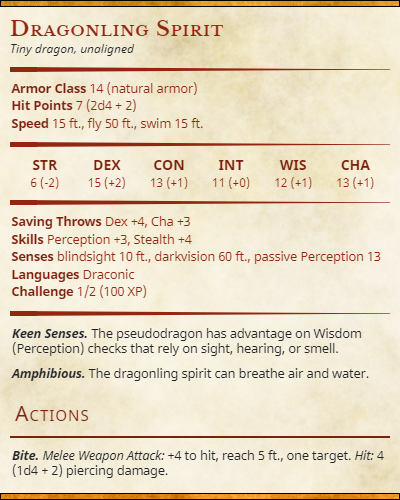
You gain the companionship of a spirit that assumes the form of a miniature version of the dragon whose soul has bonded itself to you. It assumes the game statistics of a dragonling (stats located at the end of the class features), has the personality and alignment of the dragon with which you are bonded, and it will obey your commands which can be communicated to it telepathically as long as it remains within 100 feet of you. While the dragonling is on your person (such as perched on your shoulder), you gain darkvision out to a range of 60 feet and a bonus to your passive Wisdom (Perception) score and to Wisdom (Perception) checks equal to your Proficiency bonus. If you already have darkvision, you gain an additional 30 feet of darkvision.
While perched on your shoulder, the dragonling cannot be targeted by any attack or other harmful effect; only you can cast spells on it; it can't take damage; and it is incapacitated.
As an action, you can see through the dragonling's eyes and hear what it hears while it is within 100 feet of you.
In combat, the dragonling goes directly after your initiative and you control how it acts.
Dragon's Vengeance: If it is slain by a creature, they are marked with vengeance. You know the general direction of the creature for the next hour and have advantage on any Wisdom (Perception) or Wisdom (Survival) checks you make to find it. You gain advantage on the next attack you make against the killer and deal additional damage to them equal to your level on your next successful attack of the type associated with your draconic patron.
The dragonling does not require sleep, but rests when you rest. While within 100 feet of you, it can awaken you from sleep as a bonus action.
The dragonling vanishes when it dies, if you die, or if the two of you are separated by more than 5 miles. At the end of a short or long rest, you can call the dragonling spirit back to you - no matter where it is or whether it died - and it reappears within 5 feet of you. If you call the dragonling back to you while Dragon’s Vengeance is active, the effect ends.
Choose the alignment of the draconic patron from which you derive your power between the following: Platinum Dragon (Good-leaning and usually metallic), Dragon Queen (Evil-leaning and usually chromatic), Ruby Scion (Neutral and more commonly gem), Debased Heir (Evil and either void, shadow, or undead)
2nd Level: Bless, Shield of Faith
5th Level: Warding Bond, Zone of Truth
9th Level: Protection from Energy, Tongues
13th Level: Guardian of Faith, Aura of Life
17th Level: Flame Strike, Wall of Force
2nd Level: Distort Value, Hellish Rebuke
5th Level: Suggestion, Invisibility
9th Level: Incite Greed, Major Image
13th Level: Confusion, Polymorph
17th Level: Dominate Person, Insect Plague
2nd Level: Identify, Dissonant Whispers
5th Level: Detect Thoughts, Phantasmal Force
9th Level: Hypnotic Pattern, Sending
13th Level: Arcane Eye, Psychic Lance
17th Level: Legend Lore, Telekinesis
5th Level: Shadow Blade, Darkness
9th Level: Spirit Shroud, Summon Shadowspawn
13th Level: Blight, Shadow of Moil
17th Level: Danse Macabre, Contact Other Plane
Alternatively, you can cause your allies to become emboldened by your presence. You can grant temporary hit points up to your Dragon knight level to your allies within 30 feet who can see or hear you. These temporary hit points fade after a minute.
Once you use this ability, you cannot use it again until you finish a long rest.
As an action, you expend a spell slot to exhale destructive energy. Each creature in a 15-foot cone or 5-foot wide 30-foot line originating from you must make a Dexterity saving throw or take damage of the type of your draconic patron equal to a number of Draconic Blessing dice equal to one plus the level of the spell slot expended, or half on a successful save. The DC for your breath weapon equals 8 + your Wisdom modifier + your proficiency bonus.
If you are a Warden subclass, your Dragon Companion can be commanded on their turn to use the Dragon Knight’s Breath Weapon. This use still costs the Dragon Knight’s spell slot but originates from the Dragon Companion and counts as their action. This action cannot be taken if the Dragon Knight used their Breath Weapon on their turn.
If the spell or effect is of a level equal to or less than one-third your Dragon Knight level (rounded down) it is dispeled, otherwise you must make a spellcasting ability check using your Wisdom with a DC of 10 plus the spell’s level or the effect’s equivalent spell level. If you successfully dispel a spell or targeted effect, you gain 5 temporary hit points for each spell level of the effect dispeled up to a total of 25 temporary hit points. If multiple effects are dispeled, the highest level effect dispelled is the only one that is used to calculate the temp hit points. These temporary hit points fade after 10 minutes and do not stack with other temporary hit points. Once you perform this action, you cannot do so again until you finish a short rest.
Bond of the Dragon Knight
You have received the favor of a powerful wyrm, draconic spirit, or one of the dragon gods, and have been bonded to a dragon’s soul. The draconic soul bonded to you - your draconic patron - sends forth a small portion of their spirit to aid you and act as a guide on your path. You gain the following abilities:Dragonling Spirit
You gain the companionship of a spirit that assumes the form of a miniature version of the dragon whose soul has bonded itself to you. It assumes the game statistics of a dragonling (stats located at the end of the class features), has the personality and alignment of the dragon with which you are bonded, and it will obey your commands which can be communicated to it telepathically as long as it remains within 100 feet of you. While the dragonling is on your person (such as perched on your shoulder), you gain darkvision out to a range of 60 feet and a bonus to your passive Wisdom (Perception) score and to Wisdom (Perception) checks equal to your Proficiency bonus. If you already have darkvision, you gain an additional 30 feet of darkvision.
Draconic Resonance
Additionally, you learn to channel your draconic patron’s power into your attacks. Choose the element associated with your draconic patron from the following: Acid, Cold, Fire, Lightning, Poison, and Thunder. The first successful attack you make on a turn deals extra damage equal to your Draconic Bond die (located in the Dragon Knight class table) of the damage type of your draconic patron.Voice of the Dragon
You can speak, read, and write the language Draconic. You also have advantage on Charisma checks made when interacting with dragons.Draconic Blessing
Your draconic patron grants you additional spells depending on their alignment and purpose (this is often one that is shared by the Dragon Knight, but not always). Each alignment is associated with one of the dragon gods, but that doesn’t mean that you serve that god, only that the dragon’s spirit is aligned with their vision. Once you gain access to one of these spells, you always have them prepared. These spells don't count against the number of spells you can prepare each day. If you gain a spell that doesn't appear on the dragon knight spell list, the spell is nonetheless a dragon knight spell for you.Choose the alignment of the draconic patron from which you derive your power between the following: Platinum Dragon (Good-leaning and usually metallic), Dragon Queen (Evil-leaning and usually chromatic), Ruby Scion (Neutral and more commonly gem), Debased Heir (Evil and either void, shadow, or undead)
Platinum Dragon: Justice, Protection, Wisdom
You have gained the favor of the Platinum Dragon or one who serves him. Your draconic patron has existed as a beacon of the protection, truth, and justice that their progenitor stands for.2nd Level: Bless, Shield of Faith
5th Level: Warding Bond, Zone of Truth
9th Level: Protection from Energy, Tongues
13th Level: Guardian of Faith, Aura of Life
17th Level: Flame Strike, Wall of Force
Dragon Queen: Deception, Conquest, Tyranny
You have impressed, bound yourself to, or found yourself in the clutches of the Dragon Queen or a dragon that serves her. Your draconic patron is one of greed, might and guile, so much so that they may have even tricked you into this situation.2nd Level: Distort Value, Hellish Rebuke
5th Level: Suggestion, Invisibility
9th Level: Incite Greed, Major Image
13th Level: Confusion, Polymorph
17th Level: Dominate Person, Insect Plague
Ruby Scion: Curiosity, Discovery, Knowledge
You have received the notice of the most enigmatic dragonkind. These dragons often shut themselves away from the world, preferring to hoard knowledge, and you have been sought out as one to acquire worldly knowledge for them.2nd Level: Identify, Dissonant Whispers
5th Level: Detect Thoughts, Phantasmal Force
9th Level: Hypnotic Pattern, Sending
13th Level: Arcane Eye, Psychic Lance
17th Level: Legend Lore, Telekinesis
Debased Heir: Disorder, Hatred, Destruction
You have heard a voice in the darkness that has called out to you and accepted its power. Your draconic patron is one of death and nothingness, a shadow dragon or perhaps a dracolich with hatred that fills its mind for the dragons of both the Platinum Dragon and the Dragon Queen. You will be their weapon. 2nd Level: Bane, Inflict Wounds5th Level: Shadow Blade, Darkness
9th Level: Spirit Shroud, Summon Shadowspawn
13th Level: Blight, Shadow of Moil
17th Level: Danse Macabre, Contact Other Plane
Spellcasting
By 2nd level, you are capable of channeling your link to your draconic patron into magic. (See Spellcasting section for details)Fighting Style
At 2nd level, you adopt a style of fighting as your specialty. Choose one of the following options. You cannot take a Fighting Style option more than once, even if you later get to choose again. Available fighting styles are those available to the Fighter class.Dragon Knight Path
At 3rd level, you choose which subclass of Dragon Knight you wish to be between: Dragon Soul, Dragon Warden, and Dragon Slayer. You gain additional features to these subclasses at 7th, 15th, and 20th level.Frightful and Magnificent
Starting at 3rd level, you can wield the intimidating and awe-inspiring power of a dragon to cause your enemies to quake in fear. As an action, you cause creatures of your choice within 30 feet of you to make a Wisdom Saving throw or become Frightened for 1 minute. The DC for this ability is your Dragon Knight spell save DC.Alternatively, you can cause your allies to become emboldened by your presence. You can grant temporary hit points up to your Dragon knight level to your allies within 30 feet who can see or hear you. These temporary hit points fade after a minute.
Once you use this ability, you cannot use it again until you finish a long rest.
Ability Score Improvement
When you reach 4th level, and again at 8th, 12th, 16th, and 19th level, you can increase one ability score of your choice by 2, or you can increase two ability scores of your choice by 1. As normal, you can't increase an ability score above 20 using this feature.Martial Versatility (Optional)
Whenever you reach a level in this class that grants the Ability Score Improvement feature, you can replace a fighting style you know with another fighting style available to dragon knights. This replacement represents a shift of focus in your martial practice.Extra Attack
Beginning at 5th level, you can attack twice, instead of once, whenever you take the Attack action on your turn.Dragon’s Breath
By 6th level, your connection to your draconic patron has gifted you with the ability to call forth a breath weapon. The breath weapon is separate from any breath weapon you may have as a feature of another class or race.As an action, you expend a spell slot to exhale destructive energy. Each creature in a 15-foot cone or 5-foot wide 30-foot line originating from you must make a Dexterity saving throw or take damage of the type of your draconic patron equal to a number of Draconic Blessing dice equal to one plus the level of the spell slot expended, or half on a successful save. The DC for your breath weapon equals 8 + your Wisdom modifier + your proficiency bonus.
If you are a Warden subclass, your Dragon Companion can be commanded on their turn to use the Dragon Knight’s Breath Weapon. This use still costs the Dragon Knight’s spell slot but originates from the Dragon Companion and counts as their action. This action cannot be taken if the Dragon Knight used their Breath Weapon on their turn.
Fearless
Starting at 10th level, you are immune to the Frightened condition. Additionally, when you use your Frightful and Magnificent feature, allies within 10 feet of you who are suffering from the Frightened condition have the condition ended.Devour Magic
Starting at 11th level, as an action, you can touch a creature or object within range and attempt to draw out the magic of a spell or effect active on it (as if casting the Dispel Magic spell without material or verbal components). Alternatively, you can target an effect in an area you are in or one you are within 5 feet of.If the spell or effect is of a level equal to or less than one-third your Dragon Knight level (rounded down) it is dispeled, otherwise you must make a spellcasting ability check using your Wisdom with a DC of 10 plus the spell’s level or the effect’s equivalent spell level. If you successfully dispel a spell or targeted effect, you gain 5 temporary hit points for each spell level of the effect dispeled up to a total of 25 temporary hit points. If multiple effects are dispeled, the highest level effect dispelled is the only one that is used to calculate the temp hit points. These temporary hit points fade after 10 minutes and do not stack with other temporary hit points. Once you perform this action, you cannot do so again until you finish a short rest.
Draconic Combat
Beginning at 14th level, when you use your action to breathe your Dragon’s Breath, you can immediately make one weapon attack as part of the same action.Legacy of the Dragon
Starting at 15th level, your connection to your draconic patron allows you to share in their extended lifespans. For every five years of your life, you age one.Siphon Arcana
At 18th level, your Devour Magic ability gains a range of 30 feet, can grant up to 45 temporary hp (equivalent to a 9th level spell), and you can use it twice per short rest.subclass options:
Draconic Might. You have advantage on Strength checks and Strength saving throws, and you have a +1 bonus to melee damage rolls. This bonus increases to +2 at 11th level and +3 at 18th level.
Claws. Your fingertips grow into sharp claws. You can use Dexterity or Strength for the attack and damage of your unarmed strikes, which deal 1d6 slashing or bludgeoning damage (your choice). This damage increases to 1d8 at 11th level.
Additionally, when you use the Attack action to make an unarmed strike, you can make an additional unarmed strike as a bonus action.
Scales. Your skin becomes covered in tough dragon scales. While in this form and not wearing heavy armor, you gain a bonus to your AC equal to half your Proficiency bonus, rounded down.
Dragon. While in this form you are considered both humanoid and dragon for the purposes of spells and effects (such as a weapon of dragon-slaying).
Additionally, Your claw attacks in your hybrid form have a +1 bonus to attack rolls and count as magical for the purpose of overcoming resistance and immunity to non-magical attacks. This bonus increases to +2 at 11th level and to +3 at 18th level.
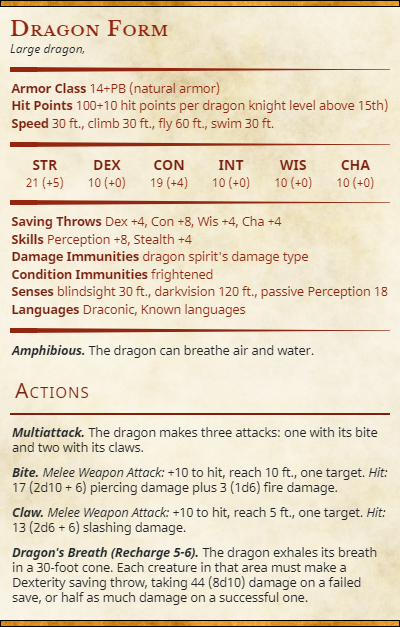
You assume the form of a dragon of your dragon spirit’s type for up to one hour or until you end the transformation. While in this form, you cannot cast spells or use your class abilities. The stat block for the dragon form is located at the end of the class description, before the spell list. You must expend both uses of your hybrid form to make this transformation and cannot use this form again until you finish a long rest.
Your game statistics are replaced by the statistics of the dragon form, though you retain your Alignment and Intelligence, Wisdom, and Charisma scores. You also retain all of your skill and saving throw Proficiencies, in addition to gaining those of the dragon, taking the higher of any shared proficiencies.
You assume the Hit Points and Hit Dice of the dragon form. When you revert to your normal form, you return to the number of Hit Points you had before you transformed. If you revert as a result of dropping to 0 Hit Points, any excess damage carries over to your normal form. As long as the excess damage doesn’t reduce your normal form to 0 Hit Points, you aren’t knocked unconscious.
You retain the benefit of any features from your class, race, or other source and can use them, provided that your dragon form is physically capable of doing so. You can’t use any Special Senses you have (for example, darkvision) unless your dragon form also has that sense. You can speak, but lack the ability to cast spells in this form.
When you transform, your equipment merges into the dragon form or is worn by it if it can wear it. Worn equipment functions as normal. The DM determines whether it is practical for the dragon form to wear a piece of equipment, based on the creature’s shape and size. Your equipment doesn’t change shape or size to match the new form, and any equipment that the dragon form can’t wear merges into your new form. Equipment that merges has no effect in that state.
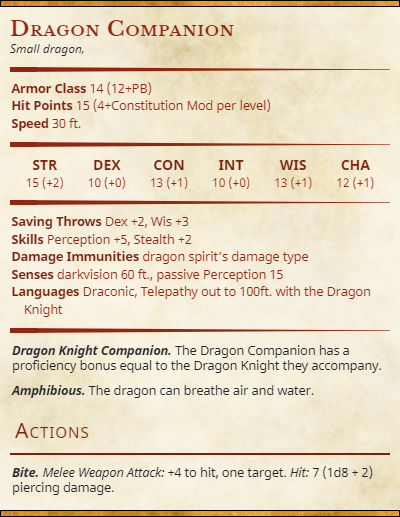
Base stats for the Dragon Spirit Companion.
While within 10 feet of your companion, you gain the benefits of your Dragonling Spirit as if they were perched on your shoulder.
In combat, the dragon shares your initiative count, but it takes its turn immediately after yours. It can move and use its reaction on its own, but the only action it takes on its turn is the Dodge action unless you use a bonus action on your turn to command it to take a different action. That action can be one in its stat block or some other action. If you are incapacitated, the dragon can take any action of its choice, not just Dodge.
Your Dragon Spirit Companion has D6 Hit Dice equal to the Dragon Knight’s level and gains an additional one each level. They also gain Ability Score Increases alongside the Dragon Knight, increasing an ability score by 2 or two ability scores by 1, but they cannot gain Feats.
The dragon remains until it is reduced to 0 hit points, until you use the Dragonling Spirit feature to summon the dragon again, or until you die. Anything the dragon was wearing or carrying is left behind when it vanishes.
When you use your Frightful and Magnificent ability to cause creatures to become frightened, creatures who fail the saving throw are frightened by both you and your companion.
Grows to Medium size.
Gains a fly speed of 40 feet.
Gains Blindsight out to a range of 10ft.
Gains a claw attack that deals 2d6 slashing damage. This claw attack uses strength to calculate to-hit and damage.
Gains a multiattack of one Bite and one Claw.
Attacks count as magical for the purpose of bypassing non-magical damage.
Can be used as a mount, but cannot fly while treated as such. The Dragon Companion can still carry creatures while flying at half speed, but cannot be used as a combat mount while doing so, granting disadvantage to attack rolls for any creature attempting to ride it or being carried by it while in combat due to its unstable flight.
Grows to Large size
Fly speed increases to 60ft.
Choose between the following movement types: Climb, Swim, and Burrow. Your dragon gains a speed for the chosen movement type equal to its walking speed.
Can be used as a flying mount without suffering from the disadvantages specified in the Wyrmling’s Advancement feature.
Bite attack increases to a 1d10 and gains an additional 1d10 elemental damage associated with your draconic patron.
Empowered Breath: Once per Short Rest, when the Dragon Breath is used by your companion, it deals an additional 2 dice of damage.
Shared Defense. While mounted upon your dragon companion, you gain the dragon’s damage immunity.
Your companion gains +2 to Strength, Constitution, and Charisma up to a maximum of 22.
Their walking and either climb, swim, or burrow speed (chosen at level 15) increases to 40 feet.
Their flying speed increases to 80 feet.
Their darkvision increases to 120 feet and their blindsight increases to 30 feet.
Their bite attack increases to 2d8 plus 1d8 additional elemental damage.
Multiattack consists of 2 claws and a bite attack.
Legendary Resistance. When you or your dragon fails a saving throw, you or they can choose to succeed instead. Once this is used by either yourself or your companion, it cannot be used again until you finish a long rest.
Dragon Soul
Draconic Hybrid Form
When you choose this archetype at 3rd level, you learn to merge with your dragonling spirit, physically manifesting its power around you. As a bonus action, you transform into a hybrid draconic form for up to 1 hour. You can speak, use equipment, cast spells, and wear armor while in this form. You can end this form early as a bonus action. You automatically revert to your normal form if you fall unconscious or die. During this transformation, you retain all the benefits you would have if your dragonling spirit were on your person. Once you use this feature, you must finish a short or long rest before you can use it again. At 11th level, you can use this feature twice per short or long rest.Draconic Hybrid Features
While transformed, you gain the following benefits:Dragonflight
When you assume your hybrid form, you also grow a pair of wings that persist for the duration of the form. Beginning at 7th level, while in your hybrid form, you gain a fly speed equal to your movement speed.Additionally, Your claw attacks in your hybrid form have a +1 bonus to attack rolls and count as magical for the purpose of overcoming resistance and immunity to non-magical attacks. This bonus increases to +2 at 11th level and to +3 at 18th level.
Dragonheart
At 15th level you learn to assume the form of a dragon fully.You assume the form of a dragon of your dragon spirit’s type for up to one hour or until you end the transformation. While in this form, you cannot cast spells or use your class abilities. The stat block for the dragon form is located at the end of the class description, before the spell list. You must expend both uses of your hybrid form to make this transformation and cannot use this form again until you finish a long rest.
Your game statistics are replaced by the statistics of the dragon form, though you retain your Alignment and Intelligence, Wisdom, and Charisma scores. You also retain all of your skill and saving throw Proficiencies, in addition to gaining those of the dragon, taking the higher of any shared proficiencies.
You assume the Hit Points and Hit Dice of the dragon form. When you revert to your normal form, you return to the number of Hit Points you had before you transformed. If you revert as a result of dropping to 0 Hit Points, any excess damage carries over to your normal form. As long as the excess damage doesn’t reduce your normal form to 0 Hit Points, you aren’t knocked unconscious.
You retain the benefit of any features from your class, race, or other source and can use them, provided that your dragon form is physically capable of doing so. You can’t use any Special Senses you have (for example, darkvision) unless your dragon form also has that sense. You can speak, but lack the ability to cast spells in this form.
When you transform, your equipment merges into the dragon form or is worn by it if it can wear it. Worn equipment functions as normal. The DM determines whether it is practical for the dragon form to wear a piece of equipment, based on the creature’s shape and size. Your equipment doesn’t change shape or size to match the new form, and any equipment that the dragon form can’t wear merges into your new form. Equipment that merges has no effect in that state.
Peritium Draconis
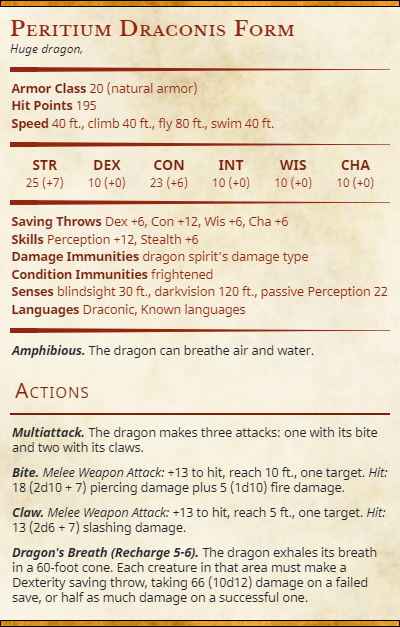
At 20th level, you have mastered your draconic transformation. Your dragon form increases in size and power (see the Peritium Draconis Form stat block below) and you are able to cast your dragon knight spells in the form. The dragon form no longer costs uses of your Hybrid form and your hybrid form no longer has a duration, allowing you to remain within the hybrid form until you are killed or taken to 0 hp and knocked unconscious.Dragon Warden
The Warden Dragon Knight specialization focuses around fighting alongside the spirit of your draconic patron rather than taking its form. Your dragonling spirit grows in strength alongside the dragon knight from a small dragonling companion to one large enough to ride into battle.Dragon Spirit Companion
Your dragonling spirit grows in both power and size into a companion to accompany you in battle. The dragon is friendly to you and your companions, and it obeys your commands. See its game statistics in the accompanying Dragon Companion stat block, which uses your proficiency bonus (PB) in several places. The dragon takes the form of a semblance of your draconic patron, such as its color.Base stats for the Dragon Spirit Companion.
Comments