Rootkeeper
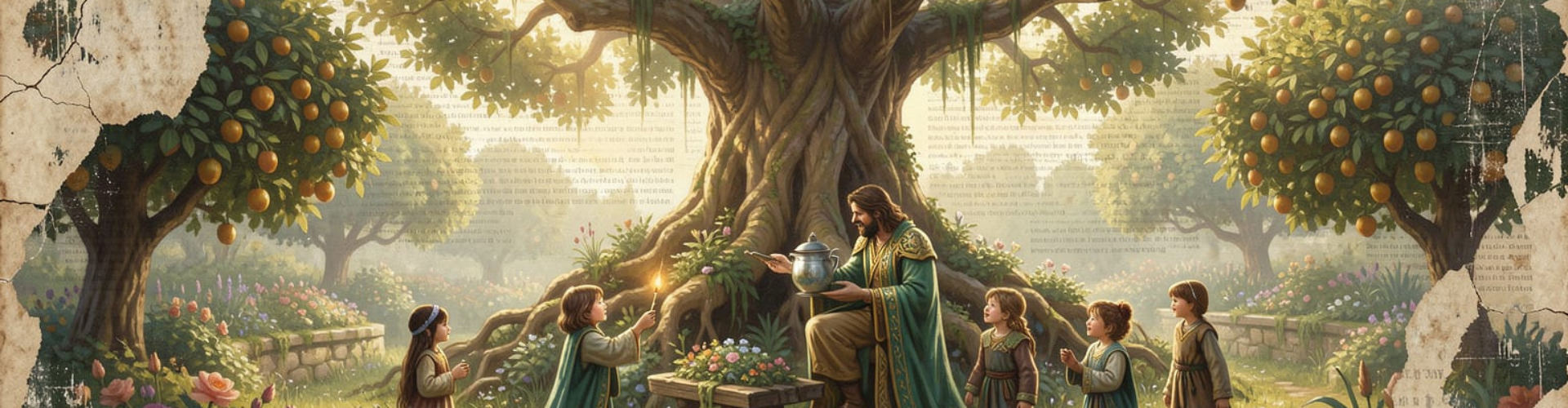
The Rootkeepers are a respected civic order devoted to cultivating both the land and the people of Al Qurdaha. Serving as gardeners, horticulturalists, teachers, and local historians, they believe that every thriving community begins with careful stewardship.
Throughout the Kingdom, Rootkeepers maintain public gardens, orchards, village groves and agricultural terraces while educating citizens in farming, conservation, and local history. Their work reflects a central belief of Al Qurdaha philosophy: that growth, whether of crops, communities, or character, never occurs by accident.
Among the people of Al Qurdaha, a Rootkeeper is often described as someone who plants far more than seeds.
History
The order traces its origins to the first settles of Morga after the Cataclysm.
As they rebuilt around Saharath, they recognized that preserving the World Tree required more than reverence. It required careful stewardship of the surrounding land.
The earliest Rootkeepers tended the groves surrounding Saharath, restored damaged soils, ad taught practical farming methods to neighboring settlements.
Over the centuries, their responsibilities expanded beyond agriculture to include education, conservation, and the preservation of local traditions.
Today, Rootkeepers can be found in nearly every town and village throughout Al Qurdaha.
Philosophy
The Rootkeepers believe that growth is an act of responsibility rather than chance. Every harvest reflects years of unseen work. Every wise citizen reflects years of careful teaching. Every thriving community reflects generations of people willing to care for something greater than themselves.
Their guiding principle is simple: "Growth must be nurtured." This philosophy extends equally to forests, fields, children, and institutions.
Duties
Rootkeepers divide their time between practical labor and public service. Their responsibilities include:
- maintaining public gardens and orchards
- teaching sustainable agriculture
- restoring damaged ecosystems
- advising communities during drought or poor harvests
- caring for heritage trees and sacred groves preserving heirloom seeds and native plant species
Many villages rely upon their Rootkeeper as both a gardener and an informal teacher.
Education
Every Rootkeeper undergoes years of apprenticeship before earning the title. Training includes:
- botany
- soil management
- irrigation
- orchard care
- ecology
- local history
- teaching methods
- community service
Senior apprentices often spend time working in Morga beneath the shadow of Saharath before returning to serve elsewhere in the Kingdom.
Relationship with Saharath
Although deeply respected by the order, Saharath is not viewed as an object of worship. Instead, the World Tree servers as the greatest living example of their philosophy. Its roots sustain what cannot be seen. Its branches shelter future generations. Rootkeepers strive to imitate this balance in everything they cultivate.
Role in Education
Perhaps the Rootkeepers' most important responsibility is teaching children. Nearly every Al Qurdaha child spends time working alongside a Rootkeeper, learning lessens that extend well beyond farming. Students are taught:
- how to cultivate healthy soil
- the importance of native plants
- responsible stewardship of water
- local history and traditions
- the belief that every generation inherits both the land and the responsibility to improve it.
Lessons are often held outdoors. Rootkeepers believe nature itself is the finest classroom.
Clothing and Symbol
Rootkeepers traditionally wear practical green and brown robes with Rootsilk trim reserved for ceremonial occasions. Their symbol is a single brancing root enclosed within a circle. The design represents unseen foundations supporting visible growth. Many carry a polished wooden staff carved from naturally fallen branches rather than cut timber.
Public Perception
Rootkeepers are among the most trusted public servants in Al Qurdaha. Though they possess no political authority, their advice is widely respected by farmers, teachers, and local officials alike.
Many communities consider the arrival of a newly appointed Rootkeeper a sign of prosperity. Children, in particular, admire them for their patience and knowledge. It is not uncommon for young students to dream of becoming Rootkeepers themselves.
Traditions
When planting a tree, a Rootkeeper invites those present o place a handful of soil around the roots. The gesture symbolizes that no lasting work belongs to one person alone.
At the completion of each apprenticeship, the new Rootkeeper plants a single sapling somewhere within the Kingdom. Many continue visiting that tree throughout their lives.
Cultural Significance
The Rootkeepers embody one of Al Qurdaha's defining values: that knowledge, like a garden, must be tended continuously or it will wither.
They are often invited to bless new schools, orchards, libraries, and public parks, symbolizing the Kingdom's belief that education and cultivation are inseparable.
Their influence extends beyond agriculture into every aspect of civic life, reminding citizens that societies flourish only when people care for one another with the same patience they show the land.
Table of Contents
Multicultural
Roots first. Branches later.
Meaning: Build strong foundations before seeking success.
A neglected garden tells of the story of its keeper.
Meaning: Leadership is measured by what one cares for.
The finest harvest belongs to grandchildren.
Meaning: The greatest rewards often come long after the work is done.
People imaginge the Rootkeepers grow gardens. They do, of couse. But if you ask me what they truly cltivate, I would answer with this: they grow good ancestors. Every lesson they teach, every tree they plant, every child they encourage is a gift offered to people they will never meet.


Comments