
Ithean Empire
The Ithean Empire has stood for well over a millennium, reigning across the northern coasts of the Sea of Riches as a paragon of divine order, civic law, and philosophical inquiry. Though once unrivaled in reach and grandeur, the empire entered a slow decline nearly six centuries ago. Its borders have gradually contracted, its coffers hollowed by wars, and its legions depleted by decades of attrition. Taxation has steadily increased to compensate for mounting debt, and once-loyal provinces grow restless beneath the strain. Yet amidst this long twilight, the Ithean flame still burns, and its legacy continues to shape the world beyond its shrinking frontiers.
Ithean society is defined by its ancient roots and mythic past, claiming descent from heroes touched by the gods. Public life centers around temples, amphitheaters, and academies, where laws are debated with oratorical flourish and civic rites celebrate the deeds of divine ancestors. A reverence for arete—excellence in all things—permeates Ithean culture. Etesians, the empire's core ethnic group, are raised from youth to embody the virtues of discipline, eloquence, piety, and martial prowess. Military service remains a respected path to honor, and while the legions have diminished, their reputation endures.
Order is maintained through a triad of institutions: the sacred authority of the Emperor, the deliberative might of the Senate, and the wide-reaching autonomy of the provincial archons. Centuries ago, the emperor ruled as the undisputed head of civil, military, and spiritual life, but those days have passed. The current emperor, Cassius VI, remains the symbolic heart of the empire, but he no longer commands its fate. Rarely seen beyond his island retreat, Cassius presides over ceremonies when compelled, but his absence has become both a political inconvenience and a convenient myth.
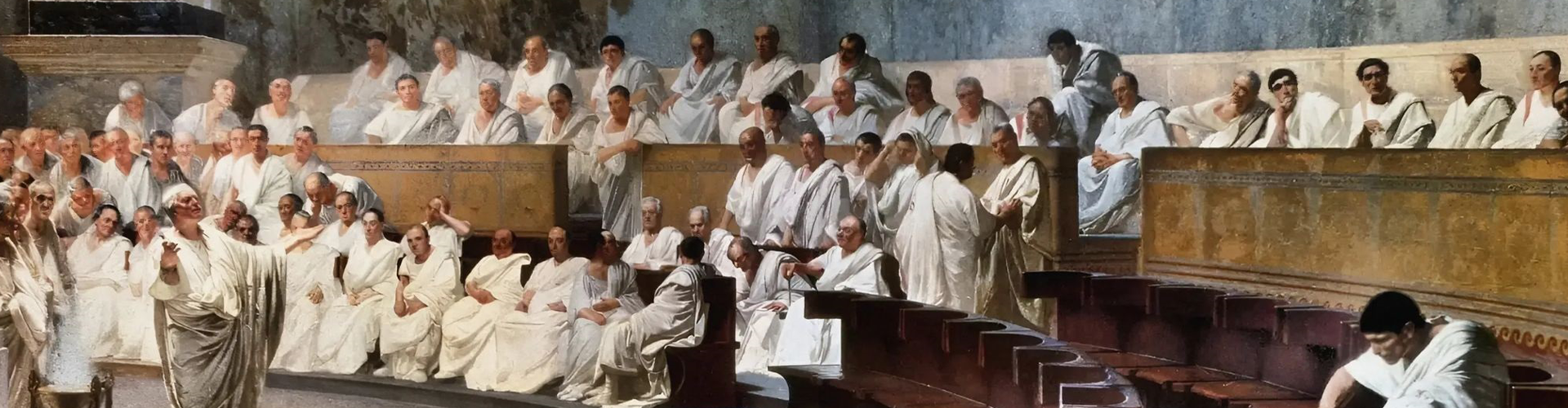
Real power now lies with the Senate, a body of aging aristocrats, merchant-princes, and self-styled philosophers who have gradually assumed control over the machinery of the state. Though their public debates are couched in the rhetoric of civic virtue and ancestral wisdom, most senators are entrenched elites with personal ties to foreign banks, mercenary companies, or private estates far from the eastern front. A handful remain true statesmen, but even their reforms are stifled by internal rivalry, procedural spectacle, or quiet sabotage. Senators range from jurists and generals to idle aristocrats, and their decisions are often delayed by tradition, poetry, or personal rivalry.
Beyond the capital, regional archons exercise sweeping authority over their provinces. In stable lands, they are elected by councils of priests and landowners and are expected to act as magistrates and stewards. In the outer marches, however, archons inherit power or seize it outright, ruling as petty kings. Some mint their own coins, command personal armies, and flout imperial edicts with impunity. Though the Senate technically reserves the right to recall archons, it rarely acts, for fear of stoking civil unrest.
Religion and state are inseparable in Ithean life. Temples are state-funded, and priests serve as advisors, judges, and chroniclers. Worship is not limited to a single god, but sanctioned cults devoted to Erathis, Pelor, and Kord dominate civic life in Thalassia. The cult of heroic ancestors remains especially influential among the Etesians, who trace their lineage to divine champions and demigods. Festivals in their honor mark the calendar year and carry the weight of law.
While the empire currently faces incursions from the east and unrest in the provinces, it remains a potent force in the Sea of Riches. Its cultural influence stretches far beyond its borders, and its teachings on law, ethics, and governance shape courts and guildhalls from the Tyrennian Peninsula to the Bariq Sea. Foreign dignitaries still study in Thalassia’s forums, and Ithean relics remain prized by collectors and clergy alike. Though diminished, Ithea endures, and many believe that as long as its temples stand and its heroes are remembered, the light of civilization will not fade.
Goals
The Ithean Empire’s chief objective is endurance: to preserve its identity, territory, and divine heritage in the face of a world that grows more hostile by the year. What began centuries ago as a campaign of expansion has become a struggle for cohesion. With war in the east, debt mounting, and old alliances fraying, survival itself has become a sacred duty.
Efforts are currently focused on fortifying the eastern provinces, restoring discipline within the legions, and strengthening the civic cults to maintain unity. Senators disagree on the path forward—whether through diplomacy, reform, or force—but all agree that the loss of the Aldrin Dominion must not be repeated. The empire’s remaining strength is now being marshaled to hold the line.
Relationships
The empire's most immediate concern is the Xvimnian Alliance, a union of the Khaveran Dynasty and Krulan Empire that wages holy war under the banner of Bane. Xvimnian legions press into the eastern provinces with relentless force, and though the Ithean military still holds the line, its resources are strained. The fall of the Aldrin Dominion, a long-standing vassal, marked a turning point in the conflict and forced the Senate to act. Aid from the Arcane Commonwealth of Illandria has slowed the advance, but the alliance is uneasy. To most Itheans, Illandria represents unchecked ambition and arcane excess: a corrupt and untrustworthy nation. Still, their support is deemed a necessary evil.
To the west, the Republic of Caspia, the Marquisate of Savona, and the Aloen Empire have flourished amid Ithea’s decline. Diplomatic ties remain intact, but many senators regard them with a mix of bitterness and begrudging respect. Caspia is often likened to a younger sibling grown rich on its elder’s legacy, once nurtured by Ithea, now bold, independent, and assertive in foreign affairs. Their influence in former imperial waters, along with their appropriation of Ithean culture, draws both admiration and quiet resentment. Meanwhile, Aloen support during the current war has been crucial, though some still recall the humiliating sale of Delion. These allies are needed, but not easily forgiven.
Key Figures
Emperor Cassius IV
Male human
Cassius VI is the withdrawn son of a once-revered general-emperor, having inherited the throne during a period of deepening imperial malaise. He rules in name alone, residing in seclusion on the island of Anthelia and avoiding the Senate, the court, and the capital entirely. Though officially the head of the faith and commander of the legions, his words are filtered or ignored, and the Senate governs in his stead. Rumors whispered by his political rivals accuse him of indulging in depravity, madness, or forbidden rites, though others believe he simply refuses to preside over the empire's slow collapse. His silence, deliberate or not, has become a canvas for speculation and scapegoating alike.
Senator Thaddeus of Nysiros
Male human
A bombastic populist and consummate showman, Thaddeus of Nysiros has become the loudest—and perhaps most dangerous—voice in the Senate. He brands his opponents as crooks, cowards, and traitors, accusing them of selling the empire’s future to bankers, mages, and foreign mercenaries. “Ithea doesn’t win anymore,” he bellows from marble podiums, waving scrolls of inflated war contracts and decrying corrupt elites. Promising to rebuild the legions, repatriate foreign-held lands, and restore the empire to its former glory, Thaddeus has cultivated a fervent following among the urban poor and disaffected veterans. His critics call him a charlatan and a threat to republican virtue, but even they admit: he dominates every room he enters.

Comments