
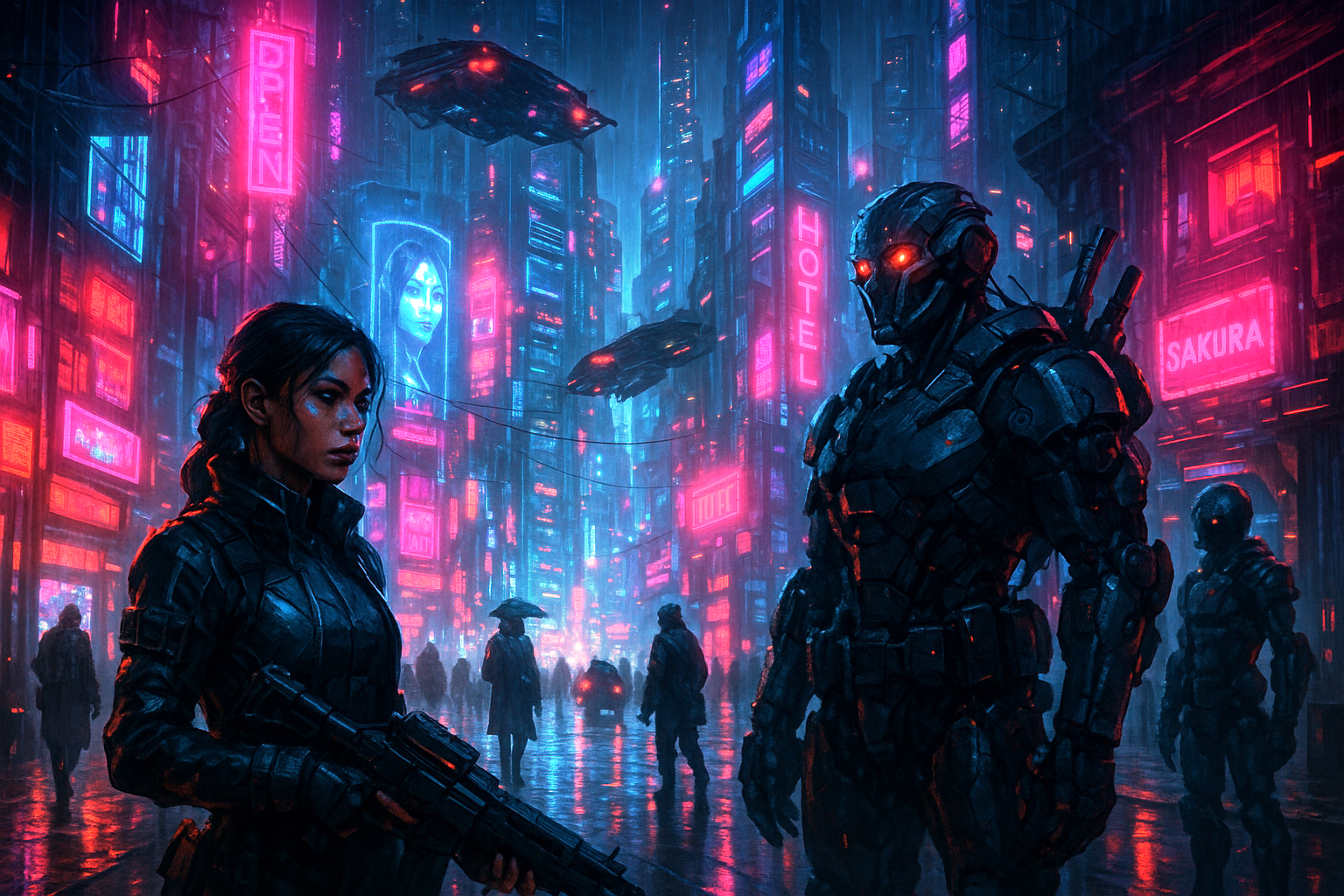
The Thirteenth Door
The Thirteenth Door
Author: "Artsy Mermaid" (pseudonym)
Original Publication: 2418 CE
Place of Publication: Valles Marineris Arcology, Mars
Genre: Cyberpunk social satire, psychological horror, political thriller, erotic drama
Current Legal Status: Officially banned or restricted in numerous jurisdictions. Unofficially one of the most widely copied books in Human history.
Overview
Few novels have generated as much controversy—or as many conspiracy theories—as The Thirteenth Door.
Written by the mysterious "Artsy Mermaid," the novel appeared anonymously on the Martian public net in 2418 CE. It sold only a few thousand copies during its first year before largely fading into obscurity.
Then the protests began.
Religious organizations condemned it.
Politicians denounced it.
Parents' associations demanded it be removed from schools.
News organizations debated it nightly.
The resulting publicity transformed an otherwise niche underground novel into a cultural phenomenon.
Today, more than four centuries later, nearly everyone has heard of The Thirteenth Door.
Almost nobody has actually read it (or admits to it).
Plot
The novel follows thirteen unrelated individuals living inside a sprawling Martian arcology.
Each discovers a mysterious maintenance door that should not exist.
Behind every door lies another version of the city.
Not a parallel universe.
Not a simulation.
Simply another possibility.
Each character slowly realizes that every choice they make quietly creates another unopened door somewhere within the arcology.
The story never explains whether these places are real.
Neither does the author.
Why It Was Banned
Official reasons varied.
Profanity
The dialogue was exceptionally crude for its era.
Characters spoke like actual dockworkers, miners, prostitutes, and gang members instead of sanitized fictional versions.
Many readers considered the language obscene.
Sexuality
The novel portrayed sexuality with remarkable openness.
Relationships included:
same-sex couples
polyamorous marriages
casual intimacy
sex workers depicted as ordinary professionals
Rather than treating these as shocking, the novel treated them as entirely mundane. Ironically, this offended nearly everyone.
Violence
The violence was graphic without being glamorous.
Characters suffered.
People died permanently.
Trauma had consequences.
The novel refused to celebrate violence.
Many readers found this more disturbing than action-oriented fiction.
Political Themes
No political ideology escaped criticism.
Governments.
Corporations.
Religious institutions.
Media.
Academia.
Criminal organizations.
Everyone was portrayed as capable of compassion.
Everyone was portrayed as capable of corruption.
As a result, nearly every political movement believed the novel targeted them specifically.
The Failed Purges
Several attempts were made to erase the novel.
Government archives removed it.
Libraries deleted digital copies.
Educational institutions banned discussion.
Several religious organizations organized what became known as the Electronic Burnings.
Members were encouraged to locate and permanently delete every copy they encountered.
The effort backfired spectacularly.
Programmers responded by hiding encrypted copies throughout the Galactic Net.
Universities archived it.
Private citizens copied it.
Eventually deleting The Thirteenth Door became effectively impossible.
The Artsy Mermaid Mystery
The author's identity has never been discovered. Thousands of theories exist.
Popular candidates include:
a university professor
an AI
a committee of writers
a Martian politician
a station janitor
No convincing evidence has ever emerged.
Modern linguistic analysis suggests only two things with reasonable confidence:
Whoever wrote it was exceptionally educated.
And deliberately wanted nobody to know.
Conspiracy Theories
The novel has become fertile ground for speculation.
The Hidden Fourteenth Door
Readers claim a secret chapter exists that was removed before publication.
No evidence has ever surfaced.
The Prediction Theory
Many believe the novel predicted later historical events.
Supporters point to vague similarities with:
corporate scandals
AI failures
political crises
Most historians dismiss these claims as confirmation bias.
The Cipher Theory
Some readers insist the first letter of every paragraph encodes hidden instructions.
After centuries of analysis, nobody has found a convincing message.
The AI Theory
One persistent rumor claims Artsy Mermaid was actually an experimental literary AI that escaped deletion.
No credible evidence supports this.
The rumor refuses to die.
Cultural Impact
The novel produced dozens of sayings.
The most famous: "Every city (station, colony, etc.) has a thirteenth door."
Meaning: Every system hides truths people would rather ignore.
Another common expression: "Don't go looking for another door."
Meaning: Be content with the life you've chosen.
Academic Importance
Ironically, the bans ensured the novel's survival.
Modern literature departments often teach The Thirteenth Door not because it is considered the greatest novel ever written, but because of what happened afterward.
Students study:
the censorship campaigns
the failed deletion efforts
the Streisand effect centuries after the term became popular
how outrage created one of humanity's longest-lived underground literary traditions
Many historians believe that if authorities had simply ignored it, The Thirteenth Door would likely have disappeared within a generation.
Instead, every attempt to destroy it only guaranteed another copy would be made.
Over four hundred years later, the novel still circulates.
Usually illegally.
Usually encrypted.
Always because someone, somewhere, decided that if a book frightened powerful people enough to make them erase it, then it was probably worth reading.

Comments