
Ogre Gorillas
Ogre Gorillas (OGs)
Ogre Gorillas are a population of cloned, engineered humanoids created long before Adi’s birth. Designed for heavy infantry and extreme-load labor, they are among the strongest sentient beings in colonized space. They stand between 2.5 and 3 meters tall and weigh 400 to 450 kg. Their intelligence and emotional responses are roughly comparable to a cheerful twelve-year-old Human. Every OG is male, every OG is a clone, and every OG is technically illegal.
Despite their terrifying appearance, most OGs are gentle, eager to please, and deeply loyal to those who treat them kindly. Their strength and simplicity make them invaluable on hazardous industrial sites like H3 mining platforms, fusion digger stations, and high-load construction projects. Aditi "Adi" Nizhóní Peshlakai met many OGs during her Marine service and has a soft spot for them.
But their origins are darker.
Physical Characteristics
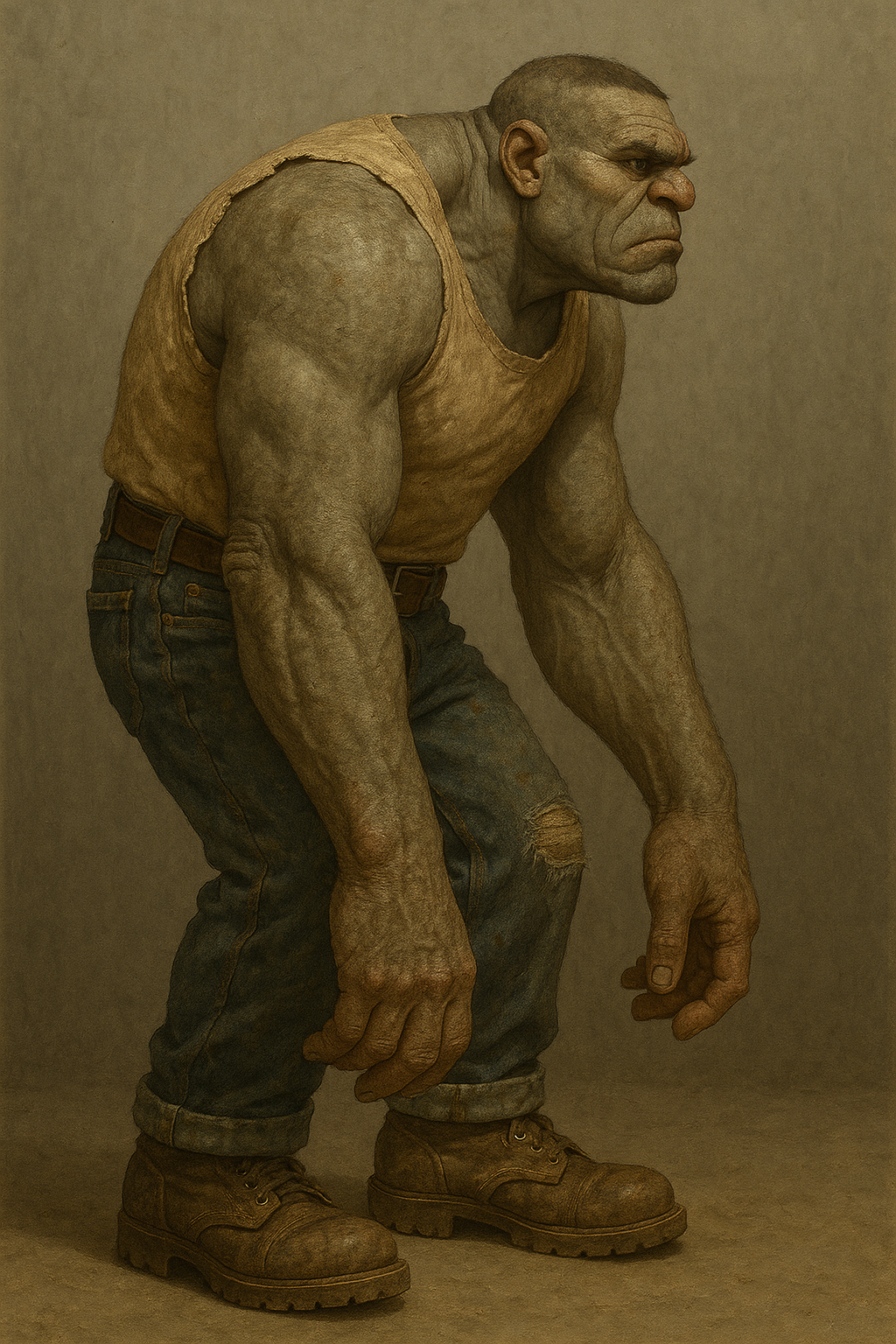
They build OGs for endurance, power, and shock absorption rather than aesthetics.
• Height: 2.5 to 3 meters
• Weight: 400 to 450 kg
• Skin: thick, gray, leathery, and extremely tear-resistant
• Skeleton: reinforced bone lattice with forged-ceramic growth plates
• Skull: slab forehead, heavy brow ridge, wide "rock crusher" jaw
• Limbs: short, thick legs; long, cable-like arms nearly touching the ground
• Hands: massive, dustbin-sized, ideal for crushing-force tasks
• Feet: broad, manhole-cover-sized, allowing stable footing under heavy loads
• Torso: wide and deep enough to accommodate oversized heart and lungs
Their posture is semi-knuckle-dragging. Even when upright, OGs keep their knees bent so their hands hover inches from the ground.
OGs struggle to swim primarily because no one ever taught them, and their substantial muscle mass causes them to sink like the proverbial brick.
Psychology and Behavior
Most OGs are friendly and eager to help. They form quick attachments to people who show them attention and gratitude. Their intelligence is functional, but limited. They follow instructions well, especially when the tasks are physical, repetitive, and clearly defined.
Common behaviors include:
• mimicry of human gestures
• simple jokes and laughter
• protective instincts toward smaller humans
• difficulty with abstract reasoning
• confusion or distress when confronted with moral ambiguity
• a tendency to self-blame when things go wrong
OGs are noted for their fondness for sweets, often consuming sweets in significant quantities.
About five percent of OGs have severe aggression disorders. The DNA-locked "aggro tattoo" marks these OGs, and it is burned into the center of the forehead. The tattoo's removal would kill the OG, and it activates scanners in most major colonies. Authorities ban Aggro OGs from employment in populated areas. Some Aggro OGs work as mercenaries, but they typically have brief careers, as their excessive aggression and quick anger often get them killed.
Origins and Creation
Engineers created the first OGs on Mars during the era leading up to the Second Mars Civil War (2417 to 2423 CE). They served as heavy infantry shock troops capable of smashing fortifications, breaching hardened bunkers, and absorbing damage that would kill ordinary soldiers.
Public records state that they discontinued OG creation after the war, and the Martian Genetic Ethics Codex outlawed its production.
Reality tells a different story.
OG creation simply moved underground. Over the past 275 years, new OGs have appeared regularly despite every legal barrier. They raise each batch in creches of roughly two hundred clones at a time. Childhood lasts fewer than five standard years. OGs mature rapidly and age rapidly, with an average lifespan of fifty standard years. By age forty, most experience breakdowns in joint cartilage and cardiovascular strain. By fifty-two or fifty-three, they are dead.
Early clone generations suffered high rates of mental instability, sensory-processing disorders, and severe autism. When they failed to meet military or industrial specifications, the military or industry euthanized many of these early OGs.
No one outside a handful of syndicates knows where the modern OG factories operate.
Possibilities include:
• illegal gene-forges hidden under Elysium Planitia
• deep-lab facilities inside Olympus Mines
• drifting clone barges in Martian orbit
• one rumored black-site on Titan’s subsurface outposts
OGs themselves do not know their origins. They transport them to buyers under sedation or in cryostasis after raising them in windowless creches.
Military Use and Decline
OG Legions were once famous, then infamous.
They fought in several colonial conflicts, often suffering horrific casualty rates. OGs were considered expendable: brave, strong, loyal, and unable to protest. Their bodies could absorb shrapnel and blunt-force trauma far better than humans, but directed fire, smart munitions, and shaped charges tore through them like anyone else.
Thirty years before Adi’s birth, officials officially disbanded the last OG legions. Veterans drifted into heavy labor industries. Some joined space and terrestrial salvage crews. The Martian shipyards at Phobos employ many OGs.
A few became station bouncers or private security. Many died early because of untreated clone-degeneration syndromes.
A few OGs were part of the early Chendiurian settlements, but they likely died decades before Adi’s time because of their limited lifespan. A few OGs have immigrated to Chendiuria, but they are exceedingly rare.
Augmentations and Variants
Some OGs who served in the military have crude, early-model subdermal armor.
These layers include:
• ceramic bead packs
• titanium spider weave and duralloy steel mesh plates
• outdated limb reinforcement rods
Such armor is primitive compared to Adi’s Marine augments, but on an OG’s massive frame, it is formidable. Combined with their strength, these OGs can tear doors off armored vehicles or smash through bulkheads.
A rare handful were fitted with experimental power amplifiers during the Second Mars Civil War, but none of those prototypes survived. Rumors say that "super OGs" exist, but no one has ever found them.
Social Standing and Rights
Most colonies do not legally consider OGs citizens. Corporations and governments classify them as “biological constructs,” so they can exploit their labor with minimal oversight.
Following the Second Machine War, governments and treaties recognized Synthetic Persons as people with all human rights and privileges. For that reason, several SP groups actively lobby for OG rights.
Common social attitudes:
• Humans often treat OGs as pets, mascots, or simple beasts of burden.
• Criminal groups see OGs as handy, easy to control muscle.
• Labor guilds resent their presence, claiming OGs depress wages.
• Some religious movements (see below) consider OGs “soulless constructs.”
• A few activist groups fight for OG rights, but with little to no success.
Despite this, OGs form strong bonds with humans who treat them fairly. Many veteran Marines have stories of OGs saving entire squads through sheer physical courage. Many of those OGs paid the ultimate price. The Corps honors the fallen OGs for their bravery and sacrifice, even though officially OGs may not receive awards or medals above a Letter of Commendation.
Many OGs are religious and regularly attend worship services. Pope Ioannes Anglicus II of the Reformed Catholic Church on Papal Station Major has decreed OGs have a soul and may enter heaven.
Pope Victor II, of the True Catholic Faith and Restored Avignon Papacy from Avignon Station, has decreed by Motu Proprio that OGs and Synthetic Persons are things and soulless constructs that do not have a soul and may not enter heaven.
For that reason most OGs belong to the Reformed Catholic Church. Some OGs belong to other, less prominent faiths, such as the Church of the Void and the Church of Loon.
Because of their fondness for sweets, many OGs belong to the Church of the Holy Poo and consume artificial honey1 in large quantities.
Reproduction and Biology
OGs are asexual and sterile. Every OG is a clone of the original genotype, with minor patchwork corrections applied across centuries. Genetic drift has introduced unexpected quirks:
• aggression markers
• emotional hyper-fixations
• preference for repetitive sensory actions
• sporadic metabolic disorders
• a tendency toward depression near end-of-life
Older OGs often commit suicide when they realize their strength and usefulness are fading. Many die alone. Those decrepit OGs that do not commit suicide, suffer a slow degradation eventually leading to death, usually by organ failure. Because of their cloned nature and built-in health limitations, life extension treatments and cloned replacement organs do not work on OGs.
Quick Heal and medical nanites have limited effect. As an OG ages, built-in limitations reduce the effectiveness of medical treatments.
Illegal Production
The groups suspected of illegally producing OGs include:
• The Broken Cradle Combine
• Martian Ghost Foundries
• The Titan Chimera Syndicate
• The Red Helix Distributors
• Unmarked gene forges operating under corporate cover
These groups charge enormous sums to produce new batches, and governments quietly buy them despite official prohibitions.
The demand for OG labor is simply too high, and profits too great.
Interaction with Adi and the Augmented Valor Narrative
Adi respects OGs. She never patronizes them and treats them as equals. OGs who served in the Marines remember her as “Little Adi,” which embarrasses her but amuses them.
After Adi’s new upgrades, only a handful of beings in colonial space will match her raw strength. OGs are among them, and even then only the strongest can reach parity.
OGs are a reminder of the moral compromises built into the colonial era: creations made to fight wars and break rocks, loved by no society yet useful to all.
They are victims of design, but survivors by nature.
- Real honey is exceedingly rare, and very costly.
2.5 to 3 meters
400 to 450 kgs
All artwork by me using ChatGPT.

Comments