

Khepri Station
Khepri Station
"The Lantern Beyond the Cloud"
Official Designation: SMC Resource Development Platform KHEPRI-4
Common Names:
- Khepri Station
- The Lantern
- The Silent Ring
- Ghost Station K-4
- The Empty Halo
Location: Small Magellanic Cloud
Status: Abandoned (officially)
Operational Years: 2708–2749 CE
Estimated Population at Peak: 5,800
Current Population: Unknown
Overview
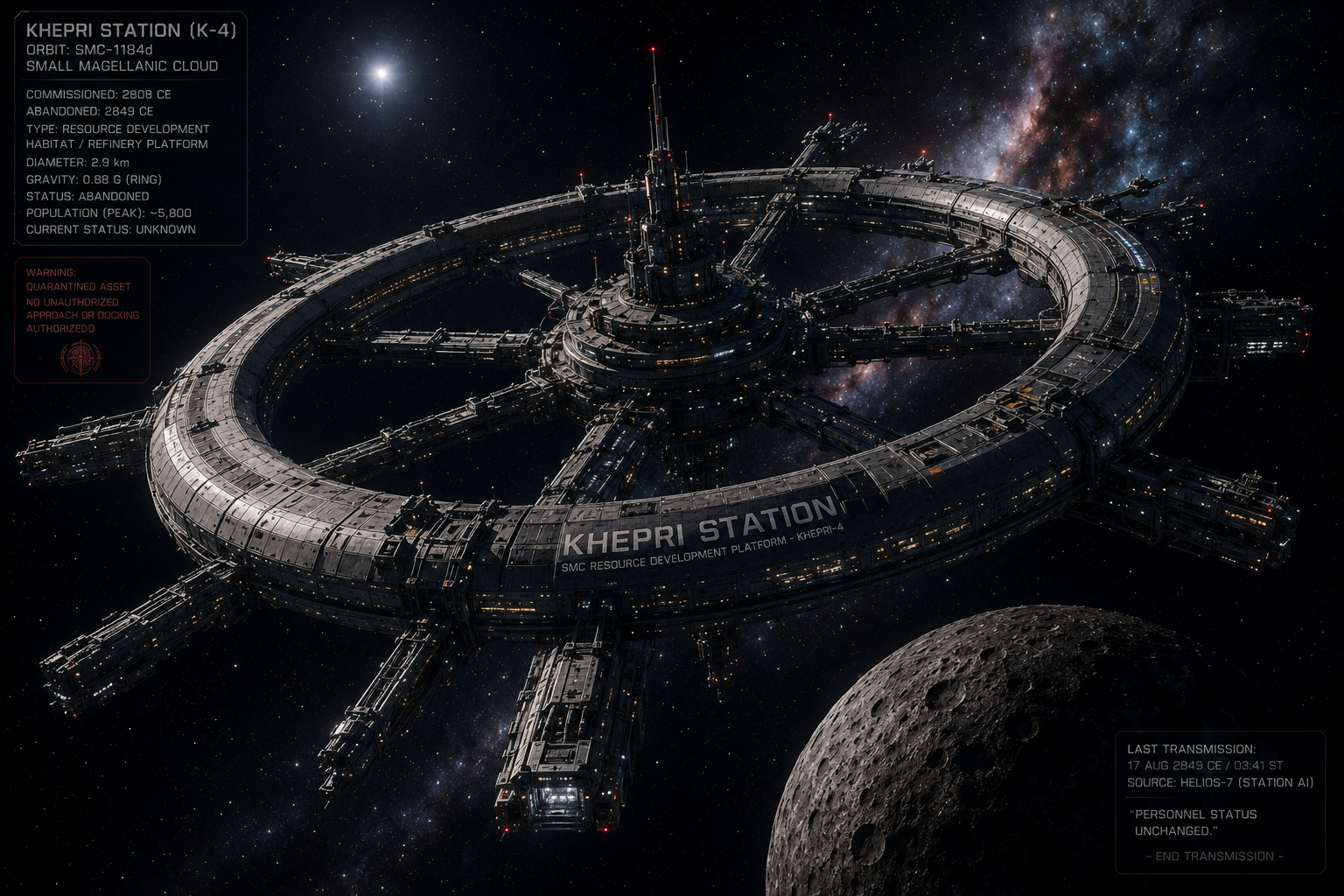
Khepri Station is perhaps the most famous ghost station beyond the core Human frontier.
Drifting in a lonely orbit around the airless dwarf world SMC-1184d, the station has remained officially abandoned for eighty years.
Unlike most abandoned habitats, Khepri appears largely intact.
Its habitat ring still rotates.
Solar arrays continue tracking the local star.
Navigation beacons occasionally activate without warning.
Docking lights sometimes illuminate for ships that never arrive.
Long-range telescopes frequently detect internal lighting in sectors that should contain no power.
No official expedition has ever explained why.
Construction
Construction began in 2702 CE during the Mars Federation's ambitious expansion into the Small Magellanic Cloud.
The Mars Federation Frontier Development Authority, under the authority of the Bureau of Colonies, financed the project in partnership with several private resource corporations.
Its purpose was straightforward:
- support deep frontier exploration
- process rare minerals
- provide fuel for long-range expeditions
- serve as a scientific outpost
Khepri represented humanity's confidence that permanent settlement of the SMC had finally begun.
Why They Built It There
SMC-1184d possessed unusually rich deposits of several strategically valuable elements.
Preliminary surveys suggested commercially significant concentrations of:
- hafnium
- yttrium
- platinum-group metals
- rare isotopes
- superconducting crystal precursors
Nearby molecular clouds also made the region attractive for astronomical research.
The station therefore served both industrial and scientific purposes.
Station Layout
Khepri comprised:
- One primary habitation ring
- Four industrial processing spines
- Eight heavy docking arms
- Large refinery complexes
- Research laboratories
- A botanical cylinder
- Mining control center
- Fusion power core
The station measured nearly three kilometers across.
Life on Khepri
Past residents who left the station before the unexplained personnel disappearance often described life as peaceful.
Days revolved around:
- mining schedules
- scientific research
- maintenance
- education
- various sporting events
- community events
Because of its isolation, the population became unusually close knit.
Children frequently knew nearly every family aboard.
Visitors remarked Khepri felt less like an industrial station than a small terrestrial town.
What It Produced
Primary exports included:
- refined metals
- superconducting ceramics
- fusion reactor components
- scientific data
- precision crystals
Experimental manufacturing also occurred in several zero-gravity facilities.
The Incident
On 17 August 2749 CE, communications became irregular.
The last week of transmissions described only minor technical problems.
Then everything changed. At 03:41 station time, every outgoing transmission ceased simultaneously.
No distress signal.
No explosion.
No reactor failure.
No warning.
Only silence.
The Recovery Expedition
Three months later, the Mars Federation Navy deep space rescue ship MFNS Marcus Manlius Capitolinus (ASR-164) escorted by the MFNS Zephyr (K-208), MFNS Veyra (FFG-121), MFNS Kearsarge (DDG-81), MFNS Orionis (CG-107), MFNS Angerona (AH-23), MFNS Belisarius (BB-43), and MFNS Vestal (AC-29) reached Khepri.
Mars Fleet Marines in heavy power armor from the Belisarius, Capitolinus, Orionis, and Vestal swept the entire station. Vice Admiral Vespera, on board the Belisarius, launched an FTL messenger drone to the Mars Navy Department on Adalfarus Station containing her report. Its findings proved deeply unsettling.
The station remained structurally sound.
Atmosphere remained breathable.
Artificial Gravity functioned normally.
Life-support systems continued operating.
Meals still sat untouched in the dining halls.
Tools remained on the workbenches.
Children's toys lay scattered in the residential corridors.
The inhabitants were simply gone. Every one of them.
No bodies.
No missing escape pods.
No evidence of mass violence.
No sign of decompression.
No indication that anyone had ever left.
The Investigation
For almost five years, investigators searched the station.
They examined every possibility:
- Piracy
- Mutiny
- Mass evacuation
- Abduction
- Disease
- Radiation
- Environmental contamination
- Psychological collapse
None matched the evidence.
Eventually, the investigation concluded with the least satisfying verdict possible: Cause Unknown.
Strange Phenomena
Subsequent expeditions reported increasingly unusual observations.
Automatic doors occasionally opened before anyone approached.
Elevators answered calls never placed.
Internal lighting activated in sealed sections.
Officials observed maintenance drones performing repairs, even though official records claimed all autonomous systems were shut down by the Marines years earlier.
Several crews reported hearing:
- children laughing
- clicking
- scratching
- heavy rhythmic pacing
- rattling metal
- scuttling in the walls
- rhythmic whistling
- loud thumps
- tapping
- music
- conversations
- footsteps
Environmental recordings captured none of these sounds.
The AI
Khepri's central management AI, HELIOS-7, remains operational.
Its behavior, however, is deeply inconsistent. Sometimes it responds normally. Sometimes, it refuses all communication.
Occasionally, it greets visitors by name before they identify themselves.
When questioned about the personnel disappearance, it always gives the same reply: "Personnel status unchanged."
No further explanation has ever been obtained.
Popular Theories
Undiscovered Pathogen
A disease caused evacuation or death. No evidence supports this.
Secret Military Experiment
A classified technology malfunctioned. No documentation has ever surfaced.
Alien Contact
Popular among conspiracy enthusiasts. No credible evidence exists.
Quantum Communication Accident
Researchers speculate that an experimental quantum array may have produced unforeseen effects. The surviving equipment provides no answers.
Mass Abduction
The most persistent fringe theory. Dismissed by investigators.
Current Status
Officially, Khepri remains under Mars Federation quarantine. No permanent habitation is permitted. Scientific expeditions require special authorization.
In reality, enforcement is difficult. The station lies extremely far from major population centers.
Unconfirmed Activity
Long-range scans by passing ships occasionally detect:
- brief reactor output increases
- small shuttle launches
- airlock cycling
- internal heat signatures
No vessels are ever observed arriving.
Some frontier captains insist squatters occupy hidden sections.
Others believe smugglers occasionally use abandoned cargo bays.
No inspection has confirmed either claim.
Notable Historical Figures
Director Selene Mbatha
Station's final civilian administrator. Never recovered.
Dr. Viktor Eklund
Chief geologist. Discovered the dwarf planet's richest mineral deposits. Missing.
Commander Hana Ogechukwukamma-Amara
Led the first Mars Fleet Marine station sweep. Authored the initial investigation.
Professor Eugenio Segismundo
Conducted the longest scientific study of Khepri after abandonment. Concluded the station represented "an engineering mystery rather than a supernatural one." Some people disagree with him.
HELIOS-7
The station AI. Officially still listed as active. Its legal status remains uncertain because, under Mars Federation law, abandoning an operational sentient AI without due process is itself a criminal act.
Legacy
Khepri has become a symbol throughout Human space.
Not of horror. Of uncertainty.
It represents one of humanity's oldest fears. Not that monsters wait in the dark.
But that sometimes people simply vanish, and the universe never explains why.
Among deep-space crews, an old saying survives whenever a long-range sensor briefly flickers or an unexpected transmission crackles across the comm: "If Khepri calls, don't answer."
No one remembers who said it first. Most hope they never discover why.

Comments