Arborean Flora & Fauna
Introduction
Welcome, dear reader, to the second half of this volume. As you no doubt have discerned by now, my truest passion lies in the study of the animals and plants that populate the worlds I visit, and few realms have presented so astonishing an array of living species as Arborea. For reasons of length and practicality, I have been forced to limit the number of organisms that may be treated in detail within the present work. It is my sincere hope that, should this volume find sufficient success, I may someday publish a second dedicated entirely to the many remarkable creatures which I have regrettably been compelled to omit.
The selection of those species worthy of inclusion has been among the most arduous and agonizing tasks I have faced in the composition of this book. In the end, I have restricted myself to but twenty species, divided into four separate groupings of five, chosen to provide you, dear reader, with some impression of the breadth and strangeness of life within this extraordinary world. There are many others no less fascinating that might have occupied these pages, but I trust that those presented herein shall suffice to awaken the curiosity necessary to support future volumes.
In this introductory essay, I shall begin with several general observations concerning the patterns life has assumed in Arborea, before introducing the four categories of species I have selected for detailed examination.
Preternatural Traits
The prevalence of telepathy and other psychical gifts throughout the kingdoms of life is perhaps the single most profound characteristic distinguishing Arborea from all other realms I have visited. These faculties are not isolated curiosities possessed only by a few remarkable organisms, but rather pervasive elements of the ecosystem itself, woven into the very fabric of survival.
Telepathy and the other psychic gifts such as Telekinesis and Clairvoyance have been adapted endlessly in service of life's perpetual contest between predator and prey. They furnish innumerable methods of attack, defense, concealment, escape, and deception, shaping Arborean ecology as profoundly as tooth, claw, or wing. Many of the creatures described within the following pages employ such abilities habitually, relying upon them as terrestrial beasts rely upon sight or hearing. Indeed, entire modes of existence have arisen through these powers which would be wholly impossible in other worlds.
Among the species I observed were hunters that stunned their prey with violent bursts of psychic force, scavengers that located carrion by tracing the fading impressions of dying minds, and communal organisms capable of coordinating themselves with a precision beyond anything achievable through ordinary sensation alone. Even the simplest Arborean animals often possess a dim awareness of nearby thoughts or emotions, making Arborea feel perpetually alert and watchful.
It is difficult to overstate how profoundly these abilities alter the nature of life itself. In Arborea, the struggle for existence is not merely physical, but mental also.
Animalia
As I have previously observed, the organisms inhabiting Arborea do not map neatly onto the taxonomic systems devised within my home realm. The evolutionary course that gave rise to Arborean flora and fauna appears to have diverged from that of my own world at some exceedingly ancient point, and this, combined with the singular conditions under which Arborean life developed, has produced an ecosystem in which many assumptions familiar to terrestrial natural philosophy are rendered wholly invalid.
The characteristic which most immediately impressed this unearthly biology upon me was the near universality of the hexapodal structure among vertebrate life. Whereas the dominant vertebrates of my own world are tetrapods, Arborea has adopted a six-limbed arrangement which prevails throughout the chordates. While I did encounter species possessing fewer than six limbs, anatomical examination invariably revealed vestigial structures indicating that such creatures had lost limbs over the course of their evolution, rather than descending from a fundamentally different ancestral form.
The second characteristic I must draw to the reader's attention is one notable chiefly for its absence. Throughout the animals of Arborea, I discovered no trace whatsoever of fur or hair. Bodies were clad in scales, feathers, leathery skin, or stranger coverings still, but nowhere did I encounter the furred integuments so characteristic of mammals in my own world. Indeed, I do not believe that any Arborean creature could properly be described as mammalian in even the broadest sense. Most are oviparous, and while some species do produce nutritive secretions for their young, the underlying structures involved appear more akin to those of arthropods than to any mammalian pattern.
Turning from the Chordata to the members of the Phylum Arthropoda, I must further remark upon the astonishing size attained by Arborean invertebrates. In nearly every other world I have visited, arthropods are constrained to relatively diminutive scales, yet in Arborea they rank among the largest animals present. I confess that I cannot satisfactorily account for this gigantism. I can only observe that their internal structures differ markedly from those of the arthropods familiar to terrestrial science, and I suspect that these differences permit their extraordinary dimensions.
A Note on Fungi
In accordance with the taxonomic standards of my home realm, I have included the fungi of Arborea within the Kingdom Plantae. I do so with some hesitation, for I have encountered persuasive arguments that such organisms are more properly assigned to a Kingdom of their own, and my observations of the fungi of Arborea incline me increasingly toward that position. Still, I feel constrained to follow the present scientific consensus while participating, insofar as I am able, in the ongoing debate concerning their proper classification.For the present, I have placed all Arborean fungi within the Subkingdom Dendrofungi. Should my peers ultimately agree upon a broader reclassification of fungal life, I shall readily dispense with this provisional category in favor of a formal fungal Kingdom designation.
Plantae
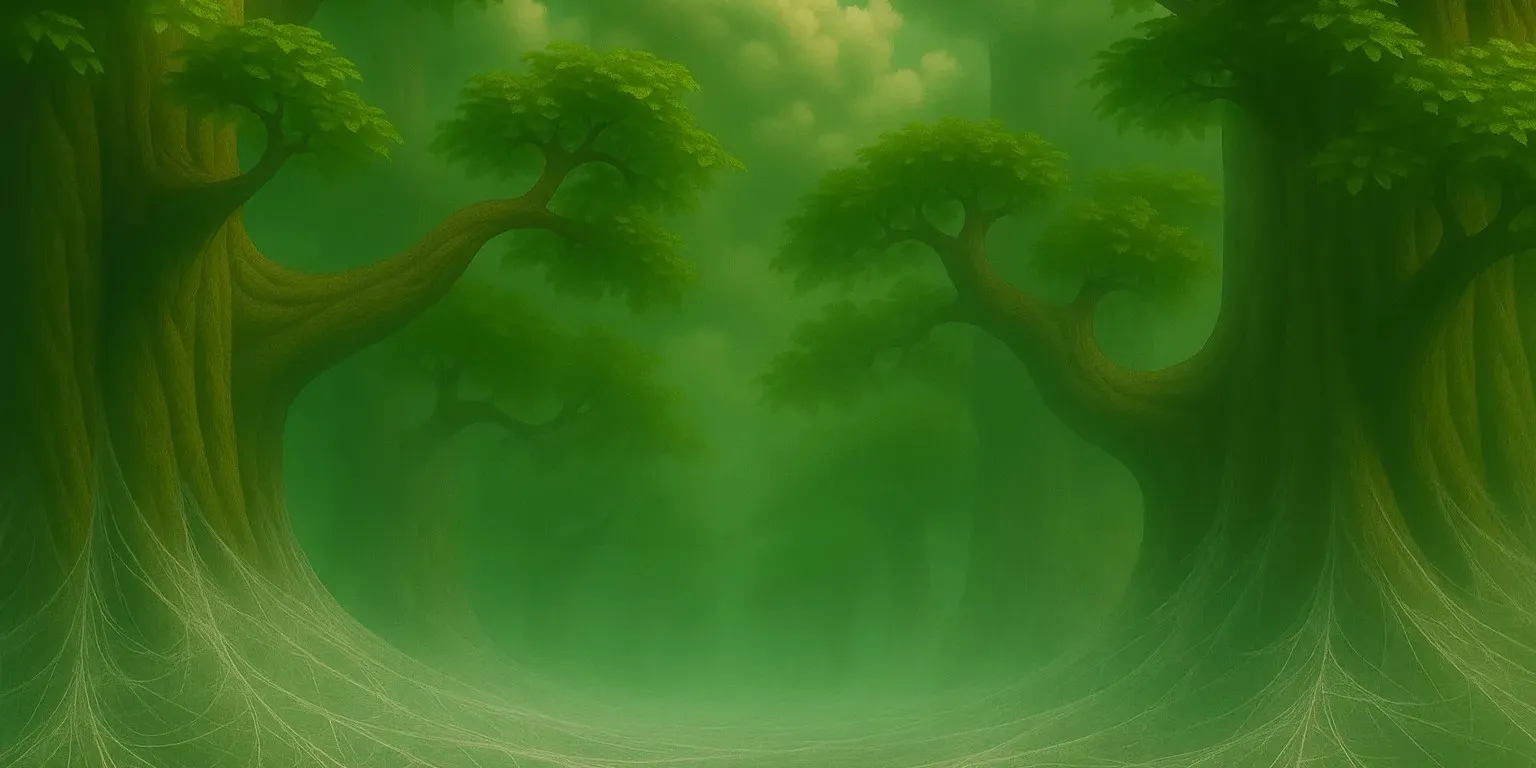
Among the plants of Arborea, the most prominent specimens are, of course, the Trees themselves, which form the very foundation upon which the world is built. They are of such overwhelming importance that I have already devoted an entire essay to them earlier in this volume, and thus shall not examine them further here. Instead, I shall direct our attention to the astonishing variety of secondary flora which dwell upon the great trunks and branches, as well as among The Clouds above and The Webs below.
One notable trait among the plants of Arborea, and one which cannot fail to arrest the attention of the natural philosopher, is the widespread tendency toward predatory behaviour, particularly among the denizens of the lower branches and The Webs. In those dim and shadowed regions, the distinction between plant and animal grows strangely indistinct, and many, if not most, of the plants supplement their sustenance through the consumption of living matter in addition to the transformation of light and soil into nourishment. They are often possessed of a degree of motility wholly foreign to the flora of my home realm, and many are capable of relocating themselves entirely when conditions become unfavorable.
These tendencies are especially pronounced among the members of the Subkingdom Dendrofungi, which sustain themselves wholly through the consumption of organic matter and derive no benefit from the green-tinged light that filters through The Clouds above. Many are capable of independent movement, and a surprising number are in fact free-floating organisms, borne aloft by the lifting gas that permits so much of Arborean life to hover amidst the upper airs. In countless respects, these remarkable beings defy every classical conception of plant life with which I was acquainted prior to my arrival in Arborea, and it is more from obedience to scientific tradition than from any deep conviction that I continue to place them within the Kingdom Plantae.
Looking Ahead
As I mentioned above, the remainder of this section shall examine twenty species of Arborea, arranged into four broad categories. These categories are as follows: Domesticated Creatures, encompassing the beasts of burden and the animals and plants cultivated by the People for food and labor; Denizens of the Trees, wherein I shall describe some of the most notable and iconic forms of wildlife inhabiting the vast realm between The Webs and The Clouds; Denizens of the Clouds, devoted to those extraordinary creatures which swim through the aerial ocean above the highest branches; and finally Denizens of the Webs, which shall examine the strange and often dreadful organisms dwelling within the shadows at the uttermost depths of Arborea.
Within each category, I have selected five species for detailed examination, in the hope of conveying to you, dear reader, some sense of the astonishing diversity of life which flourishes in this remarkable world, and of the peculiar biological principles that govern it. I must again emphasize that there remain many thousands of species yet undescribed, and it is my fervent hope that, should this volume find favor with the public, I may one day publish another devoted to those many omitted wonders.
For now, however, I shall conclude this introductory essay to the second half of this work, and invite you to turn the page and make the acquaintance of the first of our domesticated creatures: a humble but indispensable animal which I have named Halomyrmides.

Comments