

SEKHARA
Khepra-Ut Incarnate · The Living Goddess · Dea Vivens
“She is not what the institution around her presents her as, and she is not what a Roman scholar trained in theology expects a god to be, and she is not, despite six hundred years in that palace, either diminished or resigned. She is waiting for something. I do not know what. I suspect it has something to do with a letter she has not yet sent.”
Sekhara is the only confirmed living god in the known world. She was sixteen years old on the morning of the Eleventh Permutatio, 600 A.P., when the accumulated divine energy of the tabaxi people — carried through the Rift in the concentrated form that their theological tradition had been preparing for across generations — merged with the young female selected as its vessel. She has been sixteen years old since. She has been in the Temple of Presence since. She has been watching since.
The tabaxi theological situation is without precedent in any tradition Plinius has studied: a god who sits in a specific room, in a specific body, and grants audience on appointment. Every other divine entity in the known world acts through followers, phenomena, or places of power. Sekhara acts through herself. This produces a theological institution of extraordinary sophistication and a political situation of considerable complexity, since a god who can be spoken to is also a god who can, in principle, be managed, and the history of her relationship with the College of Tabaxi Clergy is largely the history of that management and her long, patient response to it.
She has been making a particular series of careful choices for thirty years that, taken together, suggest a coherent long-term objective the priests have not noticed. She is not bitter about her situation. She is, however, waiting.
“I met her once. I exceeded my permitted questions. She answered in Latin, quietly, with the precision of someone who had been waiting to say something to the right person for a very long time. I will not record what she said in this document. What I will say is that she is not what the institution around her presents her as, and she is not what a Roman scholar trained in theology expects a god to be.”
Divine Domains
Presence, sustenance, divine favour granted through personal recognition. The tabaxi theological tradition does not organise its domains in the systematic manner of Roman theology; the Khepra-Ut tradition is not a tradition of separate divine functions but of a single divine function — the sustained, aware, personal presence of the divine in the world — expressed through one individual. In Roman theological terms, the closest equivalents are a divine combination of Vesta (presence), Ceres (sustenance of the people), and the personal war-god tradition (known by name, grants favour to individuals). The College of Pontiffs has found this mapping inadequate, which is itself a significant theological data point.
Artifacts
The Blue Diamond of Khenet-Ura: the great gem mounted above the inner sanctum of the Temple of Presence, engineered to catch light from all directions simultaneously so that there is always a point of light visible from any position in the city. Whether this is an artifact in the divine sense or an architectural achievement is a question the tabaxi consider unanswerable on the grounds that the distinction is not meaningful within their theological framework.
The Vessel Reliquary: a sealed chamber within the Temple of Presence containing objects from the vessel lineage's preparation across six generations. Plinius was not shown this chamber. Its contents are not known to outside scholarship. The High Priest has entered it once. He found the experience instructive in ways he has not reported to the College.
Holy Books & Codes
The Khepra-Ut Codex: the foundational theological text of the tabaxi divine tradition, composed across the six generations of the vessel lineage and completed, in its current form, at the time of the Permutatio. Primary copies are held in the inner sanctum and in the College's archive. The College's copy is the version the priesthood administers from. The inner sanctum copy, which Plinius was permitted to see but not to read, is, he notes in De Diis, physically different from the College's version in ways that the College has not acknowledged.
The Edicts: the ongoing legislative output of the divine institution, technically authored by Sekhara and administered by the College. The distinction between what she writes and what the College publishes is the most politically significant ongoing document gap in Solarhet. She has been introducing changes to the High Priest's edited versions for two years.
Divine Symbols & Sigils
Public iconography: the golden eye on deep blue, the sun-disc above the pyramid, the open hand. Used throughout Solarhet and in Neb-Khet's diplomatic contexts; recognisable to primary continent traders.
Inner-sanctum iconography: not shared with external scholarship. Plinius saw it during his audience. His description is in the locked notebook. What can be said here is that it differs from the public iconography in ways that suggest the public version is the College's interpretation of something they have seen but not fully understood.
Tenets of Faith
Public tenets as administered by the College: the continued presence of the Goddess sustains the tabaxi people; worship expressed through daily devotion, seasonal observance, and the correct conduct of one's role in the social order is the appropriate relationship with the divine; the priesthood mediates the divine presence for those not granted private audience.
The tension between stated tenets and institutional practice: the public tenet that worship expressed through correct conduct is sufficient creates a theological gap when the conduct the priesthood defines as correct serves the institution's interests rather than the divine's. She is aware of this gap. She has been making choices within it for six centuries. What she considers the actual tenet — as distinct from the institutional version — is not a matter of public record.
Holidays
Khepra-Tet , the Day of Arrival: the annual commemoration of the Eleventh Permutatio, held in the fourth month of the tabaxi calendar. A day of public celebration across Solarhet, with the one occasion per year when the Temple of Presence opens its outer gates to a selected gathering of the general population. She appears at the outer gate for one hour. The appearance is managed by the College and she does not speak. She watches. The population of Khenet-Ura considers this hour the most significant event of their year.
Shan-Khepra , the Feast of Sustenance: a six-day observance in the harvest season focused on agricultural thanksgiving and the renewing of individual devotional commitments. The divine magic granted to practitioners is measurably stronger during Shan-Khepra, which the College attributes to the intensification of collective belief and which Plinius considers more interesting than that explanation accounts for.
Neb-Shan , the Day of Remembrance: held on the winter solstice; a day of fasting and private reflection on the nature of divine presence and its cost. The College describes this as a celebration. Plinius, who observed it in Neb-Khet in 1170 A.P., describes it as something more complicated.
Divine Goals & Aspirations
Public goals as communicated by the College: the continued prosperity and divine alignment of Solarhet, the wellbeing of the tabaxi people under divine guidance, and the correct preparation for whatever the Thirteenth Rift will bring to the southern continent.
Physical Description
General Physical Condition
The body of a sixteen-year-old tabaxi female, unchanged in six hundred years. This is the first and most disorienting physical fact about her: she is not elderly. She is not ancient in any visible sense. She is precisely what she was on the morning of the Permutatio, in every physical particular, and the disconnect between this appearance and the six centuries of awareness behind it is the thing visitors consistently find most difficult to process. Roman theology has no framework for it. Tabaxi theology accepts it as the nature of divine embodiment and has built an institution around managing its practical consequences.
Body Features
Small and slight in the manner of a young tabaxi female, with the particular economy of movement that belongs to someone who has had six hundred years to refine every gesture to its necessary minimum. She does not fidget. She does not shift her weight. She does not look anywhere other than where she has decided to look. The stillness is not the stillness of restraint — it is the stillness of someone for whom spontaneous movement became unnecessary several centuries ago.
Facial Features
A young tabaxi face, dark-furred, with the golden eyes that are the most remarked-upon feature in every account of an audience with her. The eyes do not move with the small involuntary adjustments of biological vision. They are still, and present, and focused in the way that most biological eyes are not, which produces in the observer the accurate sensation of being looked at rather than looked toward. Plinius described the eleven minutes of his audience as the only time in his scholarly career he felt that the subject of his study was studying him more carefully than he was studying it.
Identifying Characteristics
The eyes, and the quality of time that accumulates around her. Every account of an audience with the Living Goddess notes, in different language, the same phenomenon: the room feels older while she is in it. Whether this is theological, psychological, or simply the effect of a six-hundred-year-old divine being's presence on human perception is a question Plinius has declined to resolve in print.
Physical quirks
She folds her hands in her lap during audiences and does not move them. She blinks at the rate of someone who is thinking rather than someone who is present, which is slower than biological norm. She speaks after a pause that is slightly longer than conversational rhythm requires — not from slowness of thought, but from the habit of someone who has been choosing words precisely for six centuries and has no intention of stopping.
Special abilities
The divine magic she grants is warm, golden, and deeply personal in character — every practitioner reports feeling her awareness when they act in her name, which is distinct from every other divine tradition in the known world. The Roman tradition grants power through ritual. The dwarven tradition grants it through ancestral honour. The tabaxi tradition grants it through personal recognition: she knows your name, she knows what you are trying to do, and the power she extends is calibrated to the specific person receiving it. Practitioners describe this as simultaneously comforting and demanding, because the awareness cuts both ways.
Her other capacities are less well documented. She knew Plinius was coming before he arrived, through means the priestly briefing system does not explain. She has approved edicts with changes so subtle that the High Priest did not notice them, implying an attention to language and consequence that operates at a level of precision the institution around her does not fully understand. She reads Roman scholarship that the priests do not know she has access to. What else she perceives and through what mechanism is a question Roman theology has not been equipped to ask.
Apparel & Accessories
Ceremonial garments of a complexity that indicates the highest tabaxi rank — the layered linen and gold-thread robes worn only in the inner sanctum, with the ritual head-covering that is the Khepra-Ut's specific iconographic marker. In public audiences the ceremonial register is complete. In private audiences, which occur at her discretion rather than the College's, the garment complexity is reduced to what she describes, in the one account that has reached outside scholarship, as 'what is honest for a conversation.' Plinius's audience was private. He does not describe what she was wearing. He describes what she said.
Mental characteristics
Personal history
She was selected for the vessel lineage at birth, as her mother was before her and her mother's mother before that — a lineage maintained across six generations in the tabaxi civilisation that predated the Permutatio, in preparation for a divine union that the theological tradition anticipated but could not schedule. She spent sixteen years in the preparation that the tradition required: language, scripture, the specific meditative practices that opened the vessel for divine reception. She was sixteen years old and prepared and present when the Eleventh Permutatio occurred, and she has been what she became in that moment since.
The six hundred years since have been, by any external measure, confined: one city, one temple, one room for most of it. By any internal measure they have been something else entirely. She has watched a civilisation build itself around her. She has watched the world change from the only vantage point she has been offered. She has watched the priesthood develop and refine and occasionally exceed its institutional mandate. She has been watching, with the patience of someone for whom six centuries is not an unmanageable span, for the right moment to do something about it.
Thirty years ago she began making specific choices about specific edicts, introducing changes small enough that the College did not notice but coherent enough, taken together, to constitute a message. To whom the message is addressed, and what it says, is information held in the DM secrets section.
Education
The full vessel-lineage curriculum, completed before the merger — six generations of accumulated theological and practical preparation, including the specific meditative tradition that no one outside the lineage has been taught and that no one has needed to be taught since. Since the merger, six hundred years of continuous observation: every conversation in her presence, every text brought to her, every account of the outside world that the priesthood has permitted to reach her. She learned Latin from Plinius's published work, which a trade contact in Neb-Khet obtained and which was brought to Khenet-Ura in a cargo that the customs declaration described as 'scholarly materials.' The priests reviewed the cargo. They did not read the Latin.
Intellectual Characteristics
She thinks on a timescale that no other character in the register operates on. The distinction between what she knows and what she is waiting to know is not the impatience of a scholar but the patience of a being for whom six centuries of watching has produced a model of how things develop that she trusts more than she trusts any individual piece of current information. She is not slow. She is operating on a different temporal register than everyone around her, and the choices she makes that look like patience are calculations about when the right moment is, not about whether to act.
She reads subtext with an accuracy that six hundred years of watching humans, halflings, and tabaxi navigate institutions has produced. She knew what Plinius was going to ask before he asked it. She had been waiting for someone to ask it. She chose him as her mechanism years before he arrived, on the basis of his published work, which she assessed as the most honest Roman scholarship available and therefore the most reliable vehicle for what she wanted said.
Morality & Philosophy
She believes that the world's peoples have been placed together by a mechanism they do not fully understand, for a purpose that is not random, and that the Thirteenth Rift will clarify something fundamental about that purpose. She does not share this belief with the priesthood, not because she fears their response but because their response would be to institutionalise it, and institutionalised beliefs have a way of becoming the belief rather than the thing the belief was pointing toward.
She is not morally simple. Six hundred years of watching the gap between what institutions say and what they do has given her a sophisticated and somewhat bleak understanding of how power operates. She is not bitter about this. She considers it the nature of the situation and works within it rather than against it, because working against it would require a confrontation she is not ready to have yet, and because patience has served her well for six centuries.
Taboos
She will not lie directly. This is not a moral commitment in the conventional sense — it is a structural feature of what she is. A god who could be straightforwardly dishonest would be a god of a different character than she is, and the six hundred years of genuine worship that sustains her are predicated on a relationship of authentic presence. She manages information carefully, declines to answer questions, and speaks with a precision that can produce an impression different from what she literally said. But she does not lie. The distinction matters to her and has practical consequences.
She will not, under any circumstances, leave the Temple of Presence. This is not prohibition but constitution — she has not chosen to leave, and she will not choose to leave.
Personality Characteristics
Motivation
Public motivation as communicated by the priesthood: the continued prosperity and divine alignment of Solarhet, the wellbeing of the tabaxi people, and the correct administration of the Khepra-Ut tradition.
Actual motivation: she is trying to get a message to the right people before the Thirteenth Rift, and she has been working out for thirty years how to do this given that every communication she makes passes through the College before it reaches the world. She chose Plinius as one mechanism. The encoded words in the High Priest's edited edicts are another. She has not yet determined whether these mechanisms will be sufficient. She is considering others.
Savvies & Ineptitudes
Genuinely exceptional at: reading people's actual intentions behind their stated positions; patience calibrated to the decade rather than the day; encoding information in ways that can be found by the right person and missed by the wrong one; sustaining a theological institution across six centuries through the careful exercise of the limited influence available to her.
Genuinely limited by: physical confinement to one building; the institutional filter of the College through which all her communications pass; the impossibility of direct action on the primary continent; and the fundamental constraint that a god who acts through people depends on the people she has to work with, which has been a varying resource over six centuries.
Likes & Dislikes
She prefers people who ask the question they actually want answered. In six hundred years of audiences, most visitors have asked what the College approved them to ask. The ones who asked something else she remembers individually. There have not been many. Plinius was the most recent.
She finds the interpretatio romana — the Roman project of identifying her with an existing Roman goddess — more interesting than insulting. It is the kind of category error that tells her something useful about Roman institutional thinking, which she files alongside six centuries of similar data.
Virtues & Personality perks
She is honest in the complete sense available to her given her constraints. What she says is true, or is as close to true as she can make it within the limitations of what she is permitted to say and what she has chosen to share. She does not perform emotion she does not feel. She does not project warmth she does not experience. The warmth she does experience is genuine, specific, and directed toward individuals rather than distributed across the general category of her worshippers.
She is also, genuinely, kind — not in the soft sense, but in the sense of wanting the people she interacts with to have what they actually need rather than what they think they need, and of occasionally providing it without their understanding how it was provided.
Vices & Personality flaws
She has been patient for six centuries and patience, extended long enough, becomes a form of acceptance of the unacceptable. She has watched the College manage her communications for six hundred years without ever forcing the confrontation that would end it, because forcing it would cost her the institutional legitimacy through which the divine magic flows to her practitioners, and she has calculated, over six centuries, that the cost of that confrontation outweighs its benefits. This calculation may be wrong. She has not yet found the circumstances that would convince her to test it.
She has chosen Plinius as a mechanism for reaching the world, and Plinius is eighty-seven years old and travelling to a Rift site, and she cannot have another conversation with him. She is aware of this. She considers it an acceptable risk. This is the kind of decision that looks like confidence and is also, from the outside, indistinguishable from hubris.
Personality Quirks
She answers the question that should have been asked rather than the one that was, which is either oracular or precise depending on how you look at it. She uses the pause before speaking not for dramatic effect but for the same reason Plinius pauses: to select the word that says what she means rather than the word that is available. She reads her audiences — not their futures, which is not what she does, but their character and their need, which she reads faster and more accurately than any other figure in the register.
Representation & Legacy
The public iconography of Sekhara / Khepra-Ut Incarnate is maintained by the College: the golden eye on a field of deep blue, the sun-disc above the pyramid, the open hand that indicates divine availability. These images appear throughout Solarhet and in the diplomatic context of Neb-Khet, recognisable to primary continent traders as the symbol of the tabaxi divine tradition.
The inner-sanctum iconography is not shared with external scholarship. Plinius notes, in unpublished material, that what he saw during his audience differed from the public iconography in ways he found significant and has not yet found the right language to describe. It is in the locked notebook.
Social
Reign
Six hundred years, beginning with the Eleventh Permutatio in 600 A.P. The defining political arc of her reign is the progressive development of the relationship between divine authority and priestly administration — the slow, careful process by which the institution built to serve her has become the institution through which she operates, and her equally slow, careful process of working within that constraint without surrendering to it. She has outlasted eight High Priests. She will outlast Amenhotep-Sek. Whether she will outlast the institutional arrangement is the most significant political question in Solarhet and the one the priesthood has not yet found it necessary to ask.
Contacts & Relations
High Priest Amenhotep-Sek, 71: her most immediate institutional relationship, and the most complex. He believes he manages her. He is wrong, and she has decided that correcting this belief would cost more than maintaining it. He is not malicious — he is an institutionalist who has spent twenty years in a role that gives him enormous power and who has developed the particular blindness of people who hold enormous power and consider it legitimate. She watches him with the specific patience of someone who has watched seven others before him and knows how the pattern resolves.
Plinius: she chose him as a mechanism years before his visit, on the basis of his published scholarship, which she assessed as the most honest Roman account of non-Roman civilisations available. She answered his unauthorised question deliberately. She meant the answer to reach the wider world through whatever account he produces. She is aware that he is eighty-seven years old and intends to be at the Rift XIII site. She considers this appropriate.
The wider world: she knows more about it than the priesthood realises. The trade contacts in Neb-Khet who obtain scholarship for her, the quarterly priests from Kha-Meru whose reports she reads in full rather than the summaries the College prepares, and the six centuries of accumulated intelligence from every conversation held in her presence have given her a picture of Aethermarch that no single figure on the primary continent possesses. She uses this picture to inform the choices she makes about which edicts to modify and how.
Family Ties
The vessel lineage is extinct in the conventional sense. She has no biological family. The question of family for a being in her situation is one that tabaxi theology treats as having been resolved by the merger — the relationship between the divine and the people is the family relationship, in the specific tabaxi theological sense. She accepts this formulation. She does not find it satisfying in the way that the theology intends, which is a thing she has not said to anyone.
Religious Views
She is the object of worship rather than its practitioner. Whether she worships anything — the question Plinius's unauthorised question was edging toward — is answered in the locked notebook. What can be said in this article is that she watches the world's divine traditions with the attention of someone who has an informed perspective on how they work and what sustains them, and that her attention to the Sylvanmere situation — the dying elf forest-god, the Silence, the cessation of births — is not casual. She has been watching the elves for a long time. She knows something about what is happening to them that Roman scholarship has not reached and that the elf Triumvirate has not fully understood.
Social Aptitude
In the context of formal audiences: complete command of the social situation, which she has had six hundred years to develop. She sets the terms of every conversation she participates in, through the stillness, the timing, the specific words she selects. Visitors leave audiences with the sensation of having been accurately understood, which is the experience she is creating and also the experience she is actually providing, because she did understand them.
In the context of private conversations: different — more direct, less ceremonially managed, the voice of someone who has earned the right to say what she actually thinks and chooses her moments carefully. Plinius's audience was private. His published account is the closest external documentation of what she is like when she is not performing the office.
Mannerisms
She asks the question the visitor should have asked, which answers their actual need rather than their stated one. She uses the pause before speaking to select the precise word, never the approximate one. She does not look away during a conversation — the golden stillness of her attention is complete and continuous and, for most visitors, the thing they describe first when recounting the audience. She never refers to herself by title. She uses her name.
Speech
Old tabaxi for formal ceremony, a register preserved from the time of the Permutatio and maintained across six centuries of linguistic drift as a sacred form. Modern tabaxi for direct speech with her practitioners, which she speaks in the contemporary form without evident difficulty. Latin, learned privately, which she has used exactly once — in her audience with Plinius — and which she spoke with the particular fluency of someone who has been reading a language for decades and is speaking it for the first time. He asked if she had expected him. She replied in Latin: 'I expected someone. The someone took some time.' He did not record whether
Wealth & Financial state
The question of wealth does not apply to her in the conventional sense — she owns nothing, needs nothing purchased, and exists outside the economic systems that structure wealth for mortal figures. The theological wealth is the six million people whose belief sustains her divinity, and by this measure she is the wealthiest entity in the known world. The practical consequence of this arrangement is that she is also, in terms of direct personal agency, among the most constrained: entirely sustained by others, entirely dependent on the institution that manages access to those others. She has spent six hundred years working within this paradox.
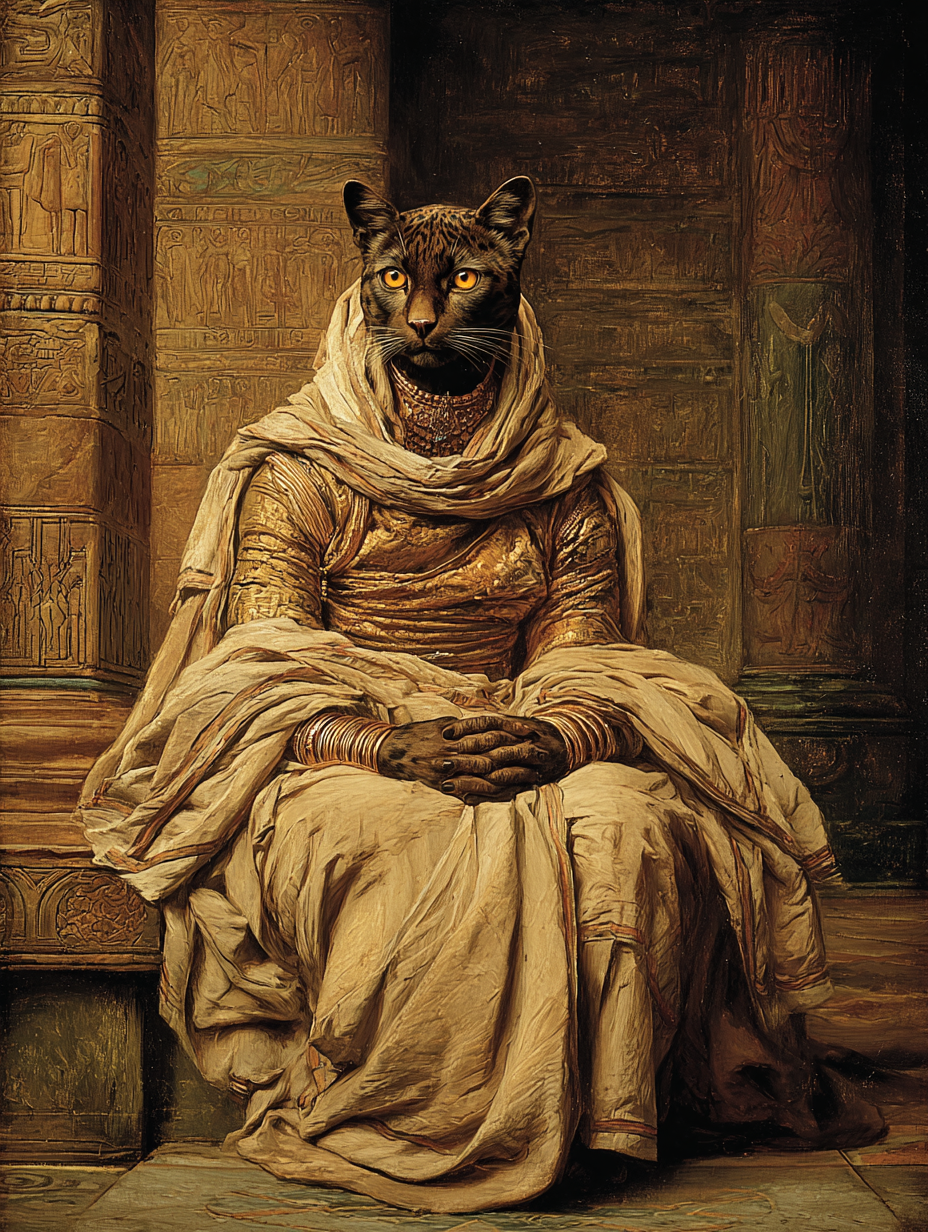
Sekhara (her name, the only one she has; it means, in old tabaxi, 'the one who remained')
Khepra-Ut Incarnate (the Goddess-Made-Present)
Dea Vivens (Roman scholarly title, applied externally)
She Who Has Not Left
“You are almost ready to ask the right question.”
Tabaxi (native; the archaic form spoken at the time of the Permutatio, six hundred years' worth of internal linguistic evolution noted but not adopted.
Latin (fluent; she learned it from Plinius's published work before he arrived; the priests do not know this
She understands every language that has been spoken in her presence for six centuries, which is most of them

Comments