

NESHET-SHA
Textile · Continens Australis (Solarhet oases and Nubis valley) · Primary tabaxi garment textile; luxury export via the halfling southern route
I own a robe of Nedjem-Sha, purchased at Portus Meridiani in 1186 A.P. for a sum I have chosen not to record. I have worn it for fourteen years. It has not developed a single loose thread. In the heat of a Nova Romae summer, it is cooler than the linen I wear beneath it. In the winter, it warms with the specific quality of a garment that seems to have decided what temperature you should be maintained at and to have accepted responsibility for the matter. I have owned Roman garments of finer thread count. I have not owned any Roman garment that reminds me, every time I put it on, that a people I have never met have been solving a specific problem for six hundred years and consider it, evidently, solved.
The Neshet-Sha, known in Roman scholarship as Byssus Solarheti and in Roman commerce as Sun-linen or Sekhara's Cloth, is the principal garment textile of the Solarhet people and one of the two most economically significant luxury exports from Continens Australis to the primary continent (the other being the temple incense compounds, treated separately). The fabric is produced from the fibre of the Neshet plant , a desert-adapted flax cultivar that grows in the oases and river valley plantations of the Solarhet interior, and has been continuously cultivated and processed by the Solarhet weaving families for the full six centuries of their presence on this world.
The fabric is worn by essentially every Solarhet from the Living Goddess Sekhara to the labourer in the fields, distinguished only by the specific weave grade. The Solarhet tradition names six distinct grades, each with its own Solarhet term reflecting the specific character of softness, flow, and finish that the grade embodies. In order from the coarsest common wear to the finest ceremonial: Djed-Sha (the Enduring), Meret-Sha (the Beloved), Nedjem-Sha (the Sweet), Nefer-Sha (the Beautiful), Akh-Sha (the Radiance), and Netjeru-Sha (the Cloth of the Gods). Each grade is produced by a specific stage of the fibre selection, retting, weaving, and finishing process, and each is associated with a specific social context of use. Djed-Sha, the coarsest, is standard agricultural labouring wear and is produced in quantities approaching universal availability throughout Solarhet territory. Netjeru-Sha, at the other end, is the ceremonial garment worn exclusively by Sekhara and is produced by three specific weaving families whose collective annual output supplies the Living Goddess's household and no other party. The halfling Merchant Council, in developing its commercial grading protocol in 1085 A.P., mapped the Solarhet terms onto a Roman-legible numerical system (Grades I through VI, finest to coarsest) that has become the standard commercial shorthand in Roman markets.
The specific quality of the fabric that has made it so valued in Roman markets is its thermal self-regulation: Neshet-Sha maintains the wearer's comfort in a broader range of ambient conditions than any comparable Roman fabric, and does so with a hand-feel that Roman weavers have consistently described as luxurious and been consistently unable to replicate. Attempts to cultivate the Neshet plant elsewhere have failed without documented exception. Attempts to reproduce the finishing process from imported raw fibre have produced results that Solarhet weavers, when shown the Roman product, have described politely as 'a sincere attempt.'
DM ONLYProperties
Material Characteristics
Neshet-Sha in its finished woven form is a textile of extraordinary softness and characteristic lustre. Djed-Sha, at the coarse end of the range, presents to touch and eye as a fine linen of slightly warmer tone than Roman flax linen and with a subtle sheen that is most visible under low-angle light. Nedjem-Sha, which is the grade this author owns and knows most intimately, presents with a substantially greater surface lustre, a hand-feel that most Roman observers describe as reminding them of no fabric they have previously handled, and a specific quality of weight that is best described as the fabric knowing where it is meant to be on the body and settling there without further arrangement.
Akh-Sha and above develop a lustre that Roman scholarship has documented as approaching the sheen of raw silk without in fact being silken in fibre character, together with a distinctive movement quality: the fabric drapes and shifts with a subtle animation that Roman weavers have consistently identified as impossible to reproduce and that halfling grading merchants have documented in specific technical vocabulary that Plinius has been unable to fully translate. Netjeru-Sha, as observed at the two senatorial functions where Plinius has seen Sekhara's ceremonial garment displayed under formal diplomatic protocol, presents with a lustre and animation that Plinius has chosen not to attempt to describe further, on the grounds that the description would either overreach the observable evidence or fail to convey what he actually saw.
Physical & Chemical Properties
The primary functional property of Neshet-Sha, and the reason it is the near-universal garment of the Solarhet people, is its thermal self-regulation. The fabric permits the passage of body heat when the wearer is warm and retains body heat when the wearer is cool, with a specific responsiveness that Roman experimental determination has documented empirically without being able to explain mechanistically. The effect is most pronounced in Akh-Sha through Nedjem-Sha; Djed-Sha shows the property in reduced form, and Netjeru-Sha is reported by Solarhet temple sources to exhibit the property in an intensified form that the standard Roman experimental protocols have not been permitted to test.
Secondary properties include exceptional durability under regular wear (Plinius's fourteen-year-old Nedjem-Sha robe shows no thread degradation and only slight softening of the fabric hand), high resistance to natural fibre pests (halfling storage protocols report near-zero moth or beetle infestation in stored Neshet-Sha bales), moderate resistance to staining with a specific characteristic that light staining tends to lift from the fabric during ordinary wear rather than becoming set, and the specific dyeing behaviour described above (accepting natural dyes exceptionally well while retaining the underlying lustre of the base fabric). The fabric is not fireproof and burns at standard textile combustion temperatures; it is not waterproof and absorbs moisture readily; it is not particularly resistant to abrasive damage from sharp edges.
DM ONLYCompounds
Neshet-Sha in its finished form is fibre alone. No compound elements are incorporated in the standard weaving process. The higher grades (Netjeru-Sha, Akh-Sha, and Nefer-Sha) receive a proprietary finishing treatment that the Solarhet temple weavers apply from a preparation whose specific composition has not been disclosed to any outside party, but which is understood to comprise a plant-derived oil, a specific mineral compound present in the Nubis valley soil, and a further ingredient that the temple has not identified. The finishing preparation is applied by hand to individual bolts of the highest grades during a preparation stage that takes approximately three weeks per bolt and is conducted at the temple weaving complex at Neb-Khet.
DM ONLYGeology & Geography
The Neshet plant grows only in specific geographic contexts within Continens Australis: the Nubis river valley (primary cultivation, approximately 400 kilometres of the river's middle course under continuous plantation), the Meret-Sesh oases (a specific system of interior desert oases in the northern Solarhet territory, secondary cultivation with lower total volume but higher-quality output), and a scattering of smaller river valley sites in the eastern Solarhet lowlands. The plant requires a specific combination of climatic conditions (hot dry air, cool night temperatures, seasonal but reliable water access) and soil conditions (the specific mineral profile of the alluvial deposits along the Nubis river and the artesian-fed oasis soils of the Meret-Sesh) that together define its viable growing range.
Attempts to cultivate the plant elsewhere have been documented in three separate Roman efforts (in the fourth, seventh, and ninth centuries A.P.) and in one better-documented halfling commercial trial in 1063 A.P. All four attempts failed within one to three growing seasons. The Roman efforts variously failed for insufficient soil mineral content, insufficient temperature variation, and disease susceptibility that the plant does not exhibit in its native range. The halfling trial, conducted on Brin-Sula in Archipelagus Brindala with soil composition adjusted through documented Solarhet consultation, produced plants that grew to maturity but did not produce fibre of usable quality: the halfling assessment concluded that the specific finishing potential of the fibre depended on soil composition factors that could not be replicated. The Solarhet weaving families, when the halfling result was reported to them, are said to have received the report with the specific quality of polite non-response that the Solarhet temple culture applies to information the temple has known for six hundred years and has chosen not to share.
DM ONLYOrigin & Source
The Neshet plant is understood by the Solarhet temple to have been brought through the Eleventh Permutatio in seed form, cultivated at Neb-Khet from the arrival year onward, and progressively extended across the Nubis valley and Meret-Sesh oases as the Solarhet people established their agricultural infrastructure. The specific origin world from which the plant was brought is not documented; the temple's teaching on this point emphasises the plant's presence in Solarhet ritual life since 'before the crossing' but does not offer information about what came before. Whether the plant existed on the origin world in a form comparable to its current form, whether it was cultivated there under similar conditions, and whether the mineral compound that enables the higher-grade finishing was present in the origin world's soils or is a feature specific to Continens Australis, are questions the temple has not addressed publicly.
Life & Expiration
Neshet-Sha in finished woven form is exceptionally stable. Under standard storage conditions (cool, dry, protected from direct light), the fabric retains its properties essentially indefinitely; documented examples of preserved Neshet-Sha in Solarhet temple storage exist that are more than five centuries old and retain the specific lustre and thermal properties of the grade at which they were originally produced. Djed-Sha and Meret-Sha show slow softening of the hand-feel across decades of regular wear, without corresponding degradation of the thermal properties. Nedjem-Sha and above show essentially no measurable degradation under normal use conditions.
The higher-grade perceptual amplification property is more temporally sensitive. Netjeru-Sha and Akh-Sha garments are reported by Solarhet temple documentation to require periodic re-treatment (approximately every fifteen to twenty years) to maintain their full perceptual sensitivity. Nefer-Sha garments have not been documented to show this pattern, presumably because their perceptual amplification is too weak to register the deterioration in ordinary use.
History & Usage
History
The Neshet-Sha's history as a Solarhet cultural artefact begins with the Eleventh Permutatio itself (600 A.P., see Annales Mundi) and the establishment of the initial Neshet cultivation at Neb-Khet in the years immediately following the tabaxi arrival. The temple weaving families were established in their current hereditary form within the first century of the Solarhet presence, and the six-grade classification (from Djed-Sha to Netjeru-Sha) has been documented consistently in Solarhet temple records since approximately 780 A.P. Sekhara's Netjeru-Sha ceremonial garment has been documented in the temple records continuously since 623 A.P., with the specific fabric replaced periodically as the perceptual amplification protocol requires but the Netjeru-Sha designation and ceremonial framework unchanged.
The fabric's entry into Roman markets begins with the establishment of the halfling southern trade route (1030 A.P.), which for the first time provided reliable maritime transport between Continens Australis and the Roman coast. Halfling merchants encountered Neshet-Sha at Neb-Khet in the earliest years of their commercial establishment and identified it immediately as a high-value luxury export with strong Roman market potential; commercial import to Portus Meridiani was established by 1040 A.P. and has grown continuously since. The halfling Merchant Council's development of a commercial grading protocol in the eleventh century (approximately 1085 A.P.), which mapped the Solarhet temple's six-grade system onto a Roman-legible numerical classification (Grades I to VI, finest to coarsest), is the specific institutional development that made the fabric a reliable trade good in Roman markets and enabled the current pricing structure. Roman merchants use the numerical grades in commercial correspondence; the Solarhet names remain standard within the temple and in diplomatic contexts.
The Roman senatorial adoption of Nefer-Sha (halfling Grade III) as principal formal garment (approximately 1140 A.P., through a specific senatorial fashion movement whose leading figures Plinius has documented separately in his notes on the Cotta family) is the current phase of the fabric's Roman cultural presence. Approximately forty senators of Nova Romae wear Nefer-Sha togas as their principal formal garment. The remainder wear Roman-produced wool or linen togas in the traditional style. The senatorial adoption has not been universal, and specific senatorial families have positioned their preference for Roman-produced fabric as a matter of political identity.
Discovery
The fabric was 'discovered' by Roman scholarship in the specific sense of being encountered by Roman merchants in the fourth decade of the eleventh century A.P., through the halfling southern trade route. The Solarhet had of course not been under any impression that the fabric required discovery; they had been producing it for approximately four hundred years by the point of Roman first contact, and had established a mature domestic cultural and commercial infrastructure around it. The Roman scholarly documentation of the fabric proceeded through the eleventh and twelfth centuries in a series of merchant and diplomatic accounts, of which the most substantial prior to the current article is the treatment in Marcus Aemilius Fructus's Res Australes (1174 A.P.), which draws on Fructus's twelve years of residence at Neb-Khet as commercial attaché and provides the most reliable Roman account of the temple weaving families and their production culture.
Everyday use
Neshet-Sha in its various grades serves as the universal garment textile of the Solarhet people. Djed-Sha (the Enduring) is standard agricultural labouring wear, produced in high volume, and is worn by the field and craft populations throughout Solarhet territory. Meret-Sha (the Beloved) is the standard urban wear for the merchant and administrative classes. Nedjem-Sha (the Sweet) is the fabric of the upper commercial class and of the middle-ranking priesthood. Nefer-Sha (the Beautiful) is the fabric of the senior priesthood, the higher administrative offices, and the Roman senatorial market. Akh-Sha (the Radiance) is worn by the highest priesthood and by the three most senior temple weavers themselves. Netjeru-Sha (the Cloth of the Gods) is worn only by Sekhara.
Within the higher grades, specific garment types have been developed for specific contexts. The ceremonial temple robe (Akh-Sha or Nefer-Sha depending on the wearer's rank) is a standardised garment produced by the temple weaving families. The senatorial toga in the Roman market (Nefer-Sha) is a Roman garment cut from Solarhet fabric rather than a Solarhet garment type. The ordinary domestic use of Nedjem-Sha and Meret-Sha by Solarhet families is broadly comparable to Roman domestic linen use and produces a similar range of household textile applications (bedding, table linen, curtains) alongside personal garments.
Cultural Significance and Usage
Neshet-Sha in its various grades serves as the universal garment textile of the Solarhet people. Djed-Sha (the Enduring) is standard agricultural labouring wear, produced in high volume, and is worn by the field and craft populations throughout Solarhet territory. Meret-Sha (the Beloved) is the standard urban wear for the merchant and administrative classes. Nedjem-Sha (the Sweet) is the fabric of the upper commercial class and of the middle-ranking priesthood. Nefer-Sha (the Beautiful) is the fabric of the senior priesthood, the higher administrative offices, and the Roman senatorial market. Akh-Sha (the Radiance) is worn by the highest priesthood and by the three most senior temple weavers themselves. Netjeru-Sha (the Cloth of the Gods) is worn only by Sekhara.
Within the higher grades, specific garment types have been developed for specific contexts. The ceremonial temple robe (Akh-Sha or Nefer-Sha depending on the wearer's rank) is a standardised garment produced by the temple weaving families. The senatorial toga in the Roman market (Nefer-Sha) is a Roman garment cut from Solarhet fabric rather than a Solarhet garment type. The ordinary domestic use of Nedjem-Sha and Meret-Sha by Solarhet families is broadly comparable to Roman domestic linen use and produces a similar range of household textile applications (bedding, table linen, curtains) alongside personal garments.
Industrial Use
Neshet-Sha has no significant industrial use outside its garment and household textile applications. The specific properties of the fabric (thermal self-regulation, high durability, exceptional hand-feel) are not properties for which industrial applications have been developed at any technology level currently available on Aethermarch, and the fabric's cost of production and limited annual supply would preclude industrial use even if applications were identified. The one exception, small in scale but noted here for completeness, is the halfling maritime application: halfling merchant vessels have adopted lightweight Meret-Sha as sail cloth on specific luxury passenger routes, where the fabric's specific weight and durability characteristics justify the substantially higher cost relative to standard sail materials. This application is rare and specialised and does not represent an industrial use in the standard sense.
Refinement
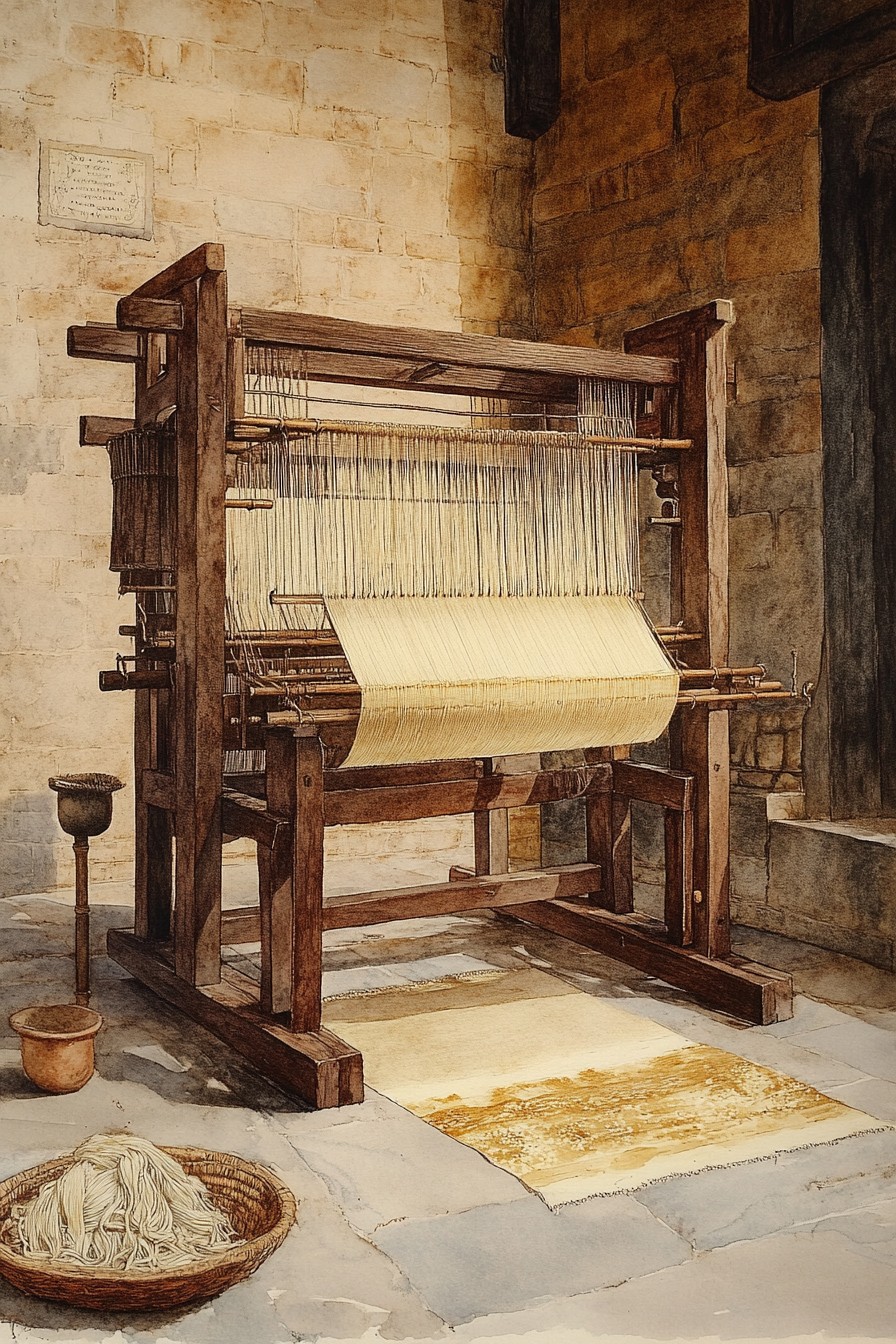
The refinement of the Neshet plant into Neshet-Sha fabric proceeds through six documented stages, each conducted by specialists within the Solarhet weaving tradition. The first stage is harvest, conducted twice annually and requiring specific timing that the temple weaving families determine through methods that combine agricultural knowledge with what Roman scholarship would recognise as astronomical observation. The second stage is retting: the harvested plants are submerged in specific pools within the temple weaving complex at Neb-Khet for approximately three weeks, during which controlled microbial activity separates the fibre from the surrounding plant matter. The third stage is fibre extraction and combing, producing the raw fibre in graded batches. The fourth stage is spinning, conducted by the intermediate-rank temple weavers with grade assignment made at this point based on fibre characteristics. The fifth stage is weaving, conducted on standing looms of a specific traditional design. The sixth stage is finishing, which for Nedjem-Sha and below comprises a standardised set of processes (washing, drying, pressing) and for Nefer-Sha, Akh-Sha, and Netjeru-Sha comprises the proprietary temple finishing treatment described in the Compounds section above.
The proprietary finishing treatment for the higher grades is conducted by three specific weaving families whose members inherit the treatment protocol through hereditary training. The treatment takes approximately three weeks per bolt, requires the specific mineral compound described in the DM notes, and involves a sequence of hand operations that Roman scholarship has never been permitted to observe. Attempts to reverse-engineer the treatment through analysis of finished Akh-Sha have identified certain of the compounds involved but have not identified the sequence of operations or the specific catalysing steps that produce the finishing effect.
Manufacturing & Products
The refinement of the Neshet plant into Neshet-Sha fabric proceeds through six documented stages, each conducted by specialists within the Solarhet weaving tradition. The first stage is harvest, conducted twice annually and requiring specific timing that the temple weaving families determine through methods that combine agricultural knowledge with what Roman scholarship would recognise as astronomical observation. The second stage is retting: the harvested plants are submerged in specific pools within the temple weaving complex at Neb-Khet for approximately three weeks, during which controlled microbial activity separates the fibre from the surrounding plant matter. The third stage is fibre extraction and combing, producing the raw fibre in graded batches. The fourth stage is spinning, conducted by the intermediate-rank temple weavers with grade assignment made at this point based on fibre characteristics. The fifth stage is weaving, conducted on standing looms of a specific traditional design. The sixth stage is finishing, which for Nedjem-Sha and below comprises a standardised set of processes (washing, drying, pressing) and for Nefer-Sha, Akh-Sha, and Netjeru-Sha comprises the proprietary temple finishing treatment described in the Compounds section above.
The proprietary finishing treatment for the higher grades is conducted by three specific weaving families whose members inherit the treatment protocol through hereditary training. The treatment takes approximately three weeks per bolt, requires the specific mineral compound described in the DM notes, and involves a sequence of hand operations that Roman scholarship has never been permitted to observe. Attempts to reverse-engineer the treatment through analysis of finished Akh-Sha have identified certain of the compounds involved but have not identified the sequence of operations or the specific catalysing steps that produce the finishing effect.
Byproducts & Sideproducts
The refinement process produces two significant byproducts. The plant matter separated from the fibre during retting is composted and returned to the plantation soils, closing the nutrient cycle at the Neshet plantations. The fibre combings that do not meet the standards for any of the six grades (approximately 8 percent of raw fibre by weight) are recovered and used for lower-grade textile applications: rope, coarse packing material, and the base of certain composite products that the temple weaving complex produces for its own use. Neither byproduct enters external trade in significant volumes.
DM ONLYHazards
The Neshet-Sha fabric in its finished form presents no documented hazards to wearers under normal use conditions. The plant itself is non-toxic in field handling and has no documented occupational health effects for the agricultural workers of the plantations. The retting process produces mild odour and low-grade water pollution in the retting pools, both of which are managed through standard Solarhet agricultural practice. The higher-grade finishing treatment involves reagents whose specific hazard profile the temple has not disclosed, but which the three finishing families' documented occupational health history suggests are moderate and manageable with appropriate protective practice.
The one specific hazard documented in Roman scholarly literature is the risk of over-attachment to Nedjem-Sha and above among Roman wearers. The specific combination of thermal comfort, hand-feel, and status signalling that the fabric provides has been documented in three separate Roman moral and philosophical treatises across the past forty years as producing a specific pattern of psychological dependence in wealthy Roman wearers, whose specific character Plinius has recognised in himself and against which he offers no defence beyond the observation that the fabric is genuinely as pleasant to wear as its adherents claim.
Environmental Impact
The Neshet plantations along the Nubis river valley have been in continuous cultivation for approximately six centuries without documented soil degradation, a stability that Solarhet agricultural practice attributes to the specific nutrient cycling protocols the temple weaving families maintain and that Roman agronomists have generally accepted as remarkable but not miraculous. The plantations do not use land that would otherwise support subsistence agriculture (the specific soil requirements of the Neshet plant confine it to zones that would not sustain the Solarhet staple crops), and the labour intensity of the cultivation supports substantial Solarhet employment across the plantation zones. The environmental impact of the plantations is therefore, on Roman scholarly assessment, broadly positive: they represent a productive and sustainable use of terrain that would otherwise be marginal, and they have contributed to Solarhet population stability and economic security for centuries.
Reusability & Recycling
Neshet-Sha garments are extensively reused within Solarhet culture. Netjeru-Sha, Akh-Sha, and Nefer-Sha garments are typically retained by the wearer's household or by the temple across generations, with periodic recutting and reweaving to accommodate wear or changed contexts. Nedjem-Sha and Meret-Sha garments enter secondary markets when their original owners cease to wear them, and can be found in domestic use for two or three generations before their specific properties are considered to have degraded sufficiently for retirement. Djed-Sha garments are typically used to exhaustion and then composted with the plantation waste, closing the material cycle at the source.
Roman practice has been slower to develop reuse patterns for imported Nefer-Sha and Nedjem-Sha, primarily because the Roman senatorial market does not yet have the multi-generational depth to have produced significant secondary supply. The specific pattern that is emerging is that Nefer-Sha garments are being cut down for daughters and daughters-in-law within the wearing families, producing Nedjem-Sha equivalents that circulate within the family for another generation before entering broader Roman secondary markets.
Distribution
Trade & Market
The fabric's trade route from Neb-Khet to Roman markets runs through the halfling Merchant Council's southern shipping network. Bulk shipments (Nedjem-Sha, Meret-Sha, and Djed-Sha, in commercial volumes) are consolidated at Neb-Khet, shipped via the halfling deep-water route to Brinhaven, graded at the halfling commercial grading facility, and re-shipped to Portus Meridiani for entry into Roman markets. Higher-grade shipments (Akh-Sha and Nefer-Sha, in smaller volumes) are handled through a specific halfling premium shipping protocol that involves dedicated cargo consignment, higher security handling, and direct delivery to identified Roman purchasers rather than open market sale. Netjeru-Sha is not shipped to any external market; the Living Goddess's supply is produced at Neb-Khet and does not leave Solarhet territory.
Roman market pricing has been broadly stable across the past forty years, with Djed-Sha at approximately 40 HS per bolt, Nedjem-Sha at approximately 380 D, and Akh-Sha at approximately 4,500 D. The specific pricing structure reflects the halfling grading protocol's supply-controlled tiering, which has been designed to maintain consistent price signals across the grades rather than to maximise short-term commercial return. This pricing discipline is considered by Roman commercial observers to be one of the halfling Merchant Council's more sophisticated commercial achievements, and one that has contributed substantially to the fabric's stable position in Roman luxury markets.
DM ONLYStorage
Neshet-Sha storage requirements are moderate. Standard practice is climate-controlled storage (dry, cool, protected from direct light) in specific cedar-lined bales that resist moisture penetration and provide protection against textile pests. Roman merchant warehouses at Portus Meridiani have developed specialised Neshet-Sha storage facilities across the past century, and the halfling commercial infrastructure at Brinhaven includes a substantial dedicated storage complex for the grading and staging operations. Long-term storage of higher-grade fabric (Netjeru-Sha, Akh-Sha, and Nefer-Sha) at the temple weaving complex at Neb-Khet uses a specific protocol that involves periodic inspection, adjustment of the storage environment to account for seasonal humidity variation, and re-treatment on the schedule described in the deterioration section. The specific storage protocol for the Living Goddess's garment supply is a temple ceremonial responsibility conducted under the direct oversight of the three finishing families.
Law & Regulation
Solarhet regulation of the fabric's production and trade is comprehensive and codified in temple law. The six-grade classification, the assignment of specific grades to specific social contexts of use, the identification of the three finishing families and their exclusive authority over the higher-grade treatment, and the export licensing that permits the halfling Merchant Council to conduct commercial handling are all specified in Solarhet temple regulation with a specificity that Roman commercial law rarely matches. Violations of the regulation are managed through the temple's own disciplinary framework and are rare; the specific status of the temple weaving families and the cultural weight of the fabric within Solarhet society together make regulation-compliance nearly universal within the traditional community.
Halfling regulation, exercised through the Merchant Council's commercial standards, focuses on grading integrity, quality control at the shipping stage, and the specific commercial protocols that support price stability in the Roman market. The Merchant Council maintains a formal Neshet-Sha grading protocol that has been continuously refined since the eleventh century and is considered by Roman commercial observers to be the most sophisticated commercial grading system operating in the primary continent's luxury textile trade.
Roman regulation is limited. The fabric is a permitted luxury import, subject to standard import duties (currently 12 percent ad valorem, unchanged since 1156 A.P.), and is not restricted from any specific class of Roman purchaser. Specific senatorial families have argued for restrictions on senatorial wear of Nefer-Sha on political grounds; the arguments have not resulted in any formal restriction, but they contribute to the political texture around the fabric described in the Cultural Significance section. There is no significant black market for imported Neshet-Sha within Roman territory beyond the specific patterns documented above.

The quote at the top is great. Amazing work as always my friend!
Your freind,
The Graiffe
Working hard at Summercamp 2026