
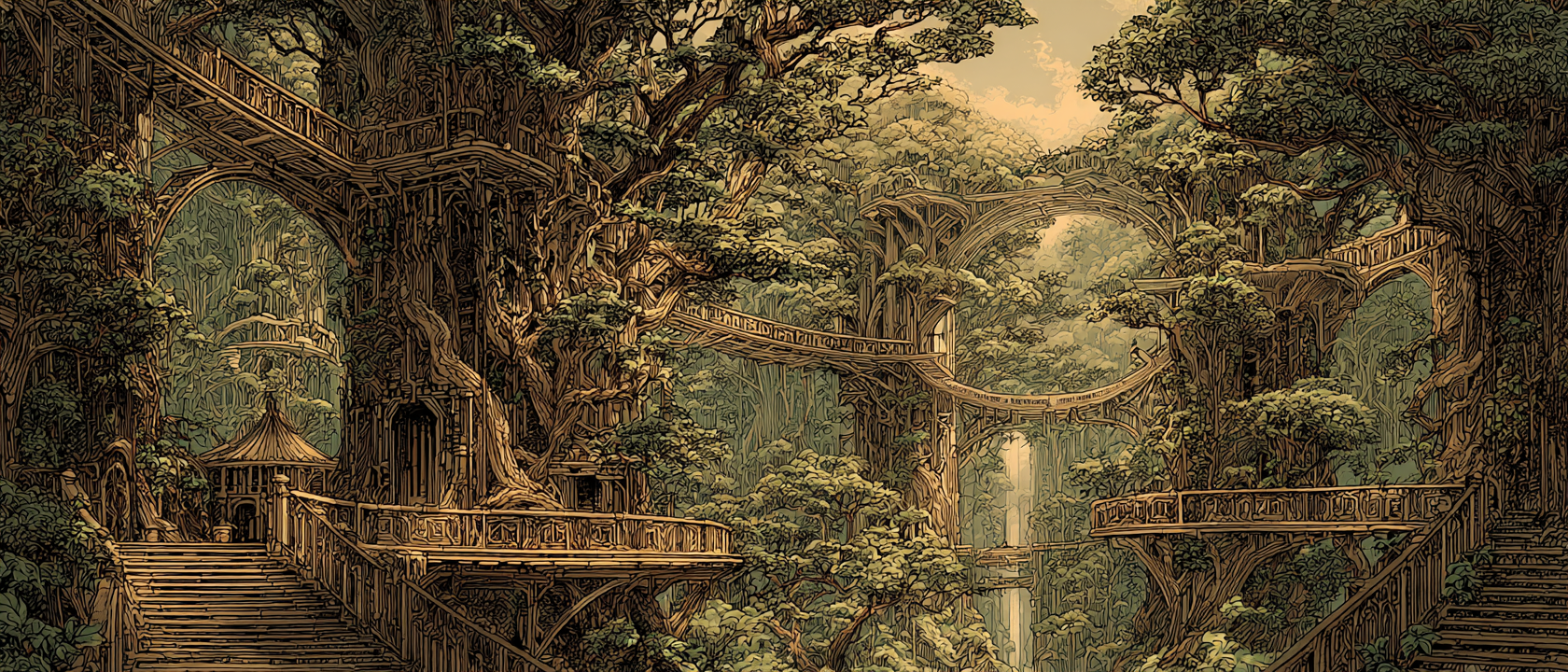
CAER'ITHIL
The Elder's Crown Residence · Ael'thalas · Ael'canoras
"I have been told about Caer'ithil by three different elves in three different conversations. Each described it differently. Each described the same thing: a space at the highest point of the canopy where the sky is present and the forest is visible below, where the oldest living elf has lived for longer than Rome has existed in this world. I have formed a picture from these accounts. I do not know how accurate it is. I am fairly certain it is not wrong in any significant way."
Caer'ithil is the quarters and council space of Caladris Ael'ven, the eldest of the three Triumvirs, grown into the crown of the tallest trees in Ael'canoras over many centuries. It is simultaneously a private residence, a council chamber, and the symbolic highest point of elvish authority. No structure in Aethermarch is older as a continuously occupied dwelling. Caladris has lived here for longer than Rome has existed in this world, which is a fact I find difficult to hold alongside the knowledge that Rome considers itself ancient.
Purpose / Function
Caer'ithil serves as Caladris's permanent residence and as the informal seat from which she exercises her authority as Prima Triumviratus. It is not a formal palace in any Roman sense — there is no throne room, no audience chamber, no processional logic. The elder practitioner council meets in the adjacent council space when it gathers, but the governance of Ael'canoras does not happen through ceremony. It happens through the long conversations of very old elves in a place that has been thinking about things for fourteen hundred years.
The council space attached to the main residential structure is, by elf account, the location where the most significant decisions about Sylvanmere's closure have been made and remade for two centuries. Caladris has presided over these conversations from the same position in the same space for all of that time. The forest has, apparently, shaped the space around the habit.
Design
The structure occupies the canopy's highest sustained growth: several great trees whose uppermost branches have thickened and intertwined over centuries into a continuous platform, with the main residential chambers formed by the living wood of the trees' own crown growth and a council space adjacent that opens, on clear days, to the sky on three sides. The residential interior is described, by the one source who mentioned it, as spare: what a person needs who has had seven hundred and eighty years to understand what she needs, and has reduced her possessions accordingly. The council space is larger, its floor grown smooth by centuries of use, its walls the living canopy itself.
Entries
Caer'ithil is accessed via the Ael'thalas walkway network from below. There is one primary approach: the walkway that connects the council space to the main canopy platforms of the district. There is no formal gate or guardian. The approach to Caer'ithil is governed by the understood conventions of elvish seniority — those who have standing approach; others do not. An elf source described this to me in terms that suggested the convention required no enforcement because the forest itself communicates displeasure at approach by those without standing. Whether this is theological or practical, the result is the same.
Sensory & Appearance
Caer'ithil is the lightest space in Ael'canoras. The canopy thins here at the crown, and the quality of light in the structure is direct rather than filtered — on clear days, actual sunlight reaches the council space, which no other part of the haven experiences. The sound is the sound of the high canopy: the slow movement of great branches, the calls of birds at this elevation, and the particular quality of wind that reaches the forest's upper growth. One source said the structure smells different from the rest of the haven: less like enclosed growth, more like open air. She said this as though it were significant. I believe it is.
Denizens
Caladris Ael'ven is the sole permanent resident. The elder practitioner council attends when summoned. Ael'thiren , the elder practitioner who maintains working spaces in Vel'anen below, is a regular presence in the council space — one of perhaps a dozen practitioners who attend Caladris's deliberations when she chooses to hold them with others present, which is not frequently.
Contents & Furnishings
The residential section contains what Caladris requires and nothing superfluous, which after seven hundred and eighty years of selective reduction is very little. The council space contains the records of the council's deliberations — not stored in the Vel'ithren archive, but kept here, in a form and location that only Caladris controls. Among the residential section's contents is material Caladris brought from the Vel'ithren archive's inner chambers forty years ago. It has not been returned. Its nature is not known to any elf other than Caladris.
Special Properties
The structure has a quality of the forest's attention that practitioners describe as more concentrated than anywhere in Ael'thalas except possibly Caer'ithil itself. Whether this is because the structure is at the forest's highest point, because it is the oldest continuously occupied space in the haven, or because of what Caladris brought back from the archive and has kept here since, is a question the practitioners have not asked her. Fourteen hundred years of continuous habitation by the elf most attuned to the forest-god has left something in the wood. Those who are sensitive to such things feel it on approach.
Architecture
Caer'ithil is grown entirely from the trees it occupies. No quarrying, no cutting, no imported material of any kind. The structure's distinctiveness comes not from its size — it is not large — but from its position and its age. The surfaces are the smoothest of any structure in the haven, worn to an evenness by fourteen hundred years of continuous occupation and the forest's long attention to the space. The oldest sections of the structure, those grown in the first generation after the Permutatio, have a colour depth that the newer growth of the lower districts does not possess. Two sources noted this independently. One described the oldest sections as looking like the wood had been thinking for a very long time.

Comments