
The Voidspire Pear
A Fruit of the Empty Dark
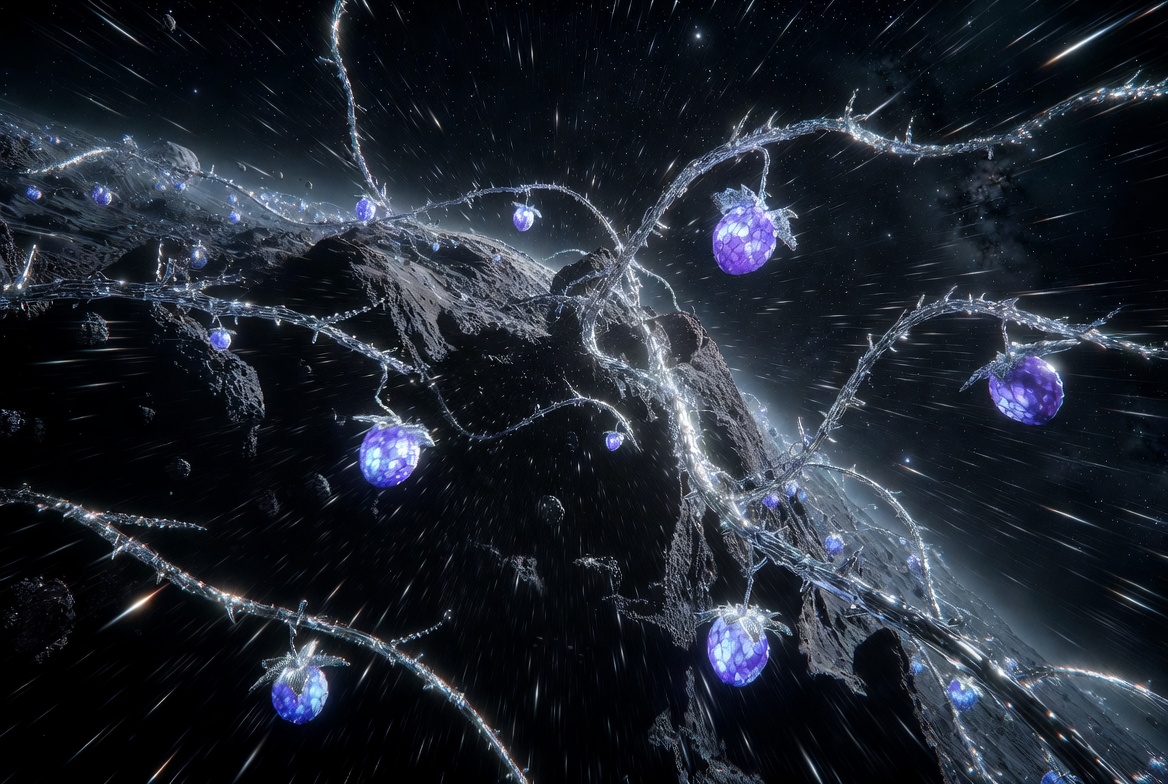
In the scattered archives of the Aether Expeditions, few discoveries have unsettled xenobotanists more than the Voidspire Pear. First catalogued during the Third Drift Survey of the Null Marches, this fruit grows where almost nothing else can: the hard vacuum of interstellar space, clinging to the shadowed faces of rogue asteroids and ancient, drifting wreckage.
Habitat and Growth
Voidspire Pears do not require soil, atmosphere, liquid water, or even significant gravity. Their roots—more accurately described as crystalline anchor filaments—burrow into the frozen regolith of carbonaceous asteroids or the pitted hulls of long-abandoned colony ships. From these anchors they extend thin, silvery vines that unfurl only on the permanently shadowed side of their host body, never facing a star.
The plant draws energy from cosmic ray flux and the faint infrared glow of distant stars. Microscopic photosynthetic analogues within the vine convert high-energy particles into chemical energy, while the fruit itself sequesters free hydrogen and carbon from the sparse interstellar medium. Growth is glacially slow by terrestrial standards. A single mature pear may take decades to reach full size, and the vine may fruit only once every few centuries.
Appearance and Structure
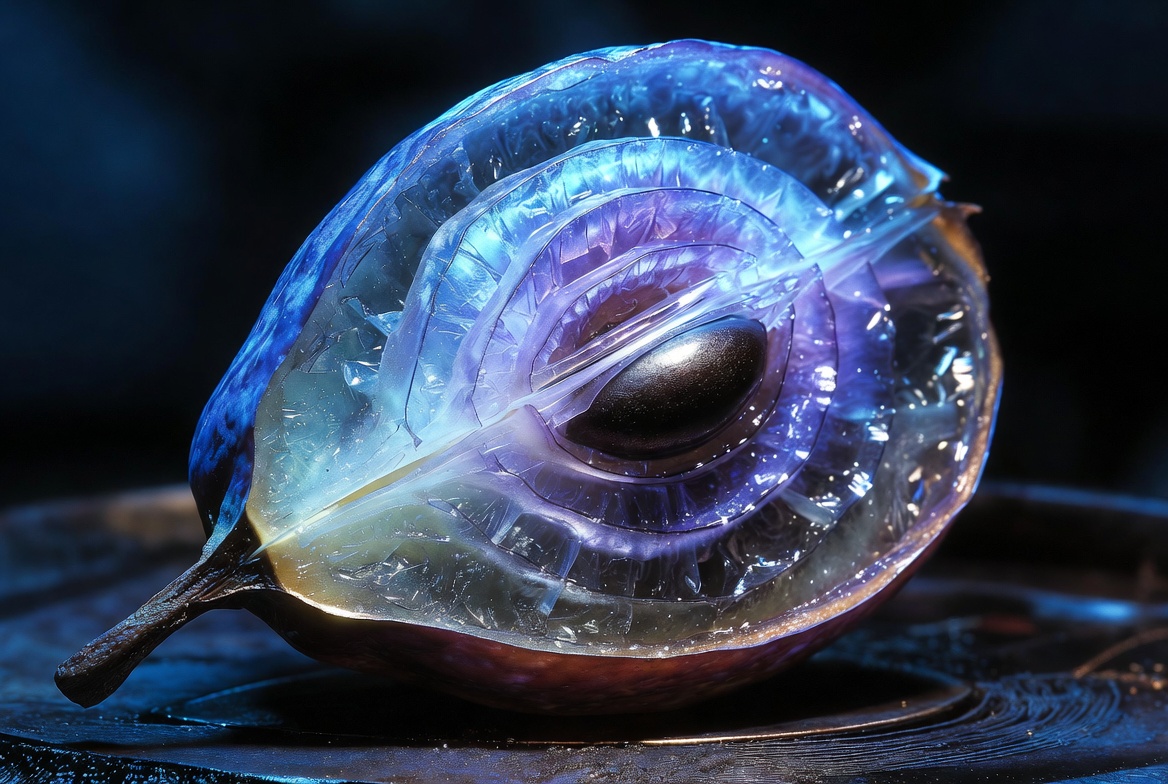
A ripe Voidspire Pear is roughly the size of a human fist, elongated and slightly tapered like a classical pear. Its skin is a deep, matte indigo that absorbs almost all visible light, giving it the appearance of a hole punched in space. When cut, the flesh reveals concentric layers of translucent, crystalline pulp that glow with a soft internal bioluminescence—pale violet near the core, shifting to cold blue toward the outer layers.
The “seeds” are not seeds in any conventional sense. They are dense, metallic nodules containing complex organic lattices and microscopic superconducting filaments. When exposed to even a trace of atmosphere or moisture, these nodules rapidly crystallize into new anchor filaments, allowing the plant to take root on any suitable surface within hours.
Nutritional and Pharmacological Properties
Despite its extreme origin, the fruit is edible—and highly valued. The crystalline pulp is dense with complex carbohydrates, free amino acids, and a suite of exotic antioxidants that neutralize radiation damage at the cellular level. Consumed raw, it produces a sharp, metallic sweetness followed by a lingering coolness on the tongue, as if the mouth itself has been briefly placed in vacuum.
More importantly, extracts of the Voidspire Pear have become central to long-duration space medicine in the Aether 2d12 continuum. Controlled doses dramatically increase cellular resistance to cosmic radiation and microgravity-induced bone loss. Overuse, however, carries risk: prolonged consumption can induce a temporary but profound sensory dissociation, in which the eater reports the sensation of “hearing” the background radiation of the universe as a low, continuous tone.
Cultural and Strategic Significance
Among free-floating habitats and deep-range survey crews, the Voidspire Pear has acquired an almost mythic status. Finding a living vine is considered both a scientific prize and a quiet omen of endurance. Some crews refuse to harvest more than one fruit from any single plant, believing that to do so invites the same emptiness that sustains the vine.
In the more militarized sectors of Aether space, controlled cultivation attempts have begun. Early results are mixed. The plant refuses to fruit under artificial gravity or within pressurized domes; it seems to require the true vacuum and the slow, patient bombardment of cosmic rays. Research continues in the outer Null Marches, where a handful of carefully monitored vines now grow on the dark sides of captured asteroids.
The Voidspire Pear remains one of the clearest proofs that life in the Aether 2d12 setting does not merely adapt to hostile environments—it sometimes chooses the most hostile ones available, and thrives there with quiet, crystalline indifference.
1/4 Lbs.
4"-5"
florescent purple

Comments