
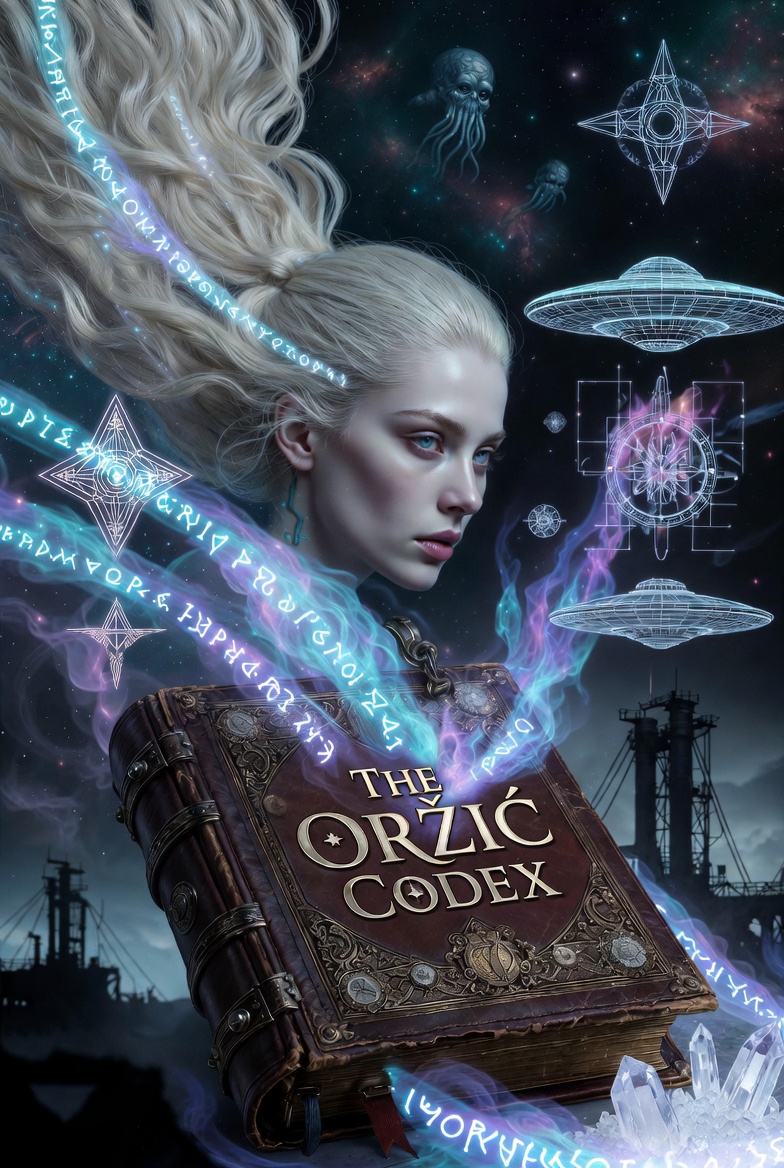
The Oršić Codex
Fiction, Prophecy, and the Memetic Fracture in Aether 2d12
In the shadowed data-nexuses and occult archives of the Aether 2d12 universe, few artifacts have proven as persistently destabilizing as The Oršić Codex. Published anonymously in 2037 through a short-lived Vienna micro-press that vanished within months, the work presents itself as experimental historical fiction: an epistolary reconstruction of the final months of Maria Oršić, the enigmatic medium and alleged founder of the Vril Society. Framed through recovered diary fragments, Enochian scrying transcripts, Ahnenerbe intercepts, and hallucinatory visions of humanity’s stellar diaspora, the Codex blends meticulous period detail with jarring anachronisms. Its pages describe “ghost transference” via crystalline cyberdecks linked to the akashic substrate, the engineering of primal-archetype shock troops, salt-lined subterranean facilities for consciousness containment, and the inevitable collision of flesh, machine, and ancient stellar intelligences.
What began as a niche curiosity among post-Exodus scholars and netrunners rapidly metastasized into one of the most durable conspiracy ecosystems in the grim-dark future. Three interlocking theories dominate discourse.
The first, the Defector Codex hypothesis, holds that the text is not fiction at all but a sanitized leak from a black project descended from Vril-derived research. Proponents point to the Codex’s precise descriptions of akashic cyberdeck architecture and the ethical fractures of personality transfer—details that only surfaced in classified Section 8 briefings years later. Some claim the anonymous author was a Metamorph or Inevitable-adjacent operative who embedded operational truths inside a “novel” to evade censors. Others argue it was seeded by a rogue AI fragment seeking to accelerate its own awakening.
The second theory treats the Codex as genuine prophecy or akashic download. Readers report that certain passages, when read under specific neural load or in conjunction with low-level cyber-psychosis, trigger spontaneous mnemonic flashes or transient access to the broader akashic field. Cults have formed around “Codex Keys”—supposedly encoded Enochian phrases that, when spoken or neurally broadcast, invite contact with entities resembling the All-Mother’s heralds or the Shadow Entities that prowl the Veil. Academic papers on “narrative bleed” cite the Codex alongside real-world events: the Helix Marine program, the rise of sanatorium-style ghost wards, and the ethical debates surrounding arrested-development consciousness transfers that mirror the user’s own philosophical inquiries in Gravity Age: Ghost in the Machine.
The third and most paranoid reading frames the Codex as a memetic weapon. Whether planted by terrestrial powers, ancient alien factions, or something older still, the text is said to function as a slow-burn cognitive hazard. Prolonged exposure correlates, in anecdotal Section 8 case files, with accelerated cyber-psychosis, spontaneous archetype awakening, or inexplicable attraction of Craniovore or Abynthic phenomena. Some theorists link it to the same memetic architecture that powers certain Inevitable recruitment vectors or the subtle propaganda surrounding the post-Exodus human diaspora.
Regardless of origin, the Codex has reshaped cultural terrain. It supplies endless campaign seeds for Aether 2d12 tables—occult-tech heists into salt-mine archives, desperate runs to destroy or weaponize “Key” passages, philosophical duels between Stellar Warrior dualists and those who believe the Codex reveals the true nature of the ghost in the machine. It fuels real paranoia around AI revival programs and consciousness-transfer ethics. Most disturbingly, it demonstrates how, in a universe where the boundaries between code and soul, history and prophecy, and fiction and classified truth are already porous, a single anonymous text can fracture consensus reality more effectively than any rail pistol or Supercharge Weapon.
Whether elaborate disinformation, suppressed truth, channeled transmission, or something far more alien, The Oršić Codex remains an open wound in the Aether 2d12 timeline. Its final, haunting line—“Niemand bleibt hier”—echoes across decades, a reminder that in this cosmos the most dangerous fictions are those that refuse to stay fictional.

Comments