
The Frozen Ghost
How an Ancient Myth Shapes Tomorrow’s Funerary Rites
In the neon-lit sprawl of the late 21st century, death is no longer the final curtain. For many, it is a pause button. The practice of cryonic suspension, once fringe pseudoscience, has become a mainstream funerary tradition, driven not by cold empirical hope alone, but by a powerful, persistent myth: cryogenics preserves the ghost.
The Myth of the Unuploaded Ghost
According to the lore that now permeates both street-level neuromancer cults and high-end corporate wellness enclaves, every human possesses a ghost, the irreducible pattern of consciousness, memory, and soul that cannot be perfectly replicated by silicon alone. Uploading one’s ghost to a cyberdeck (the sleek neural lace implants or full-mind cloud transfers that dominate the upper echelons) is considered the cleanest, most reliable path to digital immortality. Those who complete the procedure often describe the experience as “stepping into the light forever.”
But not everyone chooses, or can afford, the upload.
For those who delay, refuse, or fail the compatibility trials, the myth offers a second path. The body is placed into cryogenic suspension, not merely to preserve tissue, but to anchor the ghost. The belief holds that the freezing process slows the ghost’s natural dissipation after clinical death, keeping it tethered to its biological hardware like a ship moored in ice. Future medical technology, nanite swarms, full-body cloning, or quantum resurrection protocols will one day repair the physical vessel and allow the ghost to reinhabit it seamlessly.
This is not presented as mere hope. In the myth, it is framed as metaphysical necessity. “The ghost remembers the meat,” say the cryo-priests. “Upload without anchor risks drift. Freeze without haste risks unraveling.”
Origins and Cultural Evolution
The roots of this myth blend ancient spiritual concepts with early cryonics pioneers. Echoes appear in Egyptian mummification (preserving the body for the ka and ba), Tibetan bardo traditions (the soul’s intermediate state), and even Christian ideas of bodily resurrection. When cryonics emerged in the 20th century, it was largely materialist—focused on future medicine reviving the dead. But as neural uploading became viable in the 2040s and 2050s, the narrative shifted.
The ghost myth crystallized around 2068 during the “Great Upload Schism,” when high-profile failures of early full-consciousness transfers left celebrities and executives as fragmented digital echoes. Public fear grew: What if the uploaded self is only a sophisticated copy? What if the real ghost stays behind?
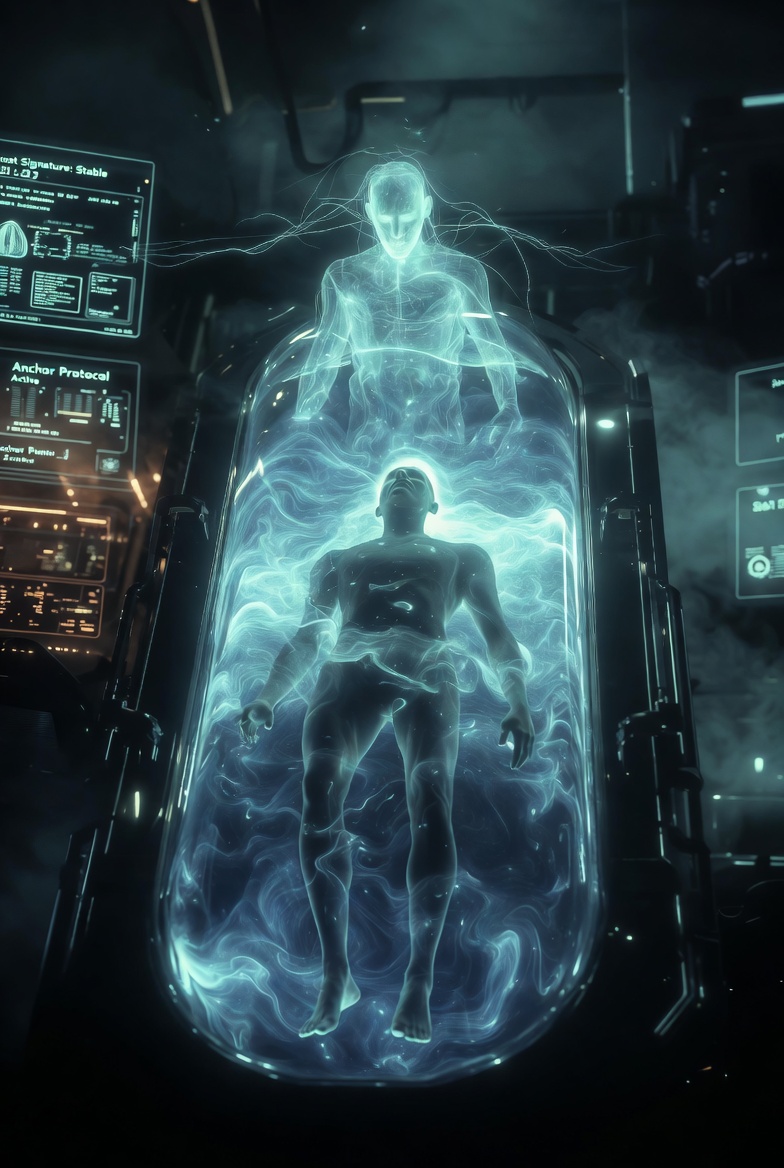
Cryonic facilities began marketing “Ghost Anchor Protocols.” Marketing imagery showed ethereal blue silhouettes hovering inside frosted capsules, waiting patiently for their bodies to be reborn. Temples to the “Unuploaded” sprang up beside cryo-vaults, offering rituals that combined neural mapping (to strengthen the ghost’s tether) with traditional funeral rites.
Modern Practices
Today, the choice is stark and deeply personal:
- The Deck-Bound: Upload early, often in one’s prime. The body is respectfully recycled or donated. The ghost lives on in vast server-farms or embodied avatars.
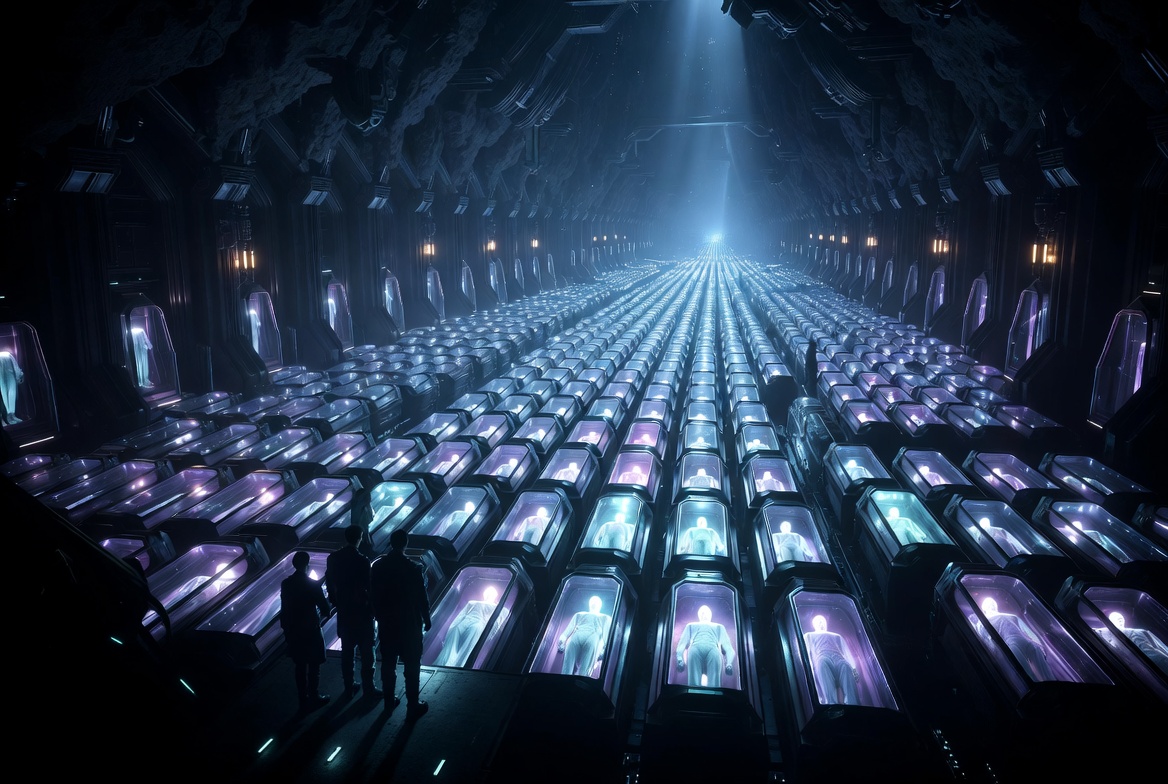
- The Frozen: Those who reject or cannot complete upload. They sign “Ghost Preservation Directives.” Upon legal death, the body is perfused with cryoprotectants, cooled to −196 °C, and stored in one of the great Vault Cities—towering subterranean arcologies humming with liquid nitrogen.
Wealthier clients opt for “Tier One” suspension: full neural mapping + experimental ghost-signature recording, with clauses for future reintegration. Lower-income participants rely on public cryo-charities, hoping communal faith and statistical odds will suffice.
Funerary ceremonies have adapted. Mourners gather around the capsule in climate-controlled viewing chambers. Holographic ghosts of the deceased deliver final messages. Priests recite the Litany of the Long Winter: “Sleep, anchored one. The thaw will come.”
Skepticism and the Ethical Iceberg
Critics, mostly radical upload purists and materialist philosophers, call it “wishful cryopreservation.” They argue the ghost is an illusion, a pre-singularity superstition. Once the body is truly dead, no amount of freezing revives the original pattern. The myth, they say, merely delays grief and funnels money into an industry that profits from uncertainty.
Defenders counter that the psychological comfort is real. Families report lower rates of complicated grief when they can visit a physical capsule rather than a sterile digital memorial. Some philosophers suggest the myth itself may be functionally true: belief in the preserved ghost creates cultural and legal momentum that may one day fund the very technologies needed to make it reality.
A Waiting Dream
Whether the ghost myth is metaphor, spiritual truth, or self-fulfilling prophecy, its power is undeniable. In an age where death can be cheated through silicon or ice, millions choose the cold path, not out of blind faith in science, but out of a deeply human refusal to let go of the body that once carried them.
They lie in their frozen tombs, ghosts suspended between worlds, waiting for the day the ice cracks and the old flesh calls them home.
Until then, the Vault Cities hum on, vast cathedrals of possibility, where the final mystery of consciousness meets the oldest human instinct: I was here. I want to come back.

Comments