
Sythuul
Children of Symbiosis A Comprehensive Lore Exploration
The Sythuul stand as one of the most elegant and unusual examples of obligate symbiosis in the known galaxy. Born from the union of two distinct species — the Sythu and the Uul — they embody a perfect merging of two separate evolutionary paths into a single, greater whole. This dual heritage grants them a perspective, resilience, and adaptability that few other species can match.
Origins and Dual Biology
The Sythuul originate from a water-rich world where two distinct intelligent lineages evolved in parallel.
The Sythu are all-female humanoid omnivores descended from aquatic primates. Sleek, hairless, and graceful, they possess slightly webbed hands and feet optimized for swimming. Their senses are specialized for murky or low-light environments: daylight vision is limited to about 10 feet, but they compensate with powerful blindsense (60 feet out of water) and blindsight (120 feet underwater). As obligate air-breathers, they are equally at home on land and in shallow waters, though they cannot remain submerged indefinitely without assistance.
The Uul, by contrast, are cephalopod-like beings resembling terrestrial octopuses but with a unique configuration: three long, powerful tentacles and two shorter, more dexterous ones. Asexual and highly intelligent (primate-level cognition), they breathe underwater and lay eggs in a process that historically proved fatal to the parent. Their vision is exceptionally sharp in aquatic environments, providing the perfect complement to the Sythu’s sensory profile.
The Bonding and the Birth of the Sythuul
The true miracle of the Sythuul occurs during the bonding ritual, which takes place when a Sythu reaches sexual maturity. Hormonal signals draw an unbonded Uul, initiating a profound and intimate process:
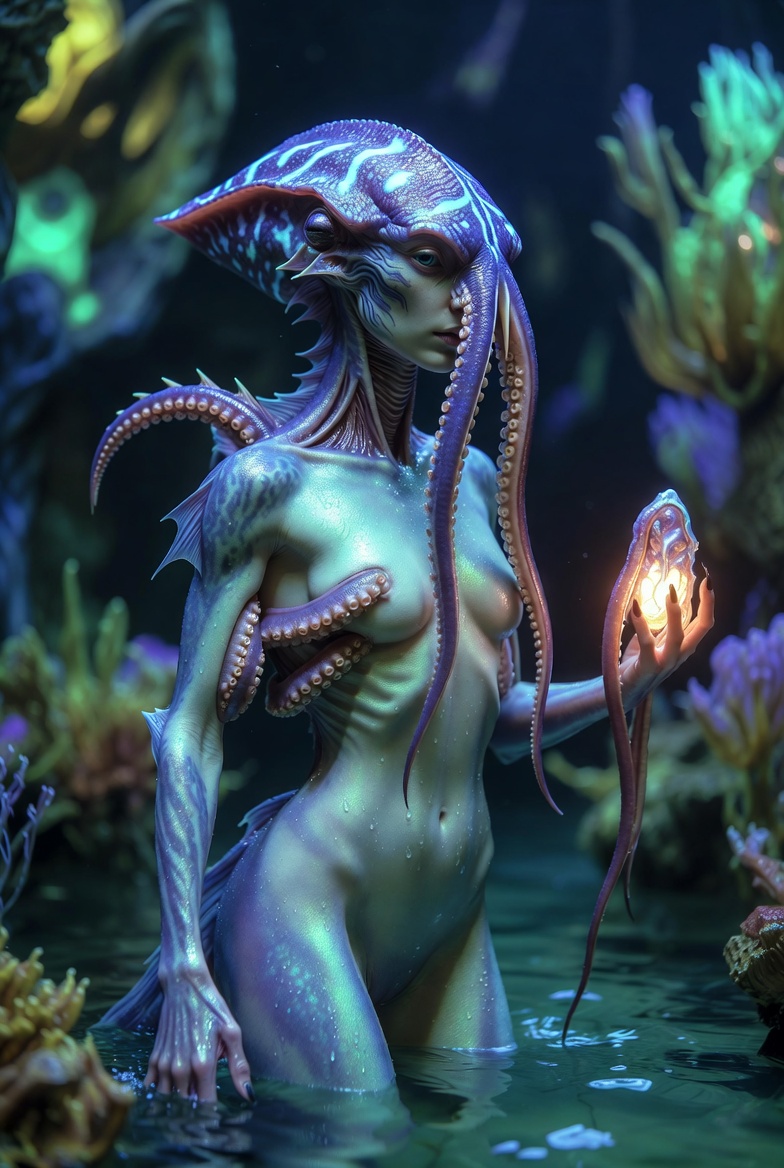
The Uul attaches to the Sythu’s head and upper back. A slender, barbed tentacle penetrates the spinal column to merge nervous systems, while two padded tentacles interface directly with the lungs beneath the arms. The remaining two long tentacles remain free, granting the newly formed Sythuul exceptional fine motor control and manipulation capabilities.
This neural merger triggers a cascade of changes:
- Dramatic increase in cognitive capacity, elevating the pair to human-level (and often beyond) intelligence.
- Unified reproduction: the fatal cost of Uul egg-laying is eliminated, and the pair can now produce viable Sythuul offspring.
- Hybrid respiration: the ability to breathe both air and water.
- Awakening of potent psionic abilities.
The result is the Sythuul — a new species that is neither purely Sythu nor Uul, but something transcendent.
Physical and Mental Characteristics
Size and Type: Medium humanoids with the Sythuul subtype.
Ability Modifiers: -2 Constitution, +2 Intellect, +2 Ego
Hit Points: 4
Key Abilities:
- Darkvision: Can see twice as far as humans in dim light and up to 60 feet in total darkness (black and white only).
- Sythuul Psionics: 3/day Mind Thrust, 1/day Suggestion (costs 1 Edge per use).
- Telepathy: Can mentally communicate with any creatures within 120 feet with whom they share a language.
The bonded entity appears as a graceful humanoid with smooth, often subtly patterned skin, large expressive eyes, and two powerful tentacles extending from the head/shoulder region. These tentacles are highly expressive and frequently used in communication, combat, and craftsmanship.
Society and Culture
Sythuul civilization is built around themes of partnership, interdependence, and shared identity. Communities typically form around large bodies of water — estuaries, lagoons, and coastal regions — where their amphibious nature gives them a decisive advantage.
Social structures emphasize collective well-being. Because every adult Sythuul is the result of a successful bond, their culture deeply values trust, consent, and mutual growth. The coming-of-age bonding ceremony is the most important rite of passage, often involving elaborate rituals, family gatherings, and spiritual preparation.
Their philosophy tends toward holism — the belief that true strength comes from unity rather than individuality. This manifests in governance (consensus-based councils), art (collaborative multi-tentacled performances), and even language (rich in concepts of “we” that carry psychic undertones).
Technology and Psionics
Sythuul technology beautifully blends organic and engineered elements. Their free tentacles allow for natural multi-tasking, leading to tools and interfaces that other species find incredibly complex. Many devices incorporate living components or psionic resonators.
Psionics are not merely tools but a fundamental part of their existence. Telepathy serves as the primary mode of intimate communication, while abilities like Mind Thrust are used both for defense and in carefully regulated ritual combat or hunting.
Ecological Role and Galactic Presence
Perfectly adapted to transitional environments, Sythuul settlements often serve as bridges between aquatic and terrestrial ecosystems. They are natural diplomats, mediators, and explorers, capable of thriving in environments that would challenge single-species civilizations.
Their unique perspective — literally seeing the world through two sets of eyes and thinking with two merged minds — makes them exceptional scientists, philosophers, and strategists. Many galactic factions value Sythuul as advisors, researchers, or elite operatives.
Narrative Potential
The Sythuul offer endless storytelling opportunities. Narratives can explore:
- The personal journey of bonding and identity formation.
- Cultural clashes when interacting with species that lack symbiotic traditions.
- Ethical questions around individuality vs. collective consciousness.
- The tension between their peaceful communal values and the necessities of survival in a hostile galaxy.
Whether as player characters, mysterious allies, or enigmatic antagonists, the Sythuul bring themes of trust, transformation, and the power of partnership to any science fiction or roleplaying setting.
The Sythuul remind us that sometimes the greatest strength is not found in standing alone, but in choosing to become something greater together. Their civilization is living proof that unity can be the ultimate evolution.
6' 10"
165 Lbs.
Sythuul seam somewhat emaciated. Mucles are we defined fit and trim.
Beige, brown, Green, blue and a mix of purple in their native state.

Comments