
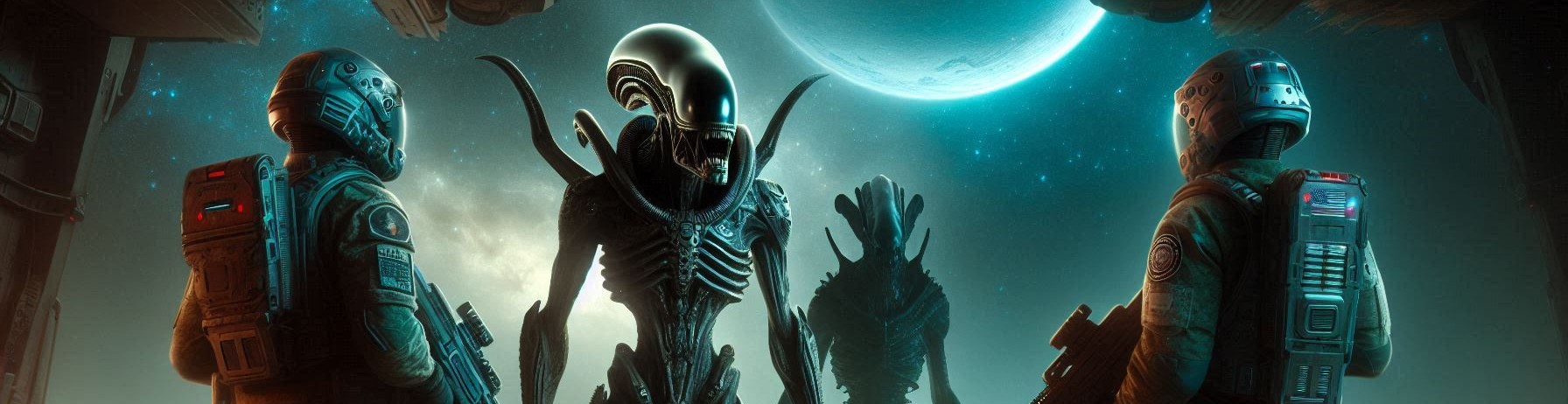
Designing Encounters
An encounter is defined as any scenario that presents player characters (PCs) with a distinct challenge requiring resolution. While many encounters entail combat with adversarial creatures or non-player characters, they may also encompass a variety of other situations: negotiating hazardous corridors filled with mechanical traps, engaging in high-stakes discussions with governmental representatives, contending with environmental threats on alien worlds, decrypting secure databases, or any circumstance that contributes dramatic tension to the gameplay experience. Encounters may involve puzzles, social interactions, physical challenges, or tasks resolvable through roleplaying and skill checks. However, combat encounters are both the most prevalent and the most intricate to design.
When designing a combat encounter, decide what level of challenge you want your PCs to face and follow the steps below.
Step 1: Determine APL
To determine your party's Average Party Level (APL), which indicates the group's ability to face challenges, start by adding together all the characters' levels. Divide this total by the number of party members and round to the nearest whole number—note that this is an exception to the typical "round down" rule. If there are fewer than four characters in the group, subtract 1 from the result; if there are six or more, add 1. For instance, a group with six members—two at level 4 and four at level 5—has a combined level of 28. Divide by six to get about 4.67, round up to 5, then add 1 for having six players, resulting in an APL of 6.
Step 2: Determine CR
Challenge Rating (CR) serves as an effective metric for assessing the relative threat level posed by an enemy, trap, hazard, or other encounter. A higher CR indicates a more formidable challenge. Reference Table: Encounter Difficulty to select an appropriate Challenge Rating for your group, based on the desired difficulty and the group's Average Party Level (APL).
Table: Encounter Difficulty
| Difficulty | CR Equivalency |
|---|---|
| Easy | APL - 1 |
| Average | APL |
| Challenging | APL + 1 |
| Hard | APL + 2 |
| Epic | APL + 3 |
Step 3: Build The Encounter
To determine the XP award for an encounter, check the CR on Table: Experience Point Awards to find your total XP budget. Add up the XP values of all creatures, traps, and hazards (based on their CR) without exceeding this budget. Start with the highest CR challenges and add lower ones as needed.
For instance, if you want a hard encounter for six 11th-level PCs (APL 12), Table: Encounter Difficulty shows this should be CR 14 with a budget of 38,400 XP. A necrovite (CR 13) costs 25,600 XP, leaving 12,800 XP for ellicoths (CR 9, 6,400 XP each), so you can include two ellicoths. Alternatively, replace the necrovite with three ellicoths and still have 19,200 XP available for other elements.
Table 11-3: Experience Point Awards
| Individual XP (by no. of players) | ||||
|---|---|---|---|---|
| CR | Total XP | 1-3 | 4-5 | 6+ |
| 1/8 | 50 | 15 | 15 | 10 |
| 1/6 | 65 | 20 | 15 | 10 |
| 1/4 | 100 | 35 | 25 | 15 |
| 1/3 | 135 | 45 | 35 | 25 |
| 1/2 | 200 | 65 | 50 | 35 |
| 1 | 400 | 135 | 100 | 65 |
| 2 | 600 | 200 | 150 | 100 |
| 3 | 800 | 265 | 200 | 135 |
| 4 | 1,200 | 400 | 300 | 200 |
| 5 | 1,600 | 535 | 400 | 265 |
| 6 | 2,400 | 800 | 600 | 400 |
| 7 | 3,200 | 1,070 | 800 | 535 |
| 8 | 4,800 | 1,600 | 1,200 | 800 |
| 9 | 6,400 | 2,130 | 1,600 | 1,070 |
| 10 | 9,600 | 3,200 | 2,400 | 1,600 |
| 11 | 12,800 | 4,270 | 3,200 | 2,130 |
| 12 | 19,200 | 6,400 | 4,800 | 3,200 |
| 13 | 25,600 | 8,530 | 6,400 | 4,270 |
| 14 | 38,400 | 12,800 | 9,600 | 6,400 |
| 15 | 51,200 | 17,100 | 12,800 | 8,530 |
| 16 | 76,800 | 25,600 | 19,200 | 12,800 |
| 17 | 102,400 | 34,100 | 25,600 | 17,100 |
| 18 | 153,600 | 51,200 | 38,400 | 25,600 |
| 19 | 204,800 | 68,300 | 51,200 | 34,100 |
| 20 | 307,200 | 102,000 | 76,800 | 51,200 |
| 21 | 409,600 | 137,000 | 102,400 | 68,300 |
| 22 | 614,400 | 205,000 | 153,600 | 102,400 |
| 23 | 819,200 | 273,000 | 204,800 | 137,000 |
| 24 | 1,228,800 | 410,000 | 307,200 | 204,800 |
| 25 | 1,638,400 | 546,000 | 409,600 | 273,000 |
Special Considerations
Designing enjoyable and balanced encounters involves flexibility; adjust standard formulas as needed to suit your group. Beyond the basic rules, also consider any relevant encounter-specific factors.
Adding NPCs
Creatures with class-like abilities, particularly those from PC races, rely more on equipment than innate powers, often mirroring player character skills. Their Challenge Rating (CR) typically matches a PC of equivalent level; for instance, a 2nd-level technomancer NPC would be CR 2. NPCs usually possess armor and weapons at or near their CR, plus one or two additional items of similar level. For detailed guidelines on NPC creation, refer to Creating Monsters and NPCs .
CR Equivalencies
When building high-challenge encounters, the large number of experience points can be intimidating, especially if you're putting together an encounter quickly. If you have many identical monsters, you can use Table: CR Equivalencies to combine them into a single Challenge Rating, which makes calculating their total XP much simpler. For instance, with this table, you'll find that four CR 8 monsters (each granting 4,800 XP) equate to one CR 12 monster (19,200 XP). You can also reverse-engineer encounters by referencing the table—if you want a CR 7 encounter using CR 4 monsters, the table shows you need three CR 4 creatures to reach CR 7.
Table 11-2: CR Equivalencies
| Number of Creatures | CR Equivalency |
|---|---|
| 1 creature | CR |
| 2 creatures | CR + 2 |
| 3 creatures | CR + 3 |
| 4 creatures | CR + 4 |
| 6 creatures | CR + 5 |
| 8 creatures | CR + 6 |
| 12 creatures | CR + 7 |
| 16 creatures | CR + 8 |
Terrain Factors
When player characters (PCs) face a creature outside of its optimal environment—for example, confronting a large dragon within a confined cave—they are granted a notable advantage. In these circumstances, it is advisable to structure the encounter as usual, so as not to inadvertently increase the difficulty and risk the party's safety. However, when distributing experience points (XP), consider awarding XP as if the encounter’s challenge rating (CR) were one lower than its standard value. The converse applies in certain situations: creature CRs are generally determined with the expectation that they are encountered within their preferred terrain. For instance, engaging a water-breathing kalo in an aquatic setting does not warrant additional XP, even if the PCs lack the ability to breathe underwater. Nevertheless, if environmental factors substantially influence the encounter, it may be appropriate to award XP as though the encounter’s CR were one higher. As an illustration, encountering a blindsight-equipped creature in total darkness requires no adjustment, but doing so where all sources of light are suppressed could justify a +1 CR consideration. Ultimately, discretionary XP adjustments based on terrain or similar factors should not penalise PCs for effective play but are intended to ensure appropriate levels of challenge and reward.
Gear Adjustments
You can greatly change an NPC's power level by modifying its equipment, especially its weapons or important items such as powered armor. If you meet an NPC without any gear—and that lack actually makes it weaker—reduce its Challenge Rating (CR) by 1. On the other hand, if an NPC has superior gear, like a weapon two levels above its CR or many items matching its CR, raise its CR by 1. Remember, these equipment changes will affect your treasure budget (see page 391), so be careful when creating NPCs with extra-strong gear!
Tactical Considerations
As players gradually master their characters’ skills, Game Masters also become more adept at utilizing their range of adversaries. Since Challenge Rating doesn’t account for every scenario, Game Masters should carefully consider both the monsters’ abilities and the specifics of the encounter environment to avoid any unexpected issues.
A significant consideration is the Challenge Rating (CR) of opposing creatures. The CR system is most effective when the CR of each game master's creature closely matches the players' Average Party Level (APL). While it may be appealing to introduce a single, high-CR adversary, such encounters can potentially overwhelm the party—particularly if their saving throws are not sufficiently advanced to mitigate the creature's abilities. Conversely, presenting a large number of CR 1 creatures against a party with an APL of 8 will likely result in minimal threat; these opponents are unlikely to overcome the party’s Armor Classes or succeed with their abilities, regardless of their numbers.
While an abundance of low-challenge rating adversaries can result in repetitive and unengaging gameplay, confronting a solitary opponent may also lack engagement, depending on that adversary’s capabilities. For example, a technomancer without protective allies or defensive measures could easily become overwhelmed or rendered unable to cast spells if restrained. Similarly, a creature possessing one powerful attack may not pose a substantial threat to a group of five moderately strong characters, given the party’s collective number of attacks each round. Typically, the most effective encounters feature several opponents who protect vulnerable entities with advanced abilities, thereby balancing the number of actions available to player characters in each round.

Comments