

Madness
Zaragraf contains numerous aberrations that can assail creature’s minds. The following rules and effect detail the myriad ways that characters' minds can be debased, debauched, or otherwise defiled.
Madness Effects:
Madness can be short-term, long-term, or indefinite. More mundane effects, like the ones presented here, impose short-term madness, which lasts for just a few minutes. More horrific effects or cumulative effects can result in long-term or indefinite madness. A creature’s intellect can help it understand eldritch knowledge without breaking its mind. Characters can add their Intelligence modifier to saving throws they make against madness. ● When a creature becomes afflicted by madness, be it short-term, long-term or indefinite, the creature is stunned (see the condition) until the start of its next turn, and then the madness takes effect. ● A character afflicted with short-term madness is subjected to an effect from the Short-Term Madness table for 1d4 minutes. ● A character afflicted with long-term madness is subjected to an effect from the Long-Term Madness table for 1d4 × eldritch moons (or 1d4 x 7 days, if you aren’t using eldritch moons in your world). ● A character afflicted with indefinite madness gains a new trait from the Indefinite Madness table that lasts until cured.Madness and the Deudific Realm:
When a creature in Zaragraf enters the Deudific Realm for the first time in a day, they must succeed on a DC 15 Wisdom saving throw or gain a short-term madness and immediately be kicked out of the plane. Creatures of the GM’s choosing are immune to this effect. For each minute spent in that plane a creature must repeat the saving throw.Short-Term Madness Guidelines
Short-term madness occurs more often than longer forms, and it can quickly trigger further madness. Short-term madness occurs when a character experiences something traumatic or mind-altering, but the effects are temporary and wear off after some time. To determine whether an event the characters encounter should cause short-term madness, consider the following guidelines: Severity. The event should be extreme or unexpected enough to cause a psychological shock or temporary break from reality. Encountering an aberration for the first time could cause a saving throw for a short-term madness if the creature is horrifying or its presence is accompanied by a disturbing event (e.g., a gruesome murder scene). However, if the encounter is less extreme or the character is already somewhat familiar with this particular aberration, it might not result in such a saving throw. Mental Resilience. Some characters might be more resistant to madness than others, depending on their background, class features, or experiences. For example, a seasoned adventurer will be less likely to succumb to short-term madness than an untraveled novice. Context and Setting. The circumstances surrounding the event play a significant role in determining whether short-term madness occurs. For example, encountering an aberration in a dark, confined space might be more terrifying than encountering it in a well-lit, open area. Similarly, discovering an aberration in the middle of a peaceful village could be more shocking than finding it in a known dangerous area, like an underground catacomb. Each time a character accumulates five forms of short-term madness in less than 48 hours, they gain a form of long-term madness.Short Term Madness
When a character is afflicted with short-term madness, roll a d100 on the table below, then roll a d10 to determine the effect of that form of madness. All effects are for the duration of the madness unless specified otherwise.

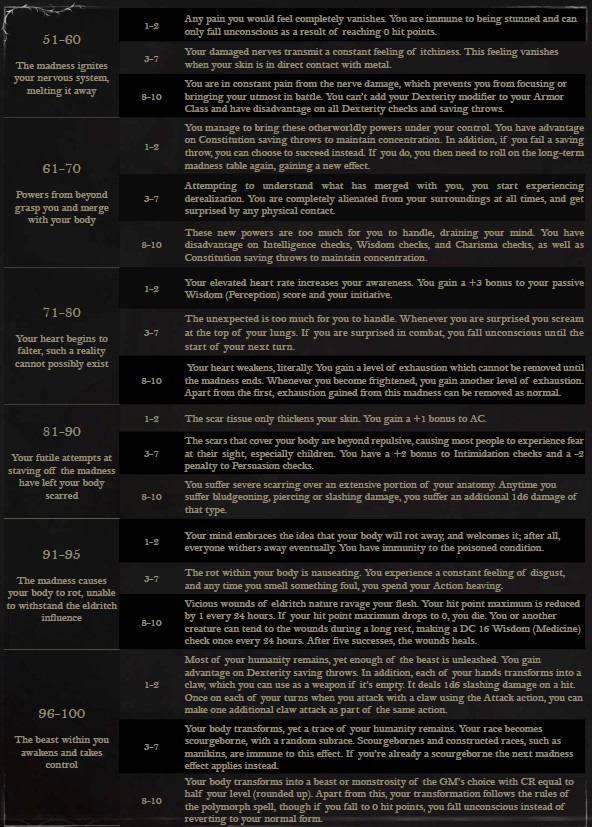
Long Term Madness
When a character is afflicted with long-term madness, roll a d100 on the table below, then roll a d10 to determine the effect of that form of madness. All effects are for the duration of the madness, and can only be cured once the madness ends, unless specified otherwise.
Curing Madness
Different types of madness have different methods for curing them. What can cure indefinite madness can also cure long-term and short-term madness, and what can cure long-term madness can also cure short-term madness. The opposite isn’t true. Short-term madness: A character suffering from short-term madness can be cured with a lesser restoration spell or by waiting for the madness to subside naturally. Long-term madness: A character suffering from longterm madness can be cured with a greater restoration spell or a modify memory spell if the traumatic event happened in the time window necessary for the spell to work.Temporary cures
Sometimes curing a madness completely is impossible, and briefly alleviating the symptoms is the only thing that can be done. What can temporarily cure indefinite madness can also temporarily cure long-term and short-term madness, and what can temporarily cure long-term madness can also temporarily cure short-term madness. The opposite isn’t true. Short-term madness: A character suffering from short-term madness can be temporarily cured by: ● A calm emotions spell for the duration of the spell. Long-term madness: A character suffering from longterm madness can be temporarily cured by: ● Being within the area of a hallow spell. ● Being under the effect of a mind blank spell. ● Being located inside of a holy site dedicated to a god that wards off eldritch influences. ● Being severely under the influence of alcohol or other drugs.Remove these ads. Join the Worldbuilders Guild





Comments