





Frogfish
Frogfish are small rodents native to the lantern forests of Hell. They are often kept as pets around the Greater Oasis.
They are one of the most well recognised creatures from Hell, an iconic animal featured in educational textbooks across the Milky Way. The animal is often used as a teaching tool in schools, about adaptation and evolution.
Anatomy
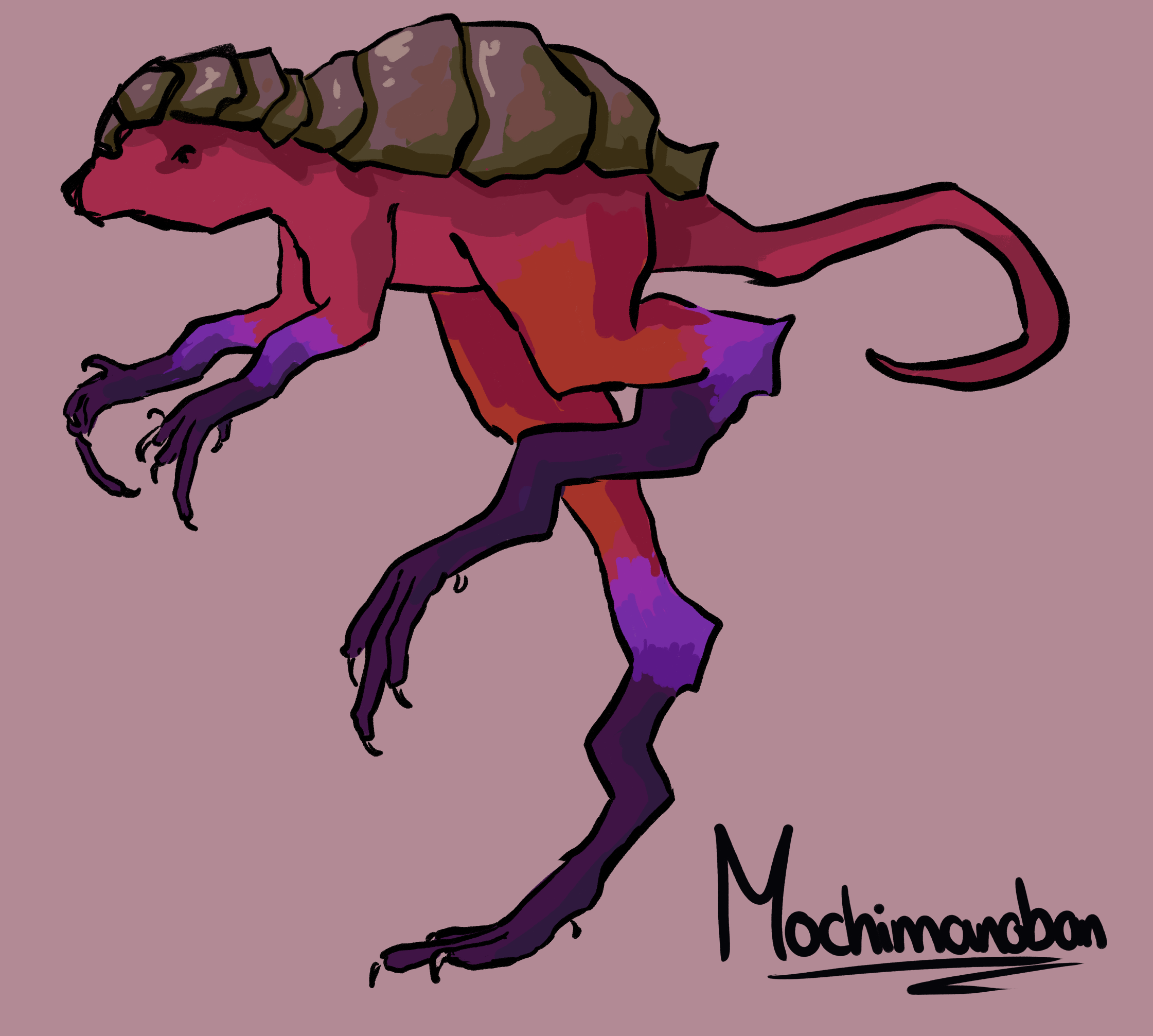
Frogfish have an bipedal stance, with long arms and long legs. Powerful leg muscles allows frogfish to dart at high speeds, for long periods of time. They have a small head, with armour plating running from the crown to the base of the tail. Frogfish have opposable thumbs; some pet owners have trained their frogfish to hold certain items.
These rodents have a bright red body and head, fading into purple arms, legs, and tail. Some subspecies feature additional spots and stripes around the sides.
The armour plating is thick, made of keratin. It grows endlessly, as do their incisors. To prevent overgrowth, frogfish will file their teeth and armour plating down on rock and bone.
Frogfish also have an extra long finger on each hand, used for breaking open seed sacs.
Male and female frogfish can be distinguished at a glance. Male frogfish have significantly darker arms, legs, and tail, almost verging on black in some subspecies. As well, males are significantly smaller, about a third of the size of an average female.
Rosy-Cheeked Frogfish
A subspecies born of the pet trade - the head of this subspecies is pink.Ormasu Frogfish
A subspecies accustomed to the Ormasu Mountain Range. Has developed yellow stripes thanks to a diet partially including sulphur.Pied Frogfish
Pied frogfish have black and white markings along the armour plating. Another species brought about by domestic breeding.Reproduction & Growth
In order to please a potential mate, male frogfish will use their strong back legs to dig a suitable hole in the ground for a nest. He will also gather leaves, ash, and mosses to create ideal padding. Males will also make a shrieking call in order to entice females to examine his nest. If she finds the nest suitable, they will mate.
Frogfish have a gestation period of approximately thirteen to sixteen days. A single litter usually contains between five and twenty squiggles. Typically, just one or two will make it to adulthood - the rest suffer from predation.
The nest is covered in a thick layer of vegetation, to hide from predators. Frogfish nest in forests or any dense foliage they can find. Both males and females will spray this vegetation with a pungent odour to deter any predators in the vicinity, though some species have realised this scent leads to a nest full of food.
Diet
Why is my frogfish not eating anything?
That's because you've fet it dog food. They need fresh vegetables and greens. Stupid.
Frogfish are strictly herbivorous, feeding on short grasses, flowers, and any other herbaceous plant. In their native range herbaceous plants are rarely accessible, so frogfish often fight for food.
In captivity, frogfish are fed mixed greens. They are popular pets on Cilvarth, where most brands of pet foods are made from short desert grasses. These are not nutritious, so additional vitamins and minerals are added.
Unfortunately, frogfish diets are often misunderstood. Many owners will feed them the wrong foods, often designed for omnivores or carnivores. A frogfish cannot digest these foods, and even a small quantity can cause fatal congestion and indigestion.
Habitat
Frogfish are found across the planet, around lantern forests. These forests are typically small, scattered across the globe, with roughly two thousand individual forests. Frogfish rely on their size to hide from predators, navigating thick spiky shrubbery. Armour plating and thick skin helps protect vital organs from this shrubbery.
When the bulbous seed sacs of chandelier willows fall to the forest floor, they are brought back to nests to feed the squiggles. A single seed sac can feed a bowl of squiggles for a few weeks. The seeds contain an astonishing amount of nutrients, while the seed sac is rich in fats.
In Society
On several planets frogfish are seen as a "beginner" friendly pet. The pet trade encourages potential owners to purchase frogfish, as they are often deemed easy to take care of. Frogfish are much more intelligent than deemed by the general public, and their needs are complex.
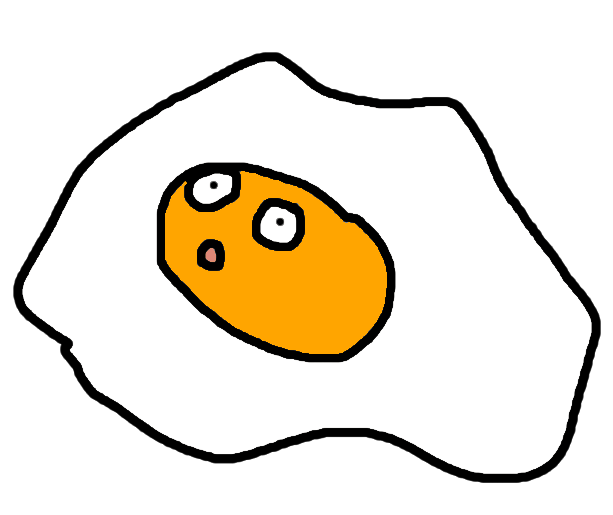
It isn't just the diet that is misunderstood - frogfish require a much larger, deeper enclosure than most are given in captivity. Even solitary frogfish need to be able to create their nests, which are typically between six and ten inches deep. Most enclosures only give about two inches of sawdust, which is not an appropriate bedding material, either.
Frogfish also need access to enough ash to enjoy dust baths, which most typical owners do not provide. Ash helps the animal's skin, keeping it warm and dry.
Frogfish are often used to demonstrate and explain evolution and adaptation in schools across the Greater Oasis. They have a number of unique evolutionary features that makes them a fantastic teaching tool. Live frogfish are often brought into classrooms for a hands on experience.
Gather round, students! We have a live frogfish in class today. I want to show you all of the different traits that makes this animal so special. Can anyone tell me what planet this creature is from?
Hell! Lavaaaaaaaaaa.
That's right! This animal is native to Hell, in the neighbouring solar system. We're very lucky to have one here today.
So! Let's look at this armour plating. It's made of keratin, like our hair and our fingernails. It never stops growing, like its teeth! And remember, ever-growing incisors is a characteristic of all rodents. Remember that, it might be in your exam!
Hey, its thumbs look like ours!
Spot on, they have opposable thumbs like us. Most rodents have partially opposable thumbs, but frogfish thumbs are completely opposable, like ours. They can hold things very easily, and have great range of motion.
Up to 12 years in captivity
40 - 50 cm (including tail)
Related Articles
| Atlas | Ash Field · Atigeo Sea · Chrihaia Lake · Endless Tower · Ison Copper Mine
| ||
|---|---|---|---|
| Biota | Atigean Clam · Clam-Eyed Fish · Fire Frog · Fire Noodle · Firepede · Firewood Beetle · Frogfish · Helsaurus · Mayhem Fish · Sawshark · Thermal Carp · Thorn-backed Thrasher | ||
| Cultures | Hell's Holiday | ||
| Misc | Hell · Hell Notes |











Love this, especially the illustration. It has now occurred to me that if I write any particularly weird creatures this Summer Camp or later on in WorldEmber, I might have to—assuming you even do commissions—hire you to design some creatures for me.
Thank you so much! I do commissions, yes! I have them typically on Ko-Fi, but I've also got then on VGen now, as I'm slowly starting to expand and work harder on them. So if you ever want commissions, hit me up! <3