Topography:
At the centre of Shibea is Yeramdon Lake. The area around Yeramdon is rich with vegetation, unlike the majority of Shibea, who’s soil is rocky and unfit to grow much more than grass or shrubs. As such, the area around Yeramdon is where a majority of Shibeans live.
Flora and Fauna:
There is a heavy population of goats in Shibea, as well as sheep.
Shibea is home to a large number of creatures which can be found elsewhere in the central region.
These include Zizs, mixes between felines and birds.
Other creatures include Leviathans, large snakes which dwell in freshwater. While Leviathans are dangerous everywhere else, the leviathans in Yeramdon Lake do not prey on sapient beings.
Behemoths are creatures similar to hippopotamuses with massive tusks, human-esque eyes, and dark red skin which appears almost metallic.
Hoopoes are small birds known for the massive crown of feathers which sits upon their heads.
As for flora, important crops include olives, grapes, and pomegranates.
People:
93% of those living in Shibea are humans known as Shibeans. They are similar in appearance to the Iraljins, but with brown eyes and curly hair. About 6% are various different groups of humans including the
Tzaeni and the
Kochilans. 1% are non-humans such as Jinn,
Cliff Walkers, and Southern
Elves.
Culture:
It can be a bit difficult to separate the culture, government, and religion of Shibea, as they are essentially the same: the cultural rules are often laws, and these laws are often in the holy Shibean texts.
Nevertheless, the collecting and distributing of information has never been an easy task.
A majority of Shibeans live a pastoral lifestyle in the area surrounding Lake Yeramdon, herding goats and sheep. Cows are not among the animals herded, as they do not live in Shibea. For some reason, this is important.
The Shibeans are deeply spiritual, with rituals absorbing almost every part of their lives. All Shibean clothing specifically has spiritual markings on it, as well as every house. Everyone is expected to wear a Piyaroz headband when they go out. This is a headband with a prayer written on it in The Sacred Language, a language and a writing system used only for religious purposes. At the centre of the headband is a blue eye.
There are three Shibean festival days: The Lamb Festival, The Fruit Festival, and The Grain Festival.
The Lamb Festival is celebrated in late spring to honour the birthing of the spring lambs. During it, a Preist will perform Anima Magic on a lamb, allowing all of its blood to be removed yet still live.
The Fruit Festival is celebrated in early spring to honour the first growing of fruit. People will enter one of the many fruit groves and hold parties there.
The Grain Festival is celebrated in fall to honour the grain harvest. This is celebrated with the baking of bread.
Another important holiday is Migration Day, which celebrates the coming of the Shibeans to Lake Yeramdom.
One last holiday is Penance Day. This is a day when everyone looks back on all of the sins they’ve committed, and apologies to everyone in their life that they have wronged.
Every Friday is considered a minor holiday, as it is on that day when everyone is expected to rest, and simply enjoy life. This is usually the day when weddings and other important ceremonies are held.
The Shibeans have many specific rules they are supposed to follow in everyday life.
For instance, one must only kill an animal on two conditions: the animal is trying to harm you, or this is an animal which is to be eaten. Not only that, but this animal must be killed as kindly as possible. On killing an animal for the purposes of eating it, one must say a prayer, and then deliver one lethal blow to the neck.
It is for this reason that hunting is never done in Shibea.
The Shibeans also try using all of the animals they kill. A goat’s meat will be eaten, its horns and bones will be used for the making of tools, and its skin will be used for clothing.
Sapient beings are not allowed to be killed at all, except in self-defense and acts of war.
This is just the tip of the iceberg.
Shibean culture is patriarchal. Women are not allowed to commit the act of butchery or serve as soldiers, and often do not choose their husbands.
When a Shibean dies, a small cut will be made on the body’s stomach and the seeds of a pomegranate tree will be placed in their body. The body will then be buried, and a pomegranate tree will bloom.
Usually, it takes about four years for a pomegranate tree to bear fruit, but in this situation, there will be a tree flush with fruit after only one year.
The idea is that part of the person’s soul is in the tree, as well as the pomegranate’s themselves.
These pomegranates will generally be eaten every Friday, which is an important day.
Government:
Shibea is a theocracy ruled by a High Priest. The exact methods of succession are complicated.
The priests and priestesses serve as the policemen, judges, and lawmakers of Shibea, and priests can also act as non-lethal executioners. Anuism outlaws the killing of humans in non-combat contexts, so instead, the highest punishment is the taking of one’s eyes and ability to move.
The official constitution of Shibea is also the official religion document of Anuism: The Codes.
Shibea has a very small military, with priests acting as generals and common folk acting as foot soldiers. All soldiers are expected to wear a special band on their heads when going into battle. This absolves them of the guilt of killing.
Religion:
91% of those living in Shibea follow
Anuism, worshipping “The Entity”,a manifestation of all the good in the universe.
Members of the clergy are generally chosen from a very young age, no more than 2 years. They will train until they reach 16, at which point they will become an official priest or priestess.
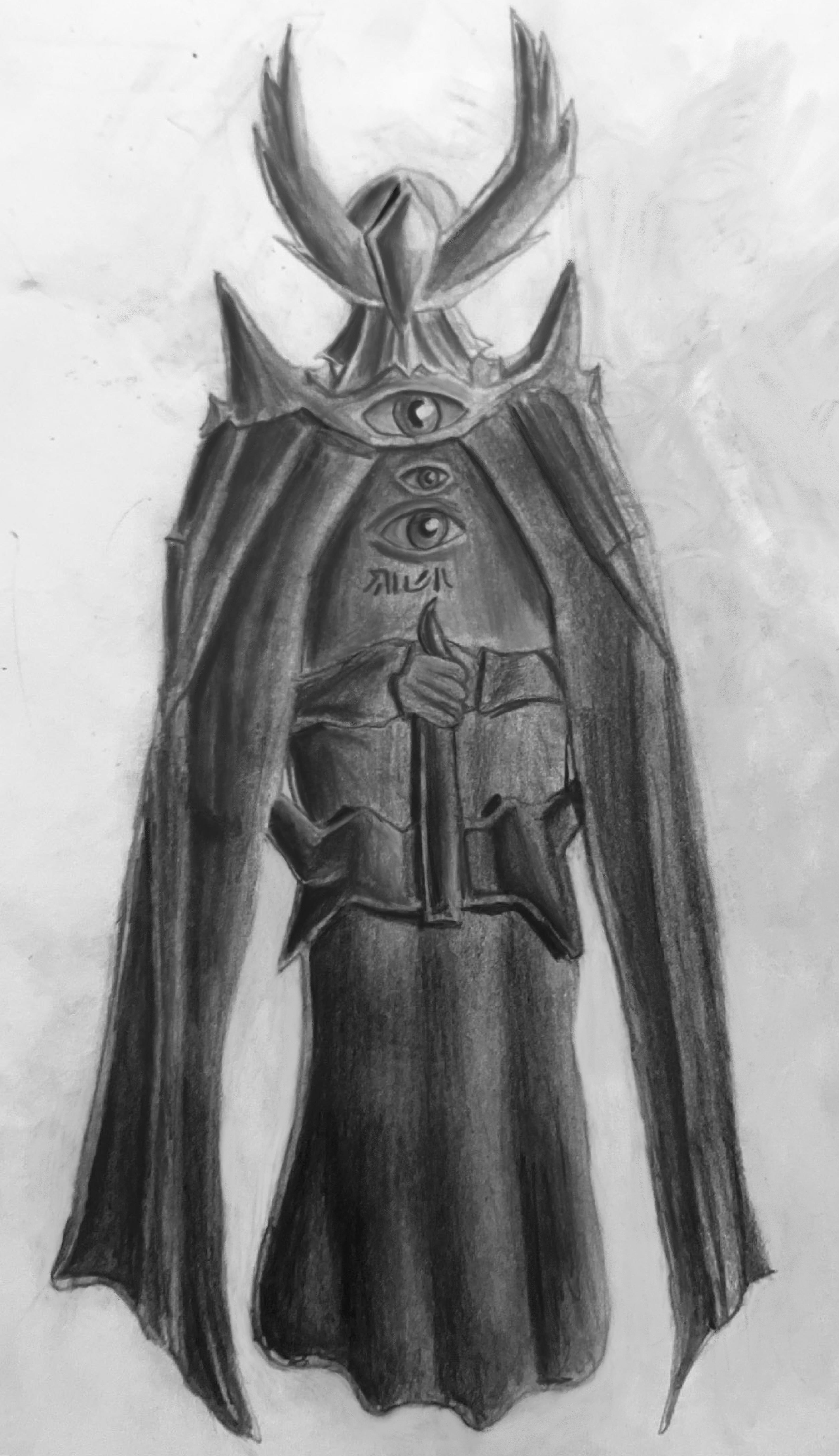
The orientation ceremony involves the taking out of the priest's eyes. Then, a mask covering the top part of their head will be placed. This mask will permanently remain there, and will be enchanted to slowly replace the skin beneath it. Over this inner mask will be placed a white face mask with a single blue eye which entirely covers the face. It can only be taken off for eating and drinking.
There will also be armour placed all over the body with similar effects, burning and replacing the skin everywhere except for certain parts of the body.
Over this armour, robes will be worn.
The entire priestly robes are blue, gold, and white, complete with eyes on certain parts of the body. The robes of a priest will use straight lines, whereas a preistess’s robes will have curved lines.
An Anuist preist.
As one can tell, the symbol of an eye is very important to Anuism religion.
In the middle of the capital city of Shibea, Neurzot is a spark of blue known as The Lapis Temple, a building measuring 30,000 square metres in area and 400 metres tall at its largest height.
Surrounding the temple is The Wall of Faces, on which is adorned the faces of every dead clergy member. To enter The Lapis Temple, one must go through an underground tunnel.
The Lapis Temple is used as the main operations for the Shibean government, as well as a gathering place for the people of Neurzot.
Every Wednesday, Anuists are expected to meet at a temple. A priest will lead the congregation in spoken prayers, while the priestess will lead the group in song.
Every temple is expected to have a priest and a priestess.
During these congregation meetings, all members are expected to dress entirely in white- except for the priests/priestesses.
Common in many Shibean religious rituals is the usage of a Censer. The burning of incense is overall common in rituals.
Wednesday is seen as a holy day, where people do not work.
On an ordinary day, Shibeans are expected to pray six times: after they wake up, before they go to bed, before breakfast, before dinner, and before the two snack times which take the place of lunch. These are all prayers of thanks to The Entity.
There are two holy Anuist books. The first is The Teachings, a set of rules. The second is The Stories, which is exactly what it sounds like.
The Stories can be divided into Four Parts.
Part One, also called The Creation, is about the creation of everything. It explains how there are many different deities. However, The Entity is the greatest of these gods, and created these various deities to overlook certain aspects of his creation.
He was also the one who created humanity, while the other species were created by his children. These include the deity of earth creating dwarves, the deity of nature creating elves, and the deity of fire creating the jinn.
While the Stories do not name these lesser deities, many Anuists will give the names of deities worshipped by other religions.
Part Two is called The Early Days, and is about the early days of the world, and includes various small stories, such as the destruction of the moon, a war between the deities of earth and water which lead to a massive flood, and the formation of the boundaries between our world and the world of spirits.
Part Three is called Anu, and it is about the early life of nun, the founder of Anuism.
Part Four is called The Migration, and it is about the migration of Anuists to Shibea.
The 9% of those living in Shibea who are not Anuists practise a variety of Indrictism such as the Vezeat religion and Indrictism.
Art:
Ceramics are very common, as is mosaic making.
Music is very important to Anuist worship, and so is also important to Shibean culture. Not only are there a variety of Shibean worship songs, but there are also a large amount of Shibean work songs, nursery rhymes, and various other songs meant to serve specific tasks. There are songs one can sing to certain plants to make them grow quicker, as well as songs one is supposed to sing to animals to make them calm down.
Speaking of which, here’s a brief fun fact: the animal calming songs do often become successful on older animals, and as to why became the beginning of the study of psychology when Aleim scientist Eiqalm Eulum visited Shibea in 3789. Upon noticing this affect, he wrote a paper on it, which is often seen as the first psychological paper.
Trade:
Shibea's main exports include figs, gold, and turmeric.








Comments